








Immortal Game: Web3 Chess – A New Path or Just Chaos?
TechFlow Selected TechFlow Selected
Immortal Game: Web3 Chess – A New Path or Just Chaos?
“You’ve got to stay open; if you get locked into one idea, it’s death.”
 Navigating Web3 tides with focused insights
By aya, TechFlow
The GameFi narrative has quietly evolved through two distinct phases:
- The first phase was heralded by the explosive rise of Axie Infinity, giving birth to a wave of Ponzi-style games with poor gameplay but massive wealth-generation effects. Projects like Raca and Farmers World exemplified this model, where in-game tokens gained significant traction in secondary markets. However, as the broader market shifted from bull to bear, these quick-in, quick-out projects gradually lost relevance.
- In the second phase, with increasing participation from traditional game developers and gaming enthusiasts, teams began adapting established games for blockchain, aligning them with new crypto-native narratives. These efforts were paired with token economic systems designed to drive player engagement. Today, this approach dominates the market—rather than building entirely new on-chain games from scratch, modifying existing Web2 games proves more cost-effective and efficient.
But what happens when the target of transformation is an ancient board game? Immortal Game is doing exactly that—bringing chess, one of humanity’s oldest games, onto the blockchain, integrating NFTs and other Web3 elements to breathe new life into a time-honored classic.
What Changes—and What Stays the Same—When Chess Goes On-Chain?
In most aspects, Immortal Game remains identical to traditional chess. Each side controls 16 pieces—king, queen, rook, bishop, knight, and pawn—for a total of 32 on the board. White moves first, players alternate turns, and the game proceeds until checkmate or draw.
However, there's a twist: each player’s 16 pieces are now divided into standard pieces and special NFT-based “Immortals.” Every player must own at least one “Immortal” NFT to participate, and may use up to four such NFTs to replace regular pieces. Unlike traditional chess, where pawns occupy fixed starting positions, players in Immortal Game can place their “Immortal” pawns on any square along the second rank. For example, while a standard rook starts only at the corners, an “Immortal” rook could begin the game on the king or queen’s original square.
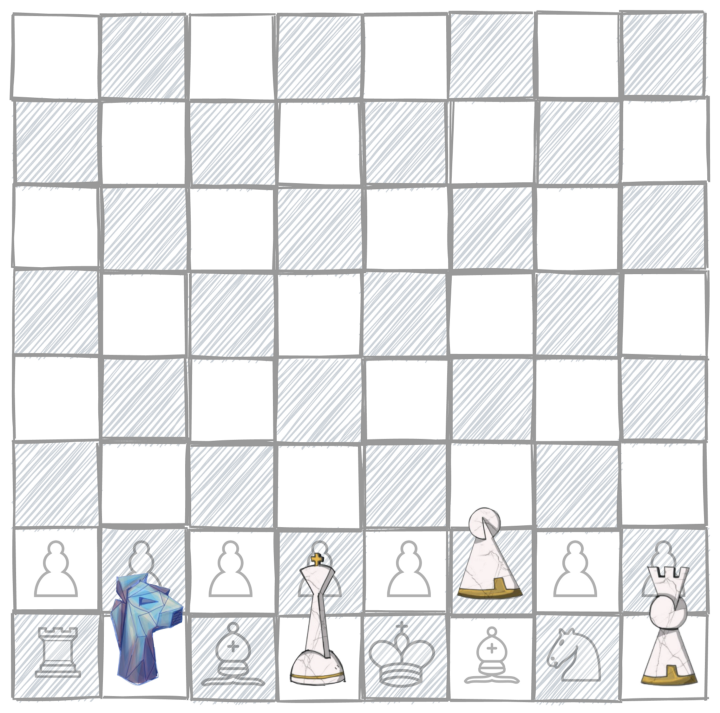
(A simple example)
Beyond this, Immortal Game integrates numerous Web3 features. Players earn GMT tokens for every match they win, and each “Immortal” receives unique in-game tasks during battle, categorized into attack, defense, and movement types. Examples include objectives like “Win without losing your bishop/knight/rook/queen/X pawns” or “Move pieces 10 times.” If a winning player completes these tasks, they receive additional token rewards.
“Immortals” come in four material tiers: Marble, Ebony, Ivory, and Crystal. They are also ranked across four rarity levels: Rough (1 point), Polished (5 points), Artwork (15 points), and Masterpiece (35 points). Higher rarity means higher scores.
By summing the scores of their chosen “Immortals,” players qualify for different league tiers. For instance, a team composed of two Polished and two Artwork pieces (totaling 40 points) can enter the International Master League, which has a 40-point threshold. Similarly, a lineup of two Rough, one Polished, and one Masterpiece (42 points) also qualifies. Token rewards scale according to the league level.
Each league also maintains its own leaderboard—after each week, top-ranking players receive token rewards or rare “Immortal” NFTs.
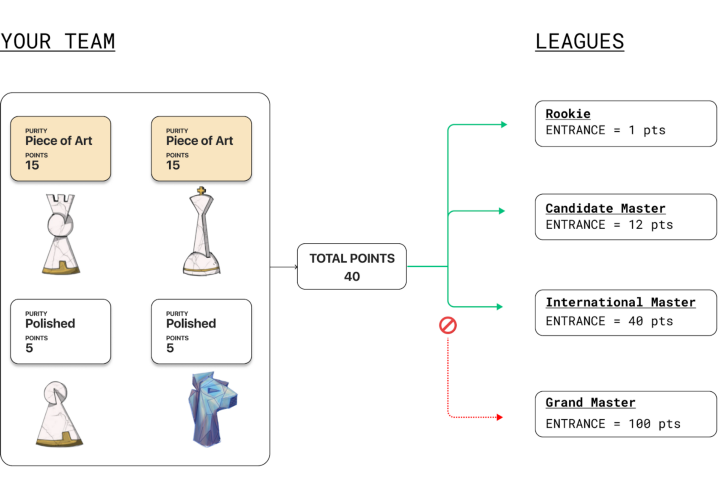
Scores also influence reward multipliers.
Suppose a player owns four “Immortal” NFTs: two Polished and two Artwork. After winning a match and completing a task, they receive the base reward (50 GMT) plus the task bonus (10 GMT).
Their score multiplier is calculated based on rarity—Polished (5%), Artwork (10%), Masterpiece (15%)—resulting in a total multiplier of 1.33 (1.05 × 1.05 × 1.1 × 1.1). Thus, the final reward amounts to approximately 80 GMT.
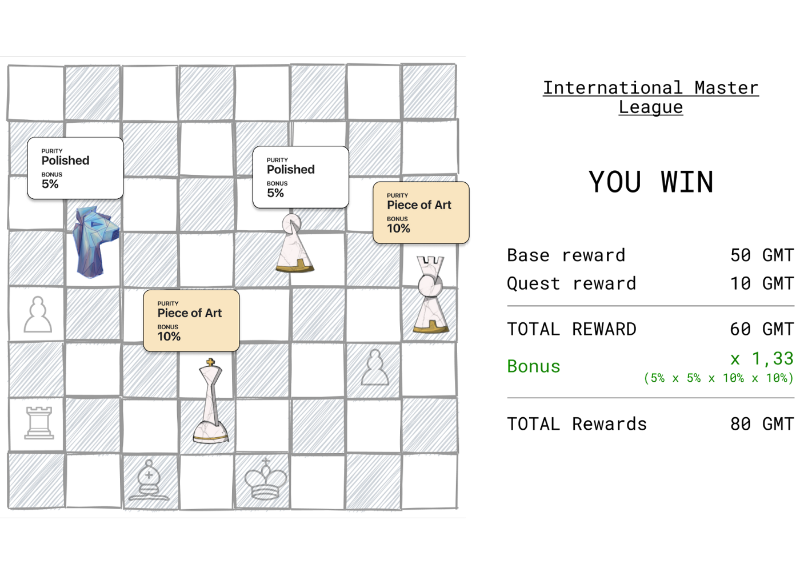
Each “Immortal” can be used a maximum of ten times per day. Beyond that, players must spend tokens to repair and reuse the same NFT. Additionally, Immortal Game introduces an experience (XP) system: winning matches earns both GMT and XP for participating “Immortals.” Once the XP bar fills, players can spend tokens to upgrade their pieces. Upgraded “Immortals” increase task reward amounts or reduce task difficulty. At certain levels, they unlock a second task, enabling players to earn even more tokens.
The Team Behind the Project
Interestingly, founder Thomas Zaepffel is not a professional chess player. He previously worked as a mergers and acquisitions analyst at Deutsche Bank and held roles at Vivendi, EDF, and within the French government. After graduating in 2014, Thomas founded his startup Adot, which he successfully sold to a French group for $50 million two years later. This exit introduced him to cryptocurrency and paved the way for his second entrepreneurial venture.
Other team members bring extensive experience in internet and Web3 industries. The project also benefits from advisors who are seasoned gamers—Alexandre, for example, ranks among the top 300 players in the European LoL server. Advisors include MVL (Maxime Vachier-Lagrave, World Blitz Champion) and Vidit Gujrathi (India’s fifth-ranked player), both providing strategic guidance for the project’s development.
Funding Overview
Just recently, Immortal Game announced it had raised $12 million in a Series A round led by TCG Crypto. Participating investors included Cassius, Greenfield One, Sparkle Ventures, Blockwall, Kraken Ventures, and Spice Capital.
Earlier this year, the project secured $3.5 million in seed funding, co-led by Cassius and Greenfield One, with support from GFC, Kraken Ventures, Moonfire, Kima Ventures, Blockwall, and BlackPool DAO.
According to the official announcement, the funds will accelerate product development and expand operations into key markets including India, the United States, and Europe.
Another Possibility for GameFi?
We’ve seen countless narratives: StepN’s “move-to-earn” hype, Bigtime’s ambitious 3A vision—every Web3 gaming project pulls out all the stops, introducing novel mechanics, flashy graphics, and lucrative (but often short-lived) earning models to attract users. Yet Immortal Game takes a different path—one that preserves the core mechanics of chess while layering in NFTs and token incentives onto this ancient board game.
Chess, with its perfect balance of competition and entertainment, boasts a massive global audience. Estimates suggest between 600 million to 1 billion people play chess worldwide—meaning that among every ten friends you know, at least one has likely played a game on the 8x8 grid. This 2,000-year-old game has never faded; if anything, it’s growing more popular. Following Netflix’s *The Queen’s Gambit*, chess surged back into the top rankings across multiple countries. Streamers like Blitzstream, the Botez Sisters, and Hikaru have amassed millions of followers, and even Twitch’s biggest streamer, xqc, occasionally dives into intense chess battles, shouting his signature “bing bang boom.”
It remains uncertain how far Immortal Game can go by embedding Web3 mechanics into chess. Win-to-earn dynamics and ranking systems tap deeply into human competitiveness and motivation. With a vast global base of chess players serving as potential users, and “Immortals” adding strategic depth that even grandmasters must reconsider, the game stands to attract significant early attention and traffic—potentially driving up token value.
Yet, introducing token incentives complicates what was once a pure test of skill. AI capable of defeating humans has existed for years. In the end, will on-chain matches devolve into bot-vs-bot grinding? Can collusion and reward farming be prevented? These are urgent challenges the team must address.
Moreover, win-to-earn models have been tried before in GameFi—with mixed results. If tokens and NFTs exist solely to serve “earn” mechanics, it may be hard to avoid repeating the fate of previous failed GameFi projects.
Still, Immortal Game has taken its first move on the Web3 battlefield, offering a fresh perspective for the GameFi space. As the protagonist of *The Queen’s Gambit* once said:
“You’ve got to stay open, if you get locked into one idea, it’s death.”
Join TechFlow official community to stay tuned
Telegram:https://t.me/TechFlowDaily
X (Twitter):https://x.com/TechFlowPost
X (Twitter) EN:https://x.com/BlockFlow_News


