








Bixin Ventures: Why We Invested in the Next-Gen New Public Chain Aptos?
TechFlow Selected TechFlow Selected
Bixin Ventures: Why We Invested in the Next-Gen New Public Chain Aptos?
The reason Aptos can achieve high TPS, how it ensures security, and how to access the upcoming mainnet.
 Navigating Web3 tides with focused insights
Original: Allen Zhao, Mustafa Yilham, Henry Ang & Jermaine Wong, "Portfolio Insights: Aptos"
Translation: Evan Gu, Wayne Zhang
Introduction:
Bixin Ventures is pleased to announce our strategic investment in Aptos, a high-performance public blockchain based on Move. This funding round continues from the new fundraising round announced by the Aptos team in late July this year. The round was co-led by FTX Ventures and Jump Crypto, with participation from Apollo, Griffin Gaming Partners, Franklin Templeton, Superscrypt, Circle Ventures, as well as existing investors a16z and Multicoin Capital who continued their support. We aim to bring in more strategic partners to promote the development of the Aptos ecosystem, expand use cases, and drive developer community growth. We also welcome entrepreneurs looking to deploy products on Aptos to reach out and build the ecosystem together.
Table of Contents:
1. Performance
2. Security
3. Roadmap
4. Aptos Grant Program
5. Ecosystem Status
6. Conclusion & Thoughts
Appendix: Full Node and Validator Node Requirements
A Blockchain Prioritizing Security and Scalability
Aptos is a brand-new Layer 1 blockchain whose vision is to help billions of people create assets and access networks in a fair, decentralized, and permissionless way.
Aptos has been hailed as the “legitimate heir” of Diem. Solana’s co-founder Anatoly even believes that compared to other EVM blockchains, Aptos is Solana’s direct competitor.
Aptos was co-founded by CEO Mo Shaikh and CTO Avery Ching. CTO Avery Ching previously served as the technical lead for Meta's most renowned Diem blockchain project. Before joining Meta, Mo worked at Consensys, BlackRock, and Boston Consulting Group, while Avery worked at Yahoo. Other members of the Aptos team, as detailed here, consist of PhDs, researchers, engineers, designers, and strategy experts formerly from Meta, Novi, Amazon, VMware, and others.
In this article, we will explain why Aptos can achieve high TPS and ensure security, introduce its upcoming roadmap, and finally explain how to participate in the soon-to-be-launched mainnet.
1. Performance
The Aptos blockchain is designed to fully utilize available hardware and enhance performance through parallel transaction execution, currently achieving over 160k TPS and sub-second block finality. The key to Aptos’ strong performance lies in modularizing the transaction lifecycle by decoupling the transaction layer from the consensus protocol via batched transactions, the parallel execution engine Block-STM, and a novel state synchronization mechanism that reduces block finalization time.
1. Batched Transactions via Proof of Availability (PoAv)
During transaction submission, validators group transactions into batches and incorporate them into blocks after reaching consensus. Execution, storage, and ledger certification are all processed in batches, optimizing the ordering system, reducing operational steps, and enabling parallel execution.
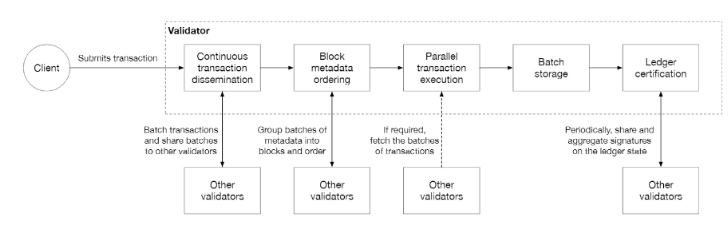
Transaction processing lifecycle
Transactions are transmitted among validators in batches. Validators then sign each batch summary. When signatures from over two-thirds of validators are collected, a Proof of Availability (PoAv) is formed. PoAv ensures that transaction batches are stored locally by at least one-third of honest validators, allowing retrieval before execution. Thus, during transaction processing, only essential batch metadata and proofs are required for ordering, improving TPS and minimizing block finalization time.
However, continuous batched transaction propagation may trigger DDoS attacks, causing validator memory overflow and crashes. To address this, Aptos attaches timestamps to each batch to assist validators in garbage collection, helping free up memory.
Click here to learn more about batched transactions, transaction propagation, and block ordering.
2. Parallel Execution Engine: Block-STM
Block-STM is an efficient, multi-threaded parallel execution engine capable of theoretically achieving up to 160k TPS. Compared to other parallel execution techniques, Block-STM pre-declares all dependencies, avoiding transaction limitations or forced fragmentation. It detects access conflicts within predefined transaction sequences, extracting maximum throughput.
Key features of Block-STM include:
Optimistic Concurrency Control: Transactions execute optimistically and are validated afterward. If validation fails, the transaction is re-executed, and all dependent transactions must be re-validated before commitment.
Multi-Version Data Structure: All writes to the same location are stored with associated versions to avoid write conflicts when new transactions occur.
Validation: During execution, transactions are divided into read sets and write sets. During validation, versions returned from memory locations in the read set are compared with corresponding versions in the write set.
Collaborative Scheduling: Coordinates validation and execution tasks between threads using counter-based methods.
Dynamic Dependency Estimation: Every failed validation records an "ESTIMATION" value in the multi-version data structure of the associated write set, ensuring future transactions wait until dependencies are resolved.
Overall, Block-STM uses collaborative schedulers and multi-version data structures to estimate dependencies in pre-set transaction orders and reduce aborts. It then uses atomic counters to ensure entire blocks can be committed.
Click here to learn more about Block-STM.
3. State Synchronization
State synchronization is critical to Aptos' architectural design. Key characteristics include:
Fast completion: Reduces transaction processing time through rapid data propagation between nodes.
Latest consensus: Brings crashed or new validators up to the latest blockchain state.
Data correctness: Prevents malicious actors from modifying or censoring data in the network.
Greater decentralization: Increases rotation frequency of active validators and allows more nodes to come online quickly.
Upgradeability: Validator management and configuration via on-chain state enable fast upgrades.
To build this state synchronization protocol, Aptos must ensure:
Persistent storage: Prevents machine failure and enables data distribution via RocksDB.
Verifiable blockchain: Validators verify Merkle roots and resulting states of committed transactions.
Trust foundation: Prevents malicious tampering with blockchain data.
This allows validators to synchronize to the blockchain anytime using the genesis block (first validator set + initial blockchain state) and trusted waypoints (hash of current validator set + blockchain state). Additionally, Aptos can perform state synchronization with other nodes (e.g., full nodes or other validators) at rates exceeding 10k TPS, achieving sub-second block finality with modest hardware requirements.
Prefetching: Reduces network block finalization time by fetching transaction data (transaction + state delta) before processing.
Pipelined execution and storage: Separates transaction execution from storage persistence to increase synchronized TPS.
Peer monitoring: Optimizes peer selection when requesting new blockchain data by monitoring behavior, distance from validator set, and local scores.
Data caching: Reduces storage read load by keeping frequently requested data items and responses in memory.
Storage cleanup: Prevents long-term storage bloat by removing unnecessary transactions and blockchain data.
To match Block-STM and achieve 100K+ TPS, the Aptos team has identified the following optimizations:
Batched transactions: Reduce expensive verification and storage by validating proofs for batches instead of individual transactions.
Network compression: Optimize bandwidth for scalability by compressing transmitted and serialized data.
Faster storage writes: Reduce time writing blockchain data to storage using more efficient data structures, configurations, or alternative storage engines.
Parallel data processing: Enable parallel data processing alongside sequential state sync via sharding or other methods.
Click here to learn more about state synchronization on Aptos.
2. Security
1. Smart Contract Programming Language – Move
Move was originally developed by Facebook for writing secure smart contracts. It is platform-agnostic and supports shared libraries, tools, and developer communities across blockchains. Move emphasizes security, aiming to prevent common issues that have harmed Web3 users, including re-entrancy vulnerabilities, poison tokens, and spoofed token approvals.
For additional protection, Move can be used with the Move Prover verification tool, which allows developers to write formal specifications for critical application properties and verify code correctness within 30 seconds.
Move’s greatest advantage lies in its asset data model, enabling high composability. Move assets are arbitrary user-defined types, meaning they can be passed as parameters, stored within other assets, and—most importantly—freely moved across contract boundaries without losing integrity. This contrasts sharply with EVM-style assets written in Solidity, which remain permanently confined within the contract that defines them.
Aptos extends core MoveVM functionality via an adapter layer, including parallel execution via Block-STM, enabling concurrent transaction execution without any user input.
Compared to Solidity (38.4K), Rust (68.9K), Ink! (950), and Cairo (786), Move’s GitHub repository currently has only 264 stars, indicating relatively low developer adoption so far. However, as Aptos grows, we will continue monitoring and tracking the language’s usage.
Click here to learn more about Move on Aptos.
2. Consensus Mechanism: AptosBFT
Aptos’ consensus mechanism evolved from the HotStuff protocol originally designed for Diem, now in its fourth iteration. Key features of AptosBFT include:
Byzantine Fault Tolerance
The network is only at risk if more than one-third of validators are malicious.
Once confirmed by >⅔ of validators, transaction finality is guaranteed.
Separation of protocol liveness and safety
As long as Aptos’ BFT consensus remains intact, the network will not fork.
Protects against DDoS attacks on the network.
Reputation-based leadership system
Tracks active validator nodes using the last committed state.
Analyzes on-chain state and automatically rotates leader nodes in response to unresponsive validators.
Minimizes impact of downtime.
Click here for deeper insights into AptosBFT.
Additionally, the Aptos team is testing its next-generation protocols based on research outputs from other teams, including Narwhal & Tusk, Bullshark, and more advanced derivatives.
3. Key Recovery and Rotation Protocol
Aptos will support private key rotation for any account, including validator consensus keys, reducing the risk of key theft. The team is also researching key recovery methods that can be directly integrated into the blockchain account model. This will ensure no monetary value is lost due to key loss and lower the barrier to entry for new crypto users.
4. Transparent Transaction Pre-Signing
Aptos will provide services offering preventive measures for transaction signing. Before signing, transaction outcomes will be displayed in human-readable form so users understand the permissions they’re granting. Combined with historical data on malicious attacks and smart contract repositories, this will help reduce fraud incidents.
3. Roadmap
Testnet
Aptos has established a testnet roadmap preparing for a robust mainnet launch. The table below outlines key goals and important timelines:
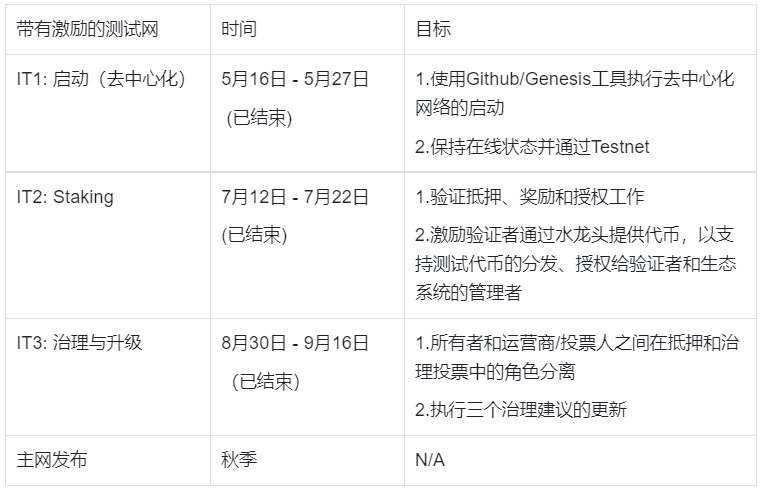
The testnet has delivered many valuable insights, reinforcing our confidence in a solid mainnet launch. Below are some issues identified from past tests and corresponding mitigation strategies:
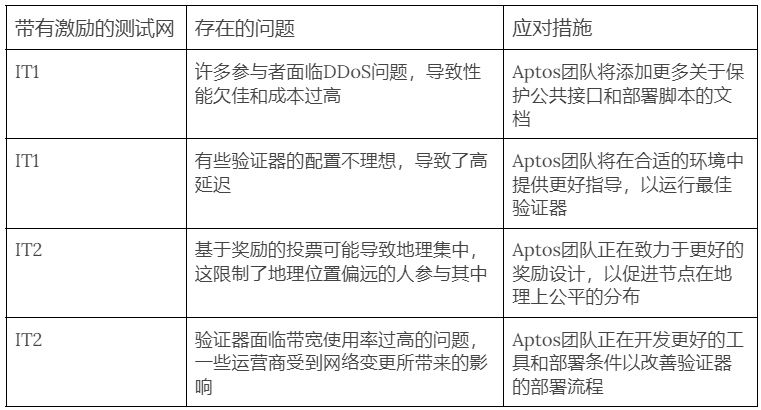
Learn the summaries of IT1 (details) and IT2 (details).
At the time of writing, performance snapshots from participants in AIT3 have been recorded, and nodes are free to leave the setup. AIT3 has transitioned into a long-running testnet, providing developers with a stable environment. Establishing a long-running testnet reflects confidence in the software stack’s long-term stability, laying the groundwork for a successful mainnet launch.
Following mainnet launch, the team plans to run AIT4 in Q4 to conduct further stress testing and open the network to more validators. We will continue monitoring the project’s progress.
4. Aptos Grant Program
The Aptos Grant Program was announced at the end of June, offering funding to accelerate dApp ecosystem development. Supported categories include:
Developer tools, SDKs, libraries, documentation, guides, tutorials
Tools and frameworks for system development, governance, DeFi, and NFTs
Core protocol contributions: token standards, libraries, protocol upgrades, etc.
Open-source and public goods
Guide-related products
Click here to learn more about application criteria, guidelines, and review processes.
5. Ecosystem Status
Since Aptos is a non-EVM chain, questions may arise about how it bootstraps liquidity within its ecosystem. With support from partners and investors, the omnichain interoperability protocol LayerZero will integrate with the Aptos mainnet upon launch, allowing users to access the Aptos ecosystem via LayerZero and provide liquidity. Currently, LayerZero supports blockchains such as Ethereum, Optimism, Arbitrum, Binance Smart Chain, Avalanche, and others.
On the project front, Aptos’ core repository has over 2,100 forks and 3,800 stars, with more than 200 projects across DeFi, NFTs, gaming, and other domains planning to deploy on mainnet around the end of September.
Here are some notable projects:
Pontem is one of the early projects in the Aptos ecosystem, featuring a wallet and a live AMM. As part of their roadmap, they plan to build a Move VM (for cross-chain deployment) and an EVM compatible with Move VM (for interoperability with other blockchains).
Martian Wallet is a crypto wallet that helps users manage digital assets and access dApps on the Aptos blockchain. It will be available as a Chrome extension and iOS app. By the end of August, downloads exceeded 100,000.
Switchboard is a permissionless, customizable multi-chain oracle protocol for general-purpose data feeds and verifiable randomness. It is live on Solana and recently announced its devnet on Aptos. Switchboard has already integrated with notable projects like Tusnami Finance, Houston Swap, and Econia Labs.
Econia is a highly parallel DEX running on DecNet, using an on-chain order book model for trade matching. Leveraging Aptos’ parallel execution engine Block-STM, it achieves significant advantages in transaction speed and efficiency.
Currently in closed beta, Topaz is the first NFT marketplace on the Aptos network, providing a creative platform for NFT creators and artists.
Ditto Finance is a secure decentralized liquid staking platform on Aptos. Given the lack of native delegation on Aptos, it provides staking rewards for users unable to run validators.
Hippo Labs is building an aggregation layer for the Aptos ecosystem, featuring functionalities such as a transaction aggregator, exchange aggregator, messaging, and transaction simulation API.
6. Conclusion & Thoughts
Aptos focuses on building a fast, secure, scalable, and upgradeable Layer 1 blockchain. While Move’s security advantages are well-proven, the developer ecosystem is still in its early stages, potentially affecting dApp ecosystem development on Aptos. More broadly, the L1 space is fiercely competitive. With the emergence of numerous high-performance L2s, competition for developer attention is intense, impacting ecosystem growth and subsequent market adoption.
Nevertheless, results from the Aptos Devnet launched in March are encouraging, with over 200 projects across DeFi, NFTs, and gaming requesting mainnet deployment. Additionally, the Aptos Grant Program launched in June will further incentivize developer growth and accelerate dApp development.
Overall, we believe the team has the capability to realize their vision. The recent launch of the incentivized testnet demonstrates the team’s proactive approach to problem-solving. We will continue monitoring developments such as the project’s economic model.
If you are a startup team building on Aptos or planning to deploy your product on Aptos, please feel free to contact us and connect!
Appendix: Full Node and Validator Node Requirements
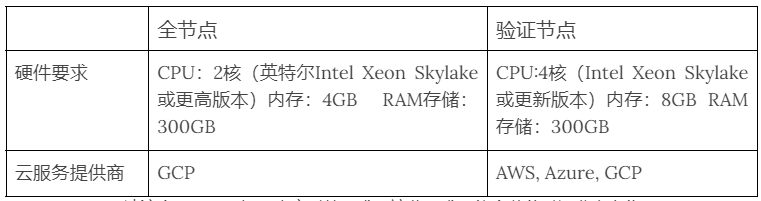
Note: The above diagram reflects requirements at the time of writing and may change over time.
Full nodes on Aptos do not participate in consensus. Instead, these nodes re-execute all transactions in Aptos blockchain history and store results locally. They use these results to challenge and provide evidence when detecting any validator misconduct.
Validator nodes run the distributed consensus protocol, executing transactions and storing results locally. They decide which transactions to include and in what order. Then, the BFT consensus protocol is used among validators to agree on the final ledger and execution results, which are then propagated to full nodes for independent verification.
Join TechFlow official community to stay tuned
Telegram:https://t.me/TechFlowDaily
X (Twitter):https://x.com/TechFlowPost
X (Twitter) EN:https://x.com/BlockFlow_News
 Bixin Ventures


