








Understanding a16z's "Cannot Be Evil" License: A New Foundation for NFT Intellectual Property Rights
TechFlow Selected TechFlow Selected
Understanding a16z's "Cannot Be Evil" License: A New Foundation for NFT Intellectual Property Rights
a16z's license is called "Can't Be Evil" (Cannot Be Evil). A subtle difference in wording leads to a nuanced shift in meaning.
 Navigating Web3 tides with focused insights
Written by: David, TechFlow
Recently, a16z launched a free and open license called "Can't Be Evil", aimed at clarifying intellectual property (IP) rights in the NFT space. Beyond the hype cycles of NFTs, perhaps what deserves more attention is the establishment of standardized licensing protocols—because they directly impact how widely NFTs and their associated IP can spread in real-world applications.
The Gray Area of Good and Evil: Ambiguity in NFT IP Usage
When you hear "Can't Be Evil," does Google's famous motto—"Don't Be Evil"—come to mind?
But this time it’s slightly different.
a16z’s new license is named “Can’t Be Evil.” A single word change brings about a subtle but significant shift:
"Don't be evil" functions more like a moral guideline—guided by conscience, reputation, and belief, telling us what we “should not do.”
"Can't be evil" functions more like a systemic constraint—based on law, formal terms, and code—that defines what we “cannot do.”
Does this feel abstract? Let's look at the current state of the NFT world.
You own an NFT from a project. If you print its image, along with the project’s trademark or logo, on clothing and sell it, is that illegal?
What if you only use the image, but not the trademark?
You probably can’t give a definitive answer. In fact, this touches upon the scope and extent of intellectual property (IP) usage.
Currently in the NFT space, the boundaries between what you can do (good) and cannot do (evil) with IP remain vague. Different projects have taken different approaches:
Conservative: Larva Labs restricts CryptoPunks holders from creating derivative products using the IP and prohibits the use of its brand/logo;
Moderate: Yuga Labs grants Bored Ape Yacht Club (BAYC) holders broader IP freedom and commercial rights, allowing them to create and sell derivative works based on their purchased NFTs—but without using BAYC’s brand name or logo;
Radical: Mfers and Moonbirds adopt CC0 licenses, going so far as to allow people—even without owning an NFT—to freely modify images, use logos and brands, or even redraw and resell them.
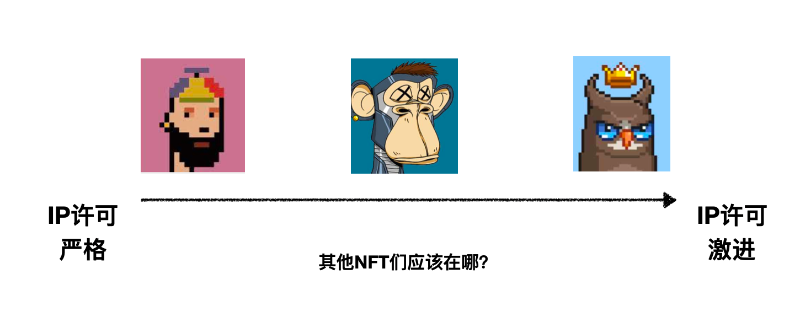
Given these diverse licensing scenarios, the NFT space urgently needs a flexible, open, and adaptable protocol standard to meet varying levels of permission requirements across different projects.
Moreover, many NFT projects may not have considered IP licensing at all during creation, resulting in chaotic and unclear licensing practices.
a16z’s “Can’t Be Evil” license aims precisely to turn this ambiguity into clarity.
Defining Boundaries: Starting with Standardized Licensing
Let’s examine exactly how a16z implements its “Can’t Be Evil” NFT license.
One prominent feature is that the license accounts for various potential rights of the buyer regarding the NFT artwork. For example:
Whether exclusivity applies (only the buyer decides how to use their NFT art; creators waive all licensing rights);
Whether commercial rights are granted (allowing buyers to use their NFT for commercial purposes);
Whether buyers may modify, adapt, or create derivatives from their purchased artwork (such as altering appearance or using it in different contexts)...
This empowers NFT projects to flexibly design license agreements according to their interests. Accordingly, a16z offers six predefined license options combining these conditions, specifying the rights of NFT owners under different scenarios:
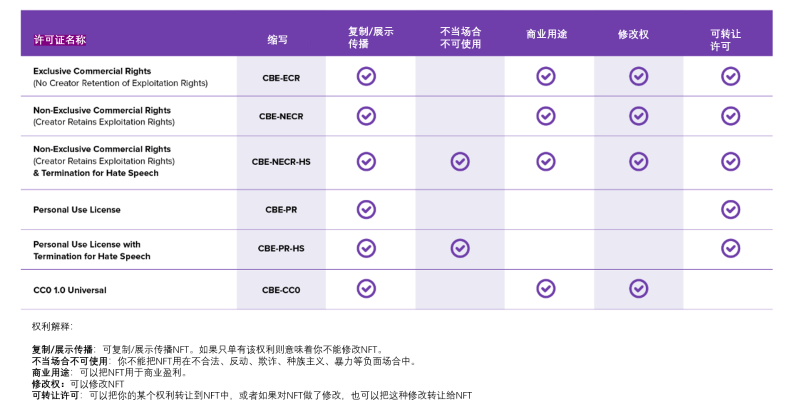
CC0 ("CBE-CC0") — Waive all copyrights under Creative Commons’ CC0 1.0 Universal terms.
No Reserved Creator Commercial Rights ("CBE-ECR") — Full exclusive commercial rights granted, including use in objectionable contexts (note: objectionable includes illegal, fraudulent, violent, etc.). Creators retain no usage rights.
Non-Exclusive Commercial Rights ("CBE-NECR") — Full non-exclusive commercial rights granted, usable in objectionable contexts. Creator retains usage rights.
Non-Exclusive Commercial Rights with Holder Suspension ("CBE-NECR-HS") — Full non-exclusive commercial rights granted, but prohibited in objectionable contexts. Creator retains usage rights.
Personal Use License ("CBE-PR") — Grants personal-use-only rights.
Personal Use License with Hate Speech Suspension ("CBE-PR-HS") — Grants personal-use rights, suspended upon hate speech violations.
Project creators can choose one of these options when launching an NFT, clearly defining users’ IP-related rights from the outset.
Additionally, while multiple options are provided, some NFT projects might still fall outside these categories, and licensing needs may evolve over time. Thus, a16z intends the “Can’t Be Evil” license as a starting point for building a broader licensing ecosystem, encouraging future innovation and new standards. To support this, they’ve also released a legal primer (PDF) outlining considerations for potential modifications.
Enforceable Protection: IP Rights Embedded in Code
On a practical level, a16z has deployed the “Can’t Be Evil” licenses onto Arweave—ensuring public, permanent, and immutable storage—and made them open-source on GitHub. Each license is packaged into smart contracts that any new NFT project can inherit.
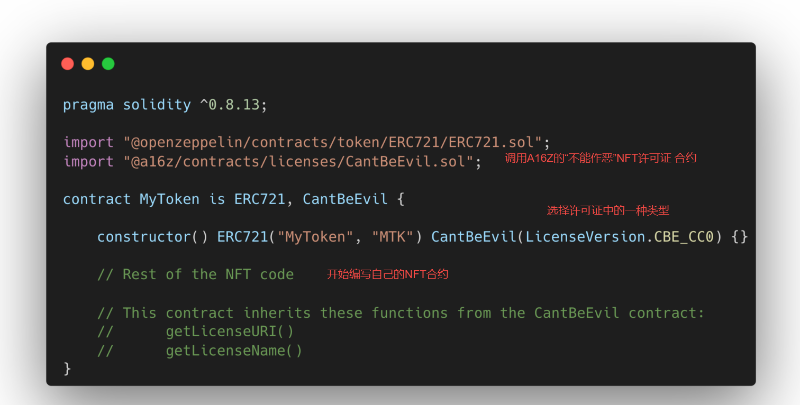
This means that when developing NFT code, projects can simply reference a16z’s license contract to formally declare their chosen licensing terms within the code itself.
For example, in the Solidity code snippet below, before writing any custom logic, a project directly imports a16z’s license contract and sets the license type to CBE_CC0—waiving all copyright.
Later, other developers, users, or businesses reviewing the project’s NFT contract can verify this reference to confirm the actual use of the CC0 license—not just a verbal claim.
Let’s draw a parallel here.
Those familiar with open-source software likely know the Apache License—an agreement used by the nonprofit Apache Software Foundation. It encourages code sharing, respects original authors' copyrights, and permits modifications.
If a project uses the Apache License, you’re allowed to modify its source code;
Likewise, if an NFT project adopts a16z’s “Can’t Be Evil” license, in theory, you must comply with its specified conditions for IP usage.
This represents a rule-based authority embedded directly in code—a true manifestation of “code is law.” Just as the Apache License became a consensus standard in open-source development, universally followed when using licensed code,
if most NFT projects adopt a16z’s license, it too could gain normative power.
A Move with Deeper Intentions?
To most people, a16z is still seen primarily as a venture capital firm—an investor profiting through funding projects.
As competition intensifies in crypto investing, high-quality projects are becoming harder to find, and marginal returns from early-stage investments may be declining due to market maturity and narrative stagnation.
Beyond investing, top-tier VCs possess exceptional research capabilities—meaning they often better understand industry gaps than others.
The NFT IP licensing space remains largely unstandardized, with urgent need for unified authorization frameworks. While building such standards, is a16z also seeking greater influence over industry norms?
History shows that when a company identifies market shortcomings and takes the lead in setting standards, it gains significantly in industry standing, potential profits, and network effects—just consider Qualcomm, Ericsson, and Huawei competing for control over 4G/5G standards.
“Xiang Zhuang dances his sword with intent on Pei Gong.” Shifting from industry investor to rule-maker—the ambition here is clear. Future moves likely extend far beyond just launching an NFT licensing protocol.
When VCs start rolling up their sleeves to build, there’s even more reason to believe in the industry’s vibrant future.
References:
a16z License Official Introduction: https://a16zcrypto.com/introducing-nft-licenses/
License GitHub Page: https://github.com/a16z/a16z-contracts
Join TechFlow official community to stay tuned
Telegram:https://t.me/TechFlowDaily
X (Twitter):https://x.com/TechFlowPost
X (Twitter) EN:https://x.com/BlockFlow_News






