








Arbitrum's ecosystem expands in depth: Nova emerges at the right moment!
TechFlow Selected TechFlow Selected
Arbitrum's ecosystem expands in depth: Nova emerges at the right moment!
With the overall growth of the Arbitrum ecosystem, the Nova chain will work alongside Nitro to provide users with a more user-friendly scaling experience.
 Navigating Web3 tides with focused insights
Author: 0xCryptolee, CIG Scholar
Proofreading: Wu Ji, Core Economic Researcher at CIG Labs
Technical Review: Jason (Arbitrum)
I. Background of Launch
After the market experienced severe volatility and a sharp downturn, with sentiment hitting rock bottom, Arbitrum launched the Odyssey campaign to attract users and support ecosystem projects. As Arbitrum's promotion gained momentum, its ecosystem projects successively received significant traffic and exposure. The number of unique addresses on Arbitrum surged accordingly, making the event exceptionally vibrant—during its second week, gas fees for transactions on Arbitrum even temporarily exceeded those on Ethereum’s mainnet. This phenomenon accelerated, to some extent, the development and launch of Nitro and Nova.
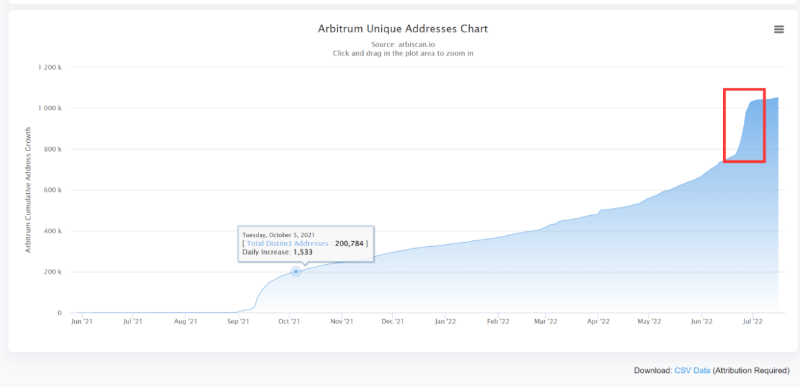
Growth in Arbitrum's unique address count, screenshot from arbiscan.io
Of course, the popularity of the Odyssey campaign was merely one catalyst accelerating the release of Nitro and Nova; the primary driver behind Nova's launch lies in Arbitrum's differentiated product strategy. While Arbitrum Rollup significantly enhances Ethereum's performance, it still faces issues of soaring gas fees under heavy traffic loads—this stems from the cost of competing for block space on Ethereum's mainnet, along with Layer-2 computation and storage expenses.
To address this issue, other Ethereum scaling solutions have introduced multiple products catering to different user needs. For example, zkSync offers the zkPorter solution, reducing costs by moving data availability off-chain; even BNB Chain has launched its own differentiated solution, BAS, to meet the demands of high-frequency transaction scenarios such as gaming and social applications. Similarly, Arbitrum chose to adopt Anytrust technology to serve diverse application scenarios, ensuring sustainable ecosystem growth—thus, Nova emerged naturally!
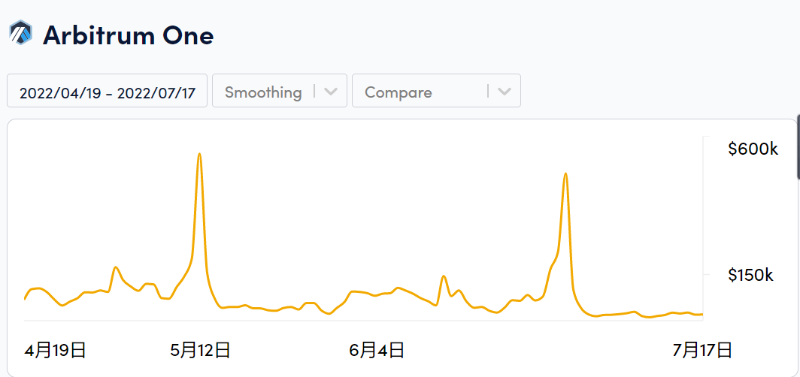
Arbitrum gas consumption trends, screenshot from cryptofees.info
II. Clarifying Concepts
1. Nova
Nova is the first chain built on Anytrust technology, launched by Offchain Labs. It is currently not open to all users. Developers can apply via Arbitrum's official website to participate in test deployments on the Nova network. Due to its use of Anytrust technology, Nova holds a significant cost advantage, enabling it to quickly attract deployment and testing of applications in high-frequency transaction scenarios, offering better interaction experiences for such use cases and their users in the future.
2. Anytrust
Anytrust was part of Arbitrum's original scalability vision and shares considerable architectural similarities with the Rollup approach. The following sections will analyze the differences and similarities between Anytrust and Rollup.
3. Arbitrum One
Arbitrum One is the current mainnet version of Arbitrum Rollup. It features a custom-built AVM (Arbitrum Virtual Machine) to achieve EVM compatibility, allowing dApps from the Ethereum ecosystem to migrate seamlessly with minimal modifications.
4. Arbitrum Nitro
Nitro is the upcoming mainnet upgrade of Arbitrum One (not yet live). After the upgrade, the existing AVM will be removed and replaced with a GETH client written in WASM. Additionally, to better align with future Ethereum EIPs, the rollup contract in Nitro will replace the Node and Challenge contracts used in Arbitrum One with lib contracts. Furthermore, the Nitro version optimizes the gas model to more closely resemble Ethereum’s mainnet gas model, reducing both user transaction costs and the difficulty for developers migrating applications.
5. Odyssey
Odyssey is an ecosystem project engagement campaign launched by Arbitrum. Through early voting, the most popular projects within the ecosystem are selected, and each week users are guided through various categories of products. Completing related tasks earns participants NFTs as interaction rewards. To date, Odyssey is the largest event within the ecosystem, attracting widespread participation from web3 natives. Although the event was temporarily paused due to network congestion during its run, it will resume after the Nitro upgrade, providing users with an improved experience.
III. In-Depth Look at Nova
Nova is an independent chain launched by Arbitrum, operating separately from the existing Arbitrum One. Since much of its architecture overlaps with Arbitrum Rollup, the following analysis assumes you have already read “The Odyssey Has Arrived—Do You Really Understand Arbitrum?”. If not, we highly recommend reading it before continuing.
1. Data Availability Committee (DAC)
As is well known, Arbitrum One uses Rollup technology. The sequencer batches transactions over a period and compresses them into calldata, which is then submitted to Ethereum’s mainnet inbox contract. In this setup, transaction data availability on Arbitrum One is stored and guaranteed by Ethereum’s mainnet—this is why its security level closely mirrors that of Ethereum.
The key difference with Anytrust is the introduction of a Data Availability Committee (DAC), which moves the calldata—originally stored in the inbox contract—to off-chain storage managed by the DAC. Under the Anytrust model, after users send transactions to the sequencer, the sequencer forwards the transaction data to the DAC. The committee then signs a Data Availability Certificate (DACert). Only these certificates—not the full data—are uploaded to the inbox contract on mainnet, further reducing the amount of data sent to layer 1. To ensure data availability, the committee operates Data Availability Servers and publicly exposes REST APIs, allowing anyone to retrieve data batches via hash.
This means that when accessing a specific batch of transaction data, one only needs to retrieve the hash from the inbox contract and use the public API provided by the Data Availability Server to obtain the full data. Compared to directly uploading calldata to the inbox contract, the Anytrust approach sacrifices some degree of decentralization, as users must trust the DAC to provide accurate data. However, Anytrust still holds significant advantages over other sidechains and chains using BFT consensus—the key being Fallback to Rollup.
2. Fallback to Rollup
Fallback to Rollup serves as Anytrust’s safety net: if the Data Availability Committee fails, Anytrust can revert to Rollup mode by placing data availability back onto layer 1 via the inbox contract. Once the DAC recovers, the system can switch back to Anytrust mode.
Compared to standard BFT consensus, Anytrust operates under weaker trust assumptions. Within the DAC, only two honest validators are required to ensure chain security. Here's how: a DACert requires signatures from N−1 validators. Even if some members act maliciously, as long as at least two honest validators exist among the N total, at least one will remain in the N−1 signing group. If a malicious attempt occurs, the honest validator will refuse to sign, preventing a valid certificate from forming.
Therefore, under Anytrust’s trust model, just two honest validators are sufficient to ensure correct signing—offering stronger security than typical BFT chains, which require 2/3 of nodes to be honest. Moreover, Anytrust has a unique advantage: even if the DAC fails, block production does not halt. The sequencer can directly send calldata to the mainnet inbox contract, triggering a fallback to Rollup mode and maintaining chain security and continuity—a feature absent in most sidechains.
Summary
In summary, Nova, powered by Anytrust technology, offers substantial advantages in transaction costs, making it ideal for gaming and NFT applications, while also requiring fewer trust assumptions and delivering higher security. As Arbitrum strengthens its overall ecosystem, Nova and Nitro together will deliver a more user-friendly scaling experience, inevitably driving further growth and prosperity within the Ethereum ecosystem and addressing long-standing performance challenges faced by users.
Article authored by 0xCryptolee, published by CIG.
CIG Labs Research Group is a collaborative learning community inspired by the open university philosophy. We welcome contributions—project analyses, industry insights, macro perspectives—all are encouraged. We regularly host discussion events and are committed to building a decentralized environment for knowledge sharing and exchange.
For details, visit our Discord to inquire
References
https://twitter.com/hhh69251498/status/1540929062889488384
https://mp.weixin.qq.com/s/V5X3bi71gVKn5BgHtQAXCw
https://mp.weixin.qq.com/s/mMBGqUwsyJ3bEYXxrwVM1w
https://mp.weixin.qq.com/s/MIK7foIIkzvDoA5PbStRIQ
https://mp.weixin.qq.com/s/s48Urgd0xQsTHQ7w6XrcUw
https://mp.weixin.qq.com/s/MIK7foIIkzvDoA5PbStRIQ
https://developer.offchainlabs.com/docs/anytrust
https://github.com/OffchainLabs/nitro/blob/master/docs/inside_anytrust.md
Join TechFlow official community to stay tuned
Telegram:https://t.me/TechFlowDaily
X (Twitter):https://x.com/TechFlowPost
X (Twitter) EN:https://x.com/BlockFlow_News






