








ETH2.0 Staking Governance Battle: How Rocket Pool Challenges Lido?
TechFlow Selected TechFlow Selected
ETH2.0 Staking Governance Battle: How Rocket Pool Challenges Lido?
Rocket Pool is quietly building at least three large-scale scaling solutions that will enable it to grow by ~1000x and compete with Lido in scale.
 Navigating Web3 tides with focused insights
Author: Marceau
Translation: TechFlow intern
TL;DR: Rocket Pool is quietly building at least three major scaling solutions that could enable ~1000x growth, allowing it to compete with Lido in scale.
Background
Rocket Pool is objectively the best liquid staking product on the market because it is fully decentralized, permissionless, and solely focused on Ethereum. Lido largely fails to meet these criteria, and we urgently need competitive staking protocols like RP to strengthen the ecosystem. However, RP’s current situation isn’t great—it’s actually quite poor. Fortunately, the path forward lies in technology, not marketing or other factors.
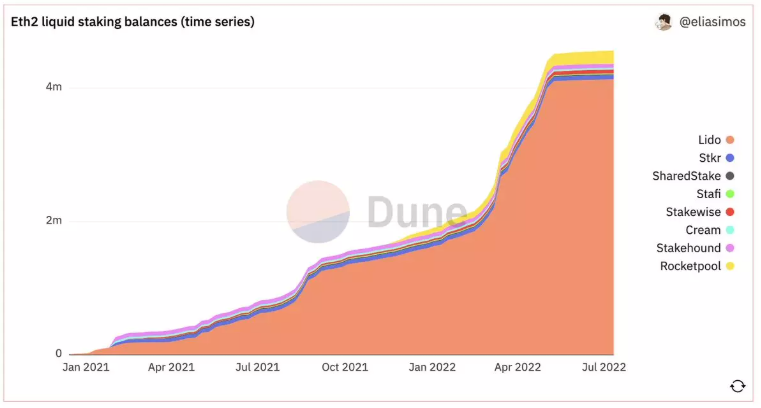
Rocket Pool has technological advantages but has been limited in growth due to capital inefficiency, as each node operator must currently collateralize 110–250%. Despite entering the market later, they’ve already grown their market share to 1.5%. Imagine if Rocket Pool weren’t just as it is today, but had scaled by three orders of magnitude—enough to overcome any self-imposed size constraints.
#1: Low ETH-Bonded Minipools (LEBs)
Research conducted by @shtimseht supports the idea of securely reducing collateral requirements from 16 ETH down to as low as 4 ETH. The RP team is now refining the economic model and integrating this concept into future contract iterations.
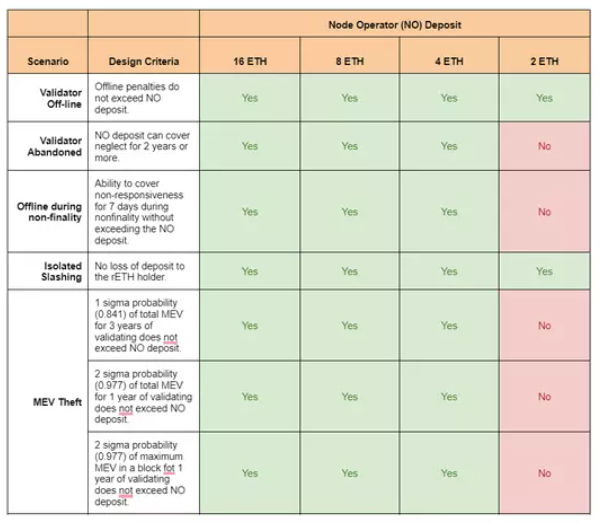
If successful, this would reduce collateral requirements by 2–4x, enabling broader participation, significantly increasing node operator revenue (as they can charge commissions on more rETH), and greatly increasing the amount of rETH minted per unit of TVL.
#2: Staking-as-a-Service (SaaS)
SaaS enables whales to participate in staking in a minimally trusted, yield-generating manner.
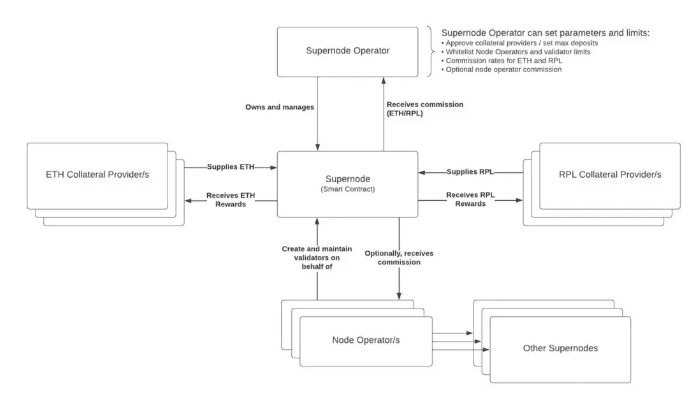
This particularly appeals to a new range of large operators, including infrastructure companies, institutional custodians, high-net-worth individuals, financial service firms, corporations, and treasuries. We already have companies lined up ready to join as SaaS providers—including some well-known names you’d recognize...
Beyond supporting these types of market participants, it unlocks new use cases—specifically, it separates node operation, ETH staking, and RPL staking into distinct layers. For example, someone could stake 100% ETH and share commission revenue with an RPL backer, earning the highest pure ETH yield in the market. This is a dream come true for many ETH maximalists who aren't interested in being long on the native protocol token (RPL).
#3: Migration for Solo Stakers
As part of the expected credential updates in the Capella hard fork, Rocket Pool will be able to offer direct migration into their ecosystem—with higher yields.
Imagine large solo stakers collectively converting their existing validators into Rocket Pool to chase better individual yields. The benefits are highly compelling: income smoothing (after two months), higher yields, easier operations, liquidity support, and more. Perhaps equally important, it synergizes with SaaS and provides a simple pathway for ETH to migrate into any number of large-scale infrastructures built atop Rocket Pool—an entire ecosystem poised to emerge.
All these developments create massive value for RPL. Beyond supporting the highest-quality staking derivative, it also benefits from merge-related tailwinds, protocol growth, anticipated technical improvements, and enhanced token economics.
It's a form of ETH leverage with strong downside protection derived from collateral efficiency.
Now let’s fast forward one year and imagine how things might look: withdrawals enabled, 3–10x scale expansion solutions live, increased yields, staking substantially de-risked, LSD pegs defendable via arbitrage. That’s the real alpha for you.
Join TechFlow official community to stay tuned
Telegram:https://t.me/TechFlowDaily
X (Twitter):https://x.com/TechFlowPost
X (Twitter) EN:https://x.com/BlockFlow_News






