Reviewing BitKeep's Growth Journey: How to Leverage Web2 Growth Strategies to Penetrate Web3?
TechFlow Selected TechFlow Selected
Reviewing BitKeep's Growth Journey: How to Leverage Web2 Growth Strategies to Penetrate Web3?
How to achieve growth in Web3 has been a frequently discussed topic recently, whether it's blockchain games, infrastructure, or DeFi.
 Navigating Web3 tides with focused insights
Author: Zolo, TechFlow
How to achieve growth in Web3 has become a frequently discussed topic lately, whether it's blockchain gaming, infrastructure, or DeFi. Everyone is exploring better ways to acquire users.
Currently, two areas of marketing exploration in Web3 seem particularly valuable:
1 – More Web2 professionals entering Web3, bringing mature market strategies into the Web3 space;
2 – Native marketing innovations in Web3 based on addresses and NFTs.
On the first point, there’s a recent strong case worth noting: BitKeep’s NFT distribution campaign. Here are some reflections that might also apply to other outreach initiatives.
Introduction to BitKeep and Campaign Background
BitKeep is a wallet application that launched its 7.0 version in March, introducing many new features—one key highlight being an in-wallet NFT marketplace. Within just two months of launch, BitKeep’s NFT marketplace ranked #1 on BNB Chain and top 5 globally.
Now, when you enter the NFT module in BitKeep, you’ll see two main sections: NFT and INO. The NFT section includes various regular operations, while INO (Initial NFT Offering) serves as an NFT launchpad. The full operational layout is shown below.
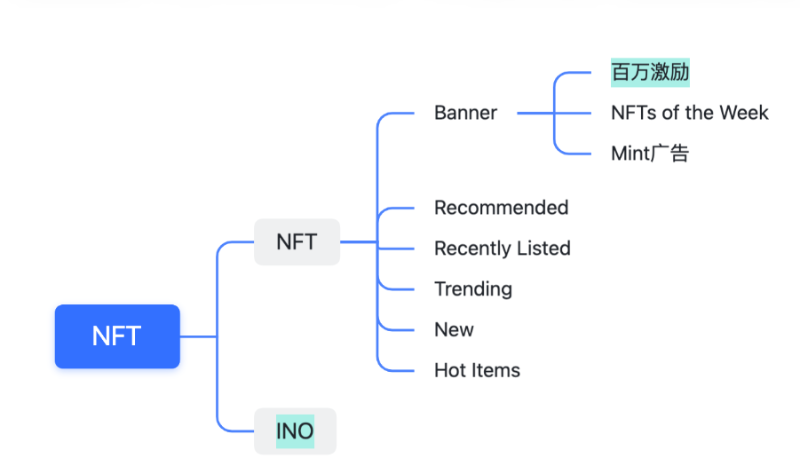
Recently, BitKeep’s campaigns have primarily revolved around a million-dollar incentive program and INO launches, so this analysis will focus on these two aspects.
Application of the AARRR Growth Model
When discussing growth, experienced Web2 marketers often think of the "AARRR" model. If you look at BitKeep’s million-dollar incentive program and INO initiative together, you’ll notice they cover most stages of the funnel—except referral.
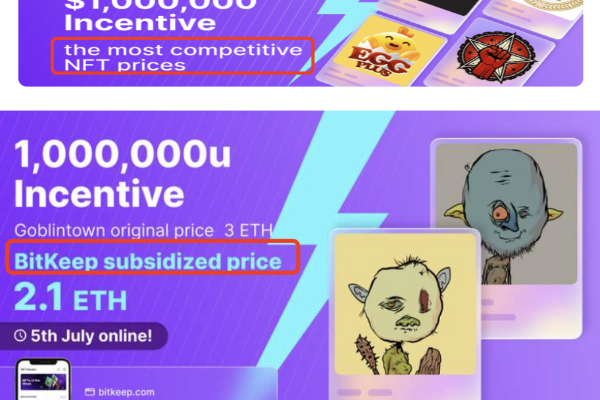
- Acquisition: In early July, BitKeep launched its 1,000,000 #USDT Incentive Program.
The core logic is simple: attract users through subsidies. On BitKeep, users can purchase NFTs at prices even lower than floor price via time-limited flash sales.
While the basic mechanism isn’t complex, the execution strategy reveals thoughtful planning worth learning from.
If BitKeep’s goal was user acquisition for its NFT marketplace, then its target audience would naturally be NFT enthusiasts. Short-term NFT players focus on new projects and floor price fluctuations, selling for profit; long-term investors care about blue-chip assets.
At the heart of “floor price” and “blue chip” lies sensitivity to pricing and the desire to hold high-quality projects.
To appeal to both user types, BitKeep introduced the 1,000,000 #USDT Incentive Program, directly tapping into short-term players’ price sensitivity through subsidies.
Meanwhile, in each campaign cycle, BitKeep featured well-known NFTs such as bilibili and Goblin to attract long-term collectors.
There’s also a concept from traditional retail called the “hero product”—using one popular item to drive sales of others.
In this context, the “hero product” translates to “quasi-blue-chip NFTs.” Each flash sale followed a format of “1 quasi-blue-chip + n standard projects,” leveraging one standout NFT to boost visibility and sales of lesser-known ones.
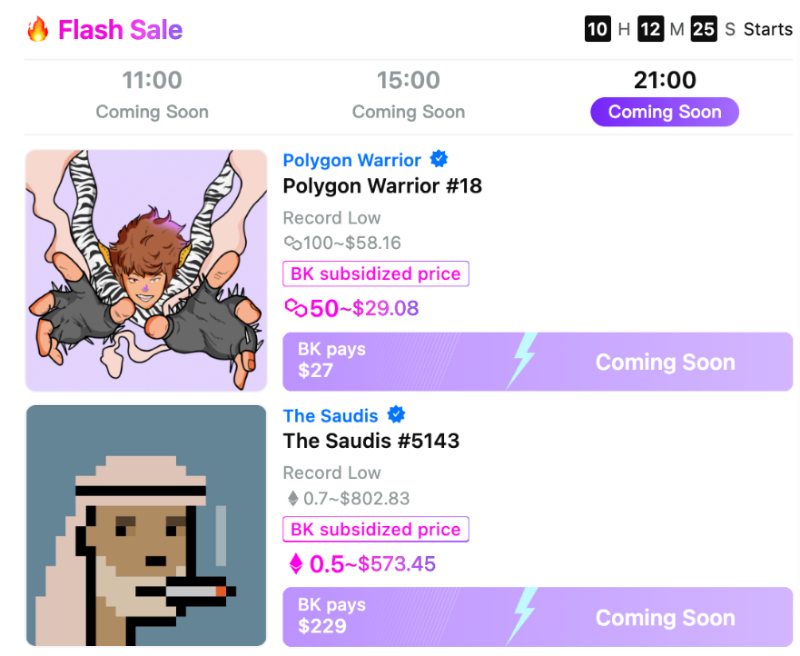
The combination of “flash sales + hero product” is a well-established tactic in Web2. Although there’s no referral (“invite friends to cut price”) mechanic here, the campaign still performed well in terms of user acquisition and transaction volume.
Besides lacking a referral system, I believe the messaging could be improved: using “lower/flash floor price” instead of “subsidized price.” Reasons include:
1 – Discount pricing is a Web2 concept; in Web3, “floor price” is already a familiar and widely accepted term among NFT users;
2 – Naming it “BitKeep Flash Floor Price” creates clearer positioning and can serve as a long-term branded campaign.
Even when applying proven Web2 tactics in Web3, some adaptation may be necessary. Of course, this is just my personal opinion—open to discussion.
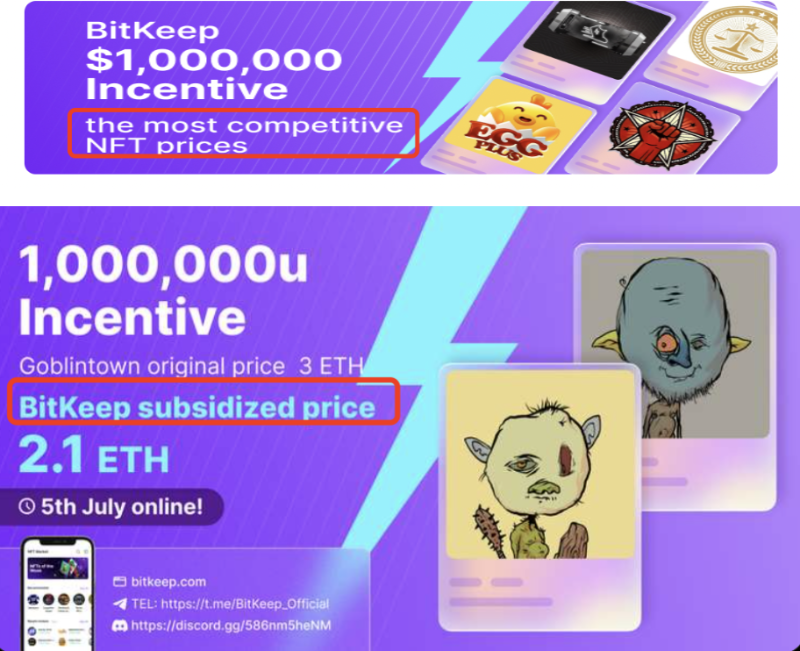
- Activation: When I checked the flash sale interface a few days ago, there weren’t finely segmented time slots—sales occurred at single points across different dates. BitKeep’s adjustment of release timing reflects optimization for user activation. Instead of one daily spike, they now offer three per day, encouraging habitual app usage.
Additionally, after acquiring users through incentives, BitKeep officially launched its long-planned INO platform on July 12. This allowed them to leverage traffic from the incentive program to activate users while simultaneously raising awareness of new product offerings.
Beyond user activation, the launch of the INO platform clearly involves monetization considerations. Details around retention and revenue won't be explored here, but reviewing the operational content makes those goals apparent.
I suspect that discounted prices for non-famous NFTs may not always be borne by BitKeep. Given BitKeep’s traffic access and exposure resources, resource swaps with project teams are likely feasible—allowing costs to be focused only on featuring well-known NFTs, thus extending the campaign duration.
That covers the NFT side. The incentive program continues, and more INO projects are expected. Interested readers can keep an eye out.
Web3 Red Packet Viral Mechanics
Another standout move in BitKeep’s operations: encrypted WeChat red packets!
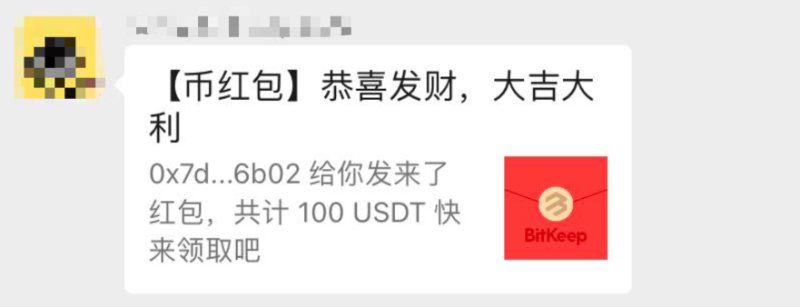
Previously, I mentioned a project called ime that also had a red packet feature, but it only supported direct (non-shareable) red packets, limiting viral spread within communities. BitKeep, however, allows direct sharing to WeChat groups, with excellent integration into the WeChat experience—very smooth.
Those interested can try this feature via the Discover tab on the mobile app.
However, these red packets are mainly used by the official team for user acquisition.
Non-BitKeep employees are unlikely to send them voluntarily—when sending red packets, people would prefer using native WeChat due to easier access.
Therefore, for WeChat group-based acquisition, calculating user cost via CAC metrics might prove expensive.
Still, this operational tactic is highly instructive. Many digital collectible projects use similar methods. Perhaps in the future, using non-token incentives could further improve ROI.
Another notable red-packet user acquisition case is Mask Network.
I’ve covered Mask in past videos—after installing the browser extension, users can send red packets directly on Twitter.
This idea sounds promising—Twitter’s public square should theoretically enable better user acquisition than WeChat’s private circles. However, I suspect Mask’s actual performance may be limited due to product design issues.
A key difference between BitKeep and Mask lies in the user journey:
● BitKeep: Users see the reward first, then download the app to claim it;
● Mask: Users must download the app first before discovering if they’re eligible for a red packet.
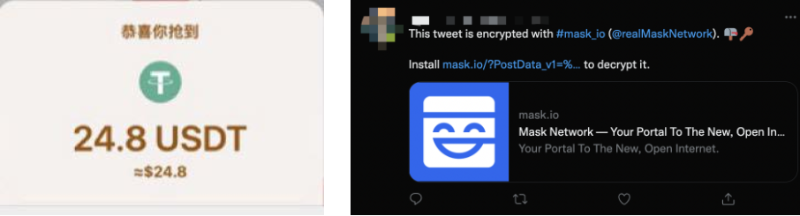
People value what they already possess more than uncertain future gains. For acquisition campaigns involving rewards, this psychological factor should be considered.
Airdrops follow the same principle—projects with clear airdrop benefits tend to gain more traction than those with vague or ambiguous incentives.
Overall, BitKeep’s recent campaigns clearly reflect strong Web2 influences—and they’ve executed them well. There will surely be more to come, and I hope to see more such cases emerge.
During this bear market, many projects are quietly building, each with unique killer features or value propositions. Continued experimentation will help better communicate their distinct values.
Despite ongoing layoffs, the talent gap for Web3 generalists remains significant. Continuous exploration and skill blending will never cease. Let’s connect and explore together.
Join TechFlow official community to stay tuned
Telegram:https://t.me/TechFlowDaily
X (Twitter):https://x.com/TechFlowPost
X (Twitter) EN:https://x.com/BlockFlow_News