









What problems need to be solved to build a successful Web 3.0 game?
TechFlow Selected TechFlow Selected
What problems need to be solved to build a successful Web 3.0 game?
The Dilemma and Outlook of Blockchain Gaming
 Navigating Web3 tides with focused insights
STEPN injected a surprising momentum into the long-silent GameFi, also known as Web 3.0 gaming, with its innovative carbon-neutral concept and "Move-to-Earn" model. We have observed practitioners exploring more X-to-Earn models and deeply contemplating how complex gameplay and tokenomics can empower each other. We are even more encouraged to see blockchain game projects moving beyond simple, short-lived mining clones toward GameFi 2.0—games featuring rich gameplay, polished production, and precisely designed economic systems and numerical balance.
Since then, many game developers and project teams have embarked on the path of exploring Web 3.0 games. These teams typically boast impressive backgrounds, notable past achievements, and advisors who are pioneers in the Web 3.0 space. Although recent market downturns have led some to question whether GameFi 2.0 is merely a mirage, we firmly believe this is only the beginning of industry transformation. Here, we aim to share our views and thoughts on Web3 gaming through these discussions.
This article compiles ten key questions that have emerged from our recent conversations with numerous game teams, attempting to answer one central inquiry: What problems must be solved to build a successful Web 3.0 game?
Question One: How did GameFi 1.0 games gradually lose attention?
Most discussions begin by identifying flaws in existing projects.
The market has passed the most FOMO-driven phase of GameFi, allowing people to clearly summarize why many once-prominent GameFi 1.0 projects ultimately failed—such as lack of engaging gameplay, absence of in-game asset consumption mechanisms, excessively fast earning rates, extreme volatility in token prices leading to abnormal equipment or output pricing, inflation destroying the in-game economy, and insufficient new player inflow to sustain Ponzi-like dynamics.
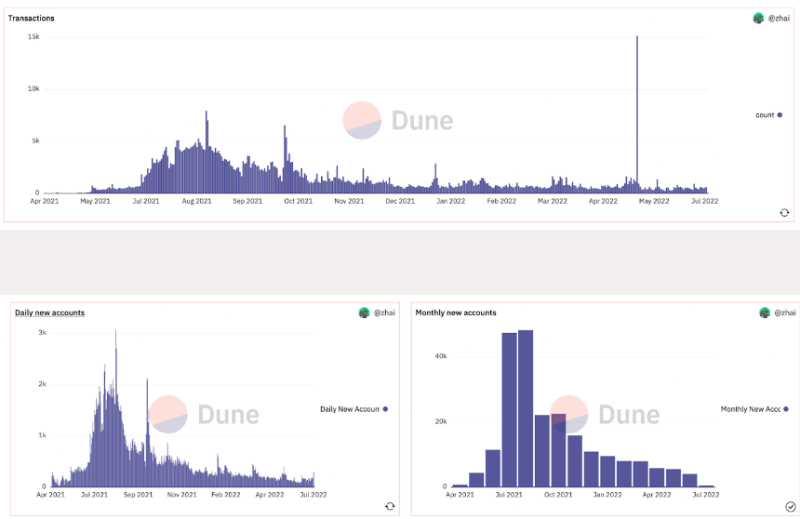
Axie Infinity’s transaction volume and new account count from April 2021 to present
These reasons are objectively valid, but our perspective is more intuitive. Viewing these games through the lens of national economies, their sequential collapse resembles countries toppling like dominoes during financial crises (e.g., South Korea, Vietnam, Malaysia, Russia). These nations experienced brief economic booms, accompanied by massive foreign debt accumulation and capital inflows. They maintained currency stability via large foreign reserves, but when hot money flowed out uncontrolled, they faced severe currency devaluation and asset price collapses. Formerly shining GameFi 1.0 projects lived through similar processes.
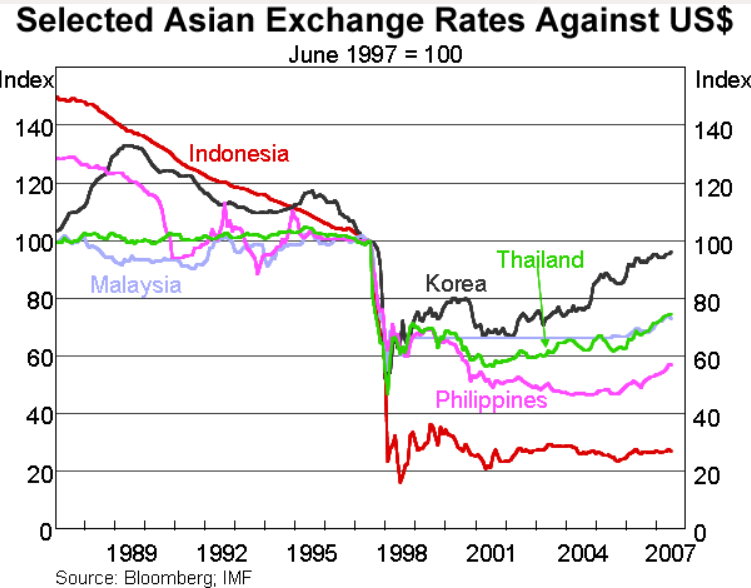
We believe the greatest failure lesson of these projects lies in neglecting the classic monetary theory known as the “Impossible Trinity.”
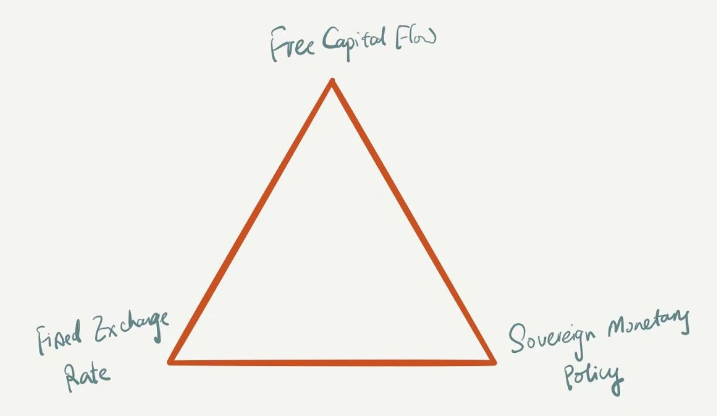
The “Impossible Trinity” states that a country cannot simultaneously achieve all three of the following:
-
Stable currency value
-
Independent monetary policy
-
Free capital flow
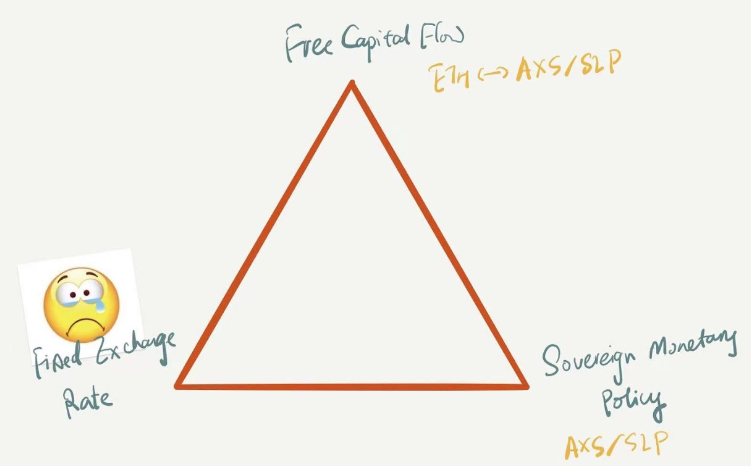
Most GameFi 1.0 projects aimed for:
-
Free capital flow. In Axie Infinity, players could freely buy or sell SLP/AXS tokens and in-game NFTs using ETH.
-
Independent monetary policy. Each game had its own rules for token issuance, consumption, and vesting schedules—akin to a nation pursuing an autonomous monetary policy independent of others.
-
Stable currency value. However, due to their independent monetary policies, many games saw significant token price fluctuations driven by player activity and speculative capital, eventually collapsing into financial crisis.
Therefore, building a successful Web3.0 game is not simply about replacing Web 2.0 game items or resources with NFTs, or converting traditional in-game points into tokens.
If viewed differently—as “blockchain games being miniature national economies”—traditional games resemble either “closed” or “open” economies, while Web 3.0 games are inherently “open economies” due to blockchain's nature. Designing NFTs or tokens is effectively initiating a process of “reform and opening up”: introducing foreign investment, taking on external debt, setting exchange rates, and adjusting monetary policy within what was previously a closed, self-contained system. This fundamentally disrupts established game-balancing models. Simply swapping existing currencies or points with tokens severely destabilizes the economy under free-flowing capital.
Question Two: What will GameFi 2.0 look like? Which games are suitable for Web 3.0 transformation?
We believe MMORPGs will lead the GameFi 2.0 era and represent one of the most suitable genres for Web 3.0 adaptation.
Classifying games by player investment, content depth, and complexity, we broadly categorize them into hardcore, mid-core, and casual games.
Hardcore games include well-known AAA titles such as GTA, often jokingly called “Game Takes Ages”; mid-core games cover most RPGs, sports, strategy SLGs, real-time strategy (RTS), card games, etc.; casual games align with puzzle or idle entertainment.
For Web 3.0 games, competing directly with AAA studios on graphics and immersive experience is unrealistic. Casual games cater to fragmented leisure time, requiring minimal time, money, or attention, and lack layered internal asset circulation. Such games are better suited for PvP “casino” models, which fall outside the scope of our P2E discussion. Therefore, we believe the most viable candidates for innovative Web 3.0 transformation lie within the mid-core category.
Among these, MMORPGs stand out as the ideal genre for transitioning into Web3.0. Compared to traditional AAA games, they feature strong social components and highly sophisticated in-game economies.
MMORPG (Massively Multiplayer Online Role-Playing Game) features rich worldviews, high replayability, deep social experiences, and mature development frameworks. MMORPGs possess relatively mature gameplay and exceptionally robust, realistic, long-lasting economic systems centered around trading. In-game assets belong to players, transactions are highly active, and individual players running item shops can generate over $1 million in half a year. These advantages contribute to longer lifespans than other game types. Titles like World of Warcraft and Dream Journey Online have operated stably for up to 19 years, and several MMORPGs on Roblox have run for 9–10 years with substantial revenue.
Most importantly, following historical trends in gaming evolution, we view current GameFi as analogous to the pre-MMORPG boom period around 2000.
Compared to the crude mining mechanics of GameFi 1.0, GameFi 2.0 represents the true realization of Play-to-Earn (P2E). Its core mission is to make blockchain games equally entertaining, social, and economically rewarding, returning true ownership of assets to players and enabling sustainable in-game earnings through balanced economic loops.
In fact, P2E is not novel to traditional MMORPG players nor exclusive to Web 3.0. For over a decade, players of World of Warcraft or Dream Journey Online have mastered monetizing in-game gold, with websites even tracking WoW Gold vs. USD exchange rates. While official channels encourage earning in-game currency, Real Money Trading (RMT)—converting in-game gold into fiat—is strictly prohibited, a point we’ll elaborate on later.
Drawing from past successes, transforming these “closed economy” MMORPGs into “open economy” Web 3.0 games becomes our central challenge.
Question Three: How many tokens should exist in a Web 3.0 game?
Conclusion: We recommend game developers implement a three-token or four-token system in Web3 games.
After decades of evolution, traditional games have developed a classic three- or four-currency model within closed economies: gold coins, silver coins, gems (and sometimes points). Crucially, different currencies must flow unidirectionally—from fiat → gold → silver → gems.
Fiat currency (e.g., RMB, USD) is first converted into gold coins. As the primary entry point, gold serves as a bookkeeping unit representing fiat purchasing power and cannot be redeemed back into fiat.
Gold coins can be exchanged for silver coins at a fixed rate. Silver functions as the main in-game circulating currency, earned through gameplay and spent on upgrades, repairs, crafting, etc. It acts as the principal medium of exchange and cannot be converted back into gold.
Silver coins can be used to purchase gems, which unlock premium chests, rare items, limited skins, etc., in official stores. Gems are restricted to in-store use, non-refundable, and non-transferable. The one-way flow from silver to gems encourages consumption of earned currency, creating deflationary pressure against inflationary earning.
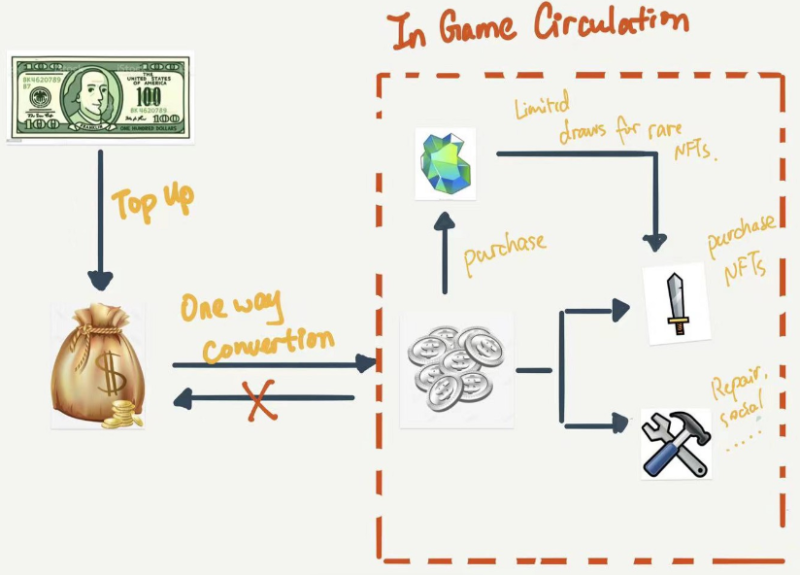
Some games introduce a fourth currency—points. Points are usually earned through daily active tasks (logins, playtime thresholds, etc.). They can be redeemed for gems but cannot be converted into gold or silver, transferred, or cashed out. This prevents farming multiple accounts to accumulate points and convert them into silver, thereby increasing downward pressure on silver’s value.
The aforementioned RMT (Real Money Trading) refers to users converting in-game silver back into gold or even fiat. Developers tightly restrict this to prevent mass botting operations from flooding the market with silver, causing inflation, distorting prices, and harming gameplay.
-
The one-way conversion from silver to gems incentivizes spending through scarce, high-end gear, achieving disinflation against mining outputs;
-
Points must never be exchangeable for silver or gold to prevent multi-account farming and artificial supply surges.
Web3.0 games differ drastically in economic design. Before proceeding, let us state our conclusion: we advise building a three- or four-token framework—but not via direct copy-paste from traditional games, as that would inevitably fail.
Because Web 3.0 forces game economies to shift from “closed planned economies” to “open markets,” the roles of various tokens (assets) diverge significantly from traditional counterparts. Let us outline an abstract token framework:
1. The role of traditional gold coins is now played by valuation tokens in Web3.0 games (e.g., ETH/BNB/SOL). Users typically spend valuation tokens to acquire certain NFTs to enter the game—for example, sneakers in STEPN.
2. The primary circulating currency—silver coins—corresponds roughly to in-game utility tokens in Web3.0 games, such as $SLP in Axie Infinity, $THC in Thetan Arena, or $GST in STEPN. These circulate internally, serve as the main medium of exchange, and have uncapped total supply.
3. Traditional gems are replaced in Web3.0 by capped-supply governance tokens, such as AXS, THG, GMT. Governance tokens are a major innovation in Web 3.0, going beyond mere in-store purchases to enable external economic cycles, player governance participation, and reward distribution. They represent player equity—a hallmark of Web3.0.
4. The function of traditional points is largely absorbed by utility tokens (e.g., SLP, THC, GST) in Web 3.0 games.
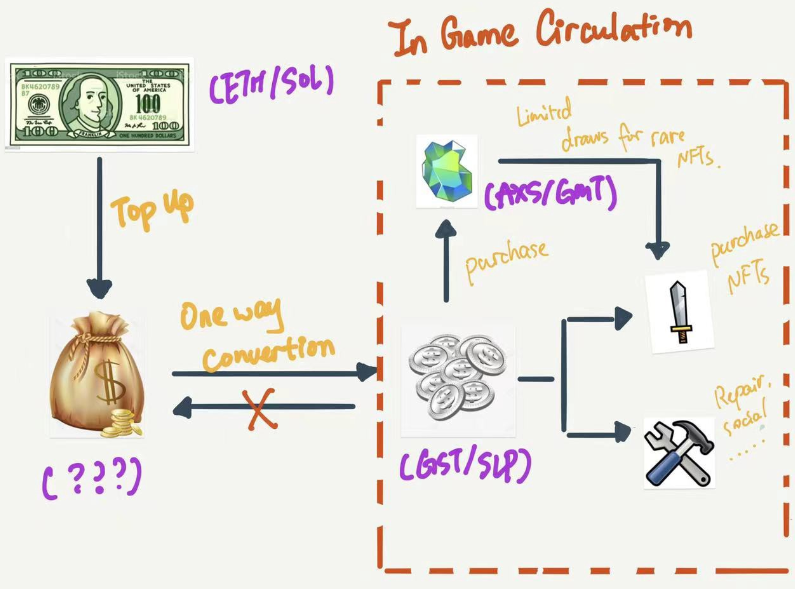
On the surface, Web 3.0 games appear capable of mapping or transplanting traditional token designs. Yet, this seemingly straightforward transfer is precisely where most Web 3.0 economic systems collapse.
As noted earlier, traditional games enforce strict one-way flows: fiat → gold → silver → gems. But in Web 3.0, since all on-chain assets trade freely on secondary markets, developers cannot control transactions involving valuation tokens (ETH, BNB, SOL) or NFTs, nor restrict trading of utility tokens like SLP or GST. Many exchanges list trading pairs for utility tokens (though arguably detrimental), and governance tokens face rampant speculation.
Imagine vast speculative capital freely impacting any part of a Web 3.0 game economy—this severely violates the “Impossible Trinity.” If a game insists on free capital movement (players freely trading tokens/assets on-chain) and independent monetary policy (game-controlled inflation mechanisms), it must sacrifice stable valuations, resulting in inevitable depreciation of both utility and governance tokens.
Consider a thought experiment: What if developers replaced utility tokens with USDC or ETH/SOL, so players earn real money? Who pays the bill?
Based on these insights, we propose Web 3.0 games adopt three core tokens:
-
A game consumption token
-
A game governance token
-
And a volatility adjustment token
Optionally, activity points may be added—their design will be discussed further below.
Question Four: Are Web 3.0 game tokens destined to die?
Before diving into specifics, we want to clarify the ultimate goal of token design: Is there a way to create a truly endless, crash-proof “infinite game”?
Our conclusion: Both Web 2.0 and Web 3.0 games have finite lifecycles. Economic laws dictate that utility tokens will inevitably inflate, but with careful modeling, we can slow inflation and extend longevity.
Reasons for continuous devaluation of utility tokens include:
-
Inherent flaws in economic design—e.g., too many earning paths and too few consumption sinks; multiple interchangeable currencies leading to oversupply and price drops;
-
Insufficient long-term operation weakening gameplay appeal, driving players away and depreciating tokens and equipment;
-
Influx of farming farms and botting workshops causing short-term token oversupply.
Over time, as high-level players accumulate and wealth gaps widen, declining productivity, soaring prices, and currency depreciation may become unavoidable.
Still, we’ve seen MMORPGs thrive for over a decade with stable economies—not just due to skilled operators’ ongoing tuning, but because of their inherently complex internal economies supporting extended lifespans. We believe Web 3.0 games can discover similarly durable tokenomic models—but only with persistent numerical balancing and operational maintenance.
Question Five: How do Web 3.0 game tokens circulate?
In our envisioned Web 3.0 game, three tokens coexist: a consumption token, a governance token, and a volatility adjustment token. Among them, the consumption token is the most critical medium of exchange.
Token circulation occurs primarily through generation and expenditure:
-
Utility token supply depends on gameplay—common sources include progression systems (PvP/PvE), social features (marriage, guilds), or daily quests; demand arises from player advancement—spending on levels, gear, skills, probabilistic crafting. A healthy economy requires relative equilibrium between supply and demand.
-
Achieving balance requires meticulous numerical design. The biggest challenge in Web 3.0 design is shifting from a “closed” to an “open” economy, introducing uncontrollable external variables.
Thus, we believe healthy Web 3.0 games should pursue these core objectives:
-
All in-game asset values should reflect players’ “socially necessary labor time” rather than mere time invested (Marx’s Capital defines this as the labor time required under average conditions and skill levels to produce a given value). Hence, the key mechanism is diversifying rewards per activity and maximizing consumption—whether of time, money, or resources—and ensuring all assets degrade over time;
-
As the primary medium, the consumption token must maintain relative price stability—neither sharp rises nor falls. Extreme volatility harms gameplay, so mechanisms balancing generation and consumption must keep the token slightly inflationary or deflationary;
-
Maximize friction in off-ramping assets—raise barriers for converting consumption tokens into ETH/SOL; implement “foreign exchange controls” to ensure “money earned in-game is spent in-game”;
-
Governance tokens need naturally demanded use cases to increase leverage among players;
-
Establish continuous monitoring and analytical capabilities to dynamically adjust monetary policies.
Question Six: How to achieve these goals? How to stabilize the consumption token after launch?
According to the economic “Impossible Trinity,” a nation cannot simultaneously maintain stable currency value, independent monetary policy, and free capital flow.
Applied to Web 3.0 game economies, developers should prioritize stable token value and independent monetary policy.
First, enforce strict capital controls—limit free fund movement, introduce friction costs on withdrawals, and encourage one-way inflows. Examples include mandatory lock-up periods for earned tokens, increased NFT trading fees, or caps on wallet holdings of consumption tokens.
Second, regulate the generation and consumption of utility tokens. Implement output constraints—STEPN uses referral codes, diminishing marginal returns per sneaker, and wear-and-tear mechanics—all effective methods to cap $GST (consumption token) issuance.
Additionally, boosting consumption is the most crucial tool for stabilizing value. STEPN’s sneaker repair, upgrade, and synthesis systems, carefully balanced numerically, significantly increase $GST burn. If the game is sufficiently engaging, players may spend more than they earn—enabling a virtuous cycle.
Furthermore, special consumption mechanisms for high-level players are essential. New raid dungeons, PvP modes, ranked seasons, cross-server battles—all aim to increase high-tier players’ spending, slowing overall inflation. This improves gameplay and maintains ecological balance.
At this point, you might realize that the X-to-Earn model itself wasn’t the key to STEPN’s success. A closer look reveals diversified consumption channels and steadily rising GST utility as its real secrets. Though STEPN is an app, its economic logic closely mirrors that of MMORPGs like World of Warcraft.
Question Seven: What foundational components are needed to achieve these goals?
We believe most current Web 3.0 games lack monetary and fiscal policies tailored to Web 3.0 characteristics. Introducing a combination of an official marketplace (NFT Marketplace) and a volatility adjustment token is essential to establish basic central banking and monetary tools.
NFT Marketplace
Currently, most Web 3.0 games plan to integrate native NFT marketplaces to facilitate in-game equipment trading.
We believe such marketplaces should offer two core functions:
-
Enable peer-to-peer trading using only in-game consumption tokens;
-
Host an official store serving developers and elite players, focused on selling limited-edition, high-value items (pets, gear, etc.) using the third token—the volatility adjustment token.
The official store complements peer-to-peer markets and enables proactive monetary intervention to manage inflation. Participation should involve developers and qualified top-tier players, governed by developer-defined rules. Developers release premium goods, which high-level players can bid for using the adjustment token.
Moreover, low-tier, mass-produced assets like shards or stars need not be NFTs. Given their lack of scarcity, they can remain standard in-game assets, lowering entry barriers. Alternatively, issue them as FTs (fungible tokens), enabling fast AMM-based trades with the game acting as central liquidity provider—giving developers greater economic control.
Volatility Adjustment Token
We recommend designing the adjustment token as an over-collateralized stablecoin similar to DAI or sUSD. Stability here doesn’t require pegging to USD; the goal is a relatively stable medium to absorb fluctuations in the consumption token’s supply-demand imbalance.
To mint this token, users must stake governance tokens and meet certain “loyalty conditions” (minimum amount or duration). Over-collateralization ratios can dynamically adjust based on ecosystem health. High-achievement NFTs could grant better minting terms.
This stable token primarily supports official store transactions and offsets penalties (e.g., bans) or achievement unlocks. Games should encourage buying it with external tokens (ETH/SOL) or other stables, but resale should be restricted or impossible.
This design allows the token to absorb temporary imbalances in supply and demand.
If excessive consumption token issuance causes rapid devaluation, the official store can release more limited items, encouraging users to lock or spend consumption tokens to mint/buy adjustment tokens. Alternatively, modify earning models so part of output automatically converts to adjustment tokens, reducing selling pressure.
If excessive consumption drives sharp appreciation, lower collateral ratios to allow burning adjustment tokens and releasing consumption tokens. Or run time-limited events offering bonus rewards for spending adjustment tokens. Future possibilities include in-store lending, buffering token volatility.
Adjustment tokens should have per-player holding caps based on level. Holdings above the cap could be incentivized to lock or burn via nonlinear staking rewards or exclusive NFT redemption. Total supply should be capped, scaled to a multiple of in-game transaction volume. Once leverage reaches a threshold, no further minting occurs, preventing oversized impact on the core economy.
Governance Token
Currently, VE models (voter-escrowed) are popular governance token designs, solving the “1 token = 1 vote” issue by locking tokens to prevent whale manipulation. However, we believe governance token rights should be more tightly integrated with the game economy.
Earlier, we argued MMORPGs and mid-core games are best suited for Web3.0 transformation—high-cost, long-development, high-risk ventures with significant post-launch user acquisition expenses. Traditional games spend tens of dollars per acquired user. In Web 3.0, developers can distribute governance tokens and NFTs to attract early users and even recoup development costs upfront—an important innovation in user acquisition.
Beyond income sharing, buybacks, and staking incentives, governance tokens should offer deeper in-game utility. For instance, high-level players wishing to open shops in the official marketplace must pay listing and promotion fees in governance tokens—creating meaningful demand. Holding or staking governance tokens could grant titles or stat boosts. Grant access to parameter settings, enabling participatory governance.
A successful Web 3.0 game can be seen as a massive exchange. Exchanges hold seats, set rules, and extract rents. Governance tokens turn rent-seeking rights into tradable assets with financial attributes—serving as vital “leverage” in Web 3.0 game operations. We hope creative teams will devise more innovative leveraged mechanisms.
Question Eight: Beyond DeFi, what other innovations are possible in Web 3.0 games?
This is a speculative question, but let’s explore scientifically.
In the previous section, we discussed monetary policy, but another pillar exists outside the economy: fiscal policy. In national economies, fiscal tools—taxation, land sales, redistribution—are key levers for intervention.
MMORPGs center on trading, generating massive volumes of transactions. NFT sales, token trades, resource production, and capital flows generate enormous fiscal revenue—taxes and asset sales. As user base grows, the game evolves into a giant exchange. In traditional games, publishers capture all profits. In Web 3.0, revenues go into a treasury shared among participants and governed collectively.
Developers can use fiscal revenue to balance game metrics or reduce wealth inequality—supporting active small spenders or merchant guilds financially.
We also observe that many MMORPGs operate multiple regional servers, each with distinct economic models and inflation levels. We suggest allowing whales to colonize new territories within the game, establishing their own nations with custom monetary rules and parameters—adding novel gameplay. These new realms should pay taxes in governance tokens, enriching land-based gameplay.
Developers should also prioritize customization—allowing avatar creation (“face-making”), releasing game editors, enabling UGC content or personalized items—all consumable via governance tokens. UGC items, issued as NFTs, could pay royalties on every trade, fueling player creativity.
Question Nine: Who is your target user?
Healthy player structures resemble pyramids: rare top-tier players spend heavily without grinding; mid-tier players both spend and grind; bottom-tier players only grind. Revenue primarily comes from top-tier spenders.
Web 3.0 games emphasize Play-to-Earn, yet everyone wants to earn. So who pays for this earning? In GameFi 1.0, only one group paid—the secondary market traders.
As GameFi transitions to 2.0, we hope more users join for entertainment, forming a healthy pyramid where P2E evolves into Free-to-Play and Skill-to-Earn.
We expect three groups to fund P2E in GameFi 2.0: secondary market traders, entertainment-focused players paying for fun or status, and external entities like advertisers, esports organizers, and media platforms.
During discussions with game teams, two issues frequently arise between investors and founders.
First, who is your target audience and corresponding market strategy?
The concern here is that today’s Web 3.0 users are mostly farmers and speculators. A high-quality, visually stunning, immersive game may not appeal to them. Ironically, superior quality and complex lore might deter farming players unfamiliar with intricate rules, undermining commercial viability.
Traditional gamers react similarly. Some tried integrating NFTs and FTs but faced backlash. Ubisoft introduced NFTs, sparking player resistance rooted in ideological opposition—they feared NFTs would trigger harmful speculation. Wemade’s MIR4 shifted from free-to-play with item sales to P2E, but launched flooded with cheats and speed hacks, ruining gameplay and economic balance, yielding poor market response and falling asset prices.
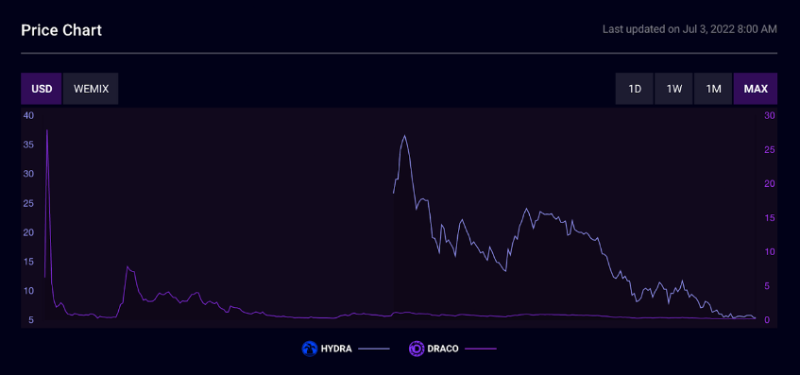
MIR4 DRACO / HYDRA price chart
Hence, launching a high-fidelity Web 2.0-style game directly into Web 3.0 risks alienating both audiences.
We believe that in this specific GameFi 2.0 phase, Web 3.0 users currently lack strong consumer value but offer excellent cold-start potential.
Teams should initially rally seed users via PFPs, land NFTs, conduct early testing, and reward early governance tokens.
However, the true target audience remains traditional gamers. The game should help them smoothly transition into Web 3.0. Thus, marketing should follow “gain consensus in Web3 first, break into mainstream Web2 later.” Traditional gaming communities—even professional player circles—often show higher engagement and strength than many Web 3.0 communities.
Second, how will you collaborate with gaming guilds?
Intuitively, cooperation with farming guilds seems unnecessary in Web 3.0 games.
In traditional games, distinctions matter: pro-player guilds receive support, while farming guilds face bans and restrictions.
Currently, nearly all GameFi guilds are farming-focused—an awkward situation. Their presence isn’t necessarily beneficial: they hoard production NFTs cheaply, rapidly farm utility tokens, avoid in-game spending, and solely increase sell-side pressure. Farming guilds aren’t positive actors in GameFi.
Moreover, anti-whale mechanisms are necessary to prevent excessive wealth concentration and preserve gameplay, stopping whales from accelerating utility token output via bulk resource ownership.
GameFi 2.0 games should continue restricting farming guilds while encouraging elite player guilds and professional merchants.
Single-purpose farming workshops have diminishing value and little partnership potential. Conversely, guilds capable of investing, participating in governance, assisting operations, educating users, expanding communities—or data analytics platforms leveraging in-game achievements—offer higher early-stage collaboration value and deserve official support.
For MMORPGs centered on trade and assets, guilds cultivating entrepreneurial, business-savvy players become invaluable partners. In the future, we envision guilds purchasing dedicated in-game land to build autonomous spaces—a direction worth pursuing.
Question Ten: Open Questions?
The greatest charm of Web 3.0 games lies in their indefinability and unimaginable future form. We still seek answers to many questions:
-
The gaming industry is highly complex, and developer skill sets differ vastly from blockchain entrepreneurs. Will traditional gaming giants need to lead self-transformation in Web 3.0?
-
Or will native Web 3.0 game studios emerge organically?
-
How should technical designs balance NFT interoperability across on-chain and off-chain environments?
-
In the next cycle, could game-native stablecoins enter the mainstream? Will NFTs, tokens, and incentive-driven communities spawn entirely new game genres?
We’ve also included an evaluation checklist for GameFi projects. If you’re building a GameFi 2.0 game, reach out—we’d love to explore breakthrough products together.
Join TechFlow official community to stay tuned
Telegram:https://t.me/TechFlowDaily
X (Twitter):https://x.com/TechFlowPost
X (Twitter) EN:https://x.com/BlockFlow_News






