Chainalysis: DAOs Aren't Actually That Decentralized
TechFlow Selected TechFlow Selected
Chainalysis: DAOs Aren't Actually That Decentralized
Superdao simplifies DAO creation; Snapshot simplifies governance; Coin Center advocates for DAO development in Congress.
 Navigating Web3 tides with focused insights
Original author: Chainalysis
Translated by: Aididiao
Decentralized Autonomous Organizations (DAOs) are the primary organizational model of the Web3 era. Built on internet and blockchain technology, DAOs offer a unique democratized governance structure for businesses, projects, and communities, where any member can participate in governance by purchasing governance tokens and voting on decisions.
The way DAOs work can be summarized as follows:
-
DAO founders create governance tokens;
-
Governance tokens are distributed to users, supporters, and other stakeholders;
-
Each governance token corresponds to a certain amount of voting power, and governance tokens can be bought and sold on secondary markets.
While this process is considered a form of decentralization, data shows that DAO ownership is highly centralized.
Concentration of Governance Tokens
By analyzing the distribution of governance tokens across ten DAOs, we found that in several major DAOs, less than 1% of holders own 90% of the voting power.
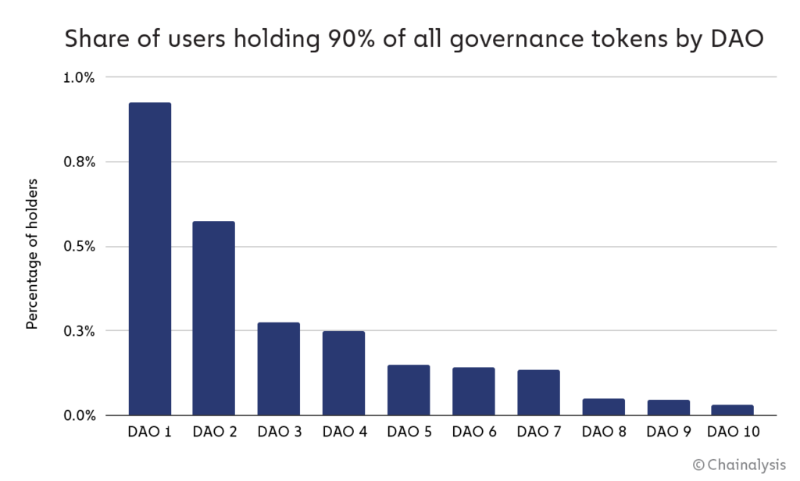
Percentage of users holding 90% of governance tokens in DAOs
Highly concentrated governance token distribution has significant implications for DAO governance. If only a small group of top 1% holders initiate a vote, their decision-making power theoretically exceeds that of the remaining 99%. Small investors may not be able to make meaningful contributions to the proposal process.
Impact of High Concentration on DAO Governance
For governance token holders, there are three key steps in governance. Voting is simple—any holder can do it—but creating proposals and getting them approved are not accessible to all holders.
Based on proposal requirements from these ten DAOs, we observe:
-
Users must hold between 0.1% and 1% of the token supply to create a proposal.
-
Users must hold between 1% and 4% of the token supply for a proposal to pass.
Using these thresholds, we find that among holders in these ten DAOs, only one in a thousand to one in ten thousand holds enough tokens to create a proposal.
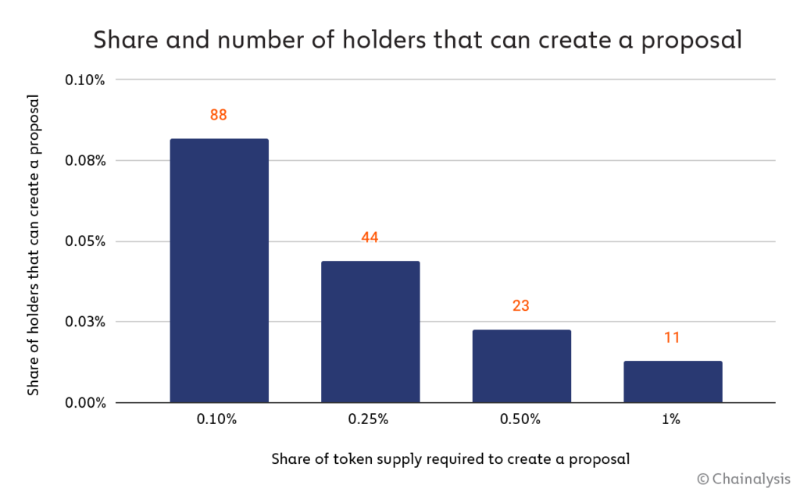
Number and percentage of holders capable of creating proposals in DAOs
If too many holders can create proposals, average proposal quality may decline, and the DAO could become flooded with governance spam. But if too few can create proposals, community members may question the authenticity of "decentralized governance."
When it comes to individuals creating proposals independently, having one in ten thousand to one in three thousand holders with sufficient tokens is reasonable.
Excessively concentrated voting power may contradict the decentralized principles underpinning Web3 development.
For example, in June this year, the DAO governing Solend—a lending protocol built on Solana—faced a critical issue: if SOL’s price dropped further, the protocol's largest whale user would face margin calls, potentially making Solend insolvent and triggering a fire sale of approximately $20 million worth of SOL tokens. This could cause asset prices to plummet and severely damage the entire Solana ecosystem. The DAO called for a vote to take control of the whale’s account, hoping to settle its position via an OTC deal rather than liquidating it on the open market.
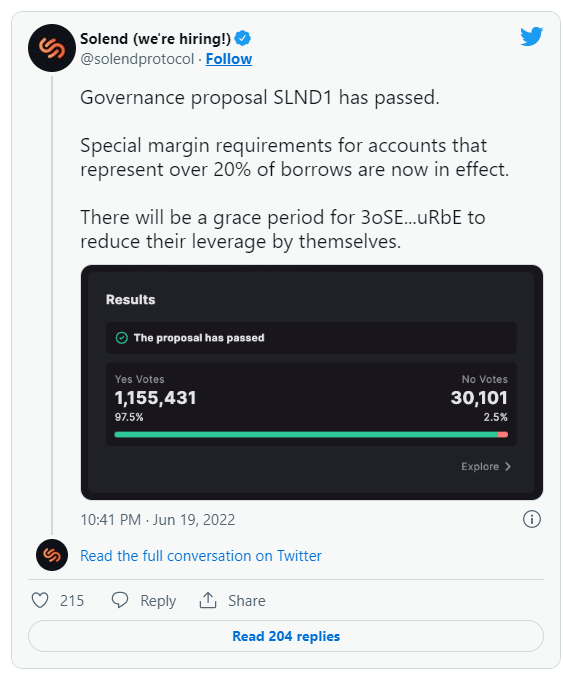
The proposal passed easily, with over 1.1 million "Yes" votes versus 30,000 "No" votes. However, more than 1 million of those votes came from a single user holding a massive amount of governance tokens. Without participation from ordinary users, the proposal would have failed due to a voter turnout below 1%.
This incident sparked strong backlash within the crypto community, with many questioning how a platform could claim to be decentralized while serving the interests of a few and overriding users’ will by seizing control of their funds. Although the Solend DAO later voted to reverse the proposal, when a small number of holders control such a large share of governance tokens, doubts arise about whether a DAO can truly act in the collective best interest of all participants.
How Are DAOs Actually Governed?
Different DAOs vary significantly in their actual governance processes. Let’s use real-world examples to illustrate, starting with Uniswap.
Example: Uniswap Governance
Anyone holding Uniswap’s governance token UNI is a member of the DAO. They can participate in governance by publicly sharing opinions or submitting proposals using their own address, or by delegating their voting rights to another address. Proposal topics vary widely—for example, recent proposals included whether to fund a donation program, integrate a new blockchain, or lower the threshold for submitting governance proposals.
Before a formal proposal can be submitted, two preliminary stages must be passed: a temperature check and a consensus check.
-
A temperature check determines whether there is sufficient community interest in changing the status quo. It lasts two days and requires 25,000 UNI votes in favor.
-
A consensus check facilitates formal discussion around a potential proposal. It lasts five days and requires 50,000 UNI votes in favor.
If both checks pass, a formal governance proposal proceeds to a vote. Then, there is a seven-day review period during which community members can discuss the proposal’s merits on the governance forum. After the review, if at least 40 million votes are in favor and opposition remains in the minority, the proposal passes and will be enacted within two days.
Example: Dream DAO Governance
Not all DAOs follow the same governance model as Uniswap, though most operate on similar foundations such as Snapshot voting systems and Discord chat servers. Dream DAO is no exception, although its vision and governance process are unique.
Dream DAO was created by Civics Unplugged, a 501(c)(3) nonprofit organization, aiming to train, fund, and build community for Gen Z youth worldwide, helping them use Web3 to transform outdated habits and mindsets to better adapt to the future.
SkywalkerZ NFT holders operate the DAO community. SkywalkerZ NFTs serve as both governance tokens and fundraising incentives for donors. When donors purchase a SkywalkerZ NFT, they can transfer its voting rights to future Gen Z youth, allowing young people to gain voting rights in the DAO without purchasing an NFT themselves. NFT buyers can either apply to join the DAO as voting members or reserve membership for sponsored Gen Z students. In either case, the NFT remains owned by the original purchaser.
By gifting NFT voting rights, financial barriers to Gen Z participation in DAO governance are removed, enabling them to immerse themselves in Web3 and actively engage with blockchain technology.
Where Are DAOs Most Common and Well-Funded?
DAOs are becoming a crucial organizational model in Web3, managing:
-
DeFi protocols: Uniswap ($UNI) and Sushi ($SUSHI), etc.
-
Social clubs: Friends With Benefits ($FWB) and Bored Ape Yacht Club ($APE), etc.
-
Grant-giving organizations: Gitcoin ($GTC) and Seed Club ($CLUB), etc.
-
Gaming guilds: Good Games Guild ($GGG) and Yield Guild Games ($YGG), etc.
-
NFT mints: Nouns (1 NFT = 1 vote).
-
Venture capital funds: MetaCartel and Orange DAO, etc.
-
Charities: Big Green DAO and DreamDAO, etc. (1 SkywalkerZ = 1 vote).
-
Blockchain games: Decentraland ($MANA) and Sandbox ($SAND), etc.
-
And more.
However, in terms of user count and funding scale, DeFi-type DAOs dominate, accounting for 83% of total treasury value across all DAOs and 33% of all DAOs by number, showing a significant lead.
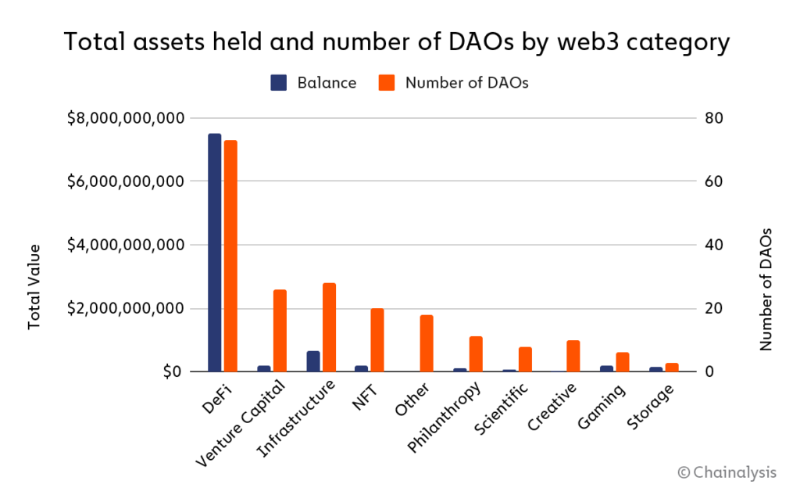
Distribution of assets and quantity across various DAO types
DAOs focused on venture capital, infrastructure, and NFTs also represent substantial shares, indicating their appeal to investors, developers, and artists. However, their on-chain asset values are relatively smaller.
Boundaries between different types of DAOs are blurred. Gaming DAOs often relate to NFTs, VC DAOs frequently fund DeFi projects, and infrastructure DAOs support all the above categories.
Treasury Management: What Assets Do DAOs Hold?
Despite varying in type and size, most on-chain treasuries hold similar cryptocurrencies. The most commonly held cryptocurrency is the stablecoin USDC—over half of the 197 DAOs analyzed hold USDC.
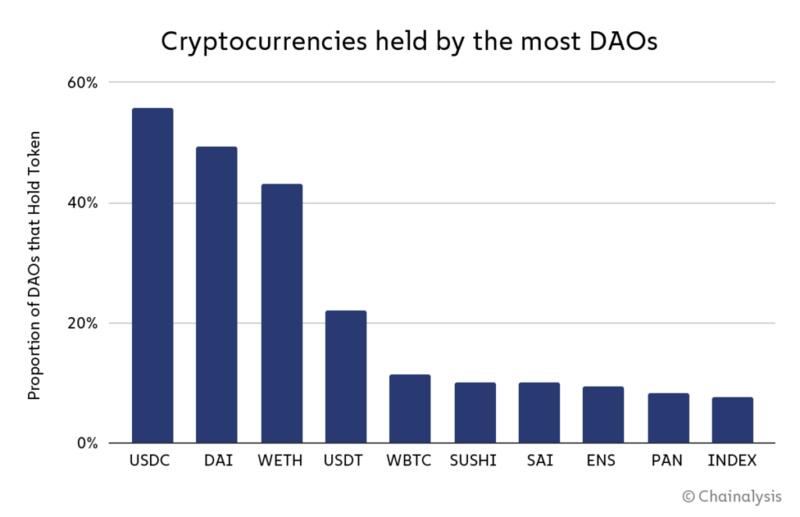
Most commonly held cryptocurrencies by DAOs
Stablecoins held by DAO treasuries rarely constitute the majority of treasury value, averaging only 23% of assets. Among the DAOs studied, 85% have treasuries composed of a single asset.
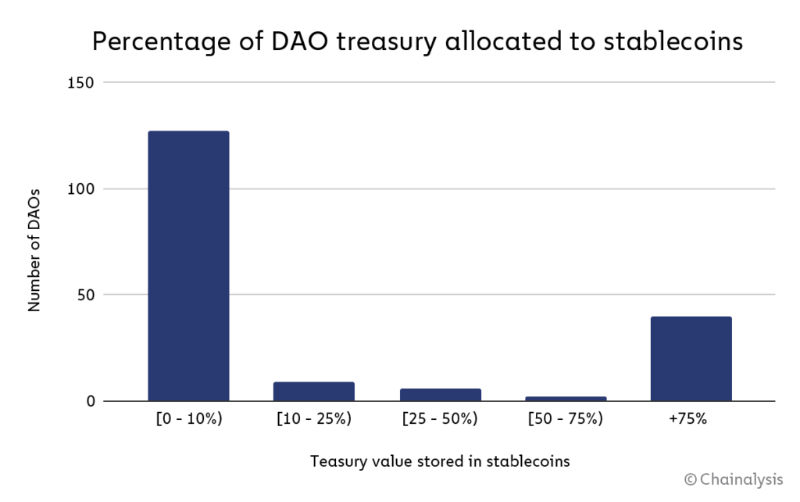
Distribution of DAOs by percentage of stablecoins in treasury
The volatility of on-chain treasury values is roughly comparable to that of Bitcoin. Assuming the assets currently held by DAOs represent their historical investment portfolios over the past year, we find:
-
DAOs with assets exceeding $1 million have an average annualized volatility of 82%, compared to 69% for Bitcoin.
-
Such DAOs experienced an average maximum drawdown of 51% over the past year, compared to 72% for Bitcoin.
DAO treasury values are also closely correlated with Bitcoin’s price movements. 38% of on-chain DAO treasuries show a correlation with Bitcoin between 0.5 and 1.0.
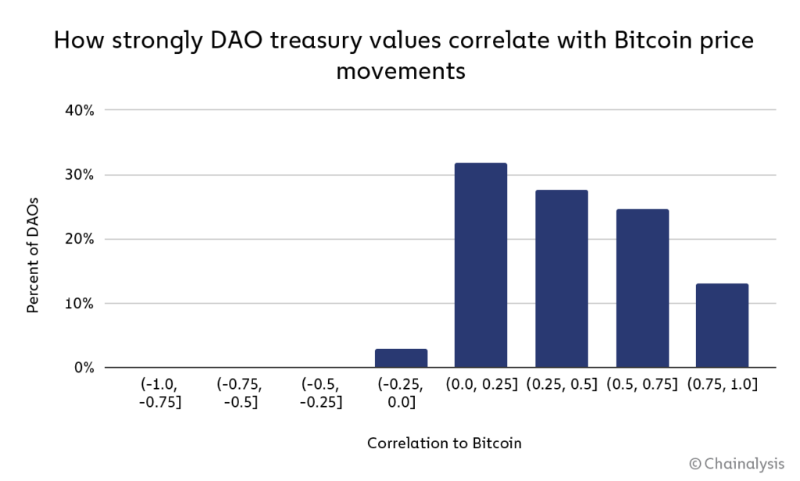
Correlation distribution between DAO treasuries and BTC price
One of the most interesting areas in treasury management for smaller DAOs is mergers and acquisitions (M&A). M&A allows DAOs to enter related fields without developing internal tools from scratch. As the DAO model matures, DAO mergers and acquisitions are expected to become more common.
To date, the financial tools and legal frameworks available to DAOs remain quite limited. For instance, due to uncertain legal status, very few DAOs use loans or credit. As the DAO model evolves, we may see more standardized regulations, management strategies, and best practices emerge.
Who Contributes to DAOs?
Although we lack statistical data on DAO participants, we can learn something about contributors through on-chain data.
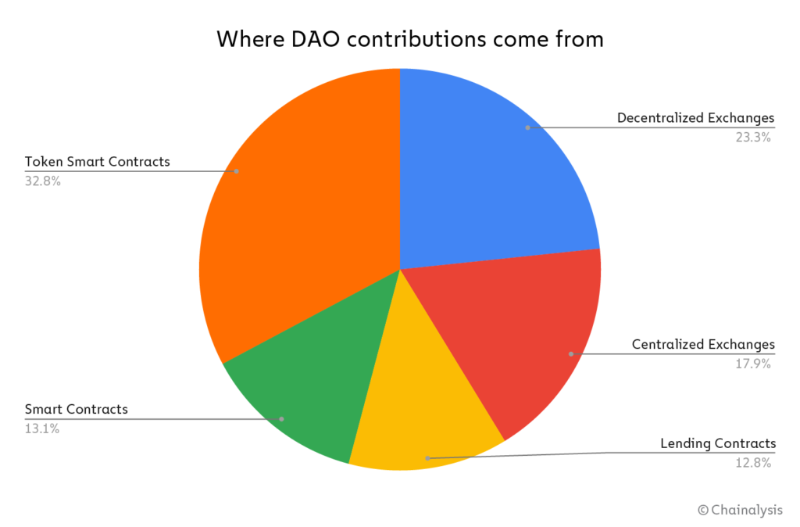
Token smart contract = project-specific ERC-20 or Layer 1 token contracts
As expected, DAO participants are advanced users of cryptocurrency services. Only 17.9% of DAO treasury funds originate from centralized services, while the remaining 82.1% come from decentralized services. This suggests that most DAO contributors also use DeFi platforms to manage their crypto holdings.
The Future of DAOs
As DAOs continue to evolve, specialized tools and teams supporting DAO growth and governance have emerged. Superdao simplifies DAO creation; Snapshot streamlines governance; Coin Center advocates for DAO development in Congress. We look forward to seeing what DAOs will achieve in the future, what they will become, and how far they will go in realizing true decentralization.
Join TechFlow official community to stay tuned
Telegram:https://t.me/TechFlowDaily
X (Twitter):https://x.com/TechFlowPost
X (Twitter) EN:https://x.com/BlockFlow_News
 Chainalysis