








Hashed Research: We need to think about ways to increase product visibility beyond airdrops
TechFlow Selected TechFlow Selected
Hashed Research: We need to think about ways to increase product visibility beyond airdrops
If you are a developer or project founder, you should consider distributing tokens or increasing product visibility in ways different from airdrops.
 Navigating Web3 tides with focused insights
Author: cpt n3mo, Hashed Research
Translation: Binggan, Chain捕手
Airdrops help projects distribute tokens to community users and can be part of a marketing strategy to raise awareness about their core or new products.
Users typically receive airdrops either just before a protocol launches or retroactively after using it, receiving them for free but only if they meet certain eligibility criteria.
But how do these airdrops impact the project's native token?
This study examines the price performance of 31 different token airdrops over a one-and-a-half-year period, from Uniswap ($UNI) in September 2020 to Evmos ($EVMOS) in April 2022.
This is not an exhaustive list of all airdrop events during that timeframe, but rather an attempt to cover as many qualifying airdrops as possible based on these parameters:
-
The native token launched simultaneously with the genesis airdrop (e.g., no airdrop after TGE)
-
The project has a roadmap documented via Gitbook or public documentation
-
The project publicly announced its intention to reward existing users, further promote its product, or decentralize token ownership through airdrops
-
The airdropped token has existed long enough to provide meaningful data points
First, let’s look at the distribution of the percentage of token supply allocated to airdrops across each project:
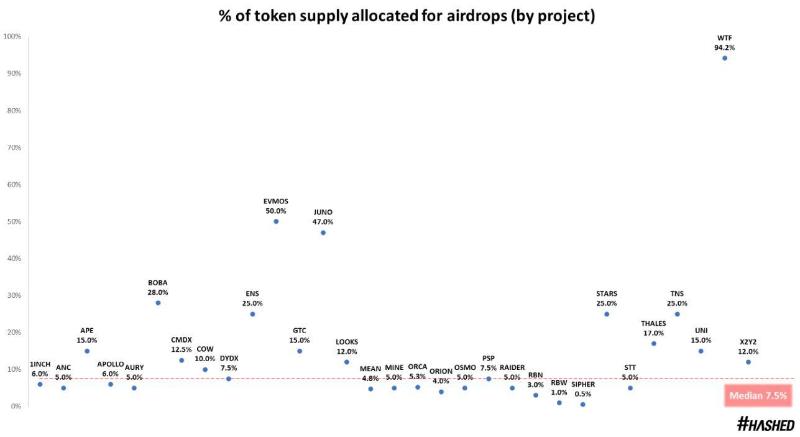
On average, projects allocated 7.5% of token supply to airdrops—calculated using the median to avoid distortion by outliers.
Most projects allocated less than 10% to airdrops, followed by 26% allocating between 10–20%, and 23% allocating more than 20%.
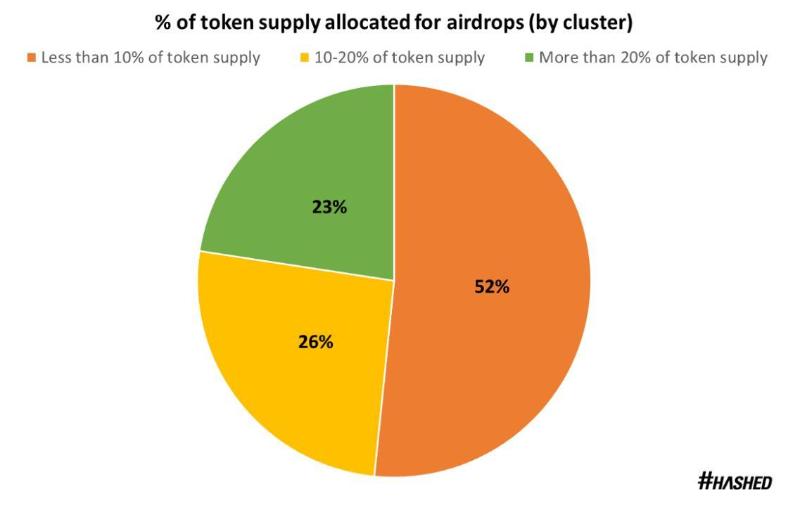
In comparison, projects tend to allocate about 10% of total token supply to investors and around 15% to team members, meaning that allocating 7.5% to airdrops represents a significant portion for projects choosing this distribution method.
Why Allocate Such a Large Percentage to Airdrops?
Token airdrops offer multiple benefits to projects:
-
If a project is launching soon, founders may use airdrops as a marketing tool to boost visibility. A successful airdrop can effectively attract user attention quickly, giving users time to evaluate the project’s fundamentals. (e.g., APE, EVMOS, LOOKS)
-
For established projects, airdrops are a great way to reward early adopters and community members while integrating tokens into daily governance processes. (e.g., COW, DYDX, ORCA)
Price Performance After Token Airdrop (100 Days)
While airdrop strategies may achieve short-term goals such as increasing DAU, TVL, or wallet interactions, their long-term incentive effects on the native token are inconsistent.
Let’s examine the price performance of each token following its genesis airdrop:
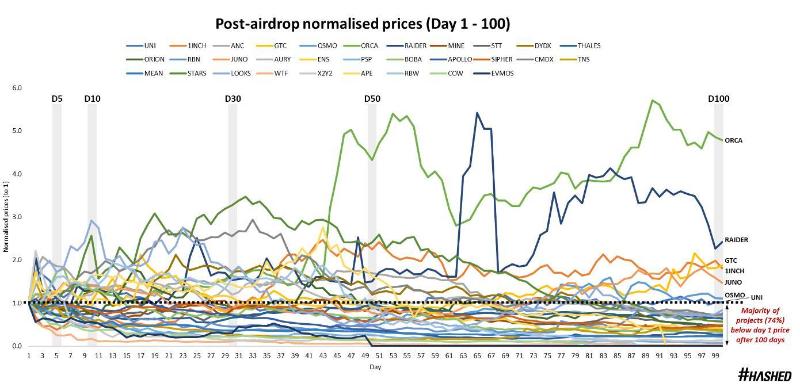
This chart appears crowded because token prices have been normalized to 1.0 (y-axis), and days since the genesis airdrop are scaled along the x-axis.
If the airdropped token price was 1.0 on Day 1, the chart shows that 100 days later, up to 74% of projects traded below their Day 1 price.
Only seven projects traded above their initial price, with $ORCA (a DEX on Solana) performing strongly at 4.8x and $RAIDER (a utility-based NFT RPG game) at 2.4x.
Other projects—$GTC, $1INCH, $JUNO, $OSMO, and $UNI—traded under 2x their launch price.
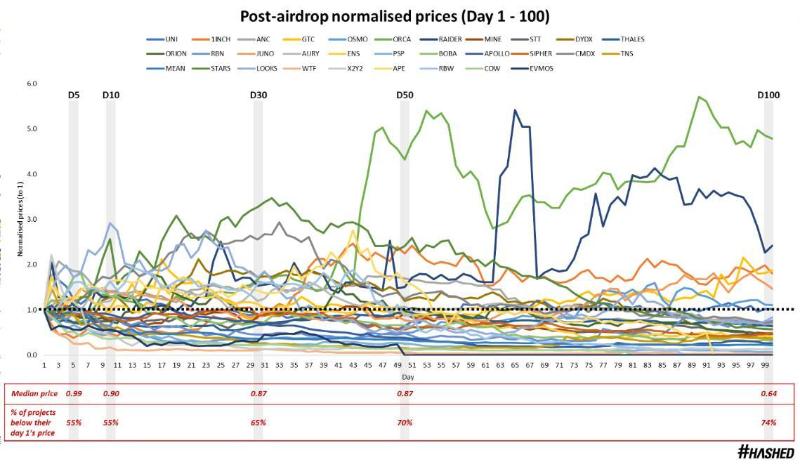
The next chart further details how over time: (i) the average price performance of airdropped tokens deteriorated, and (ii) an increasing proportion of sample tokens traded below their Day 1 price.
-
On Day 5, the average airdropped token price was 0.99 (−1% deviation from Day 1), with 55% trading below launch price.
-
On Day 50, the average price dropped to 0.87 (−13%), with 70% below launch price.
-
On Day 100, the average price fell to 0.64 (−36%), with 74% below launch price.
Price Performance After Token Airdrop (200 Days)
Over a longer horizon (200 days post-airdrop), the results remain largely unchanged.
The chart below illustrates the continued downward trend in airdropped token prices, with average prices declining from 0.99 on Day 5 to 0.44.
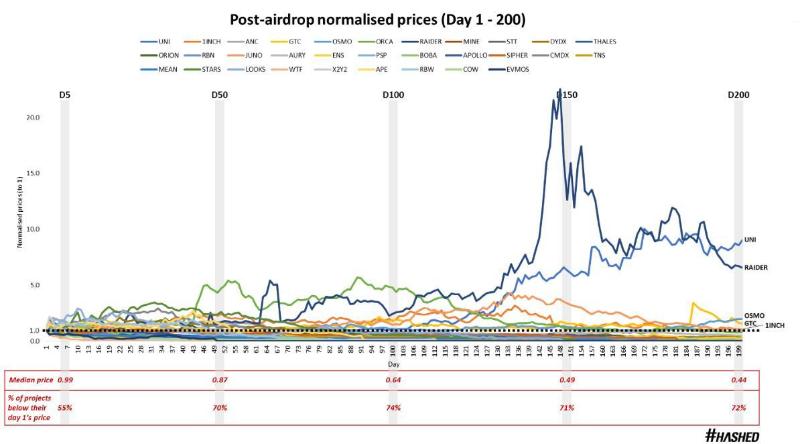
The majority of projects (72%) continued to trade below their launch price, although some notable exceptions performed well.
$UNI, launched in September 2020, became the most dominant DEX across all public chains by Q2 2021 (Day 200), measured by daily trading volume.
-
Token holders could participate in governance proposals, which served as a positive factor for post-airdrop price performance
-
Although not shown on the chart, $UNI currently trades at over 1.5x its original airdrop price
$RAIDER took an unconventional approach in August 2021, launching initially through a successful NFT sale and releasing the first version of its P2E RPG game on Polygon weeks later.
-
By Q1 2022 (Day 200), the project had built a strong community and active player base, securing a $6 million funding round co-led by Delphi, DeFiance, 3AC, and Polygon
-
This contributed to a 6.5x increase in token price post-airdrop
-
However, adverse macro conditions hit the crypto gaming sector hardest, leading to declining user metrics and a current token price of only 0.44x its original airdrop price
While $UNI and $RAIDER demonstrate that airdropped tokens can perform well over extended periods, the overall sample suggests that airdrops generally do not positively impact long-term token price.
Founders aim to distribute project tokens to community members who participate in governance, staking, or actively use the protocol.
Airdropping based on initial on-chain data or user metrics can be effective, but rumors of upcoming airdrops often attract speculative "airdrop farmers" (e.g., Paraswap, Hop Protocol, Optimism).
The chart below shows the composite average price of each airdropped token over 200 days.
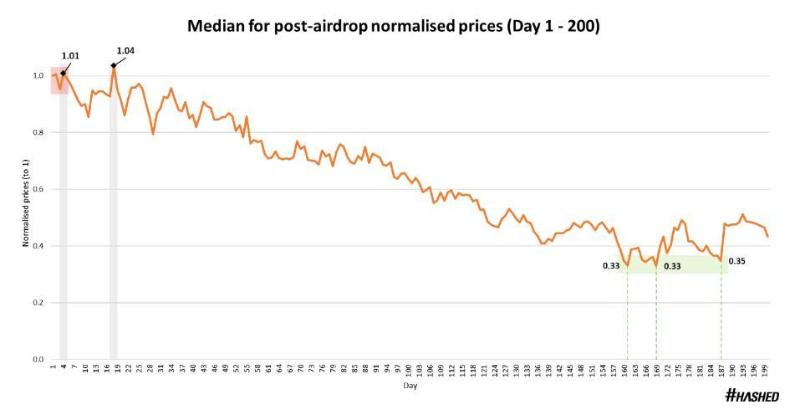
Based on historical averages, only two days within the 200-day window saw average prices outperform the launch price—Day 4 (+1%) and Day 18 (+4%).
This suggests that the optimal time for users to sell their airdropped tokens is as early as possible—ideally between Day 1 and Day 5 (shaded red area)—when price volatility is minimal.
If users are not committed to the project or unimpressed by its tokenomics, selling the airdropped tokens immediately appears to be the optimal strategy.
However, in some cases, teams airdrop tokens before gaining sufficient traction, leading users to lose confidence and sell immediately. Later, when the project gains momentum, these users realize they once participated and held equity.
The best time to re-enter is 5 to 6 months post-airdrop (shaded green area), when the average price bottoms out at 0.33x (−67% from launch day).
For example, buying $UNI and $OSMO on Day 150 and selling on Day 200 would have yielded net returns of +42% and +59%, respectively. This strategy may work for projects whose intrinsic value emerges months after the airdrop, assessed by community engagement, relationships with ecosystem foundations (e.g., Ethereum, Cosmos), and execution speed on roadmap delivery.
Conclusion
If you're a developer or project founder, consider alternative methods beyond airdrops to distribute tokens or increase product awareness.
Historically, airdrops have been detrimental to the long-term price trajectory of project tokens. This article does not assess airdrop effectiveness on other metrics like user growth, new wallet interactions, or TVL increases. But even if airdrops succeed in those areas, are you willing to bear the selling pressure from early recipients at the cost of your token’s price?
Alternative airdrop designs:
-
Time-based airdrops (linear vesting over 3 months with weekly claims)
-
Task-based airdrops (tokens released upon completion of milestone tasks)
-
Hybrid time and milestone airdrops (distribution over a specific period based on user engagement with the protocol)
If you're a retail holder receiving an airdrop, consider the following:
-
Is the token required to interact with the protocol? If yes, HODL.
-
Will selling it now significantly impact you? If not, HODL.
If you can continue using the protocol without holding the token (e.g., Paraswap DEX aggregator) and stand to gain substantial value from selling (e.g., dYdX airdrop), you might consider selling your airdrop immediately after the project adds liquidity!
Join TechFlow official community to stay tuned
Telegram:https://t.me/TechFlowDaily
X (Twitter):https://x.com/TechFlowPost
X (Twitter) EN:https://x.com/BlockFlow_News






