








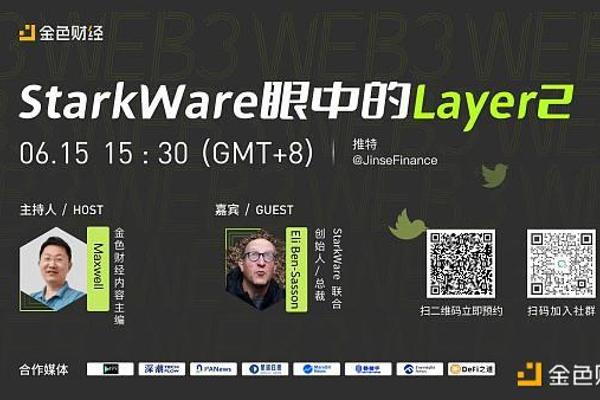
Layer2 According to StarkWare
TechFlow Selected TechFlow Selected
Layer2 According to StarkWare
Calling Web3 from the Center of the World: StarkWare's Perspective on Layer2
 Navigating Web3 tides with focused insights
The event "Calling Web3 from the Center of the World," hosted by Golden Finance, held an AMA on the topic "Layer2 Through StarkWare's Eyes," with guest Eli Ben-Sasson.
Host: Professor Eli, hello. We know you were previously a professor at the Technion – Israel Institute of Technology and conducted scientific research at renowned academic institutions such as the Institute for Advanced Study at Princeton, Harvard, and MIT. What drove you to leave academia and start a venture in the crypto industry?
Eli: In short, through my research, I discovered a set of tools that I realized could have significant impact and genuinely help humanity. I found that no one was truly pushing this technology forward, let alone applying it in the real world, so I wanted to give it a try. Another reason is that I firmly believed these tools were practical—and now I see them being used in practice. So if you have an invention you believe in, you really want it to be applied and used to do something beneficial for the world. While we can advance such inventions within academic research, sometimes you need to work harder—build a larger team and secure more funding—things that are difficult to achieve in academia.
By 2018, the technology had matured considerably. Thanks to my prior involvement with zCash—not just me, but also my co-founder, Professor Alessandro Chiesa—when we connected with key players in the blockchain world, they showed great enthusiasm. Our seed round progressed very quickly. Vitalik Buterin was one of our most important early investors, and many others strongly supported our project. We saw that we could raise funds and build a team. Many early hires at Starkware were passionate about blockchain and zero-knowledge research. We saw an opportunity to secure funding and assemble a strong, motivated team dedicated to making Starkware a reality and best supporting blockchain scalability and privacy. That’s why we built it.
Host: Could you briefly introduce StarkWare and its products such as StarkEx, StarkNet, and Cairo?
Eli: Let me explain StarkEx, StarkNet, and Cairo. First, let me step back and clarify what our core technology is. The projects you mentioned—StarkEx, StarkNet, and Cairo—are all built around a foundational technology called STARK. So what are STARKs? They are cryptographic proofs that provide integrity through mathematics. This means doing the right thing even when no one is watching. We deeply care about ensuring the integrity of computations involving our money or sensitive personal data like medical records.
We want our data to be processed correctly—even if we're not observing it directly, and even if others might want to steal our money or misuse it. We demand honesty. In the traditional world of banks and governments we’re all familiar with, we must trust centralized entities to act honestly. I must trust my government to handle my medical data properly. I must trust my bank to manage my financial data truthfully—with no alternative. Blockchain works very differently. It provides integrity through transparency, inclusivity, and cryptography. Blockchain says: “Hey, invite everyone and connect their laptops to the internet,” then record every system change and verify all transactions.
Thus, blockchains provide integrity via digital verification, inclusiveness, and transparency. However, this approach severely limits scalability because my relatively weak laptop must now validate every transaction globally. Consider systems like Alipay or WeChat Pay—it’s inconceivable that my laptop could verify all those transactions. Blockchains face real scalability issues. So where do we begin? We invented a set of mathematical tools that provide integrity through math: instead of trusting others, we verify a succinct proof confirming that a massive computation was done correctly. We know it's correct because the math proves it.
With this technology, blockchains no longer need to run all computations themselves. Instead, they act as verifiers—strict auditors checking proofs. If the proof passes, the blockchain knows all transactions were processed correctly and completely. This core technology is called STARK. It delivers exponential integrity—not by trusting another party, but by trusting mathematical proof.
Now, let me explain StarkEx, StarkNet, and Cairo.
● StarkEx: StarkEx is a system whose code is written and operated by StarkWare for individual clients. For example, dYdX has a StarkEx system, Immutable X handles NFTs, and there’s another StarkEx system built for dYdX to trade perpetuals. Each is a distinct system. They support rare features like fully non-custodial asset transfers and other functionalities launching soon. When using this tech, we process large volumes of transactions (like payments) off-chain and submit a very short STARK proof to the blockchain to verify their validity. You then inherit all the integrity and security of the blockchain without any additional trust assumptions. That’s StarkEx.
● StarkNet is like Ethereum. It’s an open platform where anyone can write and deploy smart contracts. Built for developers, they can deploy contracts, send ETH, and start building applications. Over time, we’ve provided more tools to make development and deployment easier on StarkNet, improving performance and throughput. Our goal is to deliver the best developer experience. Now, we’re preparing for production readiness—increasing speed and output. We aim for eTPS—throughput at least ten times Ethereum’s and costs at least ten times lower. This is our next milestone. Additionally, we’re beginning decentralization efforts.
Finally, what is Cairo? It’s the programming language used to write smart contracts on StarkNet—the most reliable language for this purpose.
Host: Current L2 scaling technologies include Optimistic Rollup, ZK Rollup, Plasma, and Sidechain, yet the industry generally favors ZK Rollup. What’s your view on this? What distinguishes StarkWare’s ZK Rollup from others?
Eli: People often refer to Optimistic and Arbitrum. Within validity rollups—sometimes called ZK Rollups—we have StarkNet and Cairo. Regarding our rollup, it’s actually the only one currently live that uses the security technology it promised. Let me explain: Optimistic chains lack fraud proofs. Fraud proofs are the core security mechanism meant to guarantee safety, yet they’re not enabled on Arbitrum. None of us can invoke fraud proofs—only a small group can access them. They’ve launched a testnet. It lacks ZK proofs. Currently, the only L2 secured by the technology it claims to rely on is ours. This is something we’re truly proud of and what sets us apart competitively. Incidentally, we’re now experiencing major market turbulence, highlighting the importance of having all security mechanisms and technologies fully operational. We’ve not only activated our core technology—we also possess the strongest proof-of-future technology.
Host: Among the many L2 solutions today, several projects—including dYdX, Immutable X, DeversiFi, and Sorare—are built on StarkEx. Why did they choose StarkEx?
Eli: The answer is actually simple and tied to my earlier point. When serious, successful teams seek solid technological foundations—platforms robust enough to withstand market volatility and deliver the security users demand—only one technology achieves this: ours.
Host: With so many L2-related technologies and products, composability advantages are hard to realize. What do you see as the biggest challenge for composability on L2 today, and what are potential solutions?
Eli: Our biggest challenge is reaching the level of developer tooling that developers expect. Developers are accustomed to building on Ethereum, but we’re advancing rapidly here. There’s an amazing developer ecosystem with dozens of teams building these tools. If you’re a developer looking for a fast-growing ecosystem, check out StarkNet.
On Ethereum, you get composability for free. As long as you have composability on Layer 2, you retain it. Another solution is using Layer 1 to interconnect different Layer 2s. A third solution: in validity rollups, you can achieve very fast composability because you can prove on one system that computations on another were complete. Others later use these proofs. Certain things only work on validity rollups—such as the concept of Volition layers, which we invented. This allows a third layer to function beneath. When different layers need to communicate, you can use this underlying layer to compose them—just as two people on separate floors can talk through someone behind them. This is another novel innovation by StarkWare, and we hope and believe it will become standard on StarkNet.
Host: Thank you, Professor Eli, for your excellent insights. Special thanks to our media partners for this AMA: DeFi Planet, Foresight News, Lianbushou, MarsBit News, ODAILY, Panews, TechFlow, and the 0x499 community.
This article has been edited. For the full content, please visit the Twitter Space livestream replay.
Join TechFlow official community to stay tuned
Telegram:https://t.me/TechFlowDaily
X (Twitter):https://x.com/TechFlowPost
X (Twitter) EN:https://x.com/BlockFlow_News






