Ethereum PoS Merge Eve Discussion: Opportunities and Risks
TechFlow Selected TechFlow Selected
Ethereum PoS Merge Eve Discussion: Opportunities and Risks
What opportunities and risks might the Ethereum merge bring?
 Navigating Web3 tides with focused insights
Editor: Diane Hoo
Proofreader: Arain
Produced by CIG Labs
It is widely known that the Ethereum Merge may become the biggest event in the crypto space this year or at least in the second half of the year. So what opportunities and risks could the Ethereum Merge bring? In this episode, we invited Jason Wan, Arbitrum's APAC Engineer; KS from Hashquark; and special guest Huang Zheng, a 12-year-old Ethereum developer, to discuss the landscape ahead of the Ethereum Merge!
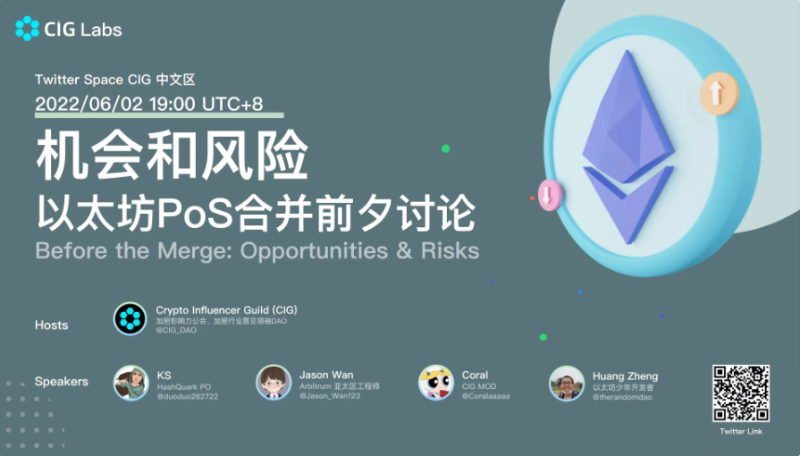
Topics discussed include:
1. What is the Ethereum Merge?
2. What are the highlights and noteworthy details in the Ethereum Merge plan?
3. How will the Ethereum Merge affect other public chains?
4. Are there any risky operations to watch out for before and after the merge? What impact does it have on retail users?
5. How will Ethereum’s ecosystem evolve in the future?
Excerpts from Space Guests Below:
Host Coral: What is the Ethereum Merge?
Jason Wan:
The Ethereum Merge refers to a change in consensus mechanism. Currently, Ethereum operates two chains: one is the PoW chain we've been using, and the other is the Beacon Chain launched on December 1, 2020, which runs under the PoS consensus mechanism. The transition from PoW to PoS involves merging these two chains—retaining the execution layer and user state of the PoW chain while adopting the PoS consensus mechanism from the Beacon Chain.
Host Coral: What are the highlights and noteworthy details in the Ethereum Merge plan?
KS:
From a product perspective, if we view this merge as a product upgrade, the biggest highlight is its smoothness—most ordinary users won't even notice the change. As a node operator, Quark sees that Ethereum has maintained or even enhanced its security while reducing costs, including our operational expenses and users' on-chain interaction fees. These are the key benefits I’ve observed from a non-technical standpoint.
Huang Zheng: I want to create an elegant background image for my dynamically generated NFT on-chain, but storing images directly on-chain takes too much space. After Ethereum transitions from PoW to PoS, will storage capacity increase?
JasonWan:
Blockchain capacity will not change during the merge—the gas limit per block remains at 30 million. The only potential improvement in TPS (transactions per second = number of transactions processed over time / duration) comes from stabilizing block times, which will shift from the current fluctuating average of around 14 seconds to a strict 12-second interval.
When we talk about Ethereum's scalability post-merge, we refer to a hard fork after the merge that will expand Ethereum 2.0, particularly increasing calldata capacity. If you wish to store image data on-chain, Huang, consider encoding your SVG and storing it in calldata rather than in state. Around年底, with the Shanghai fork and activation of EIP-4488, calldata fees will be reduced. Calldata is typically used for L2 scaling, so this could be an excellent experiment for you. We look forward to seeing what you build after EIP-4488 goes live.
Huang Zheng: Thank you, Teacher Wan. Could you explain the benefits of having a fixed 12-second block time after the merge?
Jason Wan:
Currently, block times aren't strictly controlled because mining relies on miners computing hash values, and whoever finds the correct result first gets to produce the next block. Since hash computations are probabilistic, block times vary, so difficulty adjustments keep them roughly around 14 seconds.
In ETH2.0, instead of competitive mining, validators are randomly selected via algorithm to propose blocks. The order of proposers is predetermined, enabling predictable block intervals. Fixed block times improve user experience through better predictability.
There are also advantages for developers.
For example, many DeFi applications release tokens based on the number of blocks mined. Suppose tokens are released every 1,000 blocks. Under the old model, although average block time was ~14 seconds, if actual block time rose to 20 seconds, releasing tokens would take 20,000 seconds instead of the expected 14,000—leading to instability in token emissions. Thus, fixed block times make DeFi applications more reliable.
Beyond DeFi, predictable block times also benefit Ethereum upgrades.
Currently, upgrades occur at specific block heights. For instance, London Fork was initially scheduled for July last year but didn’t activate until August due to variable block times delaying the target height.
Host Coral: The Luna incident caused widespread skepticism toward the PoS consensus mechanism. Why does Ethereum still proceed with this transition?
Jason Wan:
I believe the Luna incident was primarily an economic model failure. Consensus algorithms secure the chain; economic models secure the token. Luna collapsed not because the network was attacked, but because its token model failed. Therefore, blaming the PoS consensus is misplaced, though such concerns are understandable.
KS:
I agree with Teacher Wan. I also think the Luna collapse isn't closely related to PoS. The design flaw allowed UST to depeg, triggering endless LUNA minting, eroding confidence in both assets. This issue stems from the economic mechanism, not PoS itself, so I don't see a major connection.
Huang Zheng: Will the Ethereum Merge lead to greater node centralization?
Huang Zheng:
Will the Ethereum Merge cause increased node centralization? First, staking requires 32 ETH. Large holders have more ETH, earn higher rewards, then reinvest those earnings into more staking, compounding their gains annually. This could concentrate nodes among whales, leaving small stakers with minimal returns.
Jason Wan:
This concern is valid. The Ethereum community recognized this early—which is why PoW was chosen initially—to allow broad participation and wider token distribution before transitioning to PoS, thereby mitigating concentration risks.
Post-merge, this issue persists, but we now see decentralized staking solutions like Rocket Pool helping maintain decentralization.
However, similar centralization exists in PoW: miners use profits to buy more hardware, concentrating hash power. Average users can't afford high electricity costs. With PoS—or platforms like Rocket Pool—anyone can run a node at home, which actually supports greater decentralization.
KS:
I share Wan’s view. PoW never fully solved centralization either. Expecting PoS to completely eliminate it isn't realistic. Previously, participation required significant hardware investment, creating barriers. PoS lowers entry costs, enabling broader public participation—overall a positive shift.
Host Coral: How will the Ethereum Merge impact other public chains?
KS:
We should differentiate between PoW and PoS chains. After Ethereum shifts to PoS, miners displaced from Ethereum may migrate to other PoW chains—we’ll see whether this boosts their token prices. For other PoS chains, the pressure increases. Ethereum already leads in credibility and security. With PoS, combined with thriving Layer 2s, lower fees, and higher efficiency, user and developer preference for Ethereum will grow. A stronger ecosystem attracts more users, inevitably squeezing some competing PoS chains.
0xCryptolee:
Other chains grew popular due to Ethereum’s performance limitations. Initially after the merge, Ethereum won’t see immediate performance gains. But once its weaknesses are gradually addressed, alternative chains must prepare for real competition. Personally, I’m skeptical about their long-term prospects. I believe blockchain’s future centers on Ethereum, evolving into modular architectures—using Layer 2 and sharding for scalability, with Layer 1 providing ultimate security. The consensus shift also resolves energy consumption. Combined with Ethereum’s existing developer base and user accumulation, it’s hard for others to break through. Future innovation will likely involve Layer 2 and Layer 3 combinations—scaling on L2, building apps on L3.
Jason Wan:
In blockchain, regardless of application layers, the foundational logic of base chains must prioritize decentralization and high security. That’s why Arbitrum chose Ethereum as our Layer 1. Still, we hope other public chains continue innovating to foster healthy competition and collectively build Web3.
Coral:
In equity investing there’s the impossible trinity; similarly, in public blockchains, there’s a trilemma—security, scalability, and usability—where perfect alignment is unattainable. No chain achieves all three perfectly. Developers choose chains based on which feature they value most, then build ecosystems accordingly.
Host Coral: Are there any risky operations to watch out for before and after the Ethereum Merge?
KS:
For regular users, it's advisable to temporarily pause deposits, withdrawals, lending, or similar activities. In principle, risks are low—but if a rare rollback becomes necessary, transactions during that period might face asset loss risks.
For node operators like us, risks are minimal. We’ll follow official procedures, ensure large asset safety, and strengthen monitoring of node status.
Host Coral: How will Ethereum’s ecosystem evolve in the future?
0xCryptolee:
DeFi applications fueled the previous bull market. Axie and Stepn showed Ethereum the potential of GameFi.
Currently, some apps store data off-chain as a workaround to support high-TPS operations. I believe social and gaming apps—or even traditional Web2 apps migrating on-chain—will emerge on Layer 2 or Layer 3. These customized applications will greatly enhance user experience and potentially ignite the next bull cycle.
Jason Wan:
Keep an eye on L2 and L3 developments. We’re exploring Layer 3 ourselves—specific designs are still under research. I think specialized applications are likely to appear on L3. Stay tuned.
Host Coral: When exactly will the Ethereum Merge happen?
Jason Wan:
The exact timing depends on how soon upcoming public testnet merges complete successfully. Once stable for 2–3 months, mainnet merge can proceed. For example, Ethereum 2.0 in December 2020 also went live only after sustained stability on testnets. If everything goes smoothly, the merge will happen; otherwise, delays may push it to late this year or even next year, depending on severity of issues.
Host Coral: What impact will the Ethereum Merge have on ordinary ETH holders or ecosystem participants?
JasonWan:
Impact on regular users is minimal—mainly better UX due to lower gas fees after future upgrades.
0xCryptolee:
For retail investors, ETH becomes more valuable. Post-merge, Ethereum breaks through performance bottlenecks, supporting larger-scale applications. Even though gas fees drop, rising transaction volume increases ETH burn, while block rewards decrease—making ETH inherently more valuable.
Anonymous Doctor:
From a financial perspective, I see the Ethereum Merge as a major bullish catalyst for ETH. Typically, such利好 events peak in price before full realization. The mainnet merge won’t happen instantly—it rolls out gradually—so there may be an extended price adjustment period. Considering the macro backdrop of interest rate hikes, I expect Ethereum to enter an independent bullish phase after September this year, though further observation is needed.
Join TechFlow official community to stay tuned
Telegram:https://t.me/TechFlowDaily
X (Twitter):https://x.com/TechFlowPost
X (Twitter) EN:https://x.com/BlockFlow_News