Crema: A concentrated liquidity DeFi protocol, the "cowboy of the West" on non-EVM land
TechFlow Selected TechFlow Selected
Crema: A concentrated liquidity DeFi protocol, the "cowboy of the West" on non-EVM land
"Crema is taking over Solana's liquidity space."
 Navigating Web3 tides with focused insights
Text: Morty
"Crema is taking over Solana's liquidity space."
So said crypto KOL Crypto Monarch. As a liquidity protocol launched just two months ago, Crema became the fastest-growing DeFi protocol in terms of TVL within the Solana ecosystem in April. Over the past seven days, Crema’s TVL surged by over 71%, while its weekly active user count consistently ranked eighth among all projects in the Solana ecosystem.
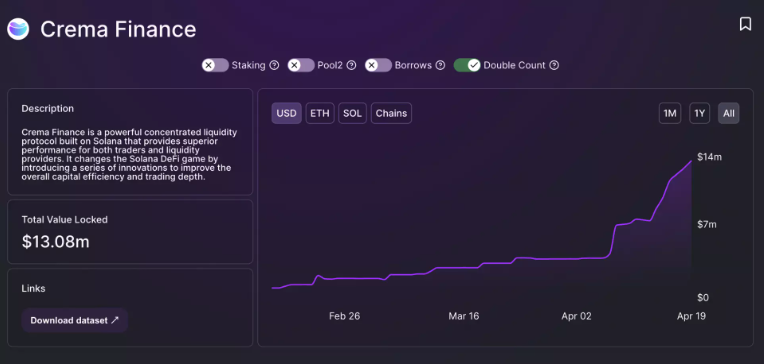
Crema Finance is a DEX enabling concentrated liquidity market making—similar to Uniswap V3—with enhanced capital efficiency. How does it achieve this?
CLMM: For Higher Capital Efficiency
Using Musk’s first-principles thinking, nearly all innovation in DeFi revolves around achieving higher capital efficiency.
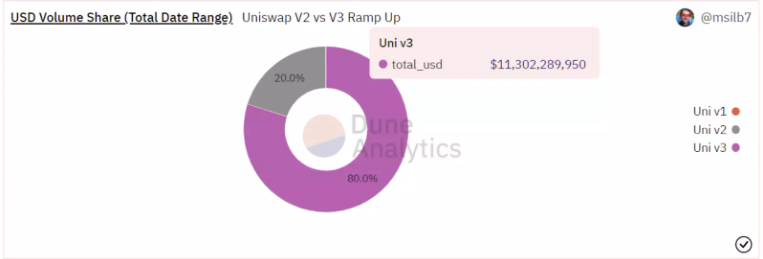
Take Uniswap V3, for example: it introduced concentrated liquidity pools, allowing users to boost capital efficiency by customizing price ranges. Today, approximately 80% of Ethereum’s trading volume originates from Uni V3 liquidity pools.
Crema Finance aims to build a “multi-chain Uniswap V3” tailored for non-EVM ecosystems, starting with deployment on the Solana network.
The non-EVM ecosystem includes public chains like Solana, Near, ICP, and Cosmos that do not fully support EVM but instead use unique tech stacks for smart contract deployment. These chains collectively hold over 20% of the market share and are still growing rapidly.
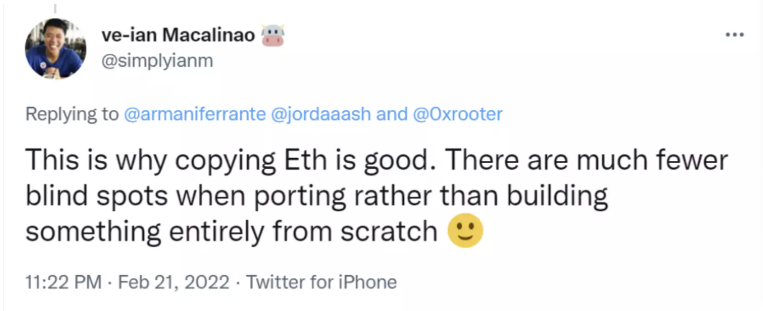
Ian, founder of Saber—the largest Curve-like product on Solana—once noted: "Replicating the Ethereum ecosystem is the optimal path, greatly reducing blind spots along the way." So why haven't we seen a Uniswap V3 equivalent emerge quickly on non-EVM chains?
Due to differences in programming languages, blockchains using Rust or Golang cannot simply copy-paste code from Ethereum-based products as EVM-compatible chains can.
Developing on non-EVM blockchains is significantly more challenging, requiring full re-implementation at the execution layer—a true test of technical capability. The Crema team has succeeded where others have not.
Meanwhile, the liquidity wars rage on, Layer 2 solutions are advancing rapidly, and emerging public chains urgently need a product like Uniswap V3 to attract users and liquidity. Crema emerged precisely at this moment.
Crema aims to launch an innovative concentrated liquidity protocol akin to Uniswap V3 within the non-EVM ecosystem—delivering higher capital utilization and pure fee-based returns for heterogeneous chain users, while helping grow total value locked across the ecosystem.
The Concentrated Liquidity Market Maker (CLMM) model is Crema’s killer feature.
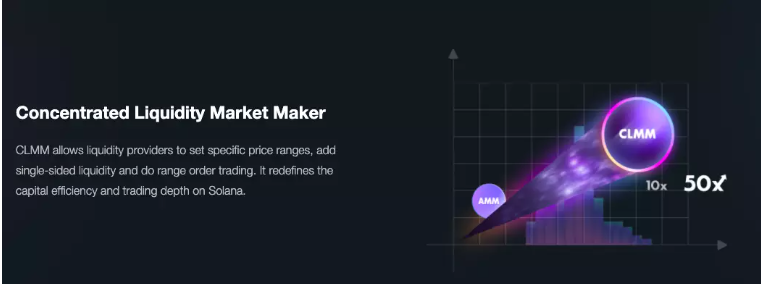
CLMM (Concentrated Liquidity Market Maker) is an upgrade and optimization over the traditional CPMM algorithm (Constant Product Market Maker), allowing liquidity providers to concentrate their liquidity within specified price ranges.
Following CLMM deployment, the Range Order function was also enabled—allowing single-sided asset deposits into liquidity pools, which only become active when market prices enter the designated range. This effectively allows users to perform "buy low, sell high" strategies indirectly through liquidity provisioning on a DEX.
Though seemingly minor, CLMM’s innovation over CPMM is highly effective: giving liquidity providers control over setting price intervals. This enables liquidity to naturally cluster tightly around current market prices—just as it does on centralized exchanges (CEXs). As a result, CLMM delivers significantly deeper trading depth than traditional CPMM models under the same TVL.
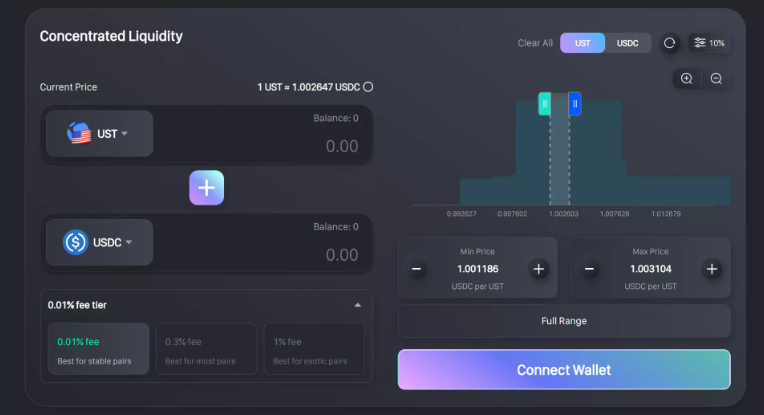
Because price ranges are customizable, available funds are distributed across different price zones. On the supply side, this helps balance the relationship between liquidity pools and traders, enabling LPs to achieve higher capital utilization—and thus greater profits.
For traders, the most immediate benefit is improved liquidity and lower slippage.
ve-Tokenomics: Building a DeFi Brotherhood
Under the CLMM model, each liquidity provider receives a unique NFT LP token due to differences in chosen price ranges and deposited assets. The metadata embedded in these NFTs records details such as liquidity amount and price range.
Unlike Uniswap V3, Crema offers additional liquidity mining incentives, allowing LPs to stake their NFT liquidity tokens in mining pools to earn extra rewards.
However, using plain NFTs as LP tokens doesn’t clearly reflect the value of a liquidity position. To solve this, Crema introduced “eLP-Value,” representing the effective liquidity value of each LP NFT.
For different types of projects, Crema designed specific incentive algorithms to assess the eLP-Value of their CLMM NFTs.
By converting eLP-Value via targeted incentive algorithms, reward proportions are determined, allowing users to receive real monetary rewards distributed in $CRM—the official Crema token—or other sponsored project tokens.
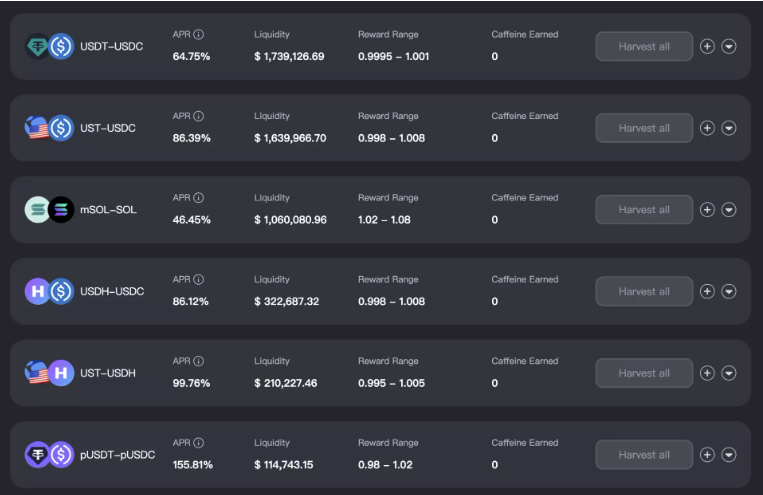
As shown above, Crema is incentivizing liquidity providers to supply liquidity to specific price ranges and token pairs.
How to better empower tokenomics?
Taking inspiration from Curve’s ve-Tokenomics, Crema allows investors to lock CRM tokens to receive veCRM (Vote-Escrowed CRM), with locking periods up to four years. The quantity of veCRM is proportional to the remaining lock time.
On one hand, veCRM holders can vote on which liquidity pools should receive CRM rewards. Additionally, veCRM serves as a revenue rights token for the Crema protocol.
Users can accelerate their liquidity mining yields through veCRM, or directly receive a share of Crema’s protocol earnings. However, unlike Curve, veCRM exists in NFT form—making it transferable and tradable.
The essence of Curve’s ve-Tokenomics lies in long-term alignment between stablecoin issuers and deep platform liquidity. In most cases, the issuing team becomes the largest and most stable liquidity provider.
On one hand, they rely on Curve-generated yields to profit from their market-making capital. On the other, they must attract external capital to buy and deposit their stablecoins into pools, sharing risk. Thus, they become deeply engaged participants in Curve, eventually forming a strong base for community governance—the secret behind Curve’s success.
This is exactly the effect Crema aims to replicate. It seeks to tightly bind its own protocol with other stablecoin-issuing protocols through ve-Tokenomics. At the same time, CLMM offers unquestionably higher trading efficiency compared to Curve’s Stable Assets AMM.
In the stable asset trading market, especially when competing against Uniswap and Curve, adding stablecoin liquidity via Crema on Solana eliminates concerns about:
1) Impermanent loss caused by incorrect price range settings
2) High gas fees on the Ethereum network.
These advantages make Crema more competitive and valuable in the stable asset trading market.
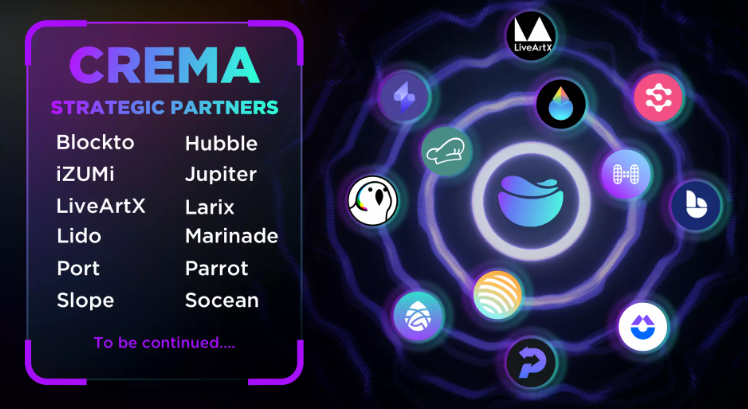
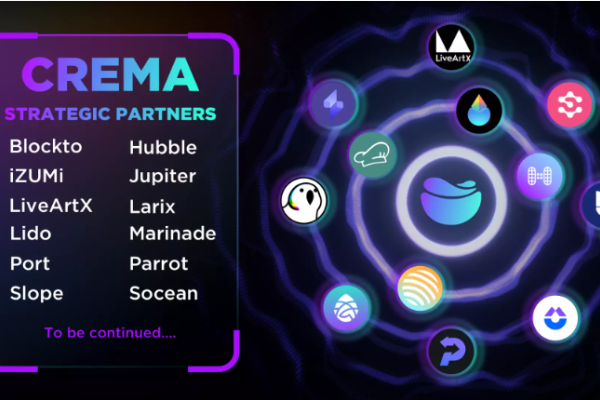
According to official disclosures, Crema has already partnered with Hubble Protocol (stablecoin USDH), Marinade Finance (mSOL), Lido (stSOL), Port Finance (lending), Parrot (prtSOL and algorithmic stablecoin PAI), and Larix (lending).
Most of these partners mirror members of the “Curve brotherhood” in the Ethereum ecosystem. It’s reasonable to believe that Crema is gradually realizing its ambition of deeply integrating itself with the broader Solana DeFi ecosystem and stablecoin issuers.
Multi-Chain Deployment: An Alternative Cross-Chain DEX
Solana is just the beginning!
According to its roadmap, Crema Finance plans to expand its liquidity footprint by deploying on other non-EVM blockchains built with Rust or Golang. Potential targets include Terra, Near, and Cosmos, with multi-chain expansion slated for Q3 2022.
NEAR uses Rust and AssemblyScript, while Cosmos SDK is based on Go—each presenting significant technical hurdles for the Crema team.
Once deployed across multiple chains, a new challenge arises: How to unify fragmented liquidity?
The simplest solution is obvious—cross-chain bridges.
Currently, Wormhole acts as the bridge connecting the SOL ecosystem with ETH and Terra. But cross-chain transfers aren’t the end goal—cross-chain trading is. With Crema’s liquidity pools spread across multiple chains, a new opportunity emerges: integrating cross-chain bridges to become a middleware supporting seamless cross-chain swaps.
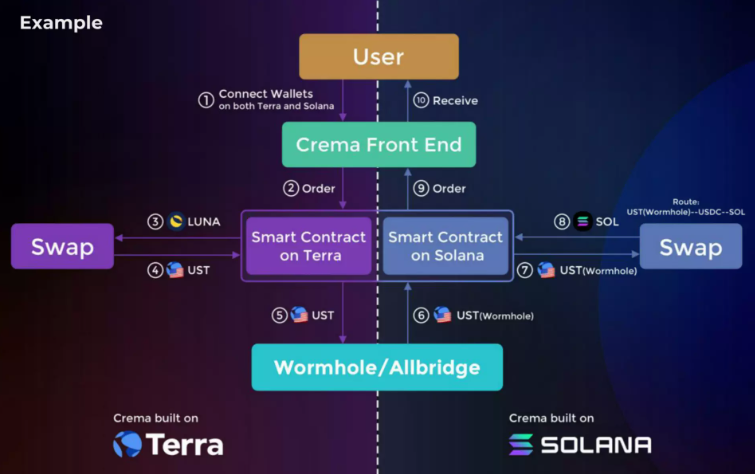
As illustrated, a typical cross-chain scenario involves someone swapping LUNA for UST within the Terra ecosystem, bridging UST to Solana via Wormhole, then exchanging UST for SOL on a DEX.
LUNA → UST → UST (Wormhole) → USDC → SOL. This cumbersome sequence could be completed in one click via Crema Finance. Leveraging multi-chain CLMM liquidity pools and integrated cross-chain bridges, Crema becomes a true cross-chain DEX.
Conclusion
In the world of DeFi, two keywords matter above all: liquidity and capital efficiency.
Whoever achieves superior capital efficiency through innovation will capture more liquidity. The multi-chain trend is unstoppable, and non-EVM chains remain the untamed Wild West. With CLMM, Crema has become one of the first cowboys to ride out—starting from Solana and pushing ever forward into new frontiers.
It’s a bold bet—on the future of multi-chain ecosystems. If Cosmos, Solana, Near, and others continue to grow, Crema stands poised to rise with them.
Join TechFlow official community to stay tuned
Telegram:https://t.me/TechFlowDaily
X (Twitter):https://x.com/TechFlowPost
X (Twitter) EN:https://x.com/BlockFlow_News