Elon Musk's Twitter War
TechFlow Selected TechFlow Selected
Elon Musk's Twitter War
This isn't the first time Musk has wanted to take a company private—the last one was Tesla.
 Navigating Web3 tides with focused insights
This isn't the first time Musk has tried to take a company private. The last time he attempted it was with Tesla in 2018—an effort that failed after being shut down by the iron fist of the U.S. SEC (Securities and Exchange Commission).
Nor is this the first time Musk has wanted to control Twitter. According to Bloomberg, in 2017 Musk posted a tweet expressing interest in acquiring Twitter, praising the social media platform and asking how much it would cost to buy the company.
“$43 billion!”
Five years later, the question finally had an answer.
Compared to other social apps like Facebook, Twitter isn't a giant. Yet it remains one of the few platforms capable of creating direct channels between opinion leaders and their followers—so powerful it can even sway public opinion.
In 2016, contrary to expectations of all mainstream media, Donald Trump was elected President of the United States, ushering in an unprecedented era of “governing by tweet.” Four years later, after losing the election and amid the Capitol riot, Trump’s Twitter account—with 88 million followers—was permanently suspended for allegedly inciting violence.
Since then, Trump has attempted to rebuild his influence through his own platform, "TRUTH Social," but with little success—nowhere near regaining his former prominence.
Indeed, his rise and fall were both fueled by Twitter.
With over 80 million followers of his own, Musk’s experience on Twitter mirrors Trump’s early trajectory. Every word Musk posts creates waves—major news outlets rush to report his tweets. He hyped Dogecoin, triggering a meme-fueled investment frenzy; he counters critics, influencing his companies’ stock prices; eventually, he disbanded Tesla’s entire headquarters PR department—after all, no PR team could match the power of Musk’s personal Twitter account.
Yet this powerful weapon remains constrained by Twitter’s official policies. The deletion of Trump’s account may have struck a chord with Musk. Something needed to be done.
Follow Trump’s path and build a new stage? Or, as the saying goes, “If you can’t beat them, buy them.”
In public, the world’s richest man would never frame his acquisition of Twitter as mere self-interest—he’d elevate the narrative to grand ideals.
“I invested in Twitter because I believe it has the potential to become a global platform for free speech, which I believe is essential for a functioning democracy.” (From Musk’s letter to Twitter chairman Bret Taylor)
“A platform that is maximally trusted and broadly inclusive is crucial for the future of civilization,” Musk said during an interview at the TED 2022 conference in Vancouver on April 14, claiming he didn’t care about financial returns at all.
In other words, Twitter isn’t “free” or “democratic” enough—it needs Musk’s “special acquisition operation” to precisely “transform” it.
Before this, Musk did what he always does—launched a poll to gauge public sentiment: “Taking Twitter private at $54.20 per share should be decided by shareholders, not the board.”
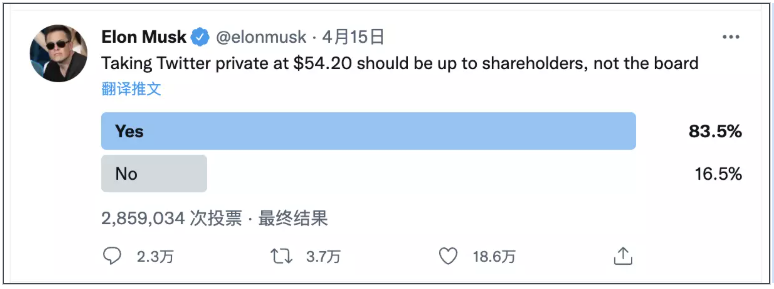
Over 2.8 million people voted—83.5% in favor!
In every way, Musk better embodies public expectations of Twitter than its current stale board, now lacking Jack Dorsey. Especially at a time when criticizing Web2 tech giants has become politically correct, Musk has transformed into a hero aiming to reshape the internet.
Back in 2018, Musk was hit by the SEC’s iron fist for market manipulation—precisely because he tweeted about taking Tesla private, ultimately paying a $20 million fine. To this day, crypto remains the wild west—Musk can move Dogecoin’s price with a single utterance. In truth, the only real constraint on Musk is Twitter itself—the dragon he seeks to tame.
Whether genuine or performative, Twitter has effectively become Musk’s weapon—a tool to counter Tesla critics, short-sellers, and media narratives, amplifying his personal views.
Ultimately, what Musk truly wants may simply be absolute freedom of speech—for himself.
Such freedom is also desired by many leaders from the crypto world. At least for now, Twitter already stands as the most “Web3-like” among Web2 giants.
Mark Cuban, owner of the NBA’s Dallas Mavericks, proposed creating a DAO to acquire Twitter.
Supporters of decentralization should create a DAO to buy Twitter, allowing token holders to vote on trending topics and verification in the future.
SBF, founder of FTX, envisioned his version of a decentralized Twitter:
1. Tweets go on-chain.
2. Two forms of monetization: the underlying protocol charges per tweet; at the UI level, users can display ads to earn revenue and cover network costs. Each UI can have its own moderation policy—no longer controlled by one person or company.
3. Integrate the following into Twitter:
a) Tips/payments/tokenization for content creators
b) NFTs / digital avatars
c) And why not add DOGE?
The question remains: does Musk want a Twitter centered around himself or Dogecoin—or a truly decentralized, free space?
At its core, making Twitter freer should mean making it more decentralized. No matter how charismatic Musk is, he himself is not decentralization.
Facing Musk’s aggressive advance, reports suggest Twitter’s board is preparing a “poison pill” defense—issuing大量 new shares at low prices to dilute the acquirer’s stake. Al Waleed bin Talal Al Saud, a billionaire investor and Saudi prince who owns 5.2% of Twitter, has also publicly rejected Musk’s offer.
On April 15, while attending the TED 2022 event in Vancouver, Musk stated “I have sufficient assets and the ability to complete the acquisition,” though he admitted he wasn’t certain of success—but even if the deal fails, he still has a Plan B.
Now it comes down to Musk’s determination. If he remains resolute, this Twitter battle will surely turn into a protracted war. But perhaps that’s not such a bad thing—regardless of whether Twitter ultimately goes private, in what may become a long-drawn-out struggle, Twitter will be forced to make meaningful changes. Compared to Musk’s grand promises, these changes might actually be more reliable.
Join TechFlow official community to stay tuned
Telegram:https://t.me/TechFlowDaily
X (Twitter):https://x.com/TechFlowPost
X (Twitter) EN:https://x.com/BlockFlow_News