Why is Near seen as the future of the crypto world?
TechFlow Selected TechFlow Selected
Why is Near seen as the future of the crypto world?
NEAR Protocol is approaching a new all-time high.
 Navigating Web3 tides with focused insights
By Captain Kole
Translated by TechFlow intern
With scalability, high transaction throughput, rapid year-over-year developer growth, and several major upcoming catalysts, NEAR Protocol is heading toward an all-time high.
Overview
NEAR Protocol is a development platform built on a sharded, proof-of-stake Layer 1 blockchain designed to improve usability. It consists of a permissionless base layer, an independent currency, a predetermined monetary policy, and a market for computing resources.
NEAR is the result of large-scale, open-source, decentralized collaboration by a team of over 90 world-class developers and researchers, many of whom come from tech giants like Google, Meta, Microsoft, and MemSQL.
NEAR advocates pragmatism over perfection, with its core value proposition being that "simplicity ultimately drives utility." Therefore, its success hinges on the protocol's ease of use and developers' ability to help those who have never experienced cryptocurrency build on NEAR.
NEAR is a developer-centric Layer 1 blockchain platform whose focus on developer and end-user experience enables long-term success.
Blockchain Architecture
At its core, NEAR is a community-operated cloud—a marketplace providing computing resources to participants. On the supply side, NEAR has node validator operators (currently 100 nodes), incentivized to secure the network. On the demand side, developers and end users are the primary focus of the NEAR platform.
There exists an inherent trilemma in Layer 1 protocols, which represents the biggest barrier to adoption and success. First, users require security but won't consider specific platforms as long as they have a smooth user experience. Second, developers care most about protocol adoption because it ensures their applications generate long-term stable revenue. Additionally, validators want higher income to ensure they can maintain the security of the proof-of-stake network. Finally, users—also the main token holders—want the blockchain token to serve as a store of value over the long term.
The fundamental solution to this trilemma is that as new users and developers increase demand for the token, application usage on the network will grow. Then, with fewer tokens staked and more tokens burned, validator yields rise, increasing their income. Through this economic flywheel, validators are compensated even as fees decrease, end users as token holders become excited, and network security improves.
NEAR vs. ETH 2.0
To quote Naval Ravikant, “NEAR looks like Ethereum 2.0’s roadmap except it’s already built.” Ethereum 2.0 aims to become a sharded, proof-of-stake blockchain compatible with Layer 1 EVM, enabling cheap, fast transactions under environmentally friendly and developer-friendly conditions. The launch of Simple Nightshade marks the beginning of NEAR’s goal to become a fully sharded and secure blockchain.
NEAR uses a permissioned proof-of-stake consensus mechanism, currently allowing 2,500–3,000 transactions per second. It consists of shards and validator seats (100 validator seats per shard), which will scale linearly with network demand while simultaneously lowering entry barriers, enabling mass adoption in the future. The network optimizes liveness over safety through Byzantine fault tolerance assumptions, reducing all transaction times to under two seconds.
The biggest difference between NEAR and Ethereum 2.0 is that NEAR uses a single chain to segment each block rather than a beacon chain. This ensures data availability for consensus while mitigating shard-level attacks. Dynamic resharding is expected to go live by the end of 2022, enabling the network to maintain low transaction fees while achieving higher throughput. Meanwhile, this approach is eco-friendly and was certified carbon-neutral by South Pole in February 2021.
Developer-Centric Protocol
However, compared to other Layer 1 blockchains, the protocol’s strongest competitive advantage lies in its developer-friendliness. NEAR prides itself on its developer-first protocol, dedicated to enhancing developer experience to encourage network adoption and usage. Since nodes run WebAssembly, developers can write applications in Rust or AssemblyScript—meaning they don’t need to learn a new programming language just to develop on NEAR.
Additionally, NEAR has its own Layer 2 protocol called Aurora. Compatible with EVM, it allows current Ethereum developers to seamlessly run their applications on NEAR at a fraction of the cost. Aurora bridges Ethereum and NEAR, offering 1-second block times, 2-second finality, and transaction costs of approximately $0.02. Over the past few years, this low entry barrier has driven significant developer adoption.
Analyzing Growth
According to Electric Capital, NEAR is one of the Layer 1s with the most active monthly developers.
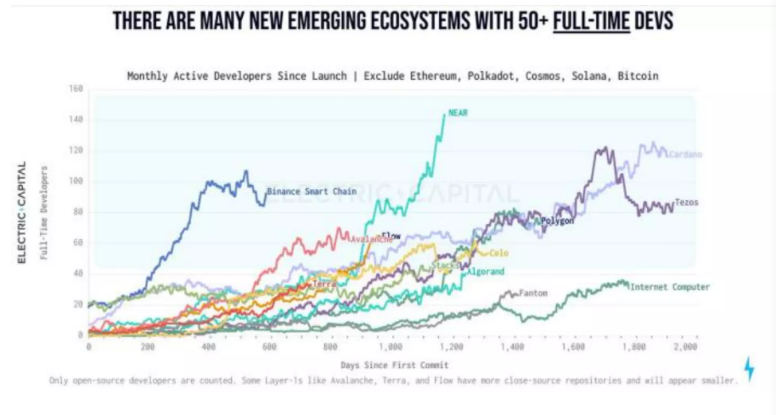
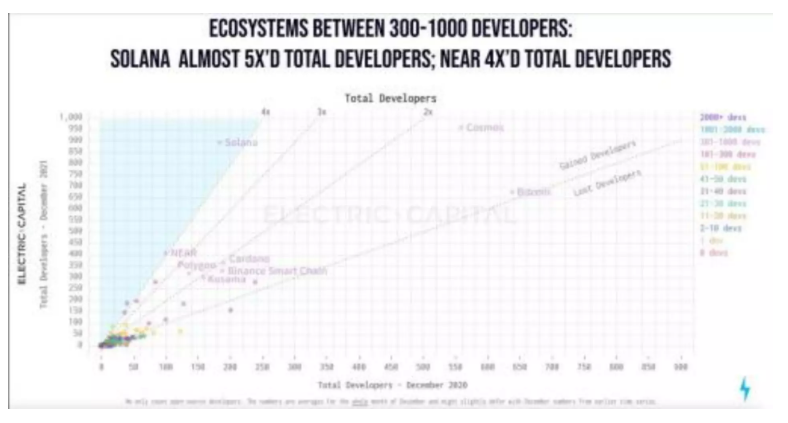
Over the past two years, it has had one of the fastest-growing ecosystems, with total developer count quadrupling. Rapid developer growth is a key indicator that the protocol’s application and usage will continue into the future.
Developer Incentives
If developers believe the value of end users exceeds gas fees, they can cover gas and transaction costs, providing predictable pricing for assessing end-user expectations. Thirty percent of transaction fees are distributed to smart contracts (shared evenly among all contracts used in the transaction)—creating a sustainable revenue source for smart contract development. With the announcement of an $800 million incentive fund, developers now have another compelling reason to start building on NEAR.
Blockchain-based applications and games have seen a 95–97% drop during onboarding. The protocol focuses on progressive security (high availability and low security, or vice versa). New end users benefit from an easy experience using account names ending in “.near”. Moreover, NEAR’s proof-of-stake consensus allows users to engage securely with the ecosystem from their very first interaction using the native wallet app. This ease of use combined with low developer entry barriers forms a core advantage for NEAR’s long-term adoption.
Future Catalysts for NEAR
Several catalysts make NEAR fundamentally an attractive investment opportunity.
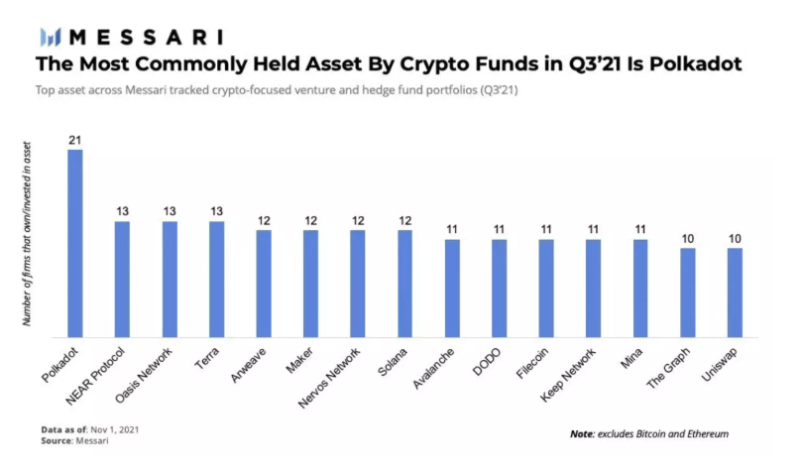
At the end of January this year, NEAR completed another $350 million funding round led by Tiger Global, adding another heavyweight to the list of venture capital giants supporting the NEAR ecosystem. According to Messari, as of Q3 2021, NEAR was the third most commonly held asset among cryptocurrency funds.
Moreover, NEAR will soon be listed on Coinbase exchange, significantly boosting its visibility. This also paves the way for NEAR NFTs to be integrated into Coinbase’s upcoming NFT marketplace. Finally, on April 20, NEAR will announce the launch of its own $USN and other well-capitalized native algorithmic stablecoins. These will offer an extremely attractive APR of around 20%, stimulating DeFi capital inflows into the NEAR ecosystem and drawing total value locked away from alternative Layer 1 protocols.
As attractive stablecoin yields surge, people may see this as the next Terra ($LUNA) story. Terra currently has a market cap of about $40 billion, while NEAR’s stands at $10 billion. These catalysts will strengthen NEAR’s fundamentals in both the short and long term, potentially driving its market cap to double or more in the coming months.
In short, NEAR is the future of crypto.
Join TechFlow official community to stay tuned
Telegram:https://t.me/TechFlowDaily
X (Twitter):https://x.com/TechFlowPost
X (Twitter) EN:https://x.com/BlockFlow_News