What Is It Like to Work in a DAO Without a Boss?
TechFlow Selected TechFlow Selected
What Is It Like to Work in a DAO Without a Boss?
If 2021 was the year of NFTs, then 2022 will be the year of DAOs.
 Navigating Web3 tides with focused insights
By ANDREW R. CHOW
Translation: TechFlow intern
In January, many across Crypto Twitter declared that if 2021 was the year of NFTs, then 2022 would be the year of DAOs.
DAO stands for "decentralized autonomous organization," a new type of organizational structure that has rapidly spread in recent years as capital floods into the cryptocurrency space. DAOs extend crypto's promise of decentralization—instead of being owned by an individual or controlled by a board, they are collectively owned by members and governed through smart contract-based voting to determine and enforce rules.
Aaron Wright, a lawyer and co-founder of Flamingo DAO—an investment group focused on NFTs and creative projects—compares DAOs to “subsidiaries with bank accounts.” He says: “The power of the internet is like a swarm—it gathers momentum quickly—but there’s no effective way to channel that energy. I believe DAOs are the answer to this problem.”
Enthusiasts firmly believe DAOs could eventually replace many traditional companies and become the collaborative organizations of a new era. (To draw a parallel with Uber, imagine a company collectively owned by its drivers.) However, most DAOs today remain concentrated on cryptocurrency and Web3 activities. Some collect NFTs (like PleasrDAO), facilitate cryptocurrency trading (like Uniswap), build blockchain products and tools (like PartyDAO), or incubate and fund NFT artists (like herstoryDAO, The Mint Fund).
Yet skeptics point out that many DAOs aren’t truly decentralized and struggle to handle the unpredictable complexities inherent in human organizations. Video essayist Dan Olson argued in his viral YouTube video *Line Goes Up – The Problem With NFTs* that calling DAOs revolutionary structures is merely smoke and mirrors—“They’re just shares with voting rights.” An article published earlier this month by *The New York Times* also highlighted some of the challenges DAOs face, including large-scale hacks, low voter turnout, and internal disputes.
Despite high-profile failures, some DAOs continue operating quietly, offering alternative models for what workplaces might look like. dOrg—one of the first DAOs legally recognized as a limited liability company (LLC) in the United States—is among them. Officially founded in 2019, dOrg is a software development firm focused on building infrastructure for Web3 and cryptocurrency projects. I spoke with four members of this DAO to understand how it differs from traditional LLCs and how those differences help or hinder their work.
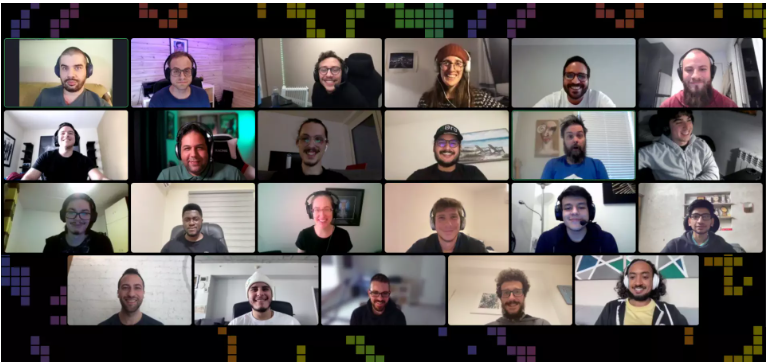
Full team call at dOrg
No management hierarchy—everyone owns the company
At dOrg, there are no conventional top-down management roles (no CEOs, CFOs, etc.). Ori Shimony, a software engineer who helped co-found the company, holds no formal leadership title and describes himself simply as someone who “helps with research and development.”
Instead, roles are fluid, shifting according to each project’s needs. Everyone formally working at the company is a legal owner of its “Vermont LLC,” holding an equal share. Decisions are made via token-based voting, with members earning tokens as they complete projects for the company. (Shimony currently holds the largest token share at about 9%, though it has steadily declined since the company’s founding and will continue to do so.)
Colin Spence, dOrg’s full-time product designer, says grasping this ownership model was a “huge wake-up call.” “In almost every company I’ve worked for, my boss would tell me, ‘I really want you to own this project.’ But in reality, I never did. Now, everything I build is actually mine. It completely changes how you manage your time.”
Still, the company isn’t entirely without hierarchy. Specific aspects of projects are led by experts—whether technical leads or project managers. But a leader on one project may report to a former subordinate on the next. “There’s a difference between leadership and authority,” says Shimony. “No single person can wave a magic wand and make decisions. But having one person—or ideally several—to offer advice, guidance, and direction is incredibly helpful.”
Developers choose their own projects and control their budgets
Work hours and locations are flexible and self-directed. I interviewed employees living in three different countries, all of whom said they work no more than 45 hours per week and emphasized their high degree of autonomy in identifying projects, cultivating client relationships, and assembling teams to execute them.
For instance, Magenta Ceiba, a dOrg project manager passionate about regenerative agriculture and supporting local economies, encountered AcreDAOS—an investment club focused on these issues—and drafted a proposal that was quickly approved by dOrg’s token holders. “There was especially strong alignment on values for this project. Many of dOrg’s builders come from Venezuela, so they deeply understand what happens during economic collapse,” she says.
Nestor Amesty, a tech lead from Venezuela, says developers have direct control over budget allocation. “We collectively audit each other. If someone misuses funds—which has definitely happened before—their peers have a responsibility to speak up when they see something they disagree with. We have a clear framework outlining how to act if conflicts arise.”
Conflicts go through mediation, then voting
Due to the lack of a central authority to resolve disputes, employees first follow the company’s “Distributed Dispute Resolution” guidelines. Sometimes, a personnel action specialist (essentially an HR role) serves as a mediator. “This has been working well recently,” says Magenta. “We have a culture of being direct and honest with each other.”
It’s not uncommon for Shimony’s own ideas to be rejected. When he proposed that dOrg issue a public token (allowing investors to buy quasi-equity stakes in the company), the idea was ultimately “killed in committee” after several conference calls. “I argued for it; dOrg chose a different path, and I’m glad it did. This is what dOrg is.”
If a decision cannot be resolved through discussion, DAO members vote on the blockchain. Spence notes that in the past, the company voted on nearly every decision, leading to “information overload—constantly feeling like you need to stay on top of everything you propose.” While this process may represent the purest form of internal democracy, it slowed progress, so the company began delegating decision-making to smaller, specialized groups.
Health benefits are outsourced
Currently, dOrg partners with Opolis—a company that sells healthcare plans to digital workers and freelancers—to provide health insurance for its U.S.-based members. Ceiba, who lives in California, expressed interest in advocating for the company to explore its own insurance options, saying, “We now have healthy enough funding to start re-evaluating this question.”
Salaries are transparent
On matters like pay rates and finances, dOrg aims for “radical transparency.” All salaries and budgets are publicly maintained on the blockchain, and every member can view payment logs.
Moreover, regardless of where employees live, dOrg pays based on skill sets. After moving from Venezuela to Madrid, Amesty says that while previously trying to work for Latin American institutions, “they usually forced developers to accept lower wages because they knew conditions in Venezuela were dire. But when I started working for dOrg, I felt my nationality didn’t matter—what mattered was my work and what I brought to the table.”
Another notable feature is that employees working on specific projects can choose to be paid either in “cash” or in “tokens representing ownership in those projects.” Choosing the latter means sacrificing short-term spending power in hopes that token value will rise as the project matures.
For example, Amesty helped build the development platform Polywrap and opted almost entirely to receive compensation in tokens, which will vest over four years. “I genuinely believe Polywrap has huge growth potential in the coming years, and I want to be part of it. It also motivates me to make it even better, because I have skin in the game.”
Skill-building remains a work in progress
In theory, a flat organizational structure could lead to worker stagnation, leaving employees feeling unmotivated to develop skills or advance. To address this, dOrg’s handbook emphasizes “skill elevation” and creating a collaborative framework where workers with different expertise learn from one another. “When people form teams, senior developers encourage junior ones to take on larger responsibilities or learn new skills,” says Ceiba. “Those with greater expertise or broader skill sets earn higher compensation.”
Spence hopes the self-improvement process becomes more formalized, providing developers with clear roadmaps of skills needed to achieve higher pay tiers and status within dOrg. He envisions a system where developers register for projects, build various competencies, and receive peer reviews from collaborators. “We need ongoing mechanisms to evaluate builder performance and ensure they’re actually developing the skills they need,” he says. Spence notes he’s proposed this idea before and hopes to push for its implementation next year.
Until then, dOrg will keep taking on projects, voting on new proposals, and refining its technical processes. “Many things start as experiments, and some need smoothing out. But it works. And I hope I can stay here for a long time,” says Amesty.
Join TechFlow official community to stay tuned
Telegram:https://t.me/TechFlowDaily
X (Twitter):https://x.com/TechFlowPost
X (Twitter) EN:https://x.com/BlockFlow_News