








Taking the Japanese production committee as an example, how to carry out WEB3.0 brand building?
TechFlow Selected TechFlow Selected
Taking the Japanese production committee as an example, how to carry out WEB3.0 brand building?
How should brand project parties uphold the quality and creative presentation of their brands and IPs within a decentralized context?
 Navigating Web3 tides with focused insights
Author: Mingzin_
Editor: Wang Hanyu
The current NFT market is already home to several blue-chip projects with exceptional value attributes. Web3.0 brands such as BAYC, CryptoPunks, and Azuki have leveraged their NFT PFPs—functioning much like intellectual properties (IPs)—to exert significant commercial influence through rich, IP-like resources. Under these conditions, resale transactions among investors alone generate substantial royalty revenues for project teams, enabling them to amass considerable profits.
If we must acknowledge a certain sophisticated and well-practiced skill in "promising grand visions" within the ambitious plans laid out by these brand projects, we must also concede that the vitality of these brands stems from their continuous expansion into future markets and evolving industry landscapes.
However, the influence and market value of future NFT PFP赛道 are facing strong disruption. New audiovisual media such as gaming, animation, and highly interactive metaverse environments are forming a "transmedia" ecosystem that transforms users’ immersive perception while reshaping their worldviews—inevitably posing a certain level of threat to the NFT PFP market.
Should brand project teams remain fixated on single-minded pursuit within the PFP market, they risk slipping from determined vision into rigid conservatism. Their commercial limitations will become increasingly evident amid market diversification, potentially leading to the erosion of their once-vibrant brand character and ultimately resulting in diminished brand value.
Thus, critical questions about brand development and future transformation move into the center of our discussion.
On one hand, how should we reconstruct the roadmap for future development of Web3.0 brands?
On the other hand, how can brand project teams uphold quality and creative expression of their brand and IP within a decentralized context?
This article attempts to address precisely this issue—the decentralized practice and transformation of Web3.0 brands—and finds that the operational mechanism of Japan’s production committees, characterized by capital dispersion, windowed operations, and specialized division of labor, may offer a highly instructive path forward for brand self-renewal.
What Is a Japanese Production Committee?
Since the 1990s, the Japanese film and animation industries have widely adopted an investment model known as the “production committee” system. This model refers primarily to a collaborative investment and production-distribution process aimed at dispersing financial risk in films, animations, and related ancillary products. For commercial films and animated works at the time, both front-end production and back-end marketing required long timelines and massive human resources. Small and mid-sized animation studios often abandoned development of high-quality IPs due to inability to bear enormous upfront investments. The maturation of the production committee model effectively resolved the most pressing bottleneck: insufficient funding and personnel in early-stage animation production.
The sharp rise in Japanese animation production costs has deep roots. In 1962, the cost of producing one episode of *Astro Boy*, based on Osamu Tezuka’s original work, was 2.1 million yen (approximately RMB 120,000). By 1982, the groundbreaking series *Macross*, combining idol culture with robot warfare, cost 5.5 million yen per episode (around RMB 330,000). By 1995, the landmark anime *Neon Genesis Evangelion* reached 6 million yen per episode (about RMB 360,000).
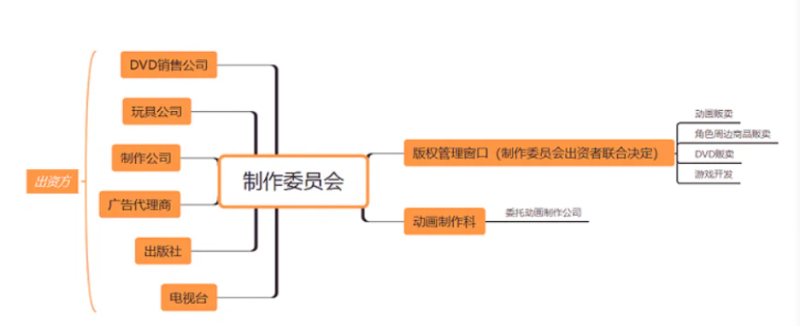
In organizational structure, the production committee is essentially a business consortium—a cooperative body formed by multiple companies for specific animation projects to manage daily investment, planning, management, and profit distribution. Typically, members include distributors, production companies, television networks, advertising agencies, publishers, animation studios, and audiovisual product manufacturers, with distribution and production firms often serving as primary executing entities (see diagram below).
It is widely recognized that the animation industry inherently possesses high-investment, high-return, and high-risk characteristics. In this context, adopting a single-source investment model would require animation studios or production houses to shoulder all pre-production expenses and post-marketing costs alone. In other words, under a single-investor model, the success of an animation project depends heavily on the quality of the final product—the production standard and presentation quality directly determine investment returns. It could be said that the emergence of the production committee system created broad market opportunities for many original animations and non-mainstream source materials previously stifled by funding constraints, significantly boosting the visibility of small and mid-sized studios such as Kyoto Animation.
Returning to the Web3.0 context, the current market situation resembles, to some extent, a state of major blue-chip dominance (with even Yuga Labs acquiring CryptoPunks) and marginalization of smaller brands—an internal structure strikingly similar to the animation industry’s past production bottlenecks. Brands like BAYC have secured unshakable monopolistic positions through multidimensional influence, widespread mainstream appeal, and crypto-native advantages. For such projects, resources are not a concern; their superior assets allow them to meticulously maintain their status as industry "top-tier," akin to a commercial empire forged through capitalist and neoliberal negotiation and collusion. However, for many small-to-mid-sized IP projects, resources represent the most fiercely contested prize, and these teams are actively expanding their presence by leveraging their unique strengths.
Thus, the formidable challenges once faced by small animation studios are being replayed today in the Web3.0 environment. Numerous brand project teams with remarkable imagination and creativity struggle with content creation and value realization due to lack of personnel and funding. On the other hand, the market’s self-regulatory mechanisms function as a double-edged sword for these teams. The crypto and NFT sectors are moving toward standardization, rigor, and systematization, while market feedback is cooling from initial frenzy to calmer rationality. Such self-correction forces project teams to balance creativity and production. As industry standards rise and evaluation systems improve, quick pump-and-dump schemes are no longer easily executable. Yet it must also be acknowledged that Web3.0’s inherent anonymity and innovation-driven market orientation provide relatively fair competitive grounds for imaginative new teams, whose bold creative ideas serve as counterforces driving disruptive innovation.
In the Japanese production committee model, investors come from diverse sources including DVD distributors, toy companies, production studios, ad agencies, publishers, and broadcasters. A Web3.0-style production committee could similarly adopt flexible, customizable configurations based on a project’s operational strategy. Looking at the common roadmaps adopted by major NFT brands today, we see potential investment directions spanning content creation, professional risk control, cross-media production services, offline distribution, and more. Thus, a new type of Web3.0-oriented production committee could consist of NFT PFP creators, potential venture capital firms, game developers, merchandise producers, and offline distributors.
Investor sources in Japanese production committees are diverse, including but not limited to DVD sales companies, toy manufacturers, production studios, advertising agencies, publishers, and television networks.
A Web3.0-based production committee could follow this model, allowing flexible and variable combinations tailored to a project team’s market operation plan. Based on the typical future development roadmaps adopted by major NFT brand projects today, we find that investment sources can expand into numerous areas such as content creation, professional risk management, cross-media production services, and offline distribution. Consequently, a new type of Web3.0 production committee would comprise NFT PFP creators, potential venture capital institutions, game development studios, merchandise manufacturers, and offline distributors, among others.
While inheriting the Japanese investment model, it is essential to recognize key differences in the Web3.0 production ecosystem. At the level of dissemination, Japanese production committees were built around animation as a medium. Amid global capitalist expansion and the emergence of the Web3.0 concept, the arrival of NFT PFPs has established a new value and dissemination framework. For instance, Web3.0 brand teams typically own full IP rights, granting them creative freedom akin to manga authors when developing content. Thus, they possess significant equity differentiation and negotiation leverage when engaging with diverse investors—fundamentally different from the position of Japanese animation studios within production committees. It is foreseeable that in the near future, Web3.0 will offer brand teams abundant strategic options, enabling them to chart development paths aligned with their intrinsic brand values.
The Japanese production committee was established around animation as a distribution channel. Yet globally, animation is not necessarily the only commercially successful medium. Indeed, the advent of NFT PFPs has introduced a novel value dissemination system. Moreover, unlike Japanese animation studios—which usually do not own IP rights—Web3.0 brand teams are IP holders, much like original manga creators, giving them distinct advantages in negotiations and equity structuring. As Web3.0 evolves, brand teams will gain increasingly diverse options to tailor developmental pathways suited to their unique brand identities.
Note: Japanese animation studios generally do not hold ownership of the IPs they produce. In today’s Web3.0 environment, brand teams first use NFT PFPs to promote their IPs and accumulate traffic and market impact. Therefore, they can simultaneously act as IP owners, PFP creators, and investors—dual roles that are not contradictory.
In her paper “The Evolution of Japan’s Animation Business Model and Its Implications,” Professor Wu Zhanwei from Shanghai Jiao Tong University highlights three key factors behind the success of Japan’s multi-party, flexible production committee model: investment decentralization, operational windowing, and production specialization. Within the Web3.0 context, such organizational composition appears equally viable for brand building.
Investment Decentralization
“Given animation production costs that easily reach tens of millions of yen, sole investment by any single company could result in fatal consequences if the project fails. In the long run, either lowering program quality or abandoning original productions would lead to audience attrition and reduced industry profitability, trapping development in an endless vicious cycle.”
Industries such as animation and game development inherently require substantial capital, making them prone to dual pitfalls: lack of expertise and depletion of funds. As a result, final products may suffer from poor quality, forcing small-to-mid-sized teams into abandoning R&D altogether. Similarly, if Web3.0 brand IP teams rely solely on initial investments or first-round NFT PFP sale revenues to fund development, they face identical production challenges—gaps emerging in future series launches or expansion into new domains. To minimize investment risks, some teams under pressure might cut quality controls, lower production standards, or abandon innovation entirely—causing irreversible harm to the industry’s healthy development cycle.
The decentralized investment model of production committees emerged in Japan as a solution forged through prolonged experimentation. By pooling investments from multiple parties, sufficient baseline funding for high-quality production is secured, while risk exposure for each investor remains within manageable limits. All committee members jointly bear the costs of content creation and marketing, reducing individual financial risks while ensuring robust support for brand IP development and value conversion—enabling creators to fully unleash their creativity and significantly elevate output quality.
Operational Windowing
“Operational windowing frees animation studios from bearing the full burden of commercial operations, delegating subsequent tasks to the production committee. The committee identifies and assigns specialized agencies best suited to handle specific functions—for example, entrusting broadcasting and distribution to TV stations, advertising and sales to agencies, and merchandising and licensing to toy companies.”
Undeniably, small-to-mid-sized animation studios often lack maturity in commercial operations—their strengths lie more in creative production than business management. Through the windowed operation of production committees, specific duties such as distribution are delegated to professional “licensing windows.” Different investors take responsibility for distinct segments across the entire production chain, greatly reducing the commercial operational burden on animation studios.
Specialization prevails—this is an eternal truth. As Web3.0 brand IPs mature, they must fully harness specialized talent and resource allocation. Original project teams should focus on NFT PFP development—their core competency—striving to maintain or even enhance production quality under the new committee model. Although current conditions remain imperfect, brand teams currently face immense pressure managing everything from animation production to fundraising, negotiations, copyright compliance, campaign planning, new赛道 exploration, and offline promotion—resulting in severe strain and resource waste. Adopting an operational model akin to Japan’s production committees could yield significant benefits in this domain.
Production Specialization
“Production specialization” refers to professional division of labor among production enterprises—a practice established during the Tezuka era and sustained ever since. After raising funds and setting the creative direction, the production committee delegates execution to a capable animation studio known as the *genshu* (primary contractor). The *genshu* manages the overall production workflow but does not perform all tasks in-house. Instead, it outsources portions of the work to smaller studios, termed *geshu* (subcontractors). These *geshu* may further subcontract parts of the work to even smaller entities, known as *niji geshu* (secondary subcontractors), forming a clearly stratified hierarchical structure.
The main reason for this model lies in Japan’s market environment: unlike Disney, Japan lacks large-scale industrial conglomerates with fully integrated production resources. As a result, SMEs must continuously strengthen collaboration and coordination to collectively advance industrialized production standards. This explains why Japan has built an audiovisual market capable of rivaling Hollywood, capturing over 60% of the global share in audiovisual products. In effect, Japan’s predominantly small animation companies have woven a network of competition and cooperation through this “specialized” industrial allocation and tiered production system. With 90% of animation studios concentrated in Tokyo, this clustering facilitates collaboration and dramatically expands the scale of the industrial cluster, accumulating formidable production power that rivals giants like Disney.
In a sense, the prevalence of small enterprises in Japan’s animation sector mirrors the inherent decentralization and distributed nature of Web3.0. The absence of dominant multinational oligopolies creates a market “vacuum,” providing fertile ground for the emergence and maturation of a specialized production model. Functionally, production specialization implies not just workflow segmentation but also fine-grained division across the entire commercial operation. A single production committee can unite the strength of dozens of members, forming a collective force capable of challenging large corporate groups. Establishing a new production committee model is nothing short of a counterforce against Web2.0’s capitalist monopolies. Guided by modernist ideals, small enterprises—once marginalized—gain broad recognition, transforming in the Web3.0 landscape into DAOs that preserve individual value and competitive advantage.
“The production committee model enables broader corporate participation in the animation industry, driving overall industrial growth. It solved the biggest problem for Japanese animation companies—lacking sufficient financial strength to establish logistics channels and sales outlets needed to promote their works.” Unlike Disney’s imperial commercial image, Japanese animation companies do not operate as a monolithic empire.
Therefore, the distributed structure of production committees effectively mobilizes cross-sectoral forces involved in transmedia production, integrating product design, business operations, and distribution networks. It places traditional standalone animation products within a broader, macro-level commodity network. In short, the integration of resources and functional division within production committees revolve around content creation, ultimately serving the work itself. Diversified corporate participation not only provides a solid foundation for animation studios to exercise creativity across varied themes but also expands their own business relationships through full-cycle involvement in production.
Ultimately, we return to the central question posed at the beginning: How can brand project teams ensure quality and creative expression of their brand and IP within a decentralized context? From the case of Japan’s animation production committees, we identify the immense advantages of hierarchical allocation, windowed operations, and segmented dissemination—offering invaluable lessons for small-to-mid-sized brand teams seeking footholds and breakthroughs in Web3.0.
Investment decentralization provides a solid financial foundation for brand IPs; operational windowing ensures rational task allocation, allowing each member to contribute effectively toward enhancing quality and influence; and production specialization combats homogenization, fueling rich creativity for narrative expansion across new domains and markets.
If we envision a Web3.0 production committee, it would undoubtedly feature a distinctly decentralized, distributed structure. While safeguarding the interests of brand teams as original IP holders, such a committee would grant relatively equal voice to all investors and participants, fostering harmonious symbiosis between content creation and operational/distribution forces based on mutual respect. In the foreseeable future, the production committee model will surely unleash its compelling potential within Web3.0.
Finally, I extend my sincere gratitude to Professor @lvxinxin. This article could not have been completed without your expert and incisive insights as a Japanese animation production investor.
Join TechFlow official community to stay tuned
Telegram:https://t.me/TechFlowDaily
X (Twitter):https://x.com/TechFlowPost
X (Twitter) EN:https://x.com/BlockFlow_News






