








Entretien avec Illia, cofondateur de Near : du génie de l'IA au fondateur de chaîne publique, la vision d'Yilong sur l'IA et la cryptographie
TechFlow SélectionTechFlow Sélection
Entretien avec Illia, cofondateur de Near : du génie de l'IA au fondateur de chaîne publique, la vision d'Yilong sur l'IA et la cryptographie
Comment NEAR utilise-t-il l'abstraction de la chaîne pour façonner un avenir meilleur en se tenant à la fois à la pointe de l'IA et de la cryptographie ?
 Dédié à des analyses Web3 approfondies
Interview : Sunny & Bella, TechFlow
Guest : Illia Polosukhin, Co-founder & CEO
"The future is NEAR."
This might be the most well-known meme. From early sharding scalability to today’s chain abstraction, NEAR has constantly evolved its narrative theme. However, it was AI that brought NEAR into the spotlight this year.
On March 20, Illia Polosukhin, co-founder of NEAR Protocol—affectionately nicknamed "Yi Long" by the Chinese crypto community—will join NVIDIA founder Jensen Huang on stage at GTC24 for a keynote and panel discussion titled "Transforming AI," firmly associating NEAR with the label of an AI-focused public blockchain and capturing significant market attention.
So, is NEAR truly related to AI? Upon closer inspection, yes—profoundly so.
Before entering the crypto industry, NEAR Protocol founder Illia Polosukhin was already an AI scientist who contributed extensively to Google's artificial intelligence project TensorFlow.
In late 2017, a groundbreaking paper titled “Attention Is All You Need” introduced the Transformer neural network architecture, which now underpins most natural language processing and modern AI advancements—an iconic foundational work in the field of AI—and Illia was one of its co-authors.
In November 2023, NEAR officially launched NEAR Tasks, a blockchain-based AI data labeling platform. Model developers (Vendors) can post tasks and upload raw datasets, while users (Taskers) participate by answering questions, performing text annotations, image recognition, and other manual data labeling tasks. Upon completion, participants are rewarded with NEAR tokens, and the labeled data is used to train corresponding AI models.
Perhaps Illia could proudly say: "In the blockchain space, no one understands AI better than I do; in the AI space, no one understands blockchain better than I do."
Beyond AI, NEAR focuses heavily on chain abstraction. In Illia’s view, the biggest challenge in the crypto world has always been the lack of sufficiently compelling applications.
As more chains and Layer 2 solutions emerge, the crypto landscape becomes increasingly fragmented and complex. NEAR’s advocated chain abstraction aims to make everything convenient and simple: enabling users to control accounts across multiple chains through a single NEAR account, conduct all transactions within one interface, without worrying about wallets, network switching, or gas fees.
Now standing at the intersection of AI and Crypto, how does NEAR plan to use chain abstraction to create a better future?
We sat down with Illia Polosukhin, founder of NEAR Protocol, to explore Yi Long and NEAR’s vision.
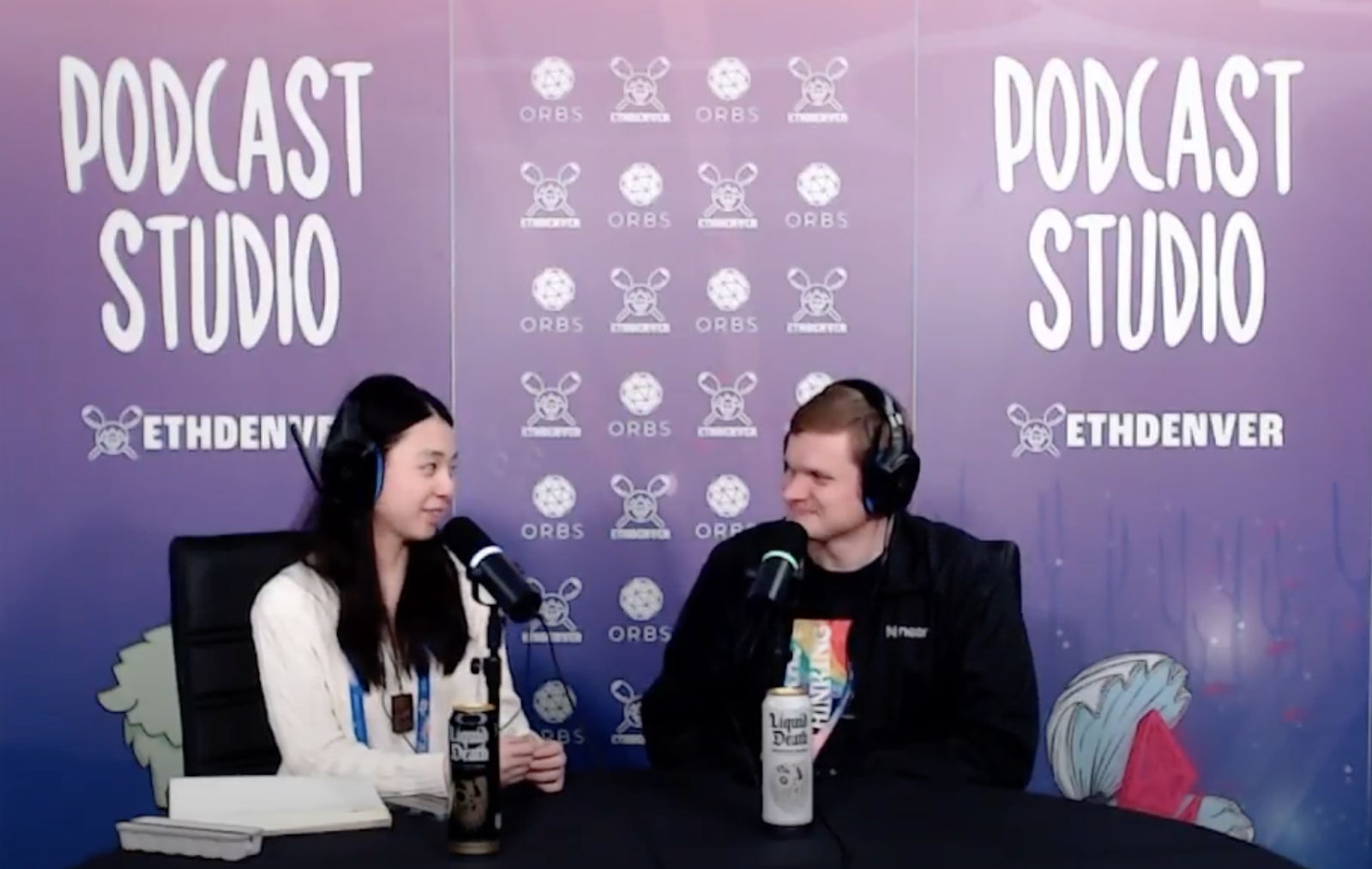
TechFlow interview snippet with Illia at ETH Denver
From AI Legend to NEAR Founder
TechFlow :Today we’re doing this interview in Denver. For all the hackers and students new to the industry, could you introduce NEAR to help them better understand its past, present, and future?
Illia:
It’s important to understand that NEAR is not just a Layer 1 blockchain—it represents a comprehensive stack for chain abstraction.
We initially focused on developing the blockchain primarily to enable developers to build applications using common languages like Rust and JavaScript. You can also write in C++, and people are even running Python in other programming environments. This flexibility truly opens up various use cases made possible through account abstraction.
Thus, we launched our mainnet in 2020. It uses sharding technology, offers affordable transaction fees, and scales capacity continuously as demand increases. This scalability is achieved via sharding—essentially parallelizing execution and storage. Recently, we released an updated design of our Nightshade sharding approach, leveraging state validation for further scaling.
Since then, we’ve seen various applications begin adopting Layer 1 blockchain technology. We've collaborated with numerous apps, including many existing Web2 platforms with large user bases eager to transition into Web3. This shift brings new economic models for their users, enables asset creation, and significantly reduces transaction costs.
For example, Cosmose AI and its app KAI-Ching moved from Stripe, a Web2 payment processor, to NEAR, saving substantial fees. As a result, it’s not only more cost-effective than other Web3 options but also cheaper than traditional Web2 solutions.
(TechFlow note: KAI-Ching is the native stablecoin of Cosmose AI’s flagship product KaiKai, operating on the NEAR network and pegged to the US dollar. Founded in 2014, Cosmose AI is a consumer shopping data analytics platform serving over 20 million stores and 1 billion users globally, with clients including LVMH, GUCCI, BURBERRY, Cartier, Tencent, and Estée Lauder.)
Through these efforts, we've acquired a massive number of users over the past year. NEAR boasts the most active users on blockchain, with over 1.2 million daily active users.
Chain abstraction has always been central to our vision. The way we built NEAR has consistently emphasized how to abstract the NEAR blockchain itself.
Over the last year, we've not only developed extensive infrastructure but also abstracted other chains—this was achieved through decentralized finance.
Take DapDap, for instance—we successfully integrated 14 different Layer 2 solutions and 150 distinct applications into a single front-end app, allowing users to discover and interact with applications in one place without switching networks or bridging assets. This is exactly the chain abstraction we've been striving for. Next, we will launch account aggregation and begin building user AI infrastructure.
We expect all these components to be integrated together next year. So this is a phased plan: starting from core blockchain infrastructure enabling identity, payments, and coordination, then building aggregated front-ends, achieving account aggregation to access other blockchains, and finally enabling user AI—all seamlessly combined.
TechFlow:After founding an AI startup focused on teaching machines to code, what inspired you to create NEAR?
Illia:
My background is in machine learning. For about ten years, I worked at Google Research on various ML and AI research topics and applications. Together with my team, we researched and developed Transformer technology—the “T” in “GPT.” This technology now enables most AI advances and current products available to users.
In 2017, I left Google and began launching a new AI startup focused on teaching machines to program.
At the time, it seemed like science fiction. Now, it’s reality.
We were deeply involved in data crowdsourcing, labeling, and generation, engaging volunteers—especially students—from China, Eastern Europe, and other regions.
However, we faced challenges paying people from the U.S. to China, especially since some didn’t have bank accounts. Similarly, payments to Eastern European countries were difficult because many Western payment systems weren’t functional there.
That’s when we realized the necessity of using blockchain as a global payment network for our own use case. But when evaluating different blockchains for this purpose, none met our needs at the time.
As system engineers, we were thus motivated to invest in building this infrastructure ourselves.
From my perspective, NEAR isn't just a blockchain—it’s a comprehensive suite of services and a platform designed to enable unique experiences both within Web3 and beyond.
We're already seeing many applications leverage AI on our platform. I'm also beginning to discuss long-term visions around autonomous systems—an AI-enabled ecosystem where users own personal AI agents that can securely access private data directly on your device to generate personalized experiences, alongside community-owned AIs governed, funded, and deployed via decentralized technologies.
We are witnessing convergence in this space. NEAR is building its future not as a single blockchain, but across the entire ecosystem.
Chain Abstraction: From Initial Concept to Design and Execution
TechFlow:Given your experience in AI and building AI products, it seems to influence your methodology toward chain abstraction. Can you explain what chain abstraction entails?
Illia:
Certainly. The concept of chain abstraction is relatively straightforward. It revolves around allowing users to interact with applications or make payments without needing to consider which blockchain they're using. Essentially, it eliminates the need for users to treat blockchains as separate entities during their Web3 interactions.
One major reason for adopting this approach is that most Web3 users currently operate on centralized exchanges and lack self-custody. This is because directly using blockchains today is extremely complex—users must set up everything from fiat onboarding to gas tokens, transaction fees, wallet configurations, etc.
Instead, ideally, users should be able to log in via email or facial recognition and start transacting immediately, without caring about specific blockchains, dApps, or smart contracts.
With increasing numbers of chains and Layer 2s launching, the space is becoming ever more complex. To simplify processes, unify liquidity, enhance user experience, and broadly integrate applications, chain abstraction is essential.
The concept of chain abstraction has always existed and remains necessary—but its importance is particularly pronounced now. It embodies a universal principle.
TechFlow:You emphasized building infrastructure within the NEAR ecosystem, with chain abstraction embedded from the outset to simplify user experience and attract millions—or even billions—of users. Can you share examples of applications that have successfully achieved this goal?
Illia:
NEAR focuses on building infrastructure within the ecosystem to eliminate steps requiring users to engage with complex underlying technologies. At its core, the value proposition is clear: when users begin using an application, they shouldn’t worry about blockchain specifics, gas fees, or infrastructure details.
We’ve already begun realizing this vision on NEAR. We launched meta-transactions and, thanks to applications like KAI-Ching, Sweatcoin, and recently HOT, attracted the largest user base in Web3. These apps abstract away blockchain complexity and have drawn in millions of users.
Starting next month, we’ll roll out account aggregation—a novel approach allowing NEAR accounts to transact across all chains. With a NEAR account, you’ll be able to send transactions on Ethereum, Solana, and Bitcoin. You’ll also be able to write smart contracts on NEAR that execute transactions across all these chains.
Therefore, while blockchains are part of our ecosystem, our focus isn't on competing with other blockchains, but on improving user experience and attracting millions—ideally billions—of users.
First Principles Thinking on AI x Web3
TechFlow:You've been in AI for 10 years and have done extensive research. Could you share some first-principles thinking on combining AI and blockchain?
Illia:
Imagine an experience where everything you see and interact with on your mobile device or any other device is fully owned by you.
You’re interacting with a local language model or AI engine that generates apps, produces content, and represents you in interactions with others, agents, communities, and brands.
All of this is built on cryptography and blockchain, ensuring that when you wake up in the morning wanting to read news, there’s a cryptographic way to verify the content you receive is accurate and published by trusted sources—not generated or manipulated.
Your local model summarizes news from various sources and presents it based on your interests, offering specific and diverse perspectives from journalists and providers—all processed locally on your device.
From there, you might want to interact with something mentioned in an article, say a brand. That brand also has its own model—you communicate peer-to-peer, securely encrypted, and can make micropayments to directly access information or services.
All these components work seamlessly together, enhancing your experience and enabling more personalized interactions with these systems.
TechFlow:Considering your rich experience in both AI and blockchain, what are the key differences between working in these two fields? What do you see as the biggest challenge in building AI models and consumer-facing products compared to blockchain development?
Illia:
This clearly depends on context, as work in AI and blockchain can involve many different activities.
Some may focus on developing foundational models—training and improving them—work typically conducted in labs, whether in companies, startups, or academia. This differs greatly from creating consumer products that integrate AI models.
However, I believe building consumer products that utilize AI models—whether in Web3 or elsewhere—isn't fundamentally different.
The main difference lies in the nature of the work: developing foundational models versus designing consensus mechanisms or protocols—each requiring distinct skill sets and knowledge.
In blockchain, greater emphasis is placed on decentralization and distributed systems, identifying and mitigating worst-case scenarios.
Conversely, in foundational model training, the focus is on developing intuitive understanding of system behavior—requiring extensive experimentation: running trials to determine what works and progressively refining models, architectures, and data inputs. This makes AI inherently more exploratory, whereas blockchain development demands meticulous design for stability and security.
At a granular level, the differences are significant, rooted in differing required skills and knowledge.
Yet from a broader perspective, the differences may not be so stark.
In fact, it's entirely possible to build applications that fully leverage both domains, opening vast opportunities for innovation.
The Worst Decision
TechFlow:During NEAR’s founding journey, what were the worst and best decisions you made?
Illia:
Actually, the worst decision was made in 2019. We were continuing our research on how to build a sharded blockchain.
We ended up developing a blockchain using Tendermint as the consensus mechanism.
We considered launching it but ultimately decided against it. Instead, we continued our research, finalized our sharding design, and only launched over a year later.
Looking back, I think this was probably the worst decision—because if we had launched in 2019, we would have gained an extra year to build, experiment, and mature our tools, enabling earlier development of more applications.
Eventually, the sharding component was integrated. Nevertheless, we managed to continuously upgrade and innovate behind the scenes, effectively hiding this complexity from users, who don’t need to be aware of it when interacting with the blockchain.
That’s the essence of chain abstraction thinking.
From that angle, delaying our launch may have been our worst decision. Entering the market earlier could have accelerated tool maturity and developer education.
On the other hand, what was the best decision? That’s a good question. I believe launching NEAR, transitioning into blockchain, and truly focusing on advancing this challenge was an excellent decision. There was a clear need matching our skillset. Combining all these elements and being able to attract an exceptionally skilled team with rich systems experience from top companies was a critical and timely move.
TechFlow:What do you think is the biggest problem facing NEAR or the blockchain industry today?
Illia:
So far, the biggest challenge has been the lack of sufficiently interesting applications.
A large part of this stems from heavy investment in infrastructure without corresponding investment in applications—especially consumer-facing ones and other domains.
Now that we have chain abstraction and other developments, we can launch applications without users needing to know which blockchain they're operating on. We can reach all users in Web3, including newcomers. Thus, I expect increased investment in consumer and business applications to truly drive these interactions.
However, so far, the real frustration has been precisely this: despite having many DeFi applications, it’s unrealistic to expect everyone to participate in DeFi.
We need a broader range of consumer applications—from creative platforms to social media, even location-based apps for various interactions.
Essentially, we need more applications at the application and business layers—covering everything from payments to project management—all leveraging blockchain.
DePIN, AI, and Chain Abstraction
TechFlow:Based on your observations, why has DePIN gained significant traction in the blockchain industry over the past year?
Illia:
Interest in these platforms stems from deep use cases gaining considerable attention. For instance, we’ve observed strong interest in Akash. Its appeal lies in market potential—particularly for conventional AI companies seeking GPUs but unable to obtain them. Akash provides a decentralized marketplace where individuals can rent out their GPU resources.
This model demonstrates blockchain’s power in crowdsourcing, enabling fascinating use cases beyond traditional applications.
Such frameworks generate significant interest, showcasing how blockchain can facilitate diverse approaches and create markets like Akash.
TechFlow:Given your insights and emphasis on emerging trends, have you identified a trend within the blockchain industry that truly resonates and has the potential to thrive?
Illia:
Regarding trends, we’ve discussed several. I believe chain abstraction will become a major trend, as it drives a fundamental shift in how we build on NEAR.
The convergence of AI and Web3 is also evident. How to combine AI and Web3—to make computation more decentralized, ensure user ownership of compute, and guarantee high-quality, community-generated data for models—are all crucial questions.
Payment use cases are gaining traction too. Usage of stablecoins for settlement and other payment-related functions is increasing. On NEAR, through HOT Wallet, we’re seeing more participation, benefiting from zero-fee stablecoin transactions.
The concept of DePIN is becoming especially attractive because blockchain provides an excellent framework for markets, simplifying supply chain management. This creates opportunities to rapidly aggregate large supplies, potentially offer more competitive pricing, and capture larger market shares in infrastructure or any other domain.
As I mentioned, the vision is to create a fully sovereign operating system integrating all these elements, enabling users to seamlessly interact with their local knowledge, global events, other brands, and communities.
This includes governance at every level—AI will play a key role in driving governance decisions, summarizing information, providing explanations, and assisting voting processes. I believe as both technologies mature and scale, we’ll witness transformative changes across many fields.
With NEAR growing tenfold annually, I expect to see a billion users in our ecosystem within the next two to three years. That’s where we’re headed.
TechFlow:Is there anything else you’d like to share with our audience?
Illia:
If you’re a developer, I encourage you to check out our documentation on how to build multi-chain applications using chain signatures and layers. We’ll be updating more docs soon. For those building in AI, there are many ways to get involved and interact. If interested, feel free to follow us on Twitter @NEARProtocol and me @ilblackdragon.
We’re changing this.
You will be able to use any application on any chain.
While we support it, it's actually powered by all blockchains operating behind the scenes.
And that—this is chain abstraction.
Bienvenue dans la communauté officielle TechFlow
Groupe Telegram :https://t.me/TechFlowDaily
Compte Twitter officiel :https://x.com/TechFlowPost
Compte Twitter anglais :https://x.com/BlockFlow_News
 深潮TechFlow






