








Female-Themed NFT Analysis: Psychoanalysis, the Gaze, and a Market Guide for the Future
TechFlow Selected TechFlow Selected
Female-Themed NFT Analysis: Psychoanalysis, the Gaze, and a Market Guide for the Future
Does my male identity inherently introduce a certain bias in my writing about women?
 Navigating Web3 tides with focused insights
Author: Mingzin
Editor: Wang Hanyu
At the outset of writing this article, I was troubled by a thorny question that made it difficult to begin: Does male identity inherently bias my writing about women? This may be an issue all authors attempting to discuss identity must confront. Later, I realized that the author's position is ultimately neither valid nor invalid—writing itself is an act of external inquiry, a suspended judgment. Before delving into my topic, I hope readers will approach this piece with critical thinking, sharing in this outsider’s contemplation. As we reflect on this controversial subject, let us remain vigilant about male positional bias and strive to broaden our perspectives to uncover the multiplicity of meanings within things.
First, perhaps we must acknowledge one fact: Whether in traditional tech industries or emerging crypto spaces, women as a socially subordinate group consistently lack visible representation. Business journalist Sohini Bagchi noted that BitMEX research found globally, women account for only about 5% of cryptocurrency investors, compared to roughly 24% among traditional stock investors. According to the 2021 U.S. Crypto Adoption Report, despite cryptocurrencies like Bitcoin being invented with the original goal of promoting financial equity, 75% of cryptocurrency holders are still male. In terms of proportions, women’s discursive “absence” clearly exposes the reality of male-dominated industries. Needless to say, a brief examination reveals similar gender injustices and suppression of female voices across many other fields; however, in the recently booming NFT market of the crypto sphere, we seem to glimpse a possibility for women reclaiming representational power through art.
In 2021, the globally popular NFT PFP culture generated an exciting and cohesive visual effect. Their digital virtuality and unique personal ownership value hold the potential to rewrite dominant discourses. Meanwhile, women’s “speechlessness” in the crypto space provides a real-world context for establishing female-themed crypto art in the NFT market. Consequently, numerous female investors, project teams, and artists have entered the crypto world, collectively cultivating fertile ground for female-themed crypto art. This trend has also drawn creators from diverse identity backgrounds into the crypto space, creating a vibrant and multifaceted discourse.
From the standpoint of ideology and value, current female-themed NFT PFPs can be divided into two categories: feminist NFT PFPs, and genuinely women-centered NFT PFPs. The reason for making such seemingly contradictory distinctions lies in the fact that feminist NFT PFPs have edged close to becoming mainstream in today’s NFT market, inevitably drawing skepticism from groups with opposing political stances. The附着 of political symbols onto feminism often does more harm than good. I firmly believe only de-symbolized practices can uncover truly decentralized paths within Web3.0 contexts—and thus reach authentic female NFT PFPs. Therefore, this article aims to examine certain hidden risks in contemporary feminist NFT projects from three angles—psychoanalytic film theory, the female gaze, and forward-looking market aesthetics—in order to answer what kind of female NFT projects we actually need in the Web3.0 era.
If the Azuki series constructs a post-national imaginary rooted in Japanese animation culture, and mfers express symptoms of global postmodern zeitgeist, then today’s traceable (originating from the real world) feminist NFT series serve as self-projections of female figures. Moved by narratives such as “women’s empowerment” and proliferating cultural symbols, this self-projection weaves a seemingly revolutionary dream. If analyzed through psychoanalytic film theory, this precisely satisfies the basic conditions required for any text to establish a relationship between itself and its audience-subject.
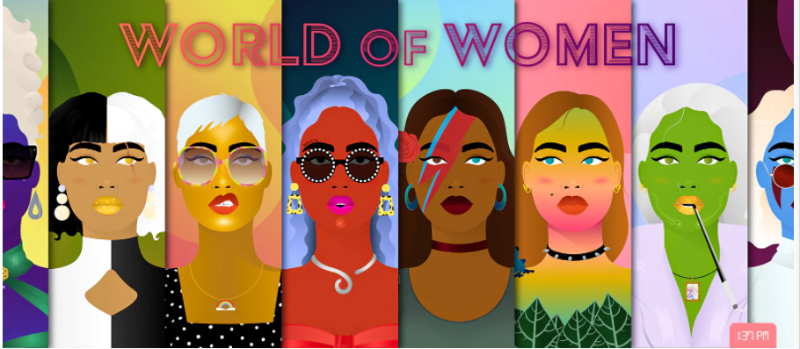
For example, popular female-themed NFT series currently championed by mainstream forces—such as WoW, The Crypto Chick, and Boss Beauties—feature character models and narratives filled with clichés. Fundamentally, their loss of novelty stems from compliance with political correctness, reducing their ostensibly inspiring stories to laughable "wealth codes." Ubiquitous, capital-attracting fatal symbols transform these feminist NFT PFP works into glittering consumer commodities, even exploiting consumption to further marginalize already disadvantaged female discourse. The so-called visions of social change offered by feminist narratives resemble nothing more than illusory castles in the air.
Professor Yan Jingjuan points out that in consumer society, men, like women, can become objects of gaze. Clearly, when market shifts occur to satisfy female consumers who dominate spending, men necessarily become the objectified subjects. In past instances of the male gaze, an idealized female image was simulated, allowing men to project their desires onto visually perceived women, thereby commodifying women to serve the male gaze. The operation of the female gaze is no different—it is covertly manipulated by capital, which fundamentally aims to stimulate female consumption by turning men into “objects produced by consumer society, symbolic goods tailored to female aesthetic preferences.”
In today’s NFT market, feminist NFT PFPs enact precisely this form of consumerist female gaze—packaging themselves with eye-catching female imagery and declarations calling for value recognition, while at their core merely replacing the gazed-upon male with the gazed-upon female. The self-declarations of feminist NFT PFPs perfectly align with the subconscious desires of those hoping to transform women’s fate. In their imagination, women in subordinate positions, urgently needing salvation, are protagonists awaiting development. Feminist NFT PFPs dazzle them with visions of idealized status.
In psychoanalytic theory, film theorist Jean-Louis Baudry identifies three ways the cinematic apparatus constructs the spectator-subject:
-
Regression mechanism;
-
Primary identification;
-
Concealment of those ‘marks of enunciation’ that stamp the film with authorship.
1. Regression Mechanism
The regression mechanism means cinema, as a dream machine, evokes a holistic viewing situation that gives viewers a womb-like experience. Cognitive regression fully activates unconscious desires; films attempt to return viewers to a pre-ego state where “I” and others, internal and external, have not yet differentiated. When female investors haven’t found an NFT PFP to signify their Web3.0 identity, we might say their cyber “self” hasn’t formed yet. This state of subjective confusion resembles infants regressed before the mirror stage, unable to define real boundaries between self and world.
French film theorist Christian Metz notes that psychoanalytic film theory distinguishes the cinematic spectator from the subject in objective reality. The spectator-subject must be established and articulated through unconscious mechanisms. According to this theory, the spectator’s subject position is constructed by the cinematic apparatus—not constructing a subject of objective reality, but activating a subject position within unconscious fantasy, which the viewer occupies. Thus, from the perspective of psychoanalytic film theory, the viewer (as subject) is both a “productive” space (capable of generating fantasies) and an “empty” space (available to be occupied).
Applying psychoanalytic film theory to feminist NFT PFP culture, we find its operational mechanism structurally homologous to the cinematic apparatus. In the Web3.0 context, perhaps everyone needs a PFP (profile picture) to bridge the virtual world, and long-silenced female groups especially require such connection. Feminist NFTs' assimilation of women parallels cinema’s assimilation of spectators—they construct beautiful narratives placing women into unconscious dreams. Female investors thus become container-like “spaces,” holding intricate narratives like universal “female empowerment” and “female voice,” along with various “feminist” symbolic features in design. Like moviegoers in a dark theater, real-world oppressed women passively accept these symbol systems’ crafted beautiful “myths,” entering a belief regime in Web3.0; they unquestioningly believe feminist NFT PFPs and their value systems are true and effective.

2. Primary Identification
The primary identification mechanism refers to the synchronization and internalization by the cinematic spectator of the very act of “looking,” creating the illusion that the film unfolds under their conscious control. When women witness the launch of Boss Beauties, manipulated by carefully woven consumer discourse, they regress into passive, hollow selves. Having never encountered any NFT series claiming to represent women, they only realize they are “watching” these feminist NFT PFPs. This naturally leads them to identify with the focal point of the presented gaze, establishing “primary identification,” followed by secondary identification through elaborate and direct narrative symbol systems.

Boss Beauties #5867 #3091 #7546 #3423
As seen, four randomly generated NFT PFPs from the Boss Beauties series—#5867, #3091, #7546, #3423—express confident and diverse female images. From left to right: female artist, athlete, soldier, and police officer, featuring different skin tones and professional attire. This appears to reflect a decentralized effort. Moreover, traditional binary oppositions are broken here—for instance, the “soldier” image is no longer exclusive to authoritative, masculine males but can also be a woman adorned with cat ears and a pink scarf. Character design is the biggest selling point of these feminist NFT PFPs. Relying on politically correct icons, they earn market favor and seem to dominate as top winners in the NFT space.

The Crypto Chicks #653 #2585 #4566 #3419
Yet, these exquisite illusions shatter before commercial logic. We cannot ignore the pronounced tendencies toward homogenization and stereotyping in these PFPs. Female facial features remain constrained by deeply entrenched Euro-American beauty standards—even focusing solely on the repetitive, full, sensual lips reveals this clearly. The overall aesthetic trend of such PFP projects becomes increasingly centralized, even establishing aesthetic bullying, excluding and disallowing any appearance that contradicts its norms. Advocacy for diversity and slogans representing women ultimately become superficial, merely flattering the形象 expectations and aesthetic认同 of elite buyers. Isn't this the greatest irony against Web3.0’s decentralization ideals?

Boss Beauties #8310 #8500 #4108 #2012
It must also be noted that algorithmic random generation is a double-edged sword. Within the algorithmic logic, using the most obvious racial skin tone as a baseline, deviations from this baseline generate female characters that bizarrely become malformed racial hybrids—difference and repetition oddly combined within single characters. For example, the four women above possess different skin tones and racial identities, yet all wear the same hairstyle called Karaba (a style common among African women), making the differentiation of female identity appear absurdly comical.
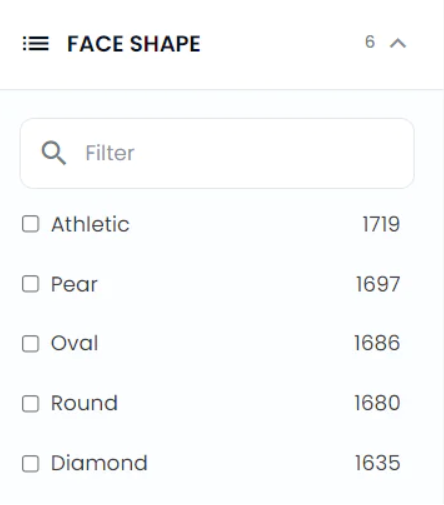
In the filtering options, the team offers five face shape designs: athletic, pear-shaped, oval, round, and angular. This classification method is far too crude—every aspect of female appearance brims with the gaze; simultaneously, women’s “face shapes” become statistical objects. Rather than creating “diversity,” it seems purely about accumulating massive data. Such simplistic, brutal treatment of “concrete individuals” will likely backfire on capital itself.
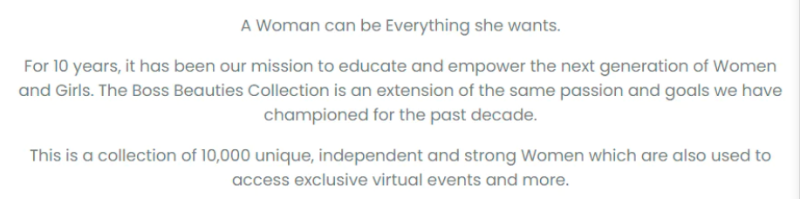
Unlike the gradual establishment of secondary identification in cinema, feminist NFT PFPs, due to their cross-media presence, can simultaneously establish primary and secondary identification, greatly accelerating the speed of co-opting female consumers’ sense of belonging. Ironically, Boss Beauties’ most prominent slogan is: “A Woman can be Everything she wants.”
Scholar Sandy Flitterman-Lewis observes that once audiences synchronize regression, primary, and secondary identification, they develop the impression that the images on screen are products of their own imagination, forgetting these are artificial dream constructs. This achieves the filmmaker’s purpose—gradually erasing their own “signature,” making viewers forget it was never their fantasy, but rather the projection of their own desires.
Let us reiterate: the process by which cinema constructs subjectivity—that is, how viewers establish self-identity and subject awareness through screen images—is reenacted in the Web3.0 virtual world. “Female investors” temporarily lose themselves when facing NFT PFPs, yet simultaneously strengthen their sense of self. In other words, at the moment of fictional identity formation and affirmation, these women both lose themselves and rediscover an imagined “self” within feminist NFT PFPs.
Immersed in these PFP images often infused with the creators’ personal agendas, women unconsciously come to believe these female characters share their fantasies and represent their repressed desires. Beneath slogans like “empowering women to become who they want to be” lies the subtle transformation and crude imposition of female aesthetic standards—women may not even realize they’re caught not just in a consumption vortex, but within a discursive prison.

Secondary identification example (1)
“The Crypto Chicks is an inaugural NFT series designed to celebrate the unique and diverse beauty of women worldwide.”

Secondary identification example (2)
“World of Women is a community that celebrates uniqueness, inclusivity, and equal opportunity for all. Comprised of an original collection of 10,000 artworks showcasing diverse and powerful women.”
Applying psychoanalytic film theory to feminist NFT PFP projects is necessary because it reveals fundamental differences between such projects and other NFT tracks. The uniqueness of feminist NFT PFPs lies precisely in their rich and concrete representations of real-world female images. Moreover, because mainstream female NFT PFPs aggressively manipulate “feminist values” and female narratives (as shown in the two secondary identification examples above), they gain dominant influence in audiovisual domains akin to film media, freely controlling women’s identity and value identification in virtual worlds.
We must scrutinize these playful character models because project teams claim they should be taken seriously. If we do not allow rigorous questioning of logical flaws and manipulative thinking, then their advocated “feminism,” “diversity,” and other serious political demands become ineffective and hypocritical. Professor Yan Jingjuan further explains: “Once women return from the simulated world to reality, they find implicit gender discrimination still exists. While feeling disappointed and frustrated, they nearly sink into the simulation world, weakening feminist consciousness and resistance.”
In summary, feminist NFT PFPs’ narratives about women are far more crude and one-sided than feminist films; furthermore, the construction of female identity politics through these PFP characters fails entirely to address the real-life concerns of most women’s social status and image. On the other hand, since these female NFT PFP characters possess some traceability, meaning they must reflect, to some extent, the construction processes of race, gender, and class in real society, we must strongly demand accountability from these feminist NFT projects regarding their character designs and feminist slogans. After all, the Web3.0 world cannot be built solely upon decorative tricks of “peaceful岁月.”
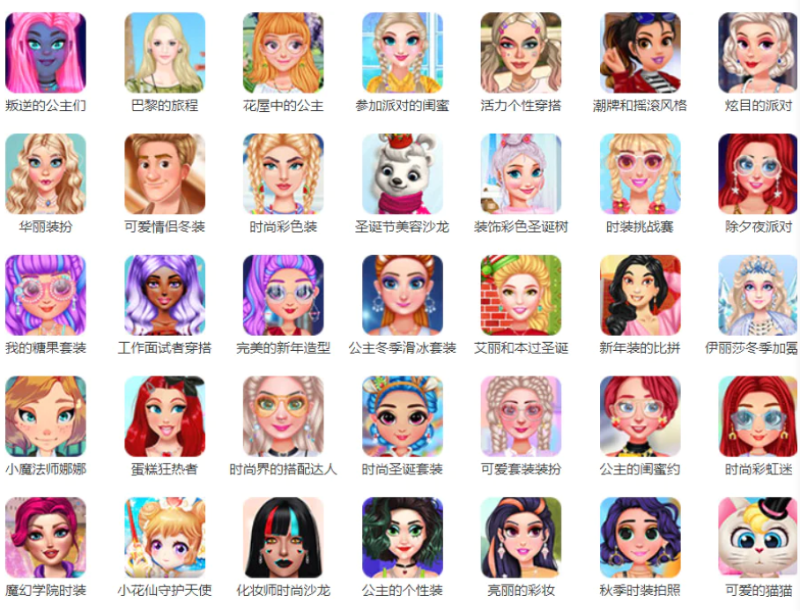
Currently, the emerging NFT market remains in a period of wild growth, where many projects derive value primarily from speculators’ emotions, while project quality becomes an uncared-for element. In the female-themed NFT PFP sector, the dominant aesthetic system resembles Flash Player makeup games from over a decade ago—an unbearable reality. If we continue tolerating such profit-driven operations treating feminism as a “wealth code,” we will soon face genuine moral and aesthetic dilemmas requiring urgent resolution.
At the 2021 Cannes Film Festival and Venice Film Festival main competitions, we saw three outstanding films told from female perspectives: *Titane*, *The Worst Person in the World*, and *Happening*. *Titane* presents a cyborg fable, boldly breaking binary gender frameworks and epistemological foundations. *The Worst Person in the World* sets its story in Nordic countries—the most gender-equal societies—depicting modern women’s anxieties and struggles in universal themes of love, career, and life. *Happening* takes us back to 1960s France, when abortion was still illegal, forcing viewers to confront societal cruelty toward women and recognize the necessity of women fighting for their “uterine rights.”

Titane. Dir. Julia Ducournau The Worst Person In The World. Dir. Joachim Trier Happening. Dir. Audrey Diwan
Professor Dai Jinhua once said: “The greatest significance of feminism lies not merely in gender equality, nor in gender confrontation, but in using women’s collective life experiences as a new cultural resource to provide imaginative space for the world—creating a new, more reasonable, alternative future, one distinct from modern logic, male logic, and capital logic, and certainly not a return to patriarchal dominance of the past.”
Needless to say, the aesthetic philosophy and overall mindset of today’s NFT market lag far behind traditional entertainment industries—a limitation rooted in historical immaturity. But precisely when everyone calls for respect and expression of female experience, feminist NFT PFPs remain obsessed with embedding political symbols within female frameworks. Such approaches are contemptible and will inevitably become “reactionaries” moving against ethics and a more decentralized, pluralistic future market.
I firmly believe that to turn action into reality, we must encourage rebellious practices and works rooted in self-experience by female artists. They must break the male gaze—not merely rejecting male-centrism, but restoring genuine female gaze and decentralized thinking. The Web3.0 world no longer needs mechanically produced abstract political slogans. Discarding the outdated ideologies of feminist NFT project teams is now the paramount mission of Web3.0.
Join TechFlow official community to stay tuned
Telegram:https://t.me/TechFlowDaily
X (Twitter):https://x.com/TechFlowPost
X (Twitter) EN:https://x.com/BlockFlow_News






