Analyzing from DogeCoin's success: Is it worth going all in on Meme coins?
TechFlow Selected TechFlow Selected
Analyzing from DogeCoin's success: Is it worth going all in on Meme coins?
Does generalizing from individual cases apply to Meme tokens?
 Navigating Web3 tides with focused insights
Author: Grace
Source: Footprint Analytics
On February 4, 2021, Elon Musk posted a Twitter about Dogecoin featuring a Photoshopped image of The Lion King, followed by an update on the 7th. According to Footprint Analytics data, Dogecoin's price surged rapidly by 21.43%. On February 19, 2022, Tesla’s Hollywood Supercharger station began accepting Dogecoin for food and beverage purchases.
With strong promotion from this self-proclaimed “DogeCoin CEO,” Dogecoin achieved success and is now traded as a cryptocurrency with circulation value. According to data compiled by Cryptwerk, as of February 25, 2022, 1,069 merchants and organizations accepted Dogecoin as payment. How did Dogecoin achieve such success? This article breaks down the key reasons behind its rise.
Dogecoin emerged in 2013 as a satirical take on BTC but rose to prominence as a trending token by 2021. Its success can be summarized into three main factors:
1. Celebrity Effect
Undoubtedly, the celebrity effect has been a crucial factor in Dogecoin’s success. Elon Musk’s enthusiasm for Dogecoin causes its price to fluctuate dramatically with every tweet—sometimes surging, sometimes crashing.
-
In February 2021, Musk tweeted that Dogecoin is the people’s crypto, leading to an intraday surge exceeding 80%.
-
In May 2021, during a “Saturday Night Live” interview, Musk admitted Dogecoin was a scam, causing the price to plummet by 34%.
-
In January 2022, Musk announced Tesla products could be purchased with Dogecoin, prompting a short-term rally exceeding 20%.
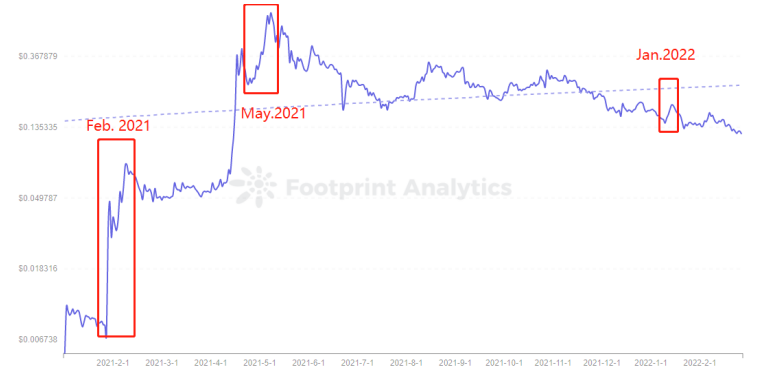
Footprint Analytics - Price of Dogecoin
On August 18, 2021, the Dogecoin Foundation was reestablished, naming both Musk and Vitalik Buterin as board advisors. Musk’s celebrity influence and contribution to the Dogecoin community were formally recognized.
2. Consensus Value
Cryptocurrency value can be broadly categorized into two types: value derived from consensus and value earned through technological merit and user adoption.
Bitcoin (BTC) is a typical example of consensus-based value—widely recognized as an investment vehicle or store of value, pursued by users and even adopted as legal tender by countries like El Salvador. Similarly, Dogecoin has achieved limited circulation value within certain communities.
3. Meme Amplification
Dogecoin is a Meme token. It copied Litecoin’s code (which itself forked from Bitcoin), offering little technical innovation. This contrasts sharply with ETH, whose high value stems from Ethereum’s robust technological foundation. Instead, Dogecoin maintains a low price point—a common trait among Meme tokens. To understand the characteristics and value of Meme tokens, one must first grasp the concept of a Meme.
· The Concept of Meme
The term "Meme" originates from Richard Dawkins’ book *The Selfish Gene*. Originally, it referred to an idea or cultural element that persists within individual minds and spreads across hosts while retaining its core traits. Today, it is widely used to describe the transmission of cultural phenomena.
Conceptually, it's clear that tokens built around memes inherently possess strong aggregation power and attention-grabbing potential.
· Characteristics of Meme Tokens
Rooted in meme culture, Meme tokens are heavily driven by their communities. Media coverage, celebrity endorsements, and shifts in community sentiment can all trigger price volatility. Prominent examples include Dogecoin, SHIB, ELON, and SOS. They share three primary traits:
-
Unlimited token supply.
-
Extremely low price, usually under $1, often purchasable for just a few cents.
-
Cultural symbolism, typically carrying specific connotations such as satire or mockery.
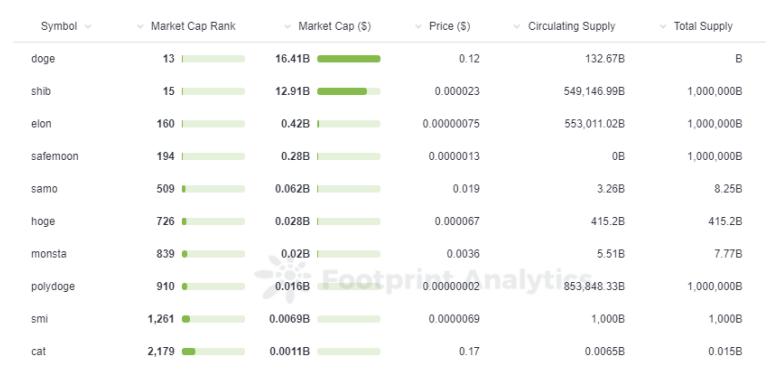
Footprint Analytics - Meme Token Ranking
While Meme tokens attract attention due to their unique cultural appeal, retaining long-term user engagement remains challenging. Key requirements include:
1) Narrative Depth: A compelling story increases the likelihood of converting attracted users into long-term holders.
2) Positive Community Culture: Given their low prices, when values increase tenfold or hundredfold, celebratory community activities play a vital role in encouraging holders to stay engaged.
3) Humor and Satire: Sufficient humor and irony foster player resonance, driving support for the token.
4) Celebrity Endorsement: With countless new tokens launching daily in blockchain, recognition from well-known public figures significantly boosts visibility. Ideally, these figures should already enjoy broad public trust.
· Successful Meme Token Cases
Currently, the most successful Meme tokens—measured by market cap and public awareness—are Dogecoin and SHIB. As of February 18, they ranked 10th and 11th respectively among all cryptocurrencies (excluding stablecoins). In many ways, their success represents the monetization of meme culture.
As a quintessential Meme token, Dogecoin gained widespread recognition not only for its satirical edge toward BTC but also for receiving backing from celebrity Elon Musk (CEO of Tesla and SpaceX). Despite one of Dogecoin’s co-founders having long abandoned the project, it still ascended to become one of the highest-valued cryptocurrencies.
Dogecoin succeeded due to the combined forces of celebrity endorsement, consensus value, and meme culture, transcending its original role as mere satire.
1) Adoption as a payment method marks a milestone achieved only by top-tier tokens.
2) The Dogecoin community raised funds in Dogecoin to sponsor Jamaica’s bobsled team at the Sochi Winter Olympics.
3) Fundraising efforts supported MSF (Doctors Without Borders) in treating Ebola victims.
These real-world applications of Dogecoin go beyond Web3, bringing principles of community governance, freedom, and decentralization into tangible impact in the physical world.
Reflections on Meme Tokens
Although Dogecoin succeeded, its extreme volatility driven by celebrity influence implies high risk. While Meme tokens are easy to launch, cheap to maintain, and highly decentralized, this does not mean they are suitable for reckless all-in investments.
In fact, gaining celebrity support and achieving broad resonance is difficult. Moreover, Meme tokens have limited use cases compared to tokens backed by technical infrastructure or DeFi protocols. Additionally, pure Meme tokens do not support smart contracts and lack ecosystem applications.
Therefore, Dogecoin’s success remains an outlier. Exploring Meme tokens out of curiosity may be fun, but as an investment strategy, they are far from ideal—let alone a wise choice for going “all in.”
Join TechFlow official community to stay tuned
Telegram:https://t.me/TechFlowDaily
X (Twitter):https://x.com/TechFlowPost
X (Twitter) EN:https://x.com/BlockFlow_News
 Footprint Analytics