








A Comparative Analysis of Metaverse Games in Web3: The Sandbox vs NFT Worlds
TechFlow Selected TechFlow Selected
A Comparative Analysis of Metaverse Games in Web3: The Sandbox vs NFT Worlds
In this article, we will introduce NFT Worlds and compare it with The Sandbox in terms of world scale, token utility, and price performance.
 Navigating Web3 tides with focused insights
Author: 0x4067
Background
The metaverse gaming market experienced explosive growth in 2021 and appeared to maintain strong momentum into 2022. One of the leading players in this space is The Sandbox, whose native token rose by 1000% and whose land prices increased by 700% over the past year.
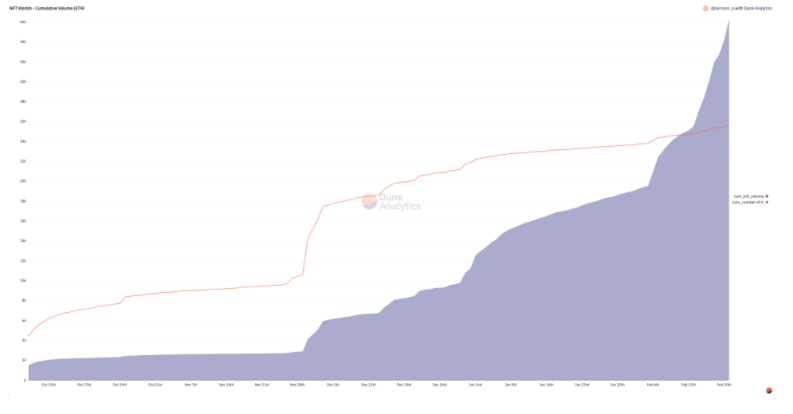
A new entrant to the industry is NFT Worlds, founded in October 2021, which has drawn attention due to its rapidly rising trading volume.
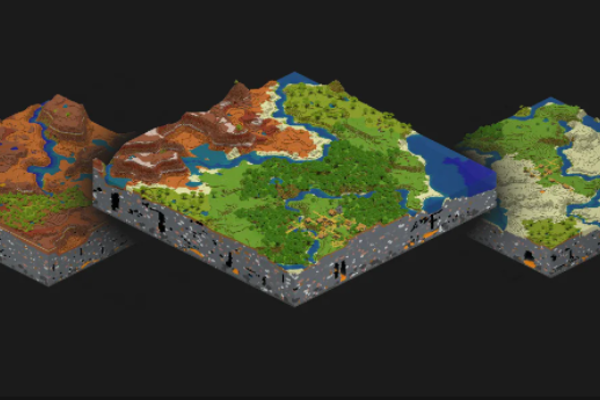
The Sandbox and NFT Worlds are similar in that both are voxel-based creator games, much like Minecraft.
But unlike Minecraft, both The Sandbox and NFT Worlds incorporate blockchain infrastructure to incentivize play-to-earn (P2E) mechanics. This means players can own digital assets within the game as non-fungible tokens (NFTs), while also earning cryptocurrency ($SAND or $WRLD) by playing the game.
In this article, we will introduce NFT Worlds and compare it with The Sandbox in terms of world scale, token utility, and price performance. We will also discuss the advantages of NFT Worlds' approach and potential future risks.
Introduction to NFT Worlds
It's impossible to introduce NFT Worlds without mentioning Minecraft. This is because NFT Worlds consists of a collection of 10,000 unique worlds, forming a decentralized, playable, and earnable ecosystem within the broader Minecraft metaverse. What does this mean?
Any Minecraft player can generate an infinite number of free worlds; currently, there are over 18 trillion Minecraft worlds in existence.
What sets NFT Worlds apart?
NFT Worlds features an integrated blockchain layer that enables players to create and experience play-to-earn games within these worlds.
This is made possible by Minecraft’s long-standing, rich open-source MOD community.
"...We knew that to remain competitive in the rapidly expanding NFT metaverse gaming sector, we needed to leverage existing open-source gaming ecosystems to bootstrap our vision, drive vibrant community development, foster community spaces, user-created games, and interconnected worlds." —— NFT Worlds Whitepaper
This "bootstrapping" approach offers several advantages. First, it saves significant time by eliminating the need to build a new game engine from scratch. In fact, just five months after launch, NFT Worlds already offers four playable worlds, with 90 more in development. In contrast, The Sandbox took four years to release its alpha version in November 2021. Another advantage is that it allows millions of existing Minecraft players to discover NFT Worlds and start playing immediately.
Comparison
Scale Comparison
Next, we will compare the amount of virtual real estate available in NFT Worlds versus The Sandbox. All available virtual land in The Sandbox forms part of a single virtual world representing approximately 1,530 square kilometers (relative to avatar size). This world is divided into 90,601 plots, each linked to an NFT and representing about 96 square meters per plot (relative to avatar size).
On the other hand, like The Sandbox, NFT Worlds is not just one single virtual world. Instead, it is a collection of 10,000 unique worlds. Each of these worlds is tied to an NFT and represents an area of 500 square kilometers (relative to avatar size).
Impact on NFT Prices
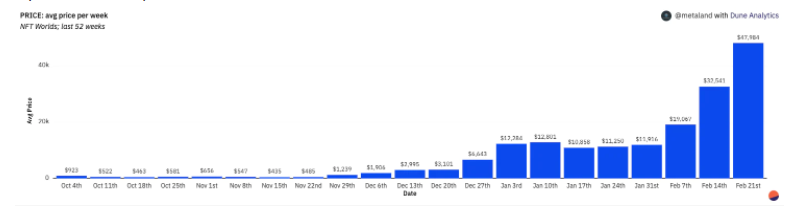
When comparing The Sandbox land with NFT Worlds land, the top-down or bottom-up comparison method significantly impacts NFT pricing. While NFT Worlds offers vastly more land than The Sandbox, it has far fewer purchasable NFTs—10,000 vs. 90,601. This scarcity has driven the price of each NFT World from free minting in October 2021 to over 15 ETH (approximately $42,000).
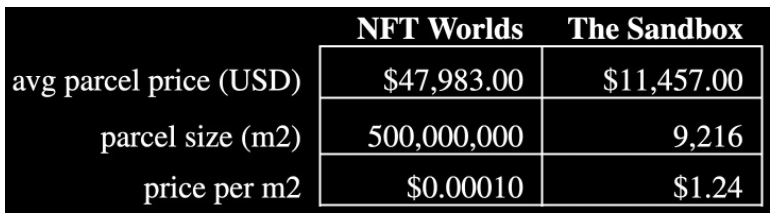
It should be noted that players can combine The Sandbox plots into larger estates. Conversely, in NFT Worlds, owners can subdivide their worlds into smaller plots. Additionally, The Sandbox may potentially add more land or generate additional worlds in the future. The per-square-meter price breakdown for subdivided land in NFT Worlds and The Sandbox can be seen in the table below.
Staking/Renting
A unique feature of NFT Worlds is that world owners can earn the platform’s native token, $WRLD, simply by staking their world. The Sandbox also plans to offer a similar functionality for landowners, but it has not yet been implemented. Both platforms plan to introduce rental features in the future, allowing land/world owners to receive additional $SAND or $WRLD payments from renters. Renters will also have the ability to earn revenue from games they create on leased land.
Tokenomics
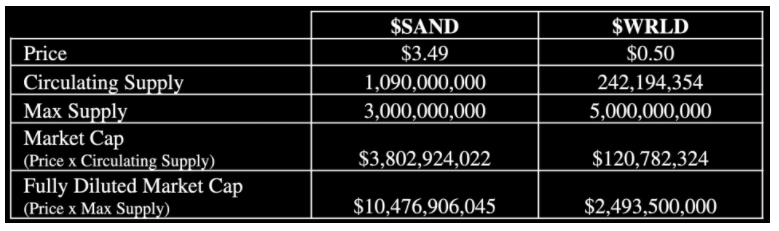
Both NFT Worlds and The Sandbox have native tokens—$WRLD and $SAND, respectively—which serve similarly as the primary medium of exchange within their platforms. Players can earn native tokens by playing games, or by creating and selling in-game assets such as wearables. Owners can also charge players fees in native tokens for accessing content on their land or world. Below is a comparison of the tokenomics of $WRLD and $SAND. Note that approximately 36% of $SAND’s maximum token supply has been released, while only about 5% of $WRLD’s maximum supply has been released so far.
Initial Token Distribution
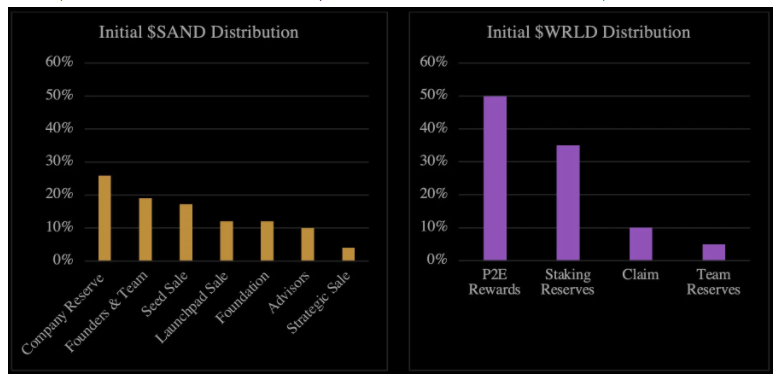
The initial distribution of native tokens for these projects highlights differences in funding and incentive strategies. The Sandbox adopted a more traditional equity financing model, allocating most of its tokens to the founding team and early investors. In contrast, NFT Worlds reserved the majority of its tokens to incentivize players and world owners, leaving relatively few in team reserves. Both projects have released only a small portion of their maximum token supply and plan to distribute the remainder over a five-year vesting schedule.
Potential Risks
NFT Worlds’ “bootstrapping” strategy carries several risks. The first is that the high price of each NFT World may deter potential game developers. If current Minecraft players can freely create their own Minecraft worlds outside the NFT Worlds ecosystem, why pay 10 ETH (around $30,000) for an NFT World? Of course, builders could choose to rent instead of buying, but rental prices are set by NFT World owners, so those prices must remain reasonable. Currently, players can earn approximately $20 worth of WRLD tokens per hour of gameplay. Game creators will need to weigh the costs and benefits to determine if it’s worthwhile. Moreover, there's a broader concern that players may not want their games to be financialized—perhaps adding too much pressure to what should be a relaxing activity.
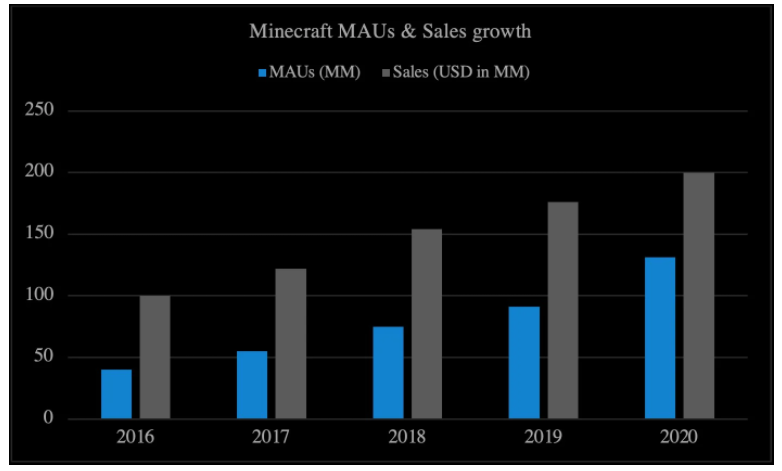
Another potential risk is the gradual migration of Minecraft players to other games like The Sandbox or Roblox. However, Minecraft’s monthly active users (MAUs) and sales data over the past five years suggest the game continues to grow in popularity.
A more plausible risk is the emergence of competitors—or even Minecraft itself deciding to implement P2E incentives, competing directly with NFT Worlds within the Minecraft ecosystem. More P2E opportunities would benefit gamers overall, but could undermine expected returns for NFT World owners and $WRLD token holders.
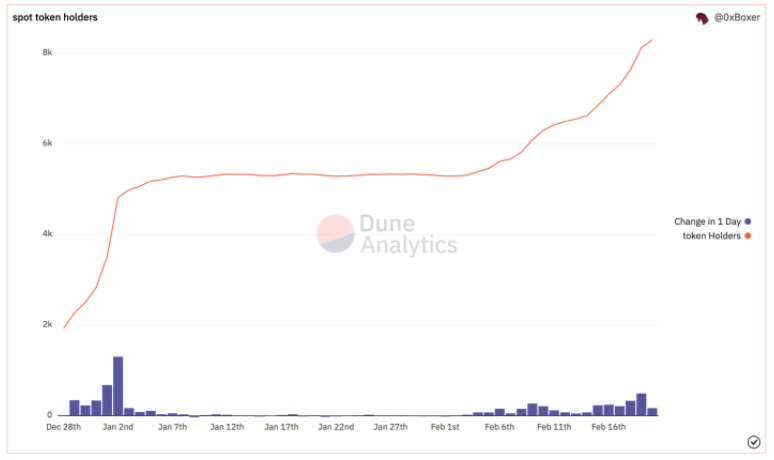
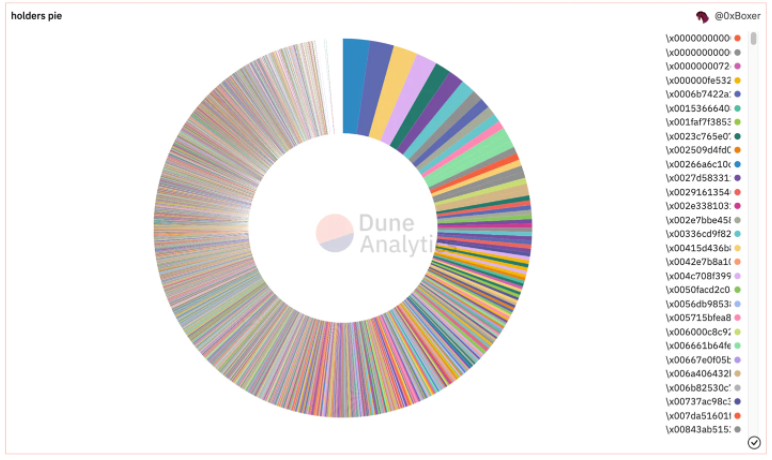
A final risk commonly seen in early-stage crypto projects is whale accumulation and potential dumping of token supply. Current wallet holder data shows that $WRLD tokens are being distributed across increasingly more wallets over time, indicating growing decentralization of ownership. However, since only 5% of the maximum token supply is currently in circulation, this distribution trend should continue to be monitored going forward.
Number of token holders over time:
Holder distribution pie chart:
Conclusion
Overall, NFT Worlds and The Sandbox share a similar vision for creator-driven games. Both offer comparable land/world utilities and have similar tokenomic structures for their native tokens. However, NFT Worlds places greater emphasis on player incentives, offering attractive P2E rewards and ownership-based equity incentives. By integrating into the thriving creator game Minecraft, NFT Worlds has accelerated game development. While this strategy carries certain risks, early investors and gamers appear passionate and optimistic about NFT Worlds’ potential.
Join TechFlow official community to stay tuned
Telegram:https://t.me/TechFlowDaily
X (Twitter):https://x.com/TechFlowPost
X (Twitter) EN:https://x.com/BlockFlow_News






