








Meta Connection | Guoooooog: The Metaverse Enables Crypto Artists to Create Continuously
TechFlow Selected TechFlow Selected
Meta Connection | Guoooooog: The Metaverse Enables Crypto Artists to Create Continuously
Placing crypto art into the metaverse enables works to be continuously created, and the artist's 'lens' will no longer be aggressive.
 Navigating Web3 tides with focused insights
Interview/Text: Fang Qinyu
Guoooooog, an emerging crypto artist, has over ten years of experience in museum design, stage design, and art exhibition design. He holds a Master of Fine Arts from the School of Experimental Art at the Central Academy of Fine Arts.
In an interview with Meta Friends Club’s "Meta Connect," Guoooooog shared that the biggest challenge in transitioning from a traditional artist to a crypto artist was learning programming from scratch, as crypto art demands both artistic expertise and coding skills.
“I believe placing crypto art within the metaverse enables continuous creation, and the artist’s ‘lens’ will no longer be intrusive,” said Guoooooog.
He has already launched two NFT series on the market—“Grab NFT” and “Timestamp”—which explore human nature and emotions.
Below is the full interview:
I. The Metaverse Needs the Business of Galleries
Meta Connect: We first met at a discussion on the metaverse. In your view, what is the relationship between the metaverse, NFTs, and crypto art?
Guoooooog: I see the metaverse as the infrastructure for NFTs, while NFTs are essentially a subcategory within the metaverse.
If crypto art is realized within the metaverse, it allows artists to create continuously, removing many constraints present in the physical world. For example, when an artist creates and interacts with people in the physical world—especially in social experiments or performance art—the participants may not wish to engage. But in the metaverse, the artist can become like a camera lens, yet one that is no longer intrusive or aggressive.
Meta Connect: At that event, the host argued that hardware isn’t a sufficient condition for the metaverse experience because 2D vs. 3D is ultimately a user choice. What do you think?
Guoooooog: I disagree. Achieving the metaverse still requires hardware—not just for vision, but also for taste, touch, and bodily sensation. Only with hardware foundations can we approach, or even surpass, real-world sensory experiences. It's not merely about choosing between 2D and 3D.
Meta Connect: How do you predict the integration trend between China’s art industry and the metaverse in 2022?
Guoooooog: Live concerts, music performances, theater, and art exhibitions might begin taking place in the metaverse. While some attempts exist now, they’re still very primitive and haven’t delivered strong experiences. Things may improve in the second half of the year. I’ve had friends in theater and live performance ask me how to integrate with the metaverse. I believe interactivity should be emphasized—focusing on aspects impossible in the physical world, which is exactly where the metaverse excels. Also, I think there’s potential in combining art galleries with the metaverse.
Meta Connect: I remember you once said gallery models wouldn’t work in the metaverse. Why has your view changed?
Guoooooog: I don’t think that anymore. Galleries act as intermediaries, and they won’t disappear anytime soon. Even if artists enter the crypto space to issue and sell their works directly at scale, they still face challenges in distribution, promotion, operations, and sales. Artists have limited bandwidth—they can’t handle both R&D and marketing alone. If galleries move into the metaverse, their role may shift compared to the physical world, but their core function—supporting and managing artists—will remain unchanged.
II. The Challenge for Traditional Artists Transitioning to Crypto Art Lies in Learning Programming
Meta Connect: I know you’re working on NFT projects. Could you introduce them? And what are your current priorities and goals this year?
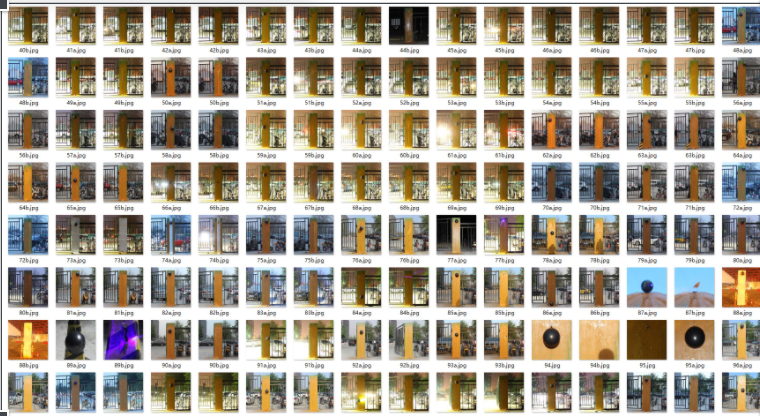
Guoooooog: I’m currently developing three different series. The first is the “Timestamp” series, continuing my earlier concept of popping one balloon every day. Building on that, I’m exploring elements like balloons, lasers, explosions, and rectangles, using code to visually express that sense of tension and danger.
Timestamp – Partial screenshot
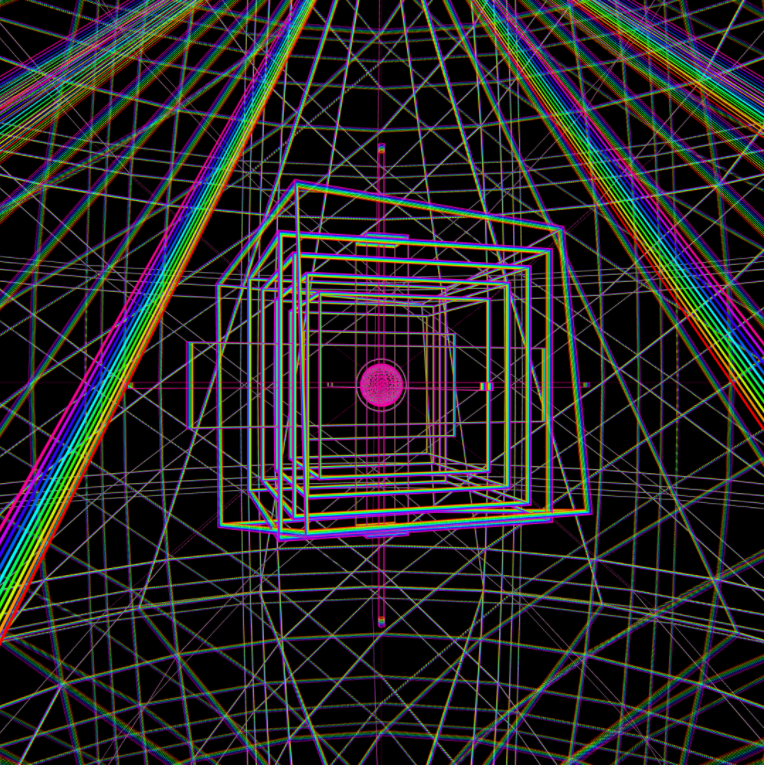
The second is the “Theater” series, which I’ve just started. This series focuses on emotional expression. Whether in crypto art or traditional art, the main goal of a piece is to evoke emotion—visual, tactile, auditory, or gustatory—on a sensory level.
Theater - Awake#6 – Video screenshot
The third series is “CryptoContext.” I’ve created the “Grab NFT” series, where I turned my personal experience of grabbing NFTs into poetry, then used code to visualize it. I added interactivity by posting it on Twitter for comments, then randomly selected comments for secondary creations.
CryptoContext Series: "Grab NFT" – Video screenshot 
"CryptoContext" series of “Comments of Grabbing NFT” #arain – Video screenshot
Recently, I’ve been diving deeper into the crypto community to understand what they’re doing and thinking, so I can inform my future work.
As for my goals this year, I hope to further refine my series and gain broader recognition.
Meta Connect: How has your recent learning process felt?
Guoooooog: Online learning feels very fragmented to me—there’s no system. But since I already have a seed idea, these fragments serve as fertilizer for growth. Mostly, I gather raw materials online, but it’s exhausting because much of it is useless, wasting a lot of time. Still, for a completely new field, this process is necessary. I must invest significant time and energy to access the latest information, sort through it, extract valuable knowledge, verify it, correct it, and gradually build my own system—a continuous loop.
Meta Connect: I know your current work differs greatly from your past work. Can you elaborate on the differences, the biggest challenges, and how you’ve addressed them?
Guoooooog: After entering the crypto world, I found many of my old methods no longer worked. Crypto art is a different domain—you must learn to code. Code is the productive force of this era. Coming from a humanities background, not computer science, it’s been quite difficult.
My solution is to base learning on creation. I first conceptualize the form of a piece I want to make, then search for relevant coding tutorials. The problem is these tutorials assume prior knowledge, so I didn’t understand much at first. Later, I started breaking down each command, mastering a few per day. That made learning faster.
Meta Connect: Doesn’t this frustrate you? Why are you so determined to join the crypto art movement?
Guoooooog: Because crypto art is the art of our time. Entering now still offers vast room for exploration.
III. Most Interested in Generative Art; Most Admires Artist PAK
Meta Connect: Which crypto artists do you follow, and why?
Guoooooog: The first is Matt Kane. His recent work “Gazers” on ArtBlocks takes the common crypto phrase “TO THE MOON,” using the moon and the concept of time to generate various evolving moon forms that mimic the progression of human civilization. Using the moon as a metaphor, gazing at it becomes like observing phenomena in the crypto market—inviting deep reflection. Before launch, Matt even created a detailed video explaining the work, showing great care.
The second is Steganon. His new piece “Autology” explores encoding/decoding, compiling/decompiling, and format conversion. Here, the generated image becomes secondary—the focus shifts from visual aesthetics to the code itself being parsed by other code.
I especially want to mention PAK. He embodies both artist and programmer—a combination that makes him far more powerful than typical artists. PAK’s works are interactive. His recent NFT “Censored” features a slash, symbolizing that Assange is still imprisoned; when the slash disappears, it means Assange has been released. I find such works incredibly compelling.
Meta Connect: When did you first start paying attention to the NFT space? What triggered your decision to enter this field?
Guoooooog: Last March, Beeple’s artwork “Everydays: The First 5000 Days” sold for around $69 million, causing a stir in the art world. I saw many friends discussing it and thought it was fascinating. In April, I attended a crypto hackathon hosted by BCA, featuring speakers like Cao Yin, REVA, and Tang Han. That deepened my understanding and slowly drew me into the industry.
Meta Connect: I know you also invest in NFTs with some success. What specifically have you bought, and any insights to share?
Guoooooog: Mainly two categories: investments, mostly PFP (profile picture) avatars, and personal interest—generative art I follow closely.
The most memorable was Rivermen, the first NFT project I bought, opened via blind box.
Interestingly, many generative art NFTs I purchased purely out of liking actually made money, while some investment-driven purchases ended up worthless.
Moreover, the investment logic for generative art NFTs differs greatly from PFPs. PFPs require quick entry and exit, while generative art should be chosen based on personal taste. Of course, if lucky, landing a rare piece can yield huge returns. One of my early purchases turned out well—I got lucky and profited handsomely.
Meta Connect: You mentioned artists inevitably become KOLs in this space. Is this a Web3 trend? Any thoughts as an artist?
Guoooooog: Yes, there’s an interesting phenomenon: everyone talks about decentralization, yet KOLs remain highly centralized. I believe the future of Web3 should belong more to creator economies. Right now, whether you’re a creator or user, your data largely resides with big tech companies. In the future, it should live on blockchains—your data, truly yours.
As Andy Warhol said, everyone will be famous for 15 minutes. If you consistently deliver value in this space and earn recognition, visibility comes faster than in traditional fields.
Join TechFlow official community to stay tuned
Telegram:https://t.me/TechFlowDaily
X (Twitter):https://x.com/TechFlowPost
X (Twitter) EN:https://x.com/BlockFlow_News






