









Bankless: 13 Red Flags of a Bad NFT Project
TechFlow Selected TechFlow Selected
Bankless: 13 Red Flags of a Bad NFT Project
What characteristics define a bad NFT project? What key red flags should one watch out for?
 Navigating Web3 tides with focused insights
Original Title:《NFT project red flags》
Original Author: William M. Peaster, Bankless
Translation: Alex, TechFlow
Dear Bankless Nation,
When it comes to great NFT projects, we value talented creators, innovative mechanisms, and vibrant communities as key strengths.
But what about bad NFT projects? What are the warning signs to watch out for?
Below, I’ve compiled thirteen red flags to consider when researching new NFT projects. These range from negligence to outright manipulation—so let’s protect our crypto assets wisely.
1) Unsustainable Mint Price
There’s plenty of room for debate over what constitutes a “reasonable” NFT mint price—no single answer fits all. However, if a new team sets their NFT mint price significantly higher than that of its predecessors or similar projects, this suggests they may be more focused on taking your ETH than building lasting value.
2) Suspicious Social Media Activity
An NFT project suddenly messages you to draw attention to an upcoming sale—an event you already saw mentioned in a tweet just hours ago. You click on the project’s profile and notice:
1) None of your follows follow this project
2) Despite being new, it has an unusually large number of followers. These are red flags! Legitimate projects don’t rely on DMs or Web2-style ads to grab individual attention—they generate organic traffic and don’t buy followers.
3) Artificial Floor Price Manipulation
Have you seen project founders openly discussing or actively propping up a specific NFT floor price? Run—run fast. They’re running a financial scheme with little genuine interest in cultural value or community. This lack of authenticity will eventually catch up with them, so remain cautious.
4) Abusive Discord Moderation
A major red flag arises when an NFT team bans Discord members for asking reasonable questions. We want inclusive, transparent projects—not combative, secretive ones. Teams should not abuse their moderation powers without valid justification.
5) No Audit
Security audits aren’t perfect, but they do provide essential safety checks. In Web3, we prefer using audited DeFi and NFT projects because unaudited infrastructure is more vulnerable to exploitation. The problem? Audit firms are overwhelmed with demand. Some new NFT teams don’t want to wait and launch unaudited systems to seize opportunities. Proceed with caution.
6) Poor Design
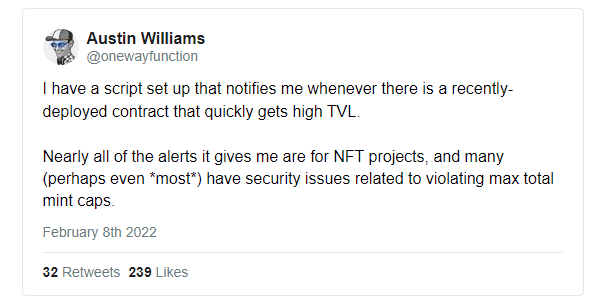
Poorly designed projects can lead to bugs, gas inefficiencies, exploitable mints, and more. For newcomers and non-technical users, evaluating bad code is difficult. Follow those who know more and learn from their judgment.
7) Low-Quality Art
If the artwork looks like it was churned out by a Fiverr content farm in under an hour, it probably was. If the NFT team doesn’t care about their art, why should you? Remember, there’s a vast difference between tasteful/minimalist/quirky/absurd art and plain garbage. Judge for yourself—but in my experience, such projects speak volumes through their quality (or lack thereof).
8) Selling Whitelists
A troubling new trend I’m seeing is NFT teams selling their own whitelist spots. Wow. That’s straight-up cash grabbing.
9) Overpromising
Are creators claiming their new NFT collection is “blue-chip quality” and will become the next Bored Ape Yacht Club (BAYC)? Is the roadmap metaphorically reaching for the moon—or promising the first NFT marketplace on the lunar surface? Avoid projects built purely on hype and empty promises.
10) Fully Anonymous Team
Having a fully anonymous team isn’t inherently problematic. People have a right to privacy, and in many cases, project quality, codebase, and track record should speak for themselves. However, in the worst-case scenario, fully anonymous teams can drain liquidity and disappear with little accountability.
11) Lack of Experienced Background
Teams lacking prior NFT experience are more likely to fail compared to those with seasoned NFT veterans.
12) Unverified on Etherscan
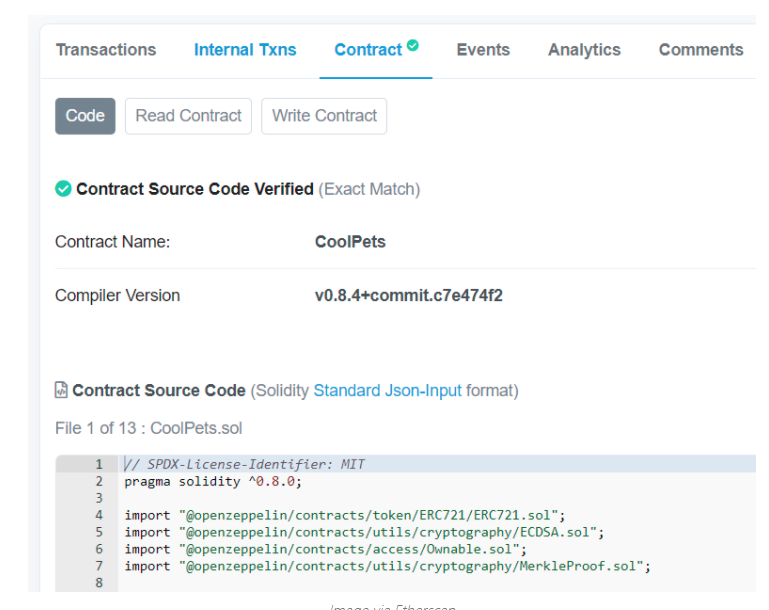
Verifying your code on Etherscan assures the public that it functions correctly on Ethereum. Using unverified smart contracts means you lack this basic performance guarantee. Always check before participating. For example, see how the Cool Pets smart contract is verified by its checkmark status—be wary of projects without such indicators.
13) Uneven Holder Distribution
Say a 10k PFP project catches your eye, but upon checking its OpenSea page, you find ownership concentrated among just a few hundred wallets. This extreme concentration means these few holders can heavily influence the market.
Conclusion
Some of the red flags listed above carry more weight than others—like abusive Discord behavior. Others, such as having a fully anonymous team, aren’t always decisive but still warrant caution. Develop the habit of spotting these signals so you can navigate your NFT journey more wisely.
Join TechFlow official community to stay tuned
Telegram:https://t.me/TechFlowDaily
X (Twitter):https://x.com/TechFlowPost
X (Twitter) EN:https://x.com/BlockFlow_News






