








Multicoin Capital: Understanding the Characteristics and Potential of Project Galaxy, a Core Component of the Web3 Stack
TechFlow Selected TechFlow Selected
Multicoin Capital: Understanding the Characteristics and Potential of Project Galaxy, a Core Component of the Web3 Stack
Credential networks and on-chain digital identity are core components of the Web3 stack. With this funding round, Project Galaxy can now serve the entire on-chain crypto ecosystem.
 Navigating Web3 tides with focused insights
Author: Mable Jiang, Partner at Multicoin Capital
Original title: Investing in Web3 Credentialing
Translated by: Hu Tao, ChainCatcher
On January 25, the Web3 credentialing network Project Galaxy announced a $10 million funding round led by Multicoin Capital and Dragonfly Capital, with participation from Spartan Group, Coinbase Ventures, Binance Smart Chain Growth Fund, Solana Ventures, Alameda Research, and others.
Below is the research report published by Multicoin Capital on the same day:
Web3 Credentials
There are many types of certificates that can represent people's achievements or contributions. Historically, credentials were shared via resumes and typically took the form of certifications issued by institutions such as universities, governments, or training programs.
In contrast, Web3 credentials exist on-chain. While they are similar in concept to traditional credentials earned through proof-of-work, the "work" here could be someone’s on-chain contributions—such as how long they’ve provided liquidity to a pool or how many Snapshot votes they’ve participated in within a community. They can also represent useful off-chain data brought onto the blockchain, such as contributions to community proposals or the number of forks they've created on GitHub.
One of the most well-known Web3 credential projects is POAP (Proof of Attendance Protocol), which issues NFTs marking verifiable participation in significant community events. (Note: The “credential data” referenced in this article refers exclusively to public data. Other forms of credential data may involve private or semi-private information; Project Galaxy plans to offer such capabilities in the future.)
Currently, credential data can be used in multiple ways. Here are some examples:
1/ Active users of certain DeFi protocols may qualify for greater voting power per token compared to passive holders;
2/ Individuals who helped promote an idea or proposal on Twitter during a specific period (e.g., retweets or comments) might receive priority access in a new token distribution;
3/ Users who have interacted with certain contracts may qualify for rewards in targeted growth-hacking campaigns; and
4/ Players achieving certain milestones in games may qualify for fast-tracked recruitment into specific guilds.
Web3 credentialing enables entirely new methods for flywheel effects and organic growth in Web3 applications—something previously impossible. Beyond simply measuring token ownership (which naturally gives more power to whales), Web3 credentials represent qualitative data that helps describe an address’s profile—a dimension whose value has historically been ignored.
The democratization of credential data effectively introduces a new (and better) way to allocate power among community members beyond token-based voting alone. For non-quantifiable behavioral data—especially off-chain activity—the mechanism allows communities to favor and reward “true fans,” even if they aren’t the largest token holders.
The Galaxy Network consists of two core components: a credential network and modular tools that help users interact with credentials. These modules are pre-configured to deliver different functionalities, such as targeted airdrops, task-based giveaways, access to closed communities, or Sybil-resistant token distributions.
The workflow for interacting with the Galaxy Network is straightforward: Curators permissionlessly contribute credentials to the Galaxy Network, expanding the available audience. Then, users of the Galaxy Network (i.e., Web3 protocols and communities) can run credential-based activities using selected sets of credentials via Galaxy Network modules. They can also integrate Project Galaxy’s credential oracle directly into their smart contracts so that it always targets the most up-to-date and qualified groups of credentials.
By decoupling the credential oracle from NFT badge issuance, users of the Galaxy Network can map credentials to the right individuals without restricting the transferability or speculative potential of NFT badges. Whenever a protocol requests data, the oracle delivers the latest credential status. NFTs are minted purely for demonstration purposes—as snapshots of credentials. Once credentials are contributed to the network, the more datasets are used, the higher the revenue curators can earn.
The Credential Flywheel
As I mentioned above, this marks our second investment in the project. Since our initial evaluation, they’ve come a long way.
Prior to working on Project Galaxy, Harry and Charles co-founded Lino Network and DLive. I met this team back in 2018, and they struck me as one of the most capable, hardworking, and ambitious teams in Web3. However, since the infrastructure wasn't ready for decentralized social platforms in 2019, Lino / DLive was eventually acquired by BitTorrent. Two years later, they continued pursuing their vision—this time through credentialing.
A credential network doesn't magically assemble itself by simply plugging query middleware into blockchains. Because the data required to create valid credentials is fragmented, building a credential network—especially at scale—is extremely difficult. Fortunately, this team has long been committed to solving these challenges and, in the process, has accumulated one of the largest Web3 credential datasets in the world. It now includes subgraph queries, on-chain snapshots, governance histories, proof-of-attendance records, and databases tracking interactions with Web2 applications. Throughout running various campaigns, Project Galaxy has also identified commonly used engagement modules and continuously added missing ones to the Galaxy suite.
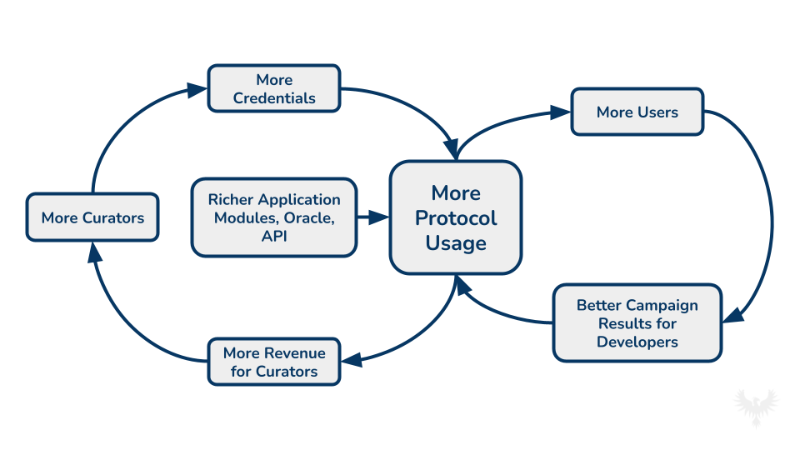
This creates an organic flywheel: 1) With the richest dataset and most user-friendly engagement modules, Galaxy has become the go-to resource for projects seeking users; 2) As more users receive rewards based on credential data, others follow suit (producing desired behaviors) and generate even more credential data; 3) This growing usage of the Galaxy Network incentivizes credential curators to contribute more credentials, since the likelihood of their credentials being used (and thus earning them income) increases—creating a self-reinforcing cycle that attracts even more projects to adopt Project Galaxy.
Galaxy Credential Network Powers Web3 Identity
There are two approaches to building Web3 identity: top-down and bottom-up. Top-down identities are typically granted by institutions—for example, government-issued IDs. Bottom-up identities emerge from the sum total of prior actions, such as a personal brand defined by one’s tweets.
Project Galaxy is pursuing the next frontier. It will allow individuals to associate their credentials across different chains with a single Galaxy ID.
Project Galaxy’s bottom-up approach is powerful in several meaningful ways:
1/ There is no single, authoritative standard definition. For instance, any decentralized application can freely define its own scoring system using the underlying credential data in the Galaxy Network. An ID can have multiple scores (e.g., one from AAVE, another from Compound), and different applications can choose whichever score best fits their needs or which they trust most.
2/ Powering a Web3 LinkedIn. Web3 tasks (e.g., quests in Web3 apps and games) can find optimal matches based on users’ past activities and achievements across different chains. The Galaxy Network provides anyone with the data needed to curate customized resumes for recruiting talent: People can display their income history when joining a game guild, or showcase all participation badges earned from being selected as a community ambassador.
3/ Transforming the paradigm of targeted marketing. Web3 applications can bootstrap adoption by targeting the right audiences using existing Web3 credentials, offering incentives for specific behaviors. Replicating such precise targeting in Web2 environments—where public behavioral data is lacking—is far more difficult.
Credential networks and on-chain digital identities are core components of the Web3 stack. Until recently, they were simply not feasible due to the complexity and effort required to bootstrap them. With this funding round, Project Galaxy is now positioned to serve the entire crypto ecosystem across all chains.
As Web3 continues evolving and more sophisticated applications are built, we expect Project Galaxy to play a central role—not only in application development but also in cutting-edge marketing strategies—enabling truly native, crypto-native ways to engage and interact with users.
Join TechFlow official community to stay tuned
Telegram:https://t.me/TechFlowDaily
X (Twitter):https://x.com/TechFlowPost
X (Twitter) EN:https://x.com/BlockFlow_News
 Multicoin Capital


