








From Web2 to Web3: How NFTs Become the Foundation of Web3 Social
TechFlow Selected TechFlow Selected
From Web2 to Web3: How NFTs Become the Foundation of Web3 Social
With the development of Web3 and the Metaverse, the era in which we live will undergo changes in the future.
 Navigating Web3 tides with focused insights
By: Andrew Beal
Translation: TechFlow
This issue was inspired by several conversations with @anonalyx—it’s been a long time since a topic excited me this much.
This week we’re discussing social experiences in Web3. These ideas are very fresh, and I believe many aspects will continue to evolve in the coming issues. Here’s the background:
Web2 social experiences (also known as social media) refer to bringing offline life online—capturing real-life moments through photos or videos and sharing them on social platforms for others to consume, like, and comment on. It's like a personal reality show, with content drawn from our actual lives.
With the development of Web3 and the Metaverse, the era we live in is shifting: our virtual lives (what we do online) will become as interesting and share-worthy as our real lives—or even more so. Web3 social experiences are built upon this shift.
Spoiler alert: NFTs steal the spotlight.
Let’s zoom in…
Web2 Social → Web3 Social
Think about the similarities between platforms like Instagram, YouTube, and TikTok. When you boil it down, they’re all digital platforms for sharing real-life experiences. You can share vacation selfies on Instagram; upload a pre-recorded skit on YouTube; post a choreographed dance video with friends on TikTok.
All of this content stems from events in real life. Social media allows people who weren’t present to experience our real lives secondhand. In other words, our real lives serve as source material for Web2 social media content.
Another interesting aspect of social media is its reliance on visual content. With the exception of Twitter, every major platform thrives on visuals. Why is that?
Photos and videos are tools we use to capture real-life moments so we can share them with others. They are the only way we can visually convey our lives to those not physically around us.
Visuals also serve as proof that something happened—they are evidence. Undeniably, our entire social media presence forms the foundation of our online reputation. As long as I show you a collection of exciting photos and videos from my life, you’ll believe these experiences were real. Your perception of me is entirely based on these images and videos.
We carefully select which moments to share, curate them into slideshows, and present them to the world via our Instagram profiles or YouTube channels. This content aggregates into a highly curated version of our lives.
Let’s summarize Web2 social media:
1) Real-life experiences as raw material
2) Reliance on visual content (photos, videos)
3) Carefully curated presentation of the version of our lives we want others to see
Now, we're transitioning into the next era: our virtual lives—our online activities—are becoming just as interesting and worth documenting as our real lives. We can own virtual items; earn digital credentials; work for DAOs; and build brands and audiences purely based on our virtual activities. The next generation of social platforms will be digital tools for sharing our digital lives.
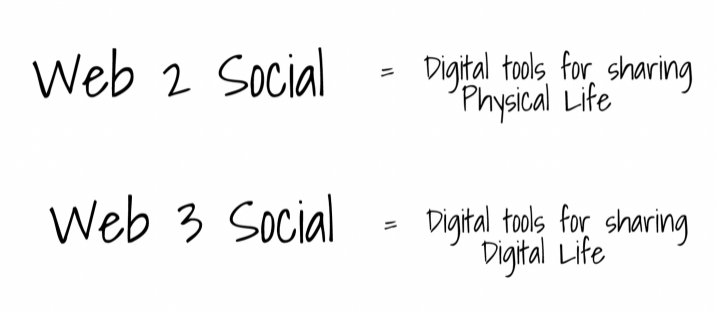
If real-life moments, experiences, and possessions are the raw material for Web2 social, then virtual moments, experiences, and assets will be the raw material for Web3 social.
So, how do you record these digital moments, experiences, and assets?
The answer is NFTs.
NFTs: The Foundation of Web3 Social
If you’ve read any recent article about the Metaverse, you’ve probably seen an image depicting a futuristic, video-game-like world—something straight out of *Ready Player One*. Last year, I used the image below in my Metaverse piece. Dozens of magazines and websites have used the exact same image in their own Metaverse articles.
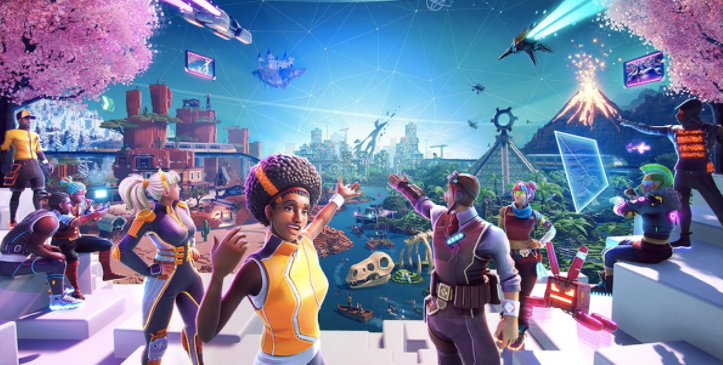
The problem is, today’s Metaverse doesn’t look like that. Current Metaverse experiences are still internet-based, mixed with some DApps and NFTs. We’re still staring at 13-inch screens, interacting through 2D graphics and web apps. We haven’t achieved full immersive virtual reality yet.
However, even without full immersion, we can already start creating assets to populate these virtual worlds. NFTs and their associated images are the first generation of Metaverse visual content.
If you’re wondering when the transition to Web3 social will begin, it started the moment NFTs became PFPs (profile pictures) on Twitter. A seemingly silly, trivial act marked the beginning of a new social phase.
It was the first time people used social media platforms to showcase their virtual lives instead of their real ones. The visual of an NFT signals to viewers, “I own this,” just like a photo of a new sports car says, “I own this.”
Before concluding this trend analysis, remember one assumption: more and more online behaviors and achievements will increasingly take the form of NFTs. In previous issues, I called them micro-credentials, but broadly speaking, they’re a way to document our virtual lives. Think about it: many fragments of life fade over time. But seeing a photo instantly brings you back to that place and moment. NFTs don’t just prove ownership—they can also signify “I did this” or “I was there.”
Just as I proudly post photos on Instagram today, in the future I’ll proudly display NFTs in my wallet.
That’s the future of NFTs. They’re not just tools for recording digital ownership, but also tools for documenting digital actions. Web3 social functionality is the equivalent of a photograph.
In every online community, the most valuable members will use NFTs as badges of reputation. If you were a seed investor in a startup, you’d get an NFT; if you’re a member of an exclusive DAO, you’d receive an NFT. Everything you do—especially things you excel at—can be represented by an NFT. Within these communities, you gain recognition and elevated status. This is how online status games play out in Web3.
But what if you don’t want every aspect of your virtual life to be publicly accessible? Right now, that’s the default—anyone can view your wallet address and its contents. On Web2 social networks, I choose what to share. With Web3, everything is already shared. Hence, curation becomes critical.
Curation
Here’s an interesting thought experiment: imagine an Instagram for the Metaverse. You can’t share photos from real life—so what would you share?
How about sharing your avatar, digital art, and other NFTs (which could represent anything)?
You can prototype this idea by connecting your MetaMask wallet to OpenSea and viewing your “Profile.” All your NFTs appear in a gallery view, typically ordered chronologically by acquisition date. NFT galleries are the first-generation social media profiles of Web3/Metaverse.
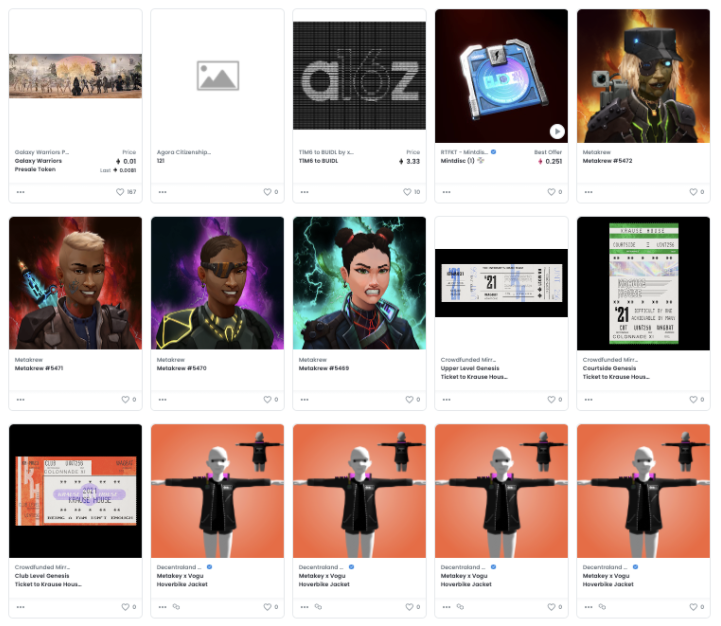
Currently, NFT galleries display every NFT in your wallet. But when our wallets contain hundreds of NFTs, the question becomes: “Do I want to show them all?” Just as we spend hours selecting and editing content for Instagram, we can naturally expect similar levels of curation and self-awareness around NFT galleries.
The next generation of NFT galleries will improve curation features—allowing users to hide, rearrange, categorize by community, etc. Keep an eye on Islands.xyz.
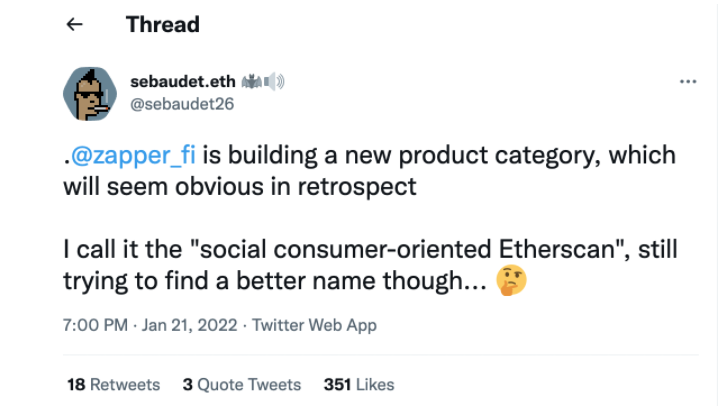
But the real breakthrough will come when you can discover and connect with others—true social interaction. There isn’t a strong example yet, but projects like Context and Zapper are poised to lead. Context delivers NFT transfer and sale activity in a “news feed” format, while Zapper is making notable progress (see screenshot).
Finally
Image-based NFTs are just the beginning. We don’t fully live in virtual worlds yet. But imagine one day posting a video of your avatar dancing.
Join TechFlow official community to stay tuned
Telegram:https://t.me/TechFlowDaily
X (Twitter):https://x.com/TechFlowPost
X (Twitter) EN:https://x.com/BlockFlow_News






