








WEB3 Outlook: Social, Music, and Fan Economy
TechFlow Selected TechFlow Selected
WEB3 Outlook: Social, Music, and Fan Economy
Web3 is a broadly defined term, with one mainstream interpretation being the use of blockchain technology to decentralize the internet based on Web2, enabling users to own and control their own data.
 Navigating Web3 tides with focused insights
Author: Cipholio Venture
Translation: Alex, TechFlow
I. The Significance of Web3 for Users
Web3 is a broadly defined term, with one mainstream definition being the use of blockchain technology atop Web2 to achieve decentralization, enabling users to own and control their data.
Previously in Web2:
-
Centralized platforms held user data and content, creating risks of data breaches;
-
Data could not be shared across platforms; users were also vulnerable to centralized censorship, blocking, and other penalties;
-
Users had no access to revenue sharing from centralized platforms.
Therefore, Web3 is seen as a solution to these problems.
However, changing user habits is not easy. To attract more users into Web3, tangible benefits must be delivered. In this process, cryptocurrency will play a crucial role at the incentive level. The introduction of crypto can transform profit distribution mechanisms, allocating platform revenues to creators and users while breaking down the barriers of centralized platforms and re-establishing user data rights.
II. Which Web3 Sectors Are Worth Watching?
We believe that as users accumulate value and time spent on Web2 platforms, the best way to attract them is through re-innovation using the Web3 paradigm.
Take GameFi projects as an example: the Play-to-Earn model redistributes income traditionally captured by game companies back to players.
Beyond gaming, which other sectors consume significant user time without allowing users to earn a share of platform profits?
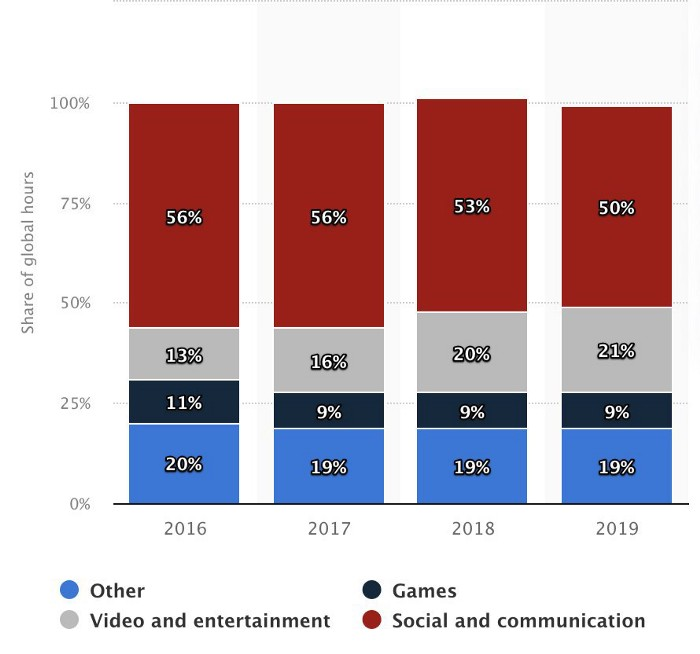
Figure 1: Global Mobile Screen Time by App Category from 2016 to 2019 (Source: Statista)
This bar chart shows that users spend the most time on social media and entertainment apps, indicating that these sectors also hold immense potential within Web3.
(1) SocialFi
Socialization is an essential human trait. Whether in the Web1 or Web2 era, social applications emerged early and have had the greatest impact on industry development.
Looking back at internet history:
-
In the Web1 era (1993–2002), MSN launched in 1995 and QQ in 1998;
-
In the Web2 era (2002–2018), Facebook was founded in 2004, YouTube in 2005, and Twitter in 2006. Social apps helped spread emerging technologies at scale.
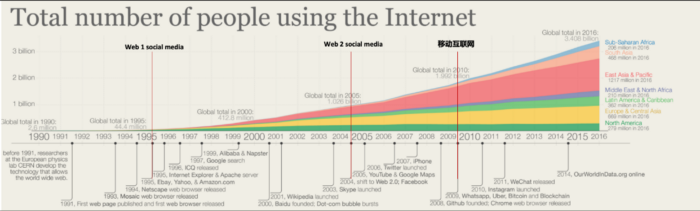
Figure 2: Growth of Internet Users from 1990 to 2016 (Source: Statista)
SocialFi and creator economies with social attributes are key directions for crypto adoption into the mainstream.
In Web2, centralized social platforms capture user data and the majority of revenue, raising privacy concerns. Blockchain, as a decentralized tool, has the potential to empower the industry and fundamentally transform production relationships.
Given the relatively small number of Web3 users, incomplete infrastructure, and subpar product experiences, SocialFi and creator economy applications are not yet ready for mass-scale growth. Leaders in the space will need time to emerge. While SocialFi may be a hot topic in the short term, infrastructure development remains more critical.
In Web2, an app is considered globally adopted only when it reaches 1 billion users. Based on this benchmark, we estimate that Web3 will achieve widespread user adoption globally by 2024. Current Web3 infrastructure still cannot support the volume of user-generated content and cryptocurrency circulation. For average DApp users today, entry barriers and usage costs remain high; additionally, the experience is often cumbersome and lengthy.
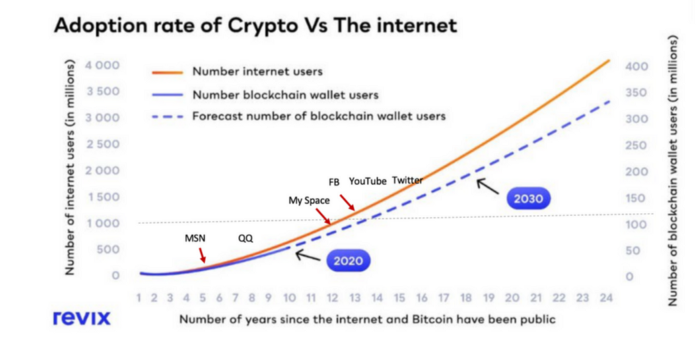
Figure 3: Crypto vs. Internet Adoption Rates (Source: REVIX)
The application layer of Web3 can only flourish once the underlying infrastructure matures. In 2022, SocialFi infrastructure is likely to be among the first to be developed. Key infrastructure areas currently receiving attention include public blockchains (Ethereum, Dfinity, Polkadot, etc.), decentralized identifiers (DID) such as ENS and Handshake, gateways like browsers and wallets (BRAVE, Phantom, etc.), decentralized storage (Arweave, etc.), data indexing (The Graph, etc.), and creator platforms (Mirror, Rally, etc.).
While it’s too early to identify clear leaders, some social applications may become early pioneers. Replicating traditional social media in Web3 is extremely challenging—it requires significant trade-offs, sacrifices of short-term gains, and lowering entry barriers to truly migrate users from Web2 to Web3. Centralized platforms like Facebook and Twitter are exploring Web3 initiatives, but due to entrenched interests and path dependency, they are unlikely to fully embrace Web3.
Web3 social projects need to redefine existing platform models, address real user needs, and improve overall user experience. We are optimistic about innovative social models leveraging crypto, AR, and other technologies—such as social gaming or social virtual content (GameFi, NFTs, metaverse applications with social features), or the integration of social platforms with DAOs.
We believe promising projects should meet the following criteria:
1) Low usage cost, weak UGC requirements, clear task objectives, and no reliance on large numbers of ordinary users as content creators.
2) Simple operations and smooth user experience.
3) A balanced and reasonable token economy that fully leverages the utility of tokens.
4) Unique selling points enabling rapid virality and low-cost user acquisition.
5) Strong sustainability with achievable, ongoing incentives for users.
(2) Music Projects
Beyond social apps, music projects represent another segment of the creator economy with strong potential for early growth in Web3. There is a vast number of niche music creators, including many professionals who remain underappreciated on Web2 platforms. Additionally, music-based projects have relatively low infrastructure demands. Therefore, music platforms could serve as an early bridge to bring more Web2 users into Web3. Investment opportunities exist in aggregated music platforms and music-related NFTs.
Key challenges facing Web3 music platforms include unclear liquidity models and copyright issues. For instance, Audius, a decentralized streaming platform, has not disrupted traditional streaming models nor effectively utilized its token. Its future trajectory depends on upcoming strategic moves.
In contrast, we believe music NFTs may see breakthroughs in 2022. On one hand, after the image-based NFT boom, users now have greater familiarity with NFTs, reducing education costs. On the other hand, leading investment firms are already entering the space, paving the way for more music NFT projects. The current challenge is that music NFTs mostly involve niche artists—greater involvement from well-known musicians is needed to expand influence.
(3) Fan Economy
Within entertainment—including music—the integration of NFTs with fan economies holds vast potential. Fan economies struggled to thrive in the Web2 era. But in Web3, through NFTs, fan economies can better realize community engagement, fan passion, and ownership-driven economic benefits.
Specifically, Web3 offers the following advantages:
First, pricing layers. Traditional advertising and subscription models rely on flat-rate pricing. In Web3, different products and services can be tokenized as distinct NFTs, enabling highly flexible monetization.
Second, direct interaction between fans and celebrities—intermediaries like record labels no longer take a cut.
Finally, users gain both economic returns and governance rights as they invest time and money, significantly boosting engagement.
The core of the fan economy lies with the fans. A key question in 2022 is whether the fan economy can trigger ripple effects across the NFT and crypto industries. As Web3 evolves and leading platforms grow their user bases, native crypto celebrities will gradually emerge.
Major celebrities face complex copyright issues, making direct NFT releases difficult. Therefore, the fan economy should not be limited to celebrity artworks. NFT asset carriers can be broader—merchandise, events, meetups, concerts, etc. Greater diversity in NFT offerings could attract more influential figures, drawing in larger fan communities.
III. Conclusion
Web3 is still in its early stages, and infrastructure development is critical. On the application side, widespread adoption requires both higher acceptance of cryptocurrency and compelling early applications to attract mass users.
Social applications, as a gateway to mainstream adoption, deserve close attention. We favor projects that innovate beyond current social models, address genuine user needs, and enhance the overall social experience.
Beyond social networks, the creator economy is another highly promising area in Web3. Music projects, with lower infrastructure demands, may flourish early. Additionally, the fan economy represents a key breakout direction where NFTs can play a pivotal role.
Regardless of sector, Web3 must solve commercialization. Token economies require sustainable capital inflows based on real utility and demand. In Web2, social media primarily earns from advertising—marketing expenditures by businesses based on concrete needs. Similarly, Web3 will need viable business models to generate solid revenue streams.
While definitive answers don’t yet exist, commercialization challenges will evolve alongside Web3's growth—just as diverse monetization models emerged during the early days of the internet, something unimaginable at the time. Amid the Web3 wave, let’s maintain optimism and openness as we learn and build.
Original link:
https://medium.com/@cipholioventures/outlook-for-web3-tracks-that-are-worth-paying-attention-to-in-2022-55b8375d3fc4
Join TechFlow official community to stay tuned
Telegram:https://t.me/TechFlowDaily
X (Twitter):https://x.com/TechFlowPost
X (Twitter) EN:https://x.com/BlockFlow_News
 Cipholio Ventures






