Vitalik Reflects on the Past Decade: PoS, BCH, L2, Past Mistakes, and Thoughts on the Future
TechFlow Selected TechFlow Selected
Vitalik Reflects on the Past Decade: PoS, BCH, L2, Past Mistakes, and Thoughts on the Future
"The cost of each transaction on the internet of money should not exceed five cents." This was the goal in 2017, and it remains the goal today. I still stand 100% by my view, and this is precisely why we spend so much time researching scalability.
 Navigating Web3 tides with focused insights
Author: Vitalik Buterin
Translation: Chain Explorer
1. In 2013, I wrote an article about "how Bitcoin could genuinely help Iranians and Argentinians." The core point: Bitcoin's main advantages are its international nature and censorship resistance, not the "21 million cap." I predicted that stable currencies would thrive.
Last week, I visited Argentina. My conclusion: largely correct. Cryptocurrency adoption is high, and so is stablecoin usage; many businesses already operate in USDT. Of course, this might change if the U.S. dollar itself starts facing more issues.
2. In 2013, I published an article on the consequences of regulating Bitcoin services. Core idea: Bitcoin’s censorship resistance stems not from belonging to a new legal category, but from technological implementation.
My view today: Yes, Bitcoin's decentralization allows it to “survive” under extremely hostile regulatory conditions, but it cannot “thrive.” Successful censorship-resistant strategies require both technical robustness and public legitimacy.
3. In 2015, I made predictions about when PoS and sharding would be achieved. Honestly, these were very wrong—and worthy of ridicule. Here's a screenshot from a 2015 talk of mine, so everyone can have an easier time laughing:
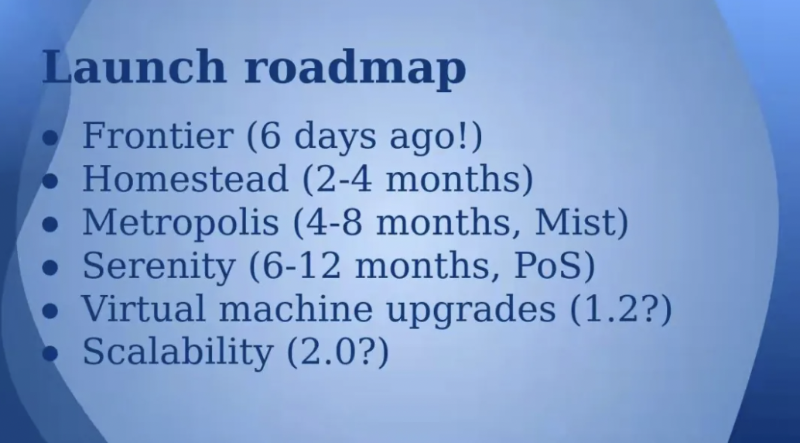
What was the core mistake? I severely underestimated the complexity of software development. Today, the Ethereum research team values simplicity—both in final designs and in implementation paths—and leans toward pragmatic compromises. Dankrad’s latest sharding design embodies this spirit.
4. “The cost per transaction on the internet of money should not exceed five cents.” This was a goal in 2017, and it remains a goal. I still fully stand by this view, which is exactly why we spend so much time researching scalability.
5. I should also add that the core concept of sharding has remained intact.
Blockchain 1.0: Every node downloads everything, with consensus
BitTorrent: Each node downloads only a few pieces, but no consensus
Ideal: BitTorrent-like efficiency, with blockchain-like consensus
Key supporting technologies come from communities, ZK-SNARKs, and data availability sampling.
6. In 2012, I was a supporter of PoW. Fortunately, by 2013, I became excited about PoS. By 2014, I changed my mind again.
This reflects a broader evolution in my thinking: from “X is something I must defend, so anything beneficial to X must be right” to “I like X, but X has flaws and Y seems to fix them; now I support X+Y.”
Soldier mindset → Scout mindset.
7. In 2014, I wrote about self-executing contracts. Essentially, it tried to argue that making society more like a formal system is good, and we should be excited about it.
Through extensive research, I’ve seen the limitations of this way of thinking: The problem with pushing everything into a formal system is that nearly any formal system with more than two participants is attackable.
8. I liked altcoins even before they became popular. See my article from September 2013 (two months before Ethereum’s inception). Three core arguments:
(i) Different chains optimized for different goals
(ii) Low cost of having multiple chains
(iii) Need for external forces if the core development team makes mistakes
Do I still agree today?
These points are less relevant today because (i) chains are more general-purpose, (ii) applications are more complex, making bridges riskier, and (iii) experimentation is feasible on L2.
Still, I believe there are things that cannot be done on L2, and space remains for different L1s.
9. I was particularly optimistic about Bitcoin Cash because, in the scaling debate, I agreed more with large-block proponents than small-block advocates.
Today, I consider BCH a failure. My main point: Communities formed around rebellion, even when they have good reasons, often face prolonged difficulties because they value courage over competence and rally around resistance rather than a coherent forward path.
10. Posts from 2016–2017 mostly encouraged building Uniswap.
“Do something simple and stupid, even if suboptimal”—while this is the current philosophy, it took me a long time to find justification for PoS and sharding designs.
11. Applications envisioned in the Ethereum white paper:
* ERC-20 standard tokens
* Algorithmic stablecoins
* Domain name systems (e.g., ENS)
* Decentralized file storage and computing
* DAOs
* Wallets with withdrawal limits
* Oracles
* Prediction markets
While incentivized file storage and computing haven’t materialized yet, many of these ideas proved correct (essentially predicting DeFi). Of course, I completely missed NFTs.
I’d say the biggest oversight in detail was the collusion problem in DAO governance.
12. In 2014, I published an article on stablecoins, much of which argued for using blockchain data as price references instead of relying on oracles.
I’m now more pessimistic about this, especially with the PoS transition—we need oracles. If we want stablecoins to be robust against a collapse of the U.S. dollar (by switching to local CPI indices if needed), we’ll require more active governance.
Conclusion:
* Back then, my thinking about politics and large-scale human organization was naive, overly focused on simple and complete formal models… I know better now.
* I did have strong early intuitions and avoided the craziest parts of Bitcoin maximalism. I made several early mistakes, but corrected them quickly.
* X being wrong doesn’t mean any resistance against X will succeed smoothly. It may face different organizational challenges.
* On the technical side, I was more accurate on abstract ideas than on software development. Over time, one must learn to understand the latter.
* I now deeply recognize that we need things simpler than I originally thought.
Join TechFlow official community to stay tuned
Telegram:https://t.me/TechFlowDaily
X (Twitter):https://x.com/TechFlowPost
X (Twitter) EN:https://x.com/BlockFlow_News
 @VitalikButerin