1confirmation partner's 2022 predictions: vertical NFT markets, cross-chain bridges, investment DAOs...
TechFlow Selected TechFlow Selected
1confirmation partner's 2022 predictions: vertical NFT markets, cross-chain bridges, investment DAOs...
Three predictions for 2022.
 Navigating Web3 tides with focused insights
Author: Richard Chen, General Partner at 1confirmation
Translation: TechFlow
This article has been authorized for translation and republication.
At the end of last year, I wrote an article predicting three under-the-radar product trends for 2021.
Before making my three predictions for 2022, let’s first review how last year’s predictions turned out.
1. Crypto Art
Verdict: Correct
While there have already been many articles this year about NFTs and crypto art, this chart perfectly summarizes the space.
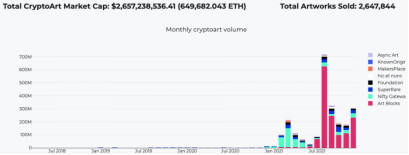
Let me reflect on two points I made in my 2021 prediction:
“Currently, DeFi maximalists treat NFTs as toys, reminiscent of how Bitcoin maximalists dismissed dApps back in 2018.” Those DeFi Twitter influencers who openly dismissed NFTs a year ago have suddenly shifted their stance—they’re now paying mint fees, selling PFPs (Profile Picture NFTs), and even raising NFT funds.
“There are currently three artists whose works are worth over $1 million, and 43 whose works exceed $100,000—I expect more by the end of 2021.” Today, four artists have total artwork valuations exceeding $100 million, 46 exceed $10 million, 268 exceed $1 million, and 1,283 exceed $100,000.
2. Prediction Markets
Verdict: Unclear
Polymarket saw a surge in volume around the January 2021 U.S. presidential election and inauguration. Trump supporters believing in #stopthesteal continuously bought “Trump shares” at 10 cents per dollar, giving those who didn’t believe a 10% “arb” (arbitrage) opportunity. But beyond one-off major political events like this, maintaining trading volume has always been challenging for prediction markets. I know prediction markets and decentralized social networks are two killer use cases for crypto, but the product-market timing still feels further out than I initially expected.
3. DeFi Derivatives
Verdict: Correct
I tweeted that in 2021, DeFi mostly iterated on incremental features (e.g., better stablecoins instead of stablecoins) or copied Ethereum projects onto other L1s.
The few true 0-to-1 innovations we saw in DeFi this year were all centered around derivatives. Structured products built by Index Coop and Ribbon provided pathways for index and yield strategies; Notional enabled fixed-rate lending. More importantly, the two biggest innovations in DeFi this year were Uniswap v3 and Primitive.
Uniswap v3 redefined liquidity providers by prioritizing capital efficiency as a KPI for DeFi protocols rather than Total Value Locked (TVL), and enabled an ecosystem of structured products like Gamma to build market-making strategies atop Uniswap. Since its launch, Uniswap increased its DEX market share from 45% to 75% (while Sushi dropped from 24% to 12%), as trading volume consolidates into AMMs with efficient execution.
Primitive was also the first project to implement replicating market makers. Given the expected payoff of certain financial derivatives (like options or swaps), it’s possible to construct a bonding curve function that uses AMM spot markets to replicate such derivatives. This is a big deal for DeFi options, which remain one of the few categories in DeFi without a clear market leader—due to gas costs and liquidity constraints, it’s been difficult to replicate traditional finance (TradFi) options on-chain.
Looking ahead, I believe Primitive will play the same role for existing options projects as Uniswap did for earlier DEXs like EtherDelta and Radar Relay.
Below are my three predictions for under-the-radar product trends in 2022:
1. Vertical-Specific NFT Marketplaces
OpenSea is clearly the biggest winner in our portfolio. While it remains a dominant and iterative player in the NFT secondary market, I believe vertical-specific marketplaces will carve out significant niches due to superior UI/UX and improved search and discovery. SuperRare is a successful example in high-end, one-of-a-kind crypto art, but other verticals exist too—photography (e.g., Sloika), metaverse land (e.g., Metahood), and music (e.g., Catalog).
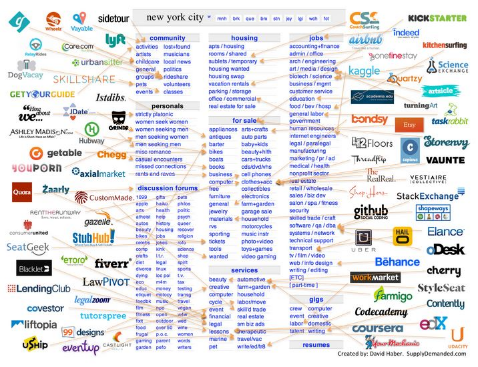
The Craigslist infographic breakdown—a favorite among web2 VCs for framing thinking
Let me particularly emphasize music NFTs. Surprisingly, unlike categories such as fine art, collectibles, and gaming, music NFTs haven’t yet seen explosive growth. However, I sense collectors’ tastes are shifting rapidly. Leading music NFT marketplace Catalog had a breakout moment in October—the volume chart reminds me of SuperRare just before crypto art took off in early 2020. For music, it’s only a matter of time.
2. Trust-Minimized Cross-Chain Bridges
Almost all cross-chain bridges today are variants of trusted multisigs. The Ethereum-to-Avalanche bridge, for instance, is literally an EOA (!), with its private key shared among four trusted Intel SGX signers. It currently holds over $6 billion in user funds. These bridges are highly profitable, and I predict bridge hacks will become the new CEX and DeFi hacks. The $611M Poly Network hack was merely the tip of the iceberg.
Fortunately, more trust-minimized bridging solutions are entering the market. Hop is currently the largest trust-minimized bridge, using bonders and stableswap AMMs to rebalance funds across chains. So far, bridges have primarily focused on token transfers. The holy grail—and an active area of research—is achieving trustless cross-chain message passing. This kind of cross-chain composability will unlock many new use cases: DeFi smart contracts on Ethereum L1 could directly call functions on smart contracts residing on L2s or sidechains.
3. Investment DAOs
Rather than viewing investment DAOs as art, I prefer to think of them as collectives. The issue I see with fractionalized NFTs is that the split tokens (ERC-20) don’t trade based on the underlying NFT (ERC-721s or ERC-1155s), because arbitrage between the two becomes impossible if their prices significantly diverge. Therefore, holding fractional tokens as a cheap index exposure to specific blue-chip NFTs (like CryptoPunks) doesn’t make much sense.
FlamingoDAO has been the most successful investment DAO so far. We’ve also seen DAOs emerge around large group purchases, such as the U.S. Constitution and Ross Ulbricht’s artwork. Currently, groups need to deploy a Gnosis Safe, but I hope to see better tools like Koop that make collective buying of expensive NFTs more seamless. It’s an open secret that 99% of NFTs won’t retain long-term value, while high-priced blue-chip NFTs (CryptoPunks, Bored Apes, etc.) will hold their value best. Investment DAOs are the best way to democratize access to premium NFTs.
Join TechFlow official community to stay tuned
Telegram:https://t.me/TechFlowDaily
X (Twitter):https://x.com/TechFlowPost
X (Twitter) EN:https://x.com/BlockFlow_News
 @1confirmation