








Nansen Research: Arbitrum, the Future of Blockchain Scaling?
TechFlow Selected TechFlow Selected
Nansen Research: Arbitrum, the Future of Blockchain Scaling?
Layer 2 scaling solutions like Arbitrum are more than just an investment opportunity—they form the foundation for ongoing and future projects in the DeFi and NFT spaces, supporting not only DAOs and virtual worlds but also the entire creator economy and metaverse.
 Navigating Web3 tides with focused insights
By Yasmine Karimi, Nansen
Translated and republished by TechFlow with permission
Introduction
In the history of cryptocurrency, there have been three occasions when Ethereum network gas fees skyrocketed to astronomical levels: the 2017 bull market, DeFi summer in 2020, and NFT summer in 2021.
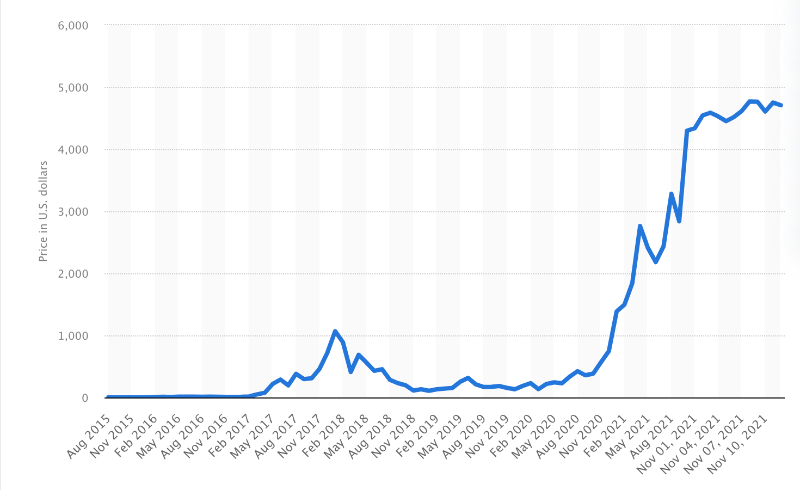
Ethereum gas prices from 2015 to 2021
Whenever gas fees spike again, the debate about Ethereum’s scalability returns to center stage, and many rush to find the next competitive blockchain to invest in. In reality, we must face the fact that high gas fees are just the tip of the iceberg. The reason gas fees are so high is that current Ethereum has not yet scaled—demand for transactions still exceeds what the Ethereum blockchain can handle per block.
You may get the impression that the scalability debate is dominated by crypto architects and developers, making it hard to understand why Ethereum faces scaling issues, what scalability actually means, and what’s at stake for you and the broader crypto ecosystem. Below is an explanation of the current landscape.
A Beginner's Guide to the Scalability Problem
A blockchain is a system for processing transactions and recording them in blocks without relying on trusted authorities, while preventing double-spending. Early blockchains like Bitcoin and Ethereum use Proof-of-Work (PoW) consensus models to process and record these transactions.
Under PoW, when you initiate a transaction, it enters a pending transaction pool and propagates across all network nodes. Although broadcast widely, only one miner computes and validates the transaction by including it in a block alongside others, earning a gas fee reward for mining.
First, because transactions are propagated before and after validation, processing times are long. Second, the computational power required consumes significant electricity. Third, each block can hold only a limited number of transactions, creating competition among users and driving up gas fees—the minimum price miners accept to process a transaction—sometimes exceeding the value being transferred. As more dApps leveraging blockchain technology for transaction processing and storage are built on the mainnet (currently around 3,000), this becomes an increasingly pressing issue.
Thus, to resolve these problems, Ethereum must scale—by increasing the number of transactions the network can process (measured in TPS, transactions per second) and speeding up transaction confirmation. To achieve this, several scaling solutions are under development: Ethereum 2.0, Layer 1 scaling, sidechains, and Layer 2 scaling. Layer 1 solutions such as Ethereum 2.0, Polkadot, and Solana restructure Ethereum’s underlying consensus and chain architecture, while Layer 2 solutions are built atop Ethereum’s mainnet and its protocols.
The stakes are high. The few blockchains that emerge dominant in this race will power the entire DeFi space and NFTs, sustain DAOs and virtual worlds, and support the creator economy and metaverse.
I will explain below why I believe Layer 2 scaling solutions like Arbitrum (backed by Marc Cuban, Polychain Capital, and Pantera Capital) will lead Ethereum’s scalability efforts for at least the next five years.
A Brief Overview of Ethereum Scalability Solutions
As mentioned above, scalability refers to increasing transaction throughput (number of transactions processed) and speeding up transaction finality. Here’s a brief overview of existing approaches aimed at achieving this:
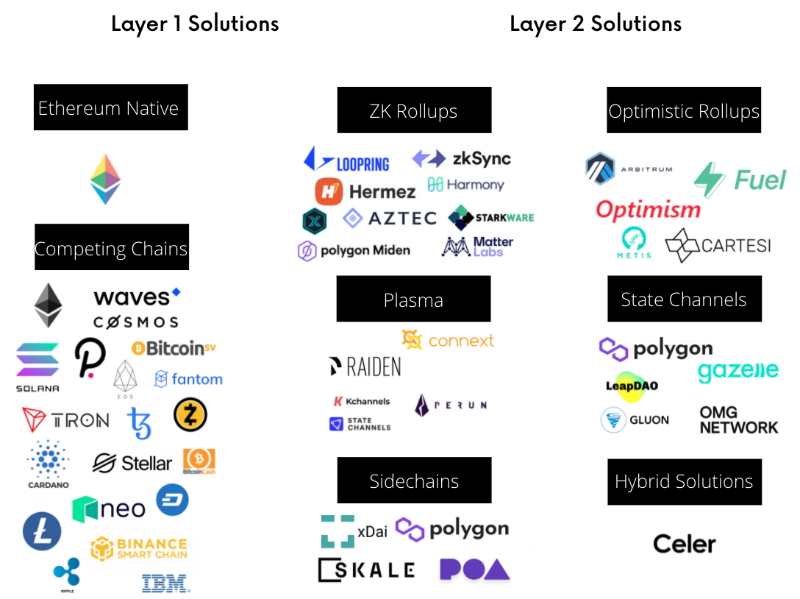
Scalability solutions in 2021, created by @yasminekarimi_
There are two ways to scale the blockchain ecosystem.
Layer 1 Scaling Solutions
Layer 1 solutions modify the base-layer protocol—the code of the mainnet blockchain itself—to improve transaction capacity. They fall into two categories:
Protocol Improvements
Protocol improvements involve changes to the base protocol to increase transaction throughput—by temporarily increasing the number of transactions per block, reducing block interval time, or transitioning structurally from Proof-of-Work to Proof-of-Stake (PoS). Unlike PoW, PoS selects validators based on the amount of cryptocurrency they stake. Since validators are chosen this way, massive computational power is no longer needed, eliminating the competition among miners that drives gas fees sky-high. Transaction validation is much faster, as individual nodes don’t need to dedicate as much processing power—blockchains like Solana achieve 30,000 TPS and Polkadot 1,000 TPS. By comparison, Ethereum handles only 16 TPS.
Sharding
Sharding divides a blockchain’s computational load and data space into multiple chains (over 63 in Ethereum 2.0). Sharded blockchain protocols naturally partition the initial network’s nodes into smaller groups, each responsible for validating unique subsets of pending transactions and storing portions of the global state. Cryptographic sorting mechanisms via verifiable random functions assign nodes to shards, preventing shard takeover attacks where most nodes in a shard are malicious. Because transactions specific to a node are validated by that node rather than the entire blockchain, there is no fee-driving competition, transactions are faster, and overall throughput increases. According to Vitalik Buterin, sharding combined with PoS should enable Ethereum 2.0 to achieve 100,000 TPS.
Layer 2 Scaling Solutions
While Layer 1 solutions change the blockchain protocol, Layer 2 solutions extend Layer 1 through smart contracts deployed on-chain. By offloading transaction execution before reporting back to Layer 1, Layer 2 solutions create additional room for transaction processing. There are various ways to implement this.
Sidechains
First, you can transfer assets to a sidechain with lower fees and faster speeds (e.g., xDai uses a delegated Proof-of-Stake mechanism enabling 5-second TPS at $0.000021). Cross-chain asset transfers are achieved via two-way peg (2WP) protocols: assets are locked on the first chain, then a transaction is created on the second blockchain containing cryptographic proof of correct locking. Polygon is a prime example.
Plasma
Plasma (see whitepaper by Joseph Poon and Vitalik Buterin) constructs blockchains within blockchains. Assets are sent to a smart contract managing the Plasma chain, which executes transactions. Only the hash of the block header is submitted to the root chain unless fraud is detected; if fraud occurs, the block is rolled back and the block creator penalized. This “only if” model enables massive scalability by minimizing state updates on the root blockchain, speeding up transactions. Major projects using state channels on Ethereum include State Channels, Celer, Perun, and Raiden.
State Channels
State channels are open-source protocols and smart contracts allowing participants to conduct x off-chain transactions while submitting only two on-chain transactions to the Ethereum network. Users must create and pay for one Ethereum transaction when opening the channel and another when closing it. This reduces the number of transactions needing processing and storage, cutting gas costs to just those for opening and closing the channel.
Rollups
Rollups scale the mainnet by batching transactions together, compressing data (e.g., using scientific notation to reduce value length in bytes), validating them off-chain, and storing state data on Layer 1. Compression and batching yield higher throughput, faster transactions, and minimal cost.
Second, rollups come in two types depending on verification method. We verify correctness by checking whether the post-state root (account balances, contract codes, etc.—all "within rollups") is accurate after batch processing. In zk-rollups, each batch generates a validity proof called a ZK-SNARK. In optimistic rollups like Arbitrum, proof computation only occurs if a node suspects fraudulent activity, further boosting speed and throughput.
How Can I Interact With the Arbitrum Rollup as a User?
As a user, your most likely interaction with Arbitrum will be through dApps you already use on Ethereum that require transactions (e.g., Uniswap or Aave). More specifically, to interact with Arbitrum, first add the Arbitrum One network to your MetaMask wallet and connect to it, then bridge your assets.
Why Will Arbitrum Lead Ethereum Scaling in the Near Future?
Arbitrum solves the blockchain trilemma: scalability, decentralization, and security.
Simply increasing scale isn’t enough. While boosting transaction throughput, blockchains must preserve two core properties of blockchain technology: decentralization and security. This is known as the blockchain trilemma. So far, the only Ethereum scaling solution satisfying all three criteria is rollups like Arbitrum. Over 3.56 million transactions have been processed on Arbitrum, peaking at 268,000 daily transactions on September 12, 2021.
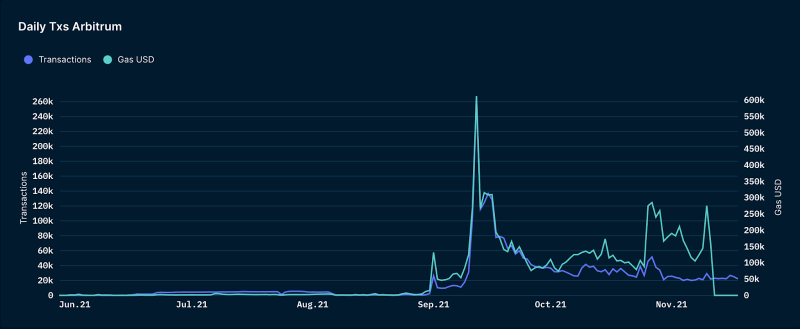
Daily total transactions on Arbitrum over time
In terms of processing capacity, Arbitrum should achieve 40,000 TPS, offering a 5x average cost advantage over Ethereum’s base layer (currently $2 vs $10.38, see real-time Layer 2 fees).
Moreover, Arbitrum is actively working to further reduce fees by 90–95%, meaning minting an NFT or transferring ETH could cost just tens of cents. Total daily gas spent on Arbitrum has consistently remained below Ethereum’s. The noticeable spike on September 12 was due to the launch of ArbiNYAN, a Layer 2 liquidity mining platform.
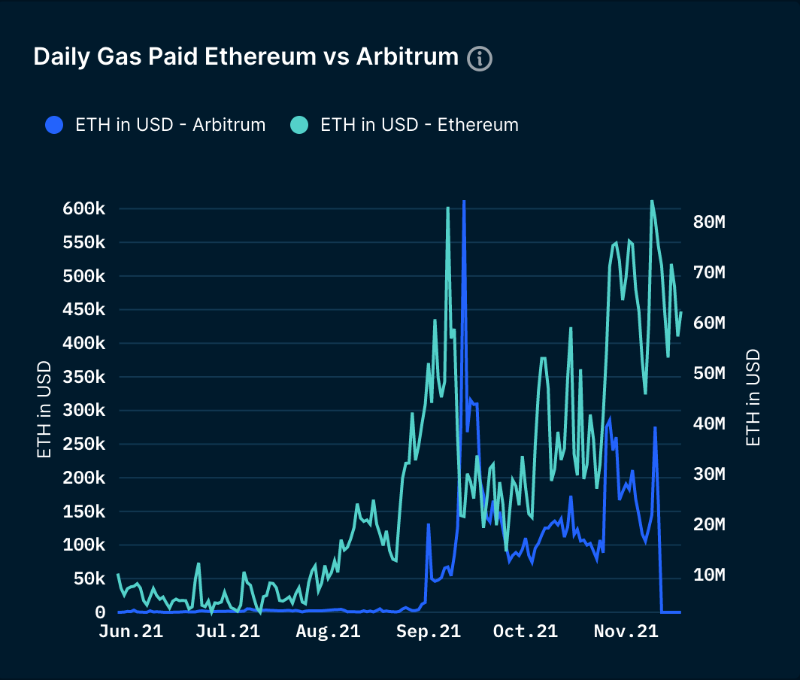
Total daily gas fees paid on Arbitrum vs Ethereum
Arbitrum achieves this high throughput while inheriting security from Layer 1 consensus.
By contrast, early Layer 1 solutions like Ethereum and Bitcoin prioritized decentralization and security but sacrificed scalability, evident in today’s high gas fees. Similarly, other competitive Layer 1s like Solana and EOS sacrifice decentralization by having only 200 and 21 nodes controlling their networks, respectively. In turn, centralization compromises security by increasing 51% attack risks.
Likewise, sidechains may introduce attack vectors into the mainnet since they rely on their own consensus and block validation models. Another example of limited security is protocol improvements—blockchains with “larger blocks” are inherently harder to validate and may become more centralized, thus less secure. However, note that not all rollups are decentralized early on, though most, if not all, aim for gradual decentralization.
Arbitrum Is the Most EVM-Compatible Layer 2 Solution to Date
Arbitrum is currently the most EVM-compatible Layer 2 solution. This makes migrating existing Ethereum applications to rollups nearly effortless for developers, as they don’t need to rewrite code. Arbitrum currently supports countless dApps and is the largest Ethereum Layer 2 network, with over $2.3 billion in total value locked across DeFi protocols. In contrast, zk-rollups and payment channels only support simple payments, swaps, and other application-specific uses. It currently hosts 2,361 verified contracts, adding an average of 12 new contracts per day since September.
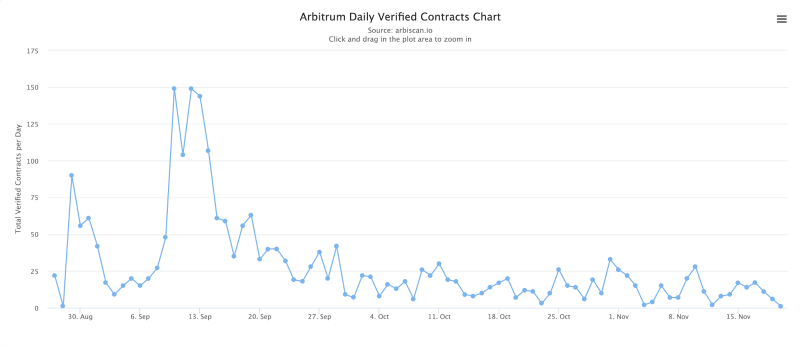
Number of daily verified addresses on Arbitrum
As more dApps integrate with Arbitrum rollup, it becomes attractive not only to developers but also to users. The growing number of unique addresses using Arbitrum confirms this.
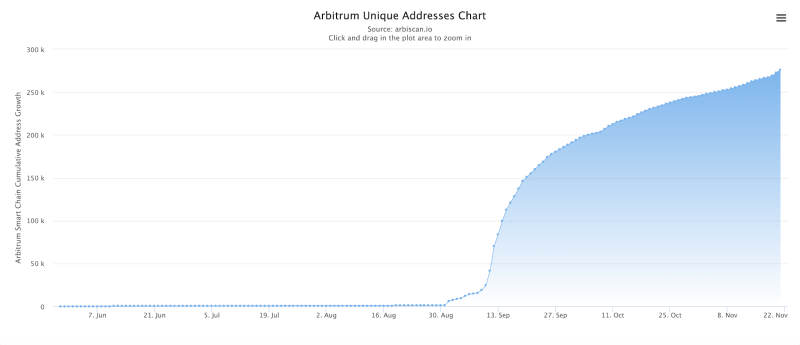
Total number of unique addresses on Arbitrum over time
Among these addresses, smart money appears particularly focused on Arbitrum. As shown below, 50% of Ethereum’s ETH millionaires also use Arbitrum. For those unfamiliar with Nansen labels, ETH millionaires are addresses holding at least $1 million worth of ETH.
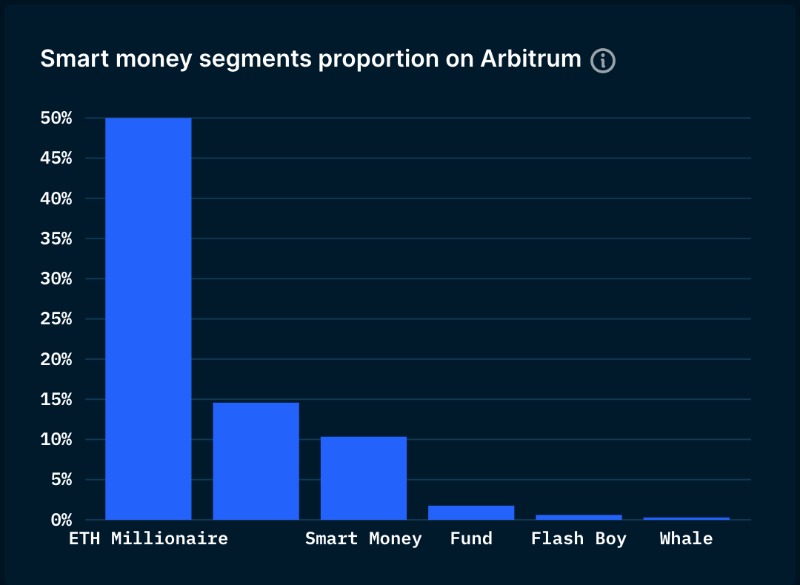
Proportion of active smart money on Arbitrum
Simply Put, It’s Built on the King of Crypto—Ethereum
Another reason we believe rollups like Arbitrum will dominate Ethereum scalability in the coming years is: they’re built on Ethereum, the king of cryptocurrency. This gives them a first-mover advantage. First, in terms of usage, Ethereum remains the world’s most popular blockchain protocol, hosting over 3,000 dApps, DeFi, NFTs, DAOs, and virtual world ecosystems. Bitcoin is the only comparable blockchain, but lacks the capability to host rollups.
Second, contrary to the belief that Ethereum 2.0 will make rollups obsolete, given Ethereum 2.0 won’t be fully deployed for years, rollups like Arbitrum are the de facto first scaling solution. On the contrary, data sharding—Ethereum 2.0’s second phase—is primarily designed to accelerate rollups. With rollups splitting state storage, shards splitting transaction history, and rollups registering to specific shards, rollup throughput scales exponentially—potentially reaching 15 million TPS by 2030.
For these reasons, it’s clear that rollups like Arbitrum occupy a unique position to lead the wave of Ethereum scalability solutions in the near future.
Get ready for Layer 2 token launches
Unless you're a developer or early investor, you can still gain exposure by purchasing project-native tokens. While most rollups like Arbitrum don’t yet have native tokens, we expect most will eventually launch theirs.
Current Challenges Facing Rollups
The first challenge is long withdrawal periods for optimistic rollups. Withdrawals may take up to 7 days, requiring a delay to allow time to publish fraud proofs and cancel withdrawals if a transaction is suspected fraudulent.
Second, the security of optimistic rollups relies on at least one honest node detecting fraudulent transactions.
Additionally, although we expect asset and data movement across rollups to become easier over time, rollups are still in early stages and lack interoperability. Still, interoperable solutions like Hop, Connext, cBridge, and Biconomy exist.
Finally, many believe that although Ethereum liquidity is currently fragmented across different rollups due to users seeking optimal pricing, over time liquidity will consolidate onto leading rollups like Arbitrum.
Rollups Five Years From Now
Realistically, in the long run, rollups’ potential extends beyond Ethereum. The future of scalability is actually a more complex system of interdependent scaling solutions across multiple Layer 1 chains. Within this complex future, we can expect three major trends.
As noted, in the short term, rollups on Ethereum like Arbitrum will dominate the scaling landscape, further strengthened by Ethereum 2.0 and its sharding rollout. Layer 2 solutions—including but not limited to rollups—will continue advancing, improving performance to compete with Layer 1s in execution.
Next, as other competitive Layer 1s reach full capacity, they’ll increasingly begin building rollups atop their mainnets. In fact, most still fail to grasp rollups’ full potential—every Layer 1 will need rollups. Ethereum is simply the first that’s been preparing for years (since 2015). For example, Tezos is adopting a rollup-centric roadmap. Likewise, NEAR, Celestia, and Polygon—all recently announced advanced zk-STARKs (from zk-Rollup) on their scaling solution Polygon Maiden.
Indeed, given demand for Ethereum and blockchain is one-directional, we can expect all scaling solutions to remain equally vital and necessary to meet growing demands of current and future market participants.
Conclusion
In summary, high gas fees are indeed just the tip of the iceberg. Ethereum has faced scalability challenges since inception, and numerous scaling solutions aim to address them.
Among them, Arbitrum rollups are not only the largest Ethereum Layer 2 network today but also likely to dominate scaling solutions in the coming years.
Arbitrum rollups have proven capable of scaling Ethereum without compromising the mainnet’s decentralization and security. As more users seeking optimal pricing migrate to Arbitrum, more developers will build on it due to its superior EVM compatibility. Beyond Ethereum, rollups represent a paradigm that will be exported to other competitive Layer 1s and integrated into an increasingly complex array of scaling solutions.
For everyone in crypto, Layer 2 solutions like Arbitrum are not merely investment opportunities—they form the foundation for ongoing and future projects in DeFi and NFTs, sustaining DAOs and virtual worlds, and supporting the entire creator economy and metaverse.
Join TechFlow official community to stay tuned
Telegram:https://t.me/TechFlowDaily
X (Twitter):https://x.com/TechFlowPost
X (Twitter) EN:https://x.com/BlockFlow_News
 Nansen






