Web3 Stack: How Does Web3 Deliver a Better User Experience Than Web2?
TechFlow Selected TechFlow Selected
Web3 Stack: How Does Web3 Deliver a Better User Experience Than Web2?
With a modular blockchain architecture, we will have all the scalability and instant confirmations needed for the coming years. Now, web3 just needs to wait for interface and application developers to build elegant and compelling user experiences, and web2 users will flock in.
 Navigating Web3 tides with focused insights
Author: Polynya
Translation: Alex Zhang
Many web3 skeptics quickly criticize the user experience as poor after using web3-related products. Even web3 advocates often admit that UX may not be great, but argue that the strong properties brought by decentralization make up for this shortcoming.
It turns out that the conditions to build a better user experience than web2 do exist. In this article, I will attempt to compare web2 and web3, offering a clearer vision of a future in which web3 delivers superior user experiences compared to web2.
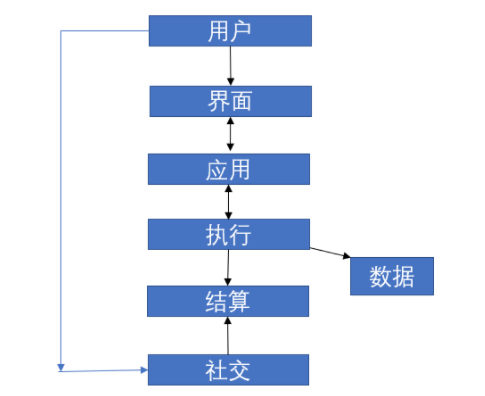
The structure of the web3 stack
Users
Although the above diagram of the web3 stack appears overly simplified, it is actually quite complex. From the user's perspective, they only need to care about web3 applications and interfaces—just like how things work in web2.
Interfaces
Users can access a variety of interfaces on web3, which will function as new "operating systems" or "browsers."
The preferred interface solution is social recovery smart contract wallets like Argent. Social recovery offers a better user experience than web2 account recovery. Managing passwords is a chore for users; if forgotten, they must rely on central authorities or web2 companies to recover them—a process that is typically tedious.
With social recovery, users don’t need to manage any passwords at all. If a user loses access to their account, they can quickly restore it with help from friends, family, or trusted entities.
Social recovery will become central to web3. These wallets will eventually resemble browsers and app stores even more closely, where people discover and use the applications they want.
Two key components solving this puzzle are account abstraction and pooling technology. Solving both enables a seamless user experience. Terms like fees, blockchains, bridges, etc., will be fully abstracted away from users, with the interface intelligently handling all these operations behind the scenes.
There could also be a "simple mode," where users don't even need to choose an application—they just select the desired functionality. For example, someone who simply wants to earn interest on their savings would deposit fiat currency and start earning interest, nothing more. The user might not know what Aave, StarkNet, or Ethereum is, yet they would indirectly use these solutions.
There will also be web2-like, application-specific scenarios. Indeed, many already exist. For instance, users can deposit fiat into Sorare and play fantasy sports games just like in web2. They don't need to know that NFTs are minted on Sorare’s rollup or settled on Ethereum.
With account abstraction, seamless bridging, pooling, social recovery, and validity rollups, we now have all the foundational building blocks needed for elegant user experiences. As a result, competition will intensify around delivering the best possible interfaces.
Applications
Ultimately, having better application experiences than web2 is a critical factor driving user adoption of web3. And without web3, such experiences wouldn't be possible at all. This hinges entirely on innovation by application developers. I believe the industry has been somewhat obsessed with blockchains and tokens so far, but I hope over time, all activity, capital, and innovation will shift toward web3.
Execution
Applications will reside on the execution layer, with interfaces interacting directly with it. I expect rollups and volitions to become the primary execution layers, hosting over 90% of activity. However, we can also have centralized, hybrid, and sovereign monolithic chains. With volition configurations, hybrid scenarios are possible.
Take Facebook as an example. Their Libra/Diem project stalled due to regulatory issues—specifically, data liability concerns. Worldcoin and Reddit were smarter—choosing zero-data-liability rollups. By processing all data on a publicly verifiable, neutral layer, they avoid being accountable to regulators in the way Facebook was. Meta’s rebranding clearly signals they're building their own execution layer. But Meta would never build rollups, right? Instead, they could create something like hybrid volitions—mostly centralized databases, but choosing to settle specific transactions on public settlement/DA layers to gain interoperability and limit data liability. In the world of blockchain Legos and modular blockchains, the possibilities are vast.
Settlement
Security, consensus, or settlement—whatever you call it—is what the execution layer relies upon. As web3 achieves mass adoption, the settlement layer will sink to the bottom. Of course, this layer provides security, and a sound monetary asset is crucial for underpinning the economy. The fat protocol thesis applies, but as we reach global scale, I expect more value to be captured at the application layer.
Data
Web3 execution layers will use two types of data: available data and retrievable data. Data availability may occur either on or off the settlement layer, but the key criterion is data availability guarantees. Here, all high-value transactions will be permanently "saved" for posterity.
However, there will also be low-value data that doesn’t require strict availability guarantees—only retrievability guarantees are sufficient.
Consider social media. To ensure rewards, transactions, and content headers are secure and available, volitions can handle these on the DA layer. But storing all content (videos, photos, etc.) on the DA layer would be prohibitively expensive. Thus, DA layers (like Ethereum data sharding, Celestia, Polygon Avail) and non-DA data layers (like Filecoin, Arweave, Swarm) can play complementary roles.
Social
The final layer—the social layer—is no less important. It gives value to the settlement layer and forms the foundation upon which the entire web3 infrastructure is built. In reality, we’ll have social layers at every step, with vibrant community governance ecosystems across each layer.
Outlook
I am confident that this technology can propel web3 to global scale—it now comes down to implementation and maturity. Certainly, this will take several years, but the path forward is viable.
With modular blockchain architecture, we will have all the scalability and instant confirmation capabilities needed for the coming years. Now, web3 simply needs to wait for interface and application developers to build elegant and compelling user experiences—then web2 users will flock over in droves.
Join TechFlow official community to stay tuned
Telegram:https://t.me/TechFlowDaily
X (Twitter):https://x.com/TechFlowPost
X (Twitter) EN:https://x.com/BlockFlow_News