Why Arweave and Solana are linked together as winners of NFT Summer?
TechFlow Selected TechFlow Selected
Why Arweave and Solana are linked together as winners of NFT Summer?
The more Solana is used in the NFT space, the more Arweave gets utilized.
 Navigating Web3 tides with focused insights
Source: arweave.news
Translation: TechFlow
Degenerate Ape Academy, Solana Monkey Business, Aurory, Sollamas—these are among the most successful projects in the emerging Solana NFT ecosystem, and they all use Arweave.
Anyone following the market recently has likely noticed the price movements of Arweave and Solana, which fluctuate somewhat independently of other asset classes and are less correlated with Bitcoin. The growth momentum between these two projects is not coincidental—they are deeply interconnected.
First, Solana's blockchain data is stored on Arweave via a bridge called the SOLAR Bridge.
In July 2020, Solana announced the SOLAR project on Medium, funded by Gitcoin. One month later, LoneRonin’s Solarweave Bridge submission on GitHub was accepted and entered production testing. By enabling fast access to historical Solana data, Arweave eliminates the need for Solana validators to run full nodes. Despite increasing demand, Arweave plays a critical role in maintaining Solana’s high efficiency.
Solana’s low transaction fees, combined with its ability to process around 65,000 transactions per second, make it a strong competitor to Ethereum. Perhaps the only missing piece is mainstream adoption—but Solana remains an emerging project that hasn’t yet become deeply embedded in crypto culture.
For NFTs, Solana is cheaper, faster, and more convenient. Like Ethereum, NFT assets are not stored directly on-chain. But for many Solana projects, Arweave is the default storage solution.
Why are so many Solana NFTs stored on Arweave?
Partly due to the reasons mentioned above, Arweave is highly recognized within the Solana community. But certainly, one major driver is Metaplex.
Metaplex is a suite of tools that allows creators to easily mint NFTs on Solana using Arweave and auction them through customizable web frontends—CryptoKickers being one example.
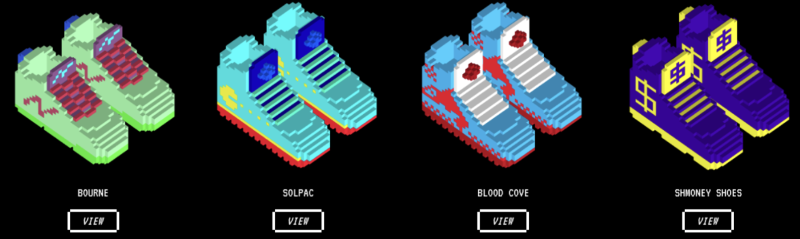
Metaplex defaults to Arweave as its storage destination—an obvious choice when auctioning high-value assets. As a result, when the JPEG speculation wave spread to Solana, it also boosted Arweave.
By this point, Arweave had already been chosen as the storage layer for the first NFTs of Beeple and JAY-Z, and this fact was well recognized.
A common requirement for NFT developers is the ability to batch-upload assets with their metadata and capture the resulting URLs. Metaplex’s Candy Machine (a command-line tool) simplifies this process with just a few commands and provides a Solana-compatible smart contract for NFT auctions.
The simplicity of this approach makes Arweave a smart default choice for projects like Solana Monkey Business.
As the primary method for launching NFT projects on Solana, we can confidently say: The more applications Solana sees in the NFT space, the more applications Arweave will gain as well.
Since the release of Metaplex Candy Machine, the entire ecosystem has made significant progress in using native tools to batch-upload NFT assets to Arweave. This gives projects the freedom to choose their preferred blockchain for launching and trading NFTs.
Josh Benaron’s arbundles documentation released today demonstrates how easy it is to send data packets to Arweave and retrieve each asset’s transaction ID. It can also be used with arkb to enable bundling.
Join TechFlow official community to stay tuned
Telegram:https://t.me/TechFlowDaily
X (Twitter):https://x.com/TechFlowPost
X (Twitter) EN:https://x.com/BlockFlow_News