








Gateway to Web3: Understanding Decentralized Domain Name Protocols
TechFlow Selected TechFlow Selected
Gateway to Web3: Understanding Decentralized Domain Name Protocols
Domain name protocols are not only key to on-chain identities but also gateways to Web3.
 Navigating Web3 tides with focused insights
Author: Erina Azmi, Coingecko
Translation: TechFlow
The crypto industry is facing strict regulatory scrutiny from various countries, including the $1 trillion infrastructure bill's "Crypto Tax Reporting," restrictions on accessing Uniswap’s equity token frontend, and China’s ban on cryptocurrencies.
Regardless of whether regulators take a proactive or aggressive stance, official oversight over the cryptocurrency sector may soon be implemented to prevent threats from “super programmers in the shadows.” In my personal opinion, regulators should expand their scope and support the potential of new technologies.
The appeal of blockchain lies in its inherent decentralization and immutability—features that make it resistant to censorship. Censorship resistance refers to our right to control our own data, something made possible only through blockchain technology.
We are now entering a new revolution that changes how we use the internet by rebuilding its infrastructure. Several Web3.0 infrastructure protocols are already working hard to power a self-sovereign internet where users can truly own their data—examples include IPFS, Arweave (AR), Filecoin (FIL), and others.
According to Ethereum.org, Web 3.0 (also known as Web3) “…refers to decentralized applications running on blockchains, which allow anyone to participate without monetizing their personal data.”
The purpose of this article is to introduce decentralized domain name system (DNS) protocols—the gateways to Web3.
Currently, four popular decentralized DNS protocols are:
Ethereum Naming Service (ENS)
Handshake (HNS)
Unstoppable Domains (UD)
Y.at. (Yat)
First, why should we care about blockchain-based domain name protocols?
DNS stands for Domain Name System—an internet-wide directory similar to a phonebook, where you provide a name and retrieve associated information such as phone numbers and addresses.
Before DNS, the original addressing method used on the internet was Internet Protocol (IP) addresses—numerical identifiers tied to hosting sites and location addresses. For example, the website freecodecamp.org maps to the IP address 104.26.2.33. DNS allows humans to access websites using readable names instead of raw numerical IPs.
The current DNS system is managed by centralized domain registrars (e.g., Verisign, GoDaddy, Namecheap) and DNS management service providers (e.g., Cloudflare and AWS).
Almost all participants on the internet rely on these centralized DNS providers. However, being governed by authoritative entities makes them vulnerable to high levels of censorship and cyberattacks. Below are three notable examples:
· On March 15, 2021, the C.R.E.A.M (CREAM) protocol suffered a DNS hijack. Attackers compromised the protocol’s GoDaddy account and redirected it to a phishing page. Seven hours later, the domain was recovered with no funds lost.
· In 2017, a hacker hijacked EtherDelta’s DNS name server, stealing ETH worth $250,000.
· Certain countries implement DNS blocking to control online content related to national interests. For instance, Turkey banned access to Twitter for its residents in 2014.
What are the leading decentralized domain name protocols?
The top four blockchain naming system projects are Ethereum Name Service (ENS), Handshake (HNS), Unstoppable Domains (UD), and Y.at (Yat).
Here is an overview of each protocol:
1. Ethereum Naming Service (ENS)
Primary Purpose: ENS maps machine-readable identifiers (such as Ethereum addresses and IPFS content hashes) into human-readable names.
For example, an Ethereum address (like 0x4Cdc……) can be mapped to CoinGecko.eth.
It works similarly to traditional internet domains like http://www.coingecko.com/, which map to the IP address of the server hosting CoinGecko.
Properties: ENS is built on the Ethereum blockchain, benefiting from its network security. All .eth registrations under ENS comply with the ERC-721 standard, meaning they are transferable NFTs.
Although built on Ethereum, ENS supports tokens from 109 different blockchains, allowing holders to receive non-ERC20 tokens such as BTC, DOGE, and SRM. Ownership is not permanent, as renewal fees apply upon expiration.
2. Handshake (HNS)
Primary Purpose: Handshake serves as a decentralized alternative to the Internet Corporation for Assigned Names and Numbers (ICANN).
Essentially, Handshake aims to create and distribute ownership of top-level domains (TLDs) in a decentralized manner. Using its native token HNS, users can bid for TLD rights via an auction system on Namebase—a registrar operating on the Handshake network.
Properties: Handshake is a blockchain with characteristics similar to Bitcoin, including its consensus algorithm (Proof-of-Work) and confirmation time (~10 minutes).
TLDs purchased on Handshake have a default lifecycle of two years and must be renewed every two years.
3. Unstoppable Domains (UD)
Primary Purpose: Similar to ENS, Unstoppable Domains maps machine-readable identifiers like IP addresses to pre-existing TLDs (.x, .crypto, .coin, .wallet, .bitcoin, .888, .nft, .dao, .zil, and .blockchain).
Properties: Unstoppable Domains operates on both Ethereum and Zilliqa blockchains, with issued domains minted as NFTs (ERC-721 and ZRC-1 respectively).
You cannot access these domains through standard browsers. However, browser extensions or blockchain-compatible browsers enable access. Currently, UD supports over 270 cryptocurrencies—including those on non-EVM chains.
Unstoppable Domains does not charge renewal fees.
4. Y.at (Yat)
Primary Purpose: Y.at is a centralized provider selling emoji subdomains.
Each yat consists of up to six emojis. You can link your yat to any destination—it currently functions like a URL shortener. Additionally, you can use it similarly to Linktree. The yat team claims functionality will expand as the platform grows.
Properties: Yats reside in a central registry controlled and operated by Emoji ID, LLC DBA Yat Labs in the United States.
Starting late July, users can now mint their yats as NFTs (ERC-721) via the dashboard and trade them on secondary markets like OpenSea. With its recent launch, users can now tokenize their yats.
However, note that you must first purchase a yat off-chain before minting it. Also, currently, you cannot receive cryptocurrency payments directly through yat. Y.at does not charge renewal fees.
Are these domains/subdomains considered NFTs?
Yes, except for Handshake—which issues TLDs on its own chain—all domain names issued by naming protocols conform to the ERC-721 standard.
An exception is Unstoppable Domains on Zilliqa, where names follow the ZRC-1 (NFT) standard.
As for Yat, more than 100,000 names have been registered, but only 2% of users have minted their yats on Ethereum (since purchasing the name off-chain is required prior to minting).
Can domain names be transferred?
Yes! They are NFTs and thus can be transferred according to the blockchain they reside on.
However, not all registered emoji strings on Yat are NFTs. You can transfer ownership by assigning a new owner’s email via the dashboard. Minted yats, however, can be treated exactly like any other ERC-721 NFT.
Typically, domains registered on blockchains cannot be accessed through standard web browsers. However, naming protocols can connect to IPFS (a decentralized file storage network) to enable access.
Yat is an exception—you don’t need IPFS to access it because it runs on centralized TLDs and on-chain data mapping has not yet been launched.
Comparison of Domain Name Protocols
The table below summarizes the four popular domain name protocols:
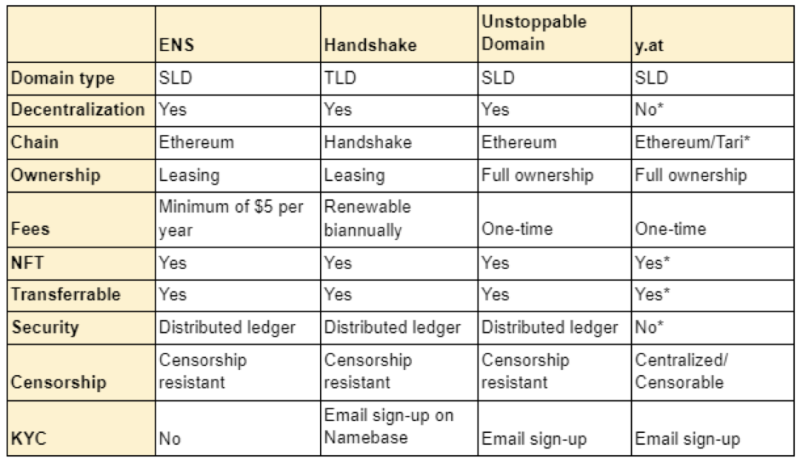
Let’s examine four key metrics to compare their performance:
1. Fees / Ownership
If you purchase a domain from ENS or Handshake, you’re essentially leasing it. Renewal is required at expiration; otherwise, you lose ownership. Domains on UD and Yat, however, are one-time purchases and belong to you permanently.
Among all naming protocols, only Handshake is incompatible with emoji IDs.
2. Scalability
HNS is the most scalable among all naming protocols, as its sole purpose is to run an alternative root zone file to ICANN on its own blockchain.
In contrast, ENS and UD depend on the Ethereum blockchain. While this benefits security and composability, their minting costs and processes are affected by gas fees. Although ENS registration costs just $5 per year for five-character or longer names, gas fees can reach $60 or higher.
As for Y.at, the goal is to gain traction as a centralized naming service before transitioning to full self-sovereign domain services.
3. Number of Registered Domains
One way to assess adoption is by looking at the number of registered domains per protocol.
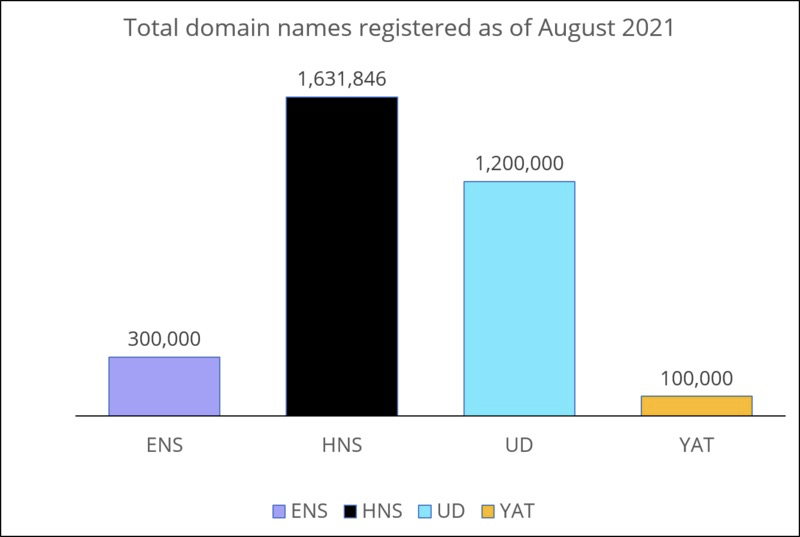
The chart above shows HNS leads in total registered domains, followed by UD, ENS, and Yat.
However, we must emphasize that a single user can register multiple domains, inflating the total count. While I couldn’t find active user counts for each protocol, I’ll use different proxies as estimates.
ENS has 300,000 registered domains and 101,000 unique addresses.
HNS has 1.6 million registered domains and 110,000 active Handshake domains.
UD has over 1.2 million registered domains and 730,000 claimed addresses.
Yat has over 100,000 registered subdomains (emoji IDs), with only 23,000 unique Ethereum addresses.
Admittedly, these metrics aren't perfectly comparable. But using them as proxies gives a better sense of adoption rates across each domain service.
Next, let’s look at the Ethereum chain. The chart below shows monthly new domain creations.
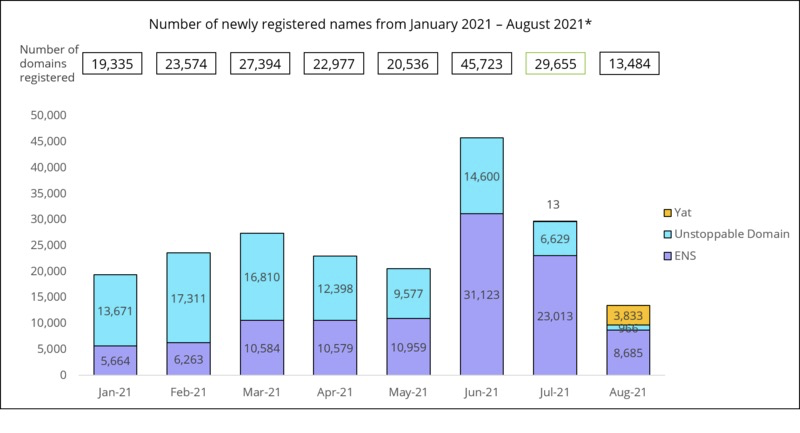
*Data for August is as of August 12, 2021
The chart shows increasing ENS mints, peaking in June 2021. Meanwhile, UD’s growth has slowed.
On the other hand, newly minted yats surged starting July 30, 2021, as part of its new minting feature rollout.
4. Integrations
Beyond domain registration, a better metric for evaluating domain protocols is the number of integrations—more integrations mean broader reach and usage.
ENS has nearly 300,000 registered names and over 250 integrations and applications, including top wallets (e.g., MetaMask, Argent), major exchanges (e.g., Uniswap, Coinbase), and popular browsers (e.g., Brave, Opera).
UD has 1.2 million registered names but only 73 integrations. It has native integration with Brave and Opera browsers. Some wallets supporting UD include Coinbase and Huobi Wallet. However, it is not supported by MetaMask.
HNS reflects content from the traditional internet and operates natively on its own chain.
Currently, Yat’s only function is redirecting URLs to a specified path or its own bio-tool landing page. You can access content by typing your emoji string into the URL bar of the Opera mobile browser. On-chain data mapping is not yet available.
Other Notable Naming Protocols
Solana Domains
Solana Name Service is similar to ENS and is a native Solana-based service developed by the Bonfida team.
It uses .sol as its top-level domain and maps second-level domain (SLD) names to off-chain and on-chain data such as SOL addresses, Twitter handles, and content hosted on IPFS.
Domain registration occurs via an auction system, with a minimum starting bid of $20. Unlike ENS, once acquired, your domain remains yours permanently without renewal fees.
PolkaDomain
PolkaDomain is a domain protocol built on Polkadot.
It offers not only domain registration but also advanced features like a domain marketplace, cross-chain transactions, and address anonymity. It also has a utility token called NAME, used to buy domains, pay transaction fees, trade domains, and participate in governance.
Note: The Polkadot chain is not yet live, so none of PolkaDomain’s products are currently operational.
THORnames
THORnames is the native domain protocol of THORChain. Functionally similar to UD, it maps human-readable names to machine-readable identifiers. It supports multiple chains, including both EVM and non-EVM chains like Ethereum and Bitcoin. This protocol has not yet launched.
Conclusion
The declaration of Web3 breaking away from Web2 is gradually becoming reality.
Domain protocols are already gaining adoption among crypto "natives," and they will continue to grow as user demand increases for simpler interaction with distributed networks.
Many projects are currently building Web3 infrastructure, tackling areas such as wireless networking, oracle databases, storage, video encoding, and more.
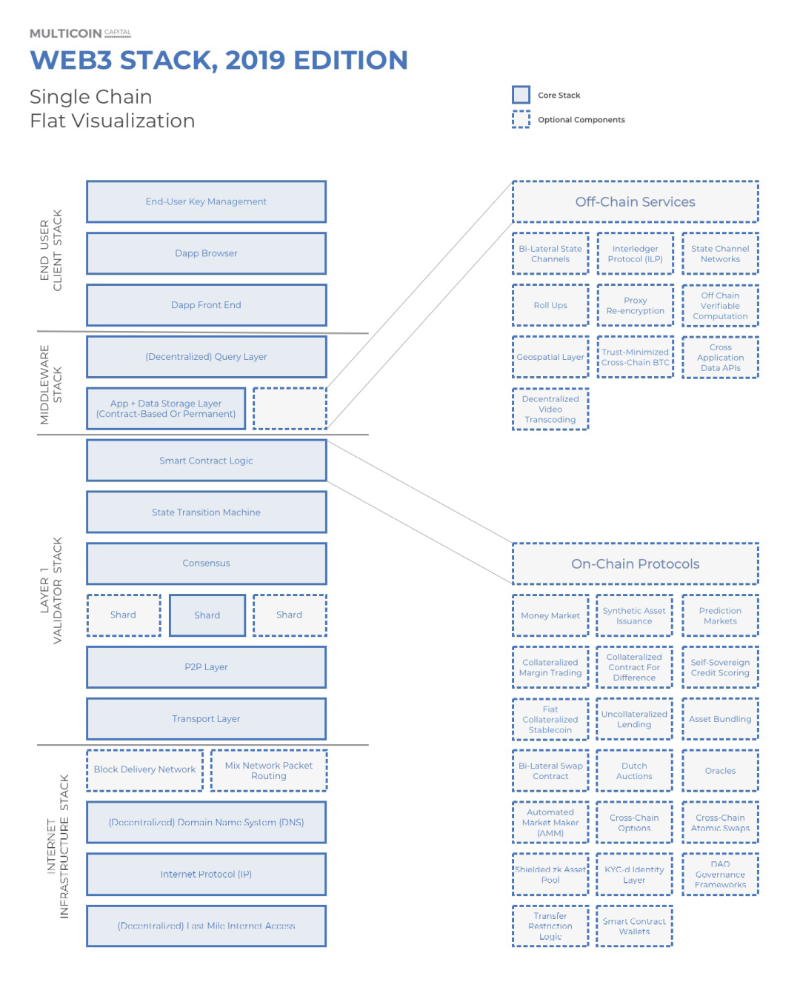
As illustrated by Kyle’s Web3 stack diagram, there are four layers, each presenting unique structural complexities and challenges. Ultimately, these Web3 infrastructure projects will overcome these barriers and fully realize the Web3 stack.
Given this context, existing login or registration systems are gradually reducing reliance on email addresses—for example, today you can use Facebook or Google credentials to create accounts on nearly any website.
Digital natives and crypto "locals" are already very familiar with this interoperability. Whenever we interact with decentralized applications, we simply use our wallets to approve logins.
Domain protocols will become your digital identity on the internet.
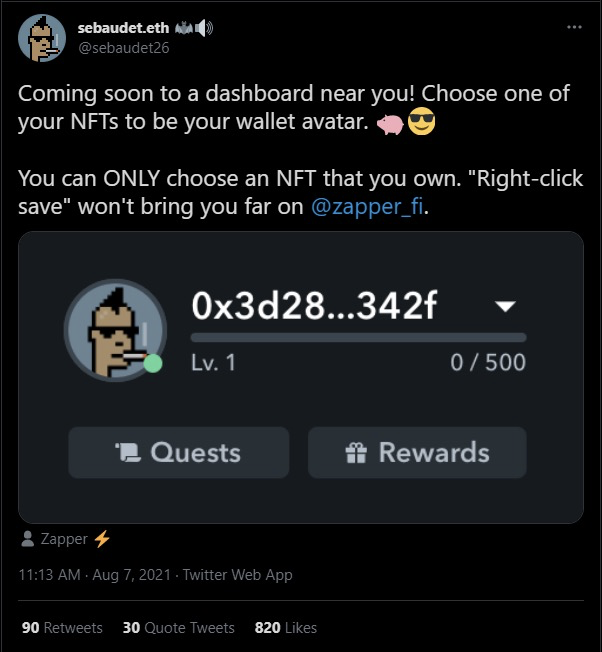
Over the past two weeks, we’ve seen the rise of NFT 2.0 season, with more people replacing their social media profile pictures with their own NFTs.
There is growing preference for using virtual avatars as primary identities. Soon, we may see deeper connections between NFTs and decentralized domains, as hinted by the CEO of Zapper (a DeFi dashboard).
Domain protocols are both keys to on-chain identity and gateways to Web3.
Join TechFlow official community to stay tuned
Telegram:https://t.me/TechFlowDaily
X (Twitter):https://x.com/TechFlowPost
X (Twitter) EN:https://x.com/BlockFlow_News






