








NFT Talk | ChainBreaker Podcast Episode 3 Recap
TechFlow Selected TechFlow Selected
NFT Talk | ChainBreaker Podcast Episode 3 Recap
The boom in the NFT market has sparked thinking and discussions about the underlying logic of NFTs.
 Navigating Web3 tides with focused insights
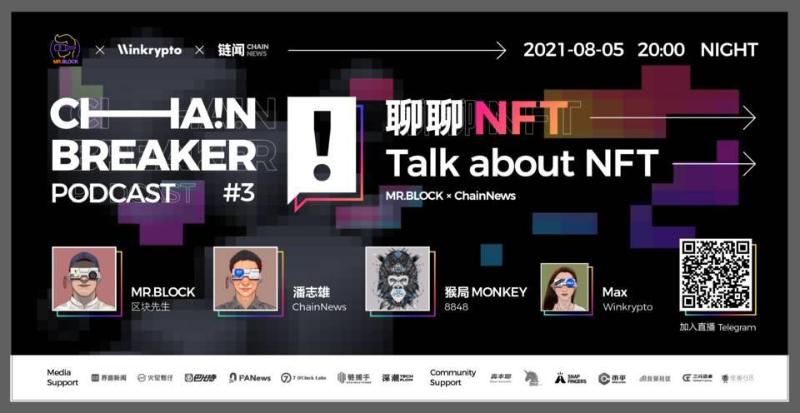
At 8:00 PM on August 6, 2021, the third episode of the "ChainBreaker Podcast" livestream event, hosted by Winkrypto, Mr. Block, and ChainNews, kicked off. ChainNews Research Director Pan ZhiXiong was joined by Mr. Block (Chris), Monkey from 8848, and Winkrypto's Max for an in-depth discussion on the trending topic "Let's Talk About NFTs."
Below is a summary of key insights from this livestream.
Background
CryptoPunks have recently surged in popularity, with #2140 and #5217 selling for record-breaking prices of 1,600 ETH and 2,200 ETH respectively—elevating the entire narrative around NFTs to new heights. The Punk craze has significantly impacted other NFT projects as well, driving substantial increases in floor prices across the board.
The surge in the NFT market has sparked widespread reflection and debate about its underlying logic.
Mr. Block Chris
In terms of transaction volume, this week marked an all-time high for NFTs, exceeding 400,000 ETH in total trading volume—with CryptoPunks alone accounting for approximately 80,000 ETH. The offer numbers are even more staggering: one anonymous bid for Punk #3100 reached as high as $90 million USD.
Punks are like real estate in the crypto world—there are only 10,000 such properties in existence. Every DeFi user, every crypto enthusiast, may eventually want to own one, which could drive prices even higher.
After DeFi took off, users became willing to spend time learning how to interact with smart contracts, how to yield-farm in DeFi protocols, and how to generate value from their tokens—moving assets from centralized exchanges to decentralized ones. This shift enabled broader exploration of new functionalities. Many features we see today were discussed years ago but have only recently become feasible.
NFTs will integrate deeply with DeFi—through collateralization to create derivatives, issuing stablecoins, or enabling lending and borrowing.
Art-based NFTs serve as excellent entry points into the crypto space—the first touchpoint for many newcomers. Celebrities with massive followings can leverage art NFTs to enter the crypto ecosystem. If you follow Instagram, you'll notice that many artists have recently changed their profile pictures to NFT avatars.
We're still in a very early stage—there are absolutely enormous opportunities ahead.
ChainNews – Pan ZhiXiong
NFT-related projects are launching at an extremely rapid pace, especially those involving non-crypto brands. For example, Burberry, Porsche, Coca-Cola, Lionel Messi, and Louis Vuitton have all partnered with service providers to launch NFTs and conduct auctions.
On the domestic front, Tencent has launched its own NFT platform "Huanhe" based on consortium blockchain technology, and is expected to roll out various NFT products in the future.
Zora has created a dedicated marketplace called Punk House for CryptoPunks—an indication of just how successful the project has become.
While Punks are iconic, their participation barrier is prohibitively high for most users. As a result, the majority of people engage with the NFT trend through games or other art-focused NFT projects.
Regarding profiting from NFTs, certain KOLs and institutions possess significant traffic and influence, allowing them to sway markets. Additionally, they often have sharp judgment, enabling them to identify promising NFTs early. However, these advantages are largely inaccessible to the average person.
There are many potential directions for NFTs, but currently, the most direct path for integration with crypto-native ecosystems lies within DeFi.
There remains fundamental logic behind NFTs—for instance, whether there’s a strong narrative or worldview supporting them, and what kind of experience they offer. If they provide a compelling overarching vision, more users will be drawn in.
NFTs are gradually polarizing into two extremes, both actively being explored. One extreme consists of high-quality NFTs created by professional game studios, top-tier designers, and renowned artists. The other extreme includes geeky, low-fidelity NFTs like pixelated CryptoPunks.
Q&A Session
1. Regarding NFT lending, if done purely via P2P models, capital efficiency would be very low. Are there better approaches? For example, something like an NFT index fund that offers full-price valuation for loans or provides guarantees with minimum buy-in commitments?
Mr. Block Chris: Most NFTs currently have negligible annual capital efficiency because there’s no way to collateralize them to extract funds.
NFTX has its limitations. Ape was included early on, but NFTX values items based on rarity. Sometimes ultra-rare pieces don’t sell as well as less rare ones—because aesthetics are subjective. It’s a highly personal market.
After NFTX launched, some participants deposited their NFTs, but collectors seeking visually appealing monkeys or Punks still prefer P2P methods to explore true value.
2. 8848Monkey: On staking and lending, how do we assess the value of an NFT? How much can be borrowed against it? How do we address the issue of self-dealing (wash trading)? And what steps should be taken to enhance the long-term value of NFTs? For example, suppose I wash-trade my NFT at 1,000 ETH and then use it to borrow 500 ETH—my goal is achieved. How can we improve this system?
Mr. Block Chris: Let's take a monkey as an example. Suppose you own one and believe it's worth $100,000, and you want to borrow $20,000. But currently on OpenSea, all open offers for similar monkeys are filled—and all below the actual buy price.
In other words, you’re willing to sell your monkey for 10 ETH, but the highest open offer is only 2 ETH. That means someone could lock up 2 ETH right now, but you refuse to accept it because you believe the true value is 10 ETH.
Here, capital efficiency suffers—those 2 ETH sit idle and unused, while you can't access them either.
This is where a lending market can step in—similar to AAVE. You could set terms, say, borrowing $20,000 with repayment due in 30 days plus interest—perhaps repaying $22,000. If you fail to repay, the NFT enters a new phase: within 10 to 15 days, if not redeemed, the lender takes ownership of the monkey. The original lender—who put up $20,000—gets the asset.
In this scenario, every NFT gains access to a basic capital-efficient market—akin to a pawnshop model.
Join TechFlow official community to stay tuned
Telegram:https://t.me/TechFlowDaily
X (Twitter):https://x.com/TechFlowPost
X (Twitter) EN:https://x.com/BlockFlow_News






