








Binance Block 101 | Aaron Choi & Ian: BNB's Comprehensive Layout in the DeFi Race
TechFlow Selected TechFlow Selected
Binance Block 101 | Aaron Choi & Ian: BNB's Comprehensive Layout in the DeFi Race
DeFi might surpass CeFi in the future, but we'll see—it's a very promising future.
 Navigating Web3 tides with focused insights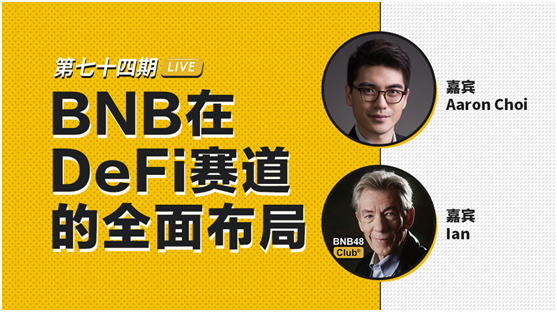
On August 6, 2020, Binance's Qianjiangyue hosted a dialogue with Aaron Choi, Global Head of Business Development at Kava, and Ian, Chairman of BNB48 Club. During the live session, Aaron and Ian shared their views on BNB and discussed potential future opportunities they foresee for BNB within the market landscape.
Aaron noted that while today’s DeFi market appears overheated, it remains in its early stages. He expects more cross-chain companies and products to emerge over time—though this requires development effort, patience, broader industry participation, and deeper integration among various platforms. Aaron emphasized that Kava will go all-in on DeFi moving forward, having chosen BNB as the first asset supported by Kava. This strategic alignment with Binance aims to deliver greater value to token holders.
Ian believes that BNB, as the direct entry currency for Binance Launchpad investments, creates short-term positive holding demand, which is clearly reflected in BNB’s price trend. In the long run, although the impact remains positive, its magnitude may be limited. However, investor optimism around Binance Launchpad projects has raised expectations for BNB, leading to stricter project selection processes and generating cyclical positive effects for BNB.
Guest Insights:
“If you observe the development of Binance as an organization, you’ll find it growing steadily with strong profitability. Based on this, we can reasonably conclude that BNB’s value will maintain a favorable trajectory for years to come. This solid fundamental underpins a compelling case for investing in BNB.”
“If you’re willing to put in more effort than other users, you gain an edge in capturing profits. Those who act quickly always earn more—that’s how it works.”
“There will always be movements toward decentralization and freedom from restrictions. Some people simply don’t want excessive control. Regulatory bodies also cannot possibly monitor every economic activity with 100% effectiveness, leaving space for DeFi to exist. As long as there's motivation and possibility, DeFi will endure.”
“At its core, removing the ‘D’ from DeFi still leaves finance. Finance itself doesn't directly create value; rather, its role is to enhance the efficiency of related economic activities. Therefore, DeFi cannot sustain high yields indefinitely—such returns are inherently abnormal. But abnormal doesn't necessarily mean bad.”
“CeFi still offers advantages—if done well, it serves users effectively. But DeFi at least gives us more choices. Right now, DeFi is still very small, even within our own industry. I believe that soon, DeFi volume within this sector will surpass CeFi—reaching daily trading volumes exceeding $100 million or even $200 million.”
“As long as Binance exists, BNB’s value is secured. That’s the most fundamental reason.”
1
Binance Qianjiangyue: Welcome everyone to today’s episode of “Block 101.” Let’s begin with guest introductions—starting with Aaron Choi.

Aaron (left), Qianjiangyue (top), Ian (bottom)
Aaron Choi: Hello everyone, I’m Aaron Choi, currently serving as Vice President of Global Business Development at Kava. Previously, I was Vice President of International Trading at BTC China. I’ve been in the blockchain industry for about three to four years, though my journey with Bitcoin began back in 2012—I’m a true OG here.
Binance Qianjiangyue: A real veteran! Now, Ian, please introduce yourself.
Ian: I’m the council member of BNB48 Club and was Binance Angel of the Year in 2020. Most people in this livestream should already know me.
Binance Qianjiangyue: Today’s theme is “BNB's Comprehensive Layout in the DeFi Track.” Let’s start with BNB. Do both of you hold BNB?
Aaron Choi: Yes, we both do.
Ian: I hold BNB.
Binance Qianjiangyue: Why are you bullish on BNB?
Aaron Choi: Given my background in exchanges, I understand exchange operations well. I’ve followed Binance since its inception and am familiar with CZ’s history and experience in blockchain. My reasons for choosing BNB are twofold: First, Binance has proven exchange expertise, and BNB is well-designed as a token. Second, participating in Launchpad projects requires holding BNB, which also provides trading fee discounts—practical benefits I personally utilize.
Binance Qianjiangyue: Kava was one of our earlier Launchpad projects.
Aaron Choi: Exactly, back in October last year.
It's not just our team—we've built strong collaborations with others, consistently aligning with our vision. We're bullish on DeFi and hope to continue creating mutual value.
Binance Qianjiangyue: Understood. Ian, what makes you bullish on BNB? As founder of a BNB fan club, we’d love to hear your perspective.
Ian: I made the decision to hold BNB quite early. BNB stands out as a clear utility token. Reading the 2017 whitepaper leads to one conclusion: BNB’s value correlates directly with Binance’s earnings power, simplifying the investment thesis.
By observing Binance’s growth trajectory, we see consistent progress and solid profitability. Thus, we can confidently expect BNB’s value to maintain a positive trend for several years ahead. This forms a strong fundamental basis for buying BNB.
Of course, some might argue that while Binance’s earnings appear stable, BNB’s price has fluctuated significantly. From an investment standpoint, fundamentals alone don’t shield against market sentiment or capital flows. Short-term volatility can be seen as noise. What matters most is understanding BNB’s intrinsic value source.
As long as Binance thrives, BNB’s value remains secure. That’s the foundational reason.
Binance Qianjiangyue: So it comes down to long-term value investing based on logic.
I’d also like to explore how Binance’s Launchpad impacts BNB. You both were selected for Launchpad—how would you evaluate it?
Aaron Choi: We’ve seen BNB prices rise recently, showing strong anticipation for new Launchpad launches. Holding more BNB increases eligibility to participate in these events.
Last year’s and this year’s Launchpad projects have performed well. The team’s rigorous project selection and reliable processes instill confidence, positively impacting BNB.
Binance Qianjiangyue: As successful applicants, what was your experience going through Launchpad?
Aaron Choi: It required extensive preparation including a whitepaper. Binance operates like a large startup with many specialized teams, each with distinct needs. Every department we interacted with took our project seriously.
When launching, our team was tiny compared to Binance’s support staff. Their dedication was remarkable—so many people actively supporting and promoting our project.
It was an intense period—I recall barely sleeping two weeks before launch, overwhelmed with tasks. Once completed, it felt incredibly rewarding.
Binance Qianjiangyue: Indeed, such collaboration builds strong relationships. Ian, what’s your take on Launchpad’s impact on BNB?
Ian: From a holder’s perspective, let me add some thoughts. Aaron spoke from the project side—Binance enforces strict review standards for Launchpad, ensuring baseline quality.
However, not every project guarantees success—even skilled investors can miss. Regarding BNB, the key mechanism is that BNB serves as the direct investment vehicle for Launchpad. Each project’s traffic and access eligibility are measured in BNB holdings.
In the short term—during snapshot and sale periods—this creates tangible holding demand for BNB, clearly visible in price charts.
Longer term, however, the snapshot window is brief. While BNB is required for purchase, post-launch behavior often involves immediate selling on secondary markets—a standard pattern in Launchpad investing.
The result is noticeable price volatility. Most notably, this dynamic contributed to a prolonged bull run in 2019—not due to individual Launchpad events driving prices up, but because holders developed expectations: frequent new projects meant holding more BNB could secure future participation without competing in short-term rushes.
But clusters of high-quality projects aren’t constant—they occur only during certain months or favorable years. When Launchpad frequency declines, its price-supporting effect weakens, reverting to periodic influence.
So yes, there’s a positive impact, but it heavily depends on Binance’s operational cadence—modest overall. That’s the conclusion.
Binance Qianjiangyue: So short-term fluctuations, but long-term impact is relatively limited.
Ian: Correct. At least it’s not negative—Launchpad hasn’t suppressed BNB prices long-term. But claiming massive upside impact would be overstated.
I suspect this reflects Binance’s strategy—they likely avoid aggressive scarcity tactics using Launchpad to boost BNB. There are many ways they could intensify demand: extend snapshot windows or raise holding caps.
But perhaps they prefer fairness—avoiding excessive advantage for BNB holders that disadvantages others. For an exchange, that would be inequitable.
2
Binance Qianjiangyue: Balance is important.
Now shifting focus—Kava, what’s your project vision? What problems did you aim to solve when founding Kava?
Aaron Choi: Kava is a DeFi protocol built on Cosmos, primarily offering CDPs (Collateralized Debt Positions) to unlock users’ digital assets.
Currently, digital assets held on exchanges sit idle without yield. Our platform enables borrowing—users receive stablecoins they can use to acquire more assets, make payments, or earn interest rewards.
Binance Qianjiangyue: So the goal was enhancing asset liquidity and utility.
Aaron Choi: Exactly.
Binance Qianjiangyue: Your stablecoin USDX—is this the primary stablecoin supported on your DeFi protocol?
Aaron Choi: Yes. USDX is minted by users depositing collateral assets into our system.
Our system features two tokens: KAVA and USDX. KAVA is our governance token—holders can vote on proposals and stake for rewards, influencing new developments.
USDX is the stablecoin issued on the Kava protocol. Users don’t need separate addresses—it works seamlessly via Kava wallets. Pegged 1:1 to USD, we use various mechanisms to maintain this parity.
Binance Qianjiangyue: Could you elaborate on USDX specifics?
Aaron Choi: Sure. USDX differs fundamentally from other stablecoins. We have no fiat backing—no bank accounts, no USD reserves. Traditional stablecoins rely on dollar-denominated accounts, requiring trust in issuers’ claims.
We’re different—our value is fully backed by crypto collateral. You can verify total locked value and circulating USDX supply directly on our website. Currently, about $25 million in collateral supports roughly $6 million in USDX.
Ian: Actually, $6.5 million.
Aaron Choi: We currently support BNB as the first asset. If you hold BNB, you can mint USDX via our platform. We’re also discussing listing USDX on exchanges with Binance so users can trade it beyond just earning yield.
Another key difference: holding USDX generates yield. Unlike USDT, which remains static unless moved, USDX accrues interest. All lending fees are redistributed to USDX holders—currently yielding ~4.5% APY, visibly increasing in your wallet. No other stablecoin offers this model today.
Other fintech platforms may show interest in adopting USDX—we’re exploring such expansion opportunities.
Binance Qianjiangyue: Someone asked where the yield comes from. Let’s explain Kava’s economic model. Ian, you previously discussed this with me—could you share your understanding?
Ian: Happy to.
First, where does yield come from? Think of Kava as a blockchain-based bank offering secured loans. You deposit assets and borrow stablecoins.
Next, why does holding USDX generate yield? Simple: just as banks pay interest on deposits, Kava distributes the spread between lending and deposit rates. On mainnet, lending APR is 5%, and depositors receive 90% of that—4.5%. This parameter is adjustable on-chain, but that’s the current rate. The yield source is clear: borrower-paid interest.
What about borrowing costs? Borrowing incurs an annualized 5% fee on the amount drawn—longer duration means higher total interest, shorter reduces it. Straightforward.
Recall the joke about a Jewish merchant who pledged luxury cars, real estate, bonds, etc., to borrow just $1, repaying it later. Bank staff asked why such heavy collateral for $1. He replied: “I needed secure storage—and minimal interest.”
This perfectly mirrors Kava. Even storing private keys securely via collateralized $1 loan is viable and safe.
Are there Chinese-language wallets supporting BNB-to-USDX minting? It’s challenging. Early BNB48 members faced hurdles, especially cross-chain transfers using Binance Chain’s BEP3 standard—an intermediary process involving dual transactions across chains.
Technically inclined users can use command-line tools (English-only). Alternatively, combine Trust Wallet and Frontier Wallet: initiate BNB transfer via Trust Wallet, confirm on Kava chain using Frontier. Requires learning, but feasible.
For ease, I recommend Cosmostation—it’s English, but crypto users manage fine. They offer web and mobile versions. Kava team is reportedly simplifying UI—better tools coming soon. Stay tuned.
Aaron Choi: We’re developing a web interface at app.kava.io—not live yet, but imminent. Hardware wallet users will find it simpler. I’m also partnering with wallet providers to integrate our features—e.g., Math Wallet already supports Kava, though CDP functions aren’t ready.
Ian: Another option: Big Dipper, Kava’s popular block explorer. It includes direct action buttons—discovered accidentally. Requires hardware wallet connection. Interface is decently localized—essentially a browser-wallet hybrid solution.
Ultimately, DeFi interactions remain complex—even using Compound or Lend. That’s why yield farming incentives exist—to offset the learning curve. If you invest extra effort mastering these skills early, you gain profit advantages over others.
Speed matters—faster actors earn more. Always.
3
Binance Qianjiangyue: Speaking of DeFi—given its current hype, do you think it’s overheated? Any underlying risks?
Aaron Choi: Volatility is natural—nothing to panic about. I believe DeFi isn’t disappearing. Digital assets represent the future, and we’re building toward decentralized financial systems.
Short-term surges may occur, but sustained growth will bring more companies, products, and improved accessibility. Platforms like Uniswap and Lend have matured, liquidity issues resolved. New users may struggle initially, but veterans from 2017 ICO days understand the mechanics.
Looking ahead, expect more cross-chain DeFi ventures. Development takes time and collaboration. More adoption and integration will follow—perhaps in two or three years. I believe it will happen.
Binance Qianjiangyue: Still early stage, but promising long-term. Ian, your view on DeFi?
Ian: DeFi is undoubtedly in the spotlight. Investors must assess hype critically. Remember: strip away the “D,” and it’s still finance. Finance doesn’t create value directly—it amplifies efficiency in connected economic activities. Hence, DeFi cannot sustain perpetual high yields. Such returns are abnormal—but not necessarily harmful.
Healthy DeFi projects today offer high yields as marketing incentives—subsidized by early-stage economics, not sustainable profits. Carefully distinguish legitimate DeFi from schemes disguised as DeFi, like Ponzi or money pools. Outcomes differ drastically depending on which type you engage with.
A simple analogy: ride-hailing services like Uber, Didi, or Kuaidi once offered deep subsidies—rides costing just $1 or free. Critics questioned sustainability—drivers need pay, vehicles cost money, fuel isn’t free. Yet today, we see these businesses thrive, albeit without initial user subsidies. DeFi follows a similar path.
Even earlier internet examples apply—the initial hype draws attention. Mature forms won’t resemble today’s high-yield phase, but viable decentralized economic models will persist. Just don’t expect endless riches.
Binance Qianjiangyue: Early incentives attract users—common across industries. Demand ensures DeFi’s longevity, though initial acquisition tactics will evolve. Exercise judgment—adopt rational investment principles.
Given Kava’s first-supported asset is BNB, why was BNB chosen? What efforts has Kava made to integrate BNB’s value?
Aaron Choi: We chose BNB for two reasons. First, Binance’s support—including Launchpad—and its status as the largest exchange with the broadest trader base make it ideal for our product. Our tools appeal to professional traders using them for hedging or other strategies—aligning well with Binance’s ecosystem.
Second, Binance adopted Cosmos technology, as did Kava. While integration wasn’t trivial—we spent considerable time debugging—it was far smoother than bridging other chains. Coincidentally, our shared tech stack simplified the partnership. We chose Cosmos for its technology, team, and vision—and Binance happened to choose it too. That synergy led us to BNB.
We’ve gained significant benefits collaborating with BNB’s community—especially strategic partnerships with BNB48, the largest BNB holder community. Together, we aim to deliver greater value to BNB holders.
We encourage users to try our product, join incentive programs, provide feedback, and help improve UX. We acknowledge current UX isn’t perfect—ongoing optimizations will bring better tools and wallet integrations. User satisfaction drives our long-term success.
4
Binance Qianjiangyue: Aaron highlighted synergy with a top-tier team and aligned technology stacks enabling seamless integration.
He mentioned Kava’s collaboration with BNB48. Ian, could you detail specific joint initiatives?
Ian: Let’s start with motivation. With DeFi booming, BNB holders seek passive income. Products like Binance Savings offer yields uncompetitive against alternatives—partly due to constraints around shorting BNB.
When we discovered Kava, it seemed mutually beneficial. Setting aside chain differences, its model resembles MakerDAO—but with greater ambition. Kava launched as an independent chain, meaning no native assets for collateral. Its first collateral had to be cross-chain—an enormous technical challenge raising user barriers.
Thus, Kava needed a strong partner asset. BNB proved ideal—backed by Binance’s ecosystem (a strength), yet potentially problematic if perceived as overly centralized. BNB holders craved truly decentralized yield opportunities.
We welcomed Kava’s exclusive BNB support—it signaled meaningful third-party utility beyond DeFi. After analyzing Kava’s business logic, we found it robust and product design sound.
Though unproven then, we conducted internal votes and decided to allocate club funds toward Kava’s minting rewards—capturing early benefits while testing workflows. This enabled us to streamline processes and later co-develop community education and engagement initiatives.
Today, we operate three CDP-focused WeChat groups answering common questions, plus a Telegram group for smaller, developer-centric discussions. We’ve built tools like on-chain quota monitors—community contributions enhancing usability.
Additionally, recognizing Kava as a Cosmos-based application chain, we contribute to network security and reliability by operating validator nodes. Our node launched in late May/early June.
Through two or three network upgrades, we’ve maintained exceptional uptime—under one minute downtime—ranking among the top 10 globally. Currently ranked #28 by voting power, we also provide unofficial technical support for Chinese-speaking users on Kava validation, operations, and promotion. These represent our core collaboration areas with Kava.
Binance Qianjiangyue: Ian shared motivations and concrete cooperation areas. Looking ahead, will Kava focus entirely on DeFi?
Aaron Choi: Absolutely—we’re all-in on DeFi. We aim to attract more developers and applications to build on Kava. We’re developing cross-chain tools and providing infrastructure for developers to integrate our stablecoin—envisioning an Ethereum-like DeFi ecosystem. MakerDAO took years to reach its current scale—we’re patient but determined.
We welcome more users and ideas—there’s room for all. I’ve spoken with teams exploring cross-chain bridges. Whether they complete it this year depends on their execution.
Binance Qianjiangyue: Collaboration drives progress. Ian, what are BNB48’s future plans?
Ian: We’ll continue operating this node—it’s our first live infrastructure service. Going forward, we’ll focus on projects within the BNB ecosystem. Activities include industry research, project scouting, angel investing, community building, product development, and node operation—a natural extension of our investment approach.
We’re also upgrading our governance model toward greater decentralization. BNB48 aims to become a DAO—decentralized autonomous organization. Progress will be gradual—some operations can’t move fully on-chain yet—but we’ll decentralize key decisions and expedite on-chain implementation.
5
Binance Qianjiangyue: Now to Q&A. Submit your questions—we’ll pick five winners receiving limited-edition Launchpad cards and co-branded BNB48 × Kava T-shirts.
Question: Has Kava’s BNB collateral cap been reached? Can new users still join?
Aaron Choi: Not yet. The cap is 1.225 million BNB.
Ian: Currently used: 1.016292 million—about 200,000 BNB remaining.
Aaron Choi: Participation remains open, though USDX issuance is near capacity.
Ian: Without transferring BNB in, you can’t participate.
Aaron Choi: Transfer BNB first. We increase limits weekly—advance notice given.
Binance Qianjiangyue: Two similar questions: Will Kava support new collateral types like BTC or DOGE?
Aaron Choi: Yes. We’ll prioritize Binance ecosystem assets—BUSD, then BTCB (Binance Chain’s Bitcoin), followed by SRP and native Bitcoin. Public chains are complex—timeline uncertain. BUSD support expected within weeks.
We welcome user suggestions. Engaging top-tier public chains and major coins—if interested, they may propose integration. Governance allows KAVA holders to vote on next assets. Expect this process to launch in two to three months. We’re committed to expanding support.
Binance Qianjiangyue: What collateral ratio does Kava require? Is liquidation risk present?
Ian: Kava’s requirements align with mainstream DeFi. Minimum collateral ratio is 150%. For example, $1.5M in collateral supports up to $1M in stablecoins. The 150% threshold is the liquidation line—approaching it risks immediate liquidation. Safer practice: deposit $1.5M to borrow $1M, allowing buffer.
No absolute safety exists—DeFi lending relies on over-collateralization to secure the system. The extra 50% cushions against price drops during volatile market conditions, protecting system solvency.
Liquidation doesn’t mean losing all collateral—remaining value after auction is returned. Standard practice. Kava applies no additional penalties or fees. Most leading DeFi platforms operate similarly.
Binance Qianjiangyue: What are USDX’s use cases and upcoming promotion plans?
Aaron Choi: Priority one: list USDX on more exchanges. Currently unused due to limited availability—we hear the feedback and are working urgently to expand access points.
Second, we’re approaching non-crypto platforms for simple integrations. Fintech firms increasingly need crypto and stablecoin solutions. We’re engaging traditional financial institutions unrelated to crypto—they show strong interest in our banking history and track record.
A 4.5% annual yield seems modest in some regions, but in Western countries like the U.S., it’s highly attractive. Some digital-native banks initially skeptical about crypto become intrigued upon hearing 4.5%. They ask: “Is this risky?” We clarify it’s earned via lending—safe, distributable to their customers. They perceive lower risk.
Our growth path may lie beyond crypto—targeting traditional finance. Though a DeFi company, our product can serve CeFi institutions, accelerating their evolution toward decentralized models.
6
Binance Qianjiangyue: Aaron outlined future directions—plenty to look forward to. Question: Will DeFi replace CeFi?
Ian: Direct answer—no. I can’t envision a world entirely devoid of CeFi, where all finance becomes decentralized. That would be inefficient and potentially less secure. Modern finance uses complex instruments—even within CeFi, many require human oversight due to inherent process flaws.
Translating all such processes entirely onto DeFi via smart contracts eliminates flexibility. My conclusion: DeFi cannot fully replace CeFi. But DeFi will persist long-term—driven by humanity’s innate pursuit of freedom, even beyond reasonable bounds. This impulse fuels economic—and non-economic—activities alike.
Decentralization and deregulation will always attract adherents unwilling to accept excessive controls. Regulators cannot monitor 100% of economic activity—leaving space for DeFi. Where motivation and possibility exist, DeFi will survive.
Aaron Choi: I agree with Ian. CeFi will persist because governments recognize its legitimacy and utility. Unless all governments vanish—which I don’t wish for—CeFi will coexist. Well-run CeFi serves users effectively. But DeFi expands choice. Currently tiny—even within crypto—soon DeFi volume may surpass CeFi, hitting $100–200 million daily.
Many exchanges don’t reach those volumes—some fabricated. But Uniswap’s transparent data shows real traction. DeFi may eventually exceed CeFi. We’ll see. An exciting future—I hope Kava grows into a major player, offering users greater choice.
Binance Qianjiangyue: Great discussion today. That concludes our livestream. Thank you all for watching, and special thanks to Aaron and Ian for sharing your insights.
Thank you! Goodbye!
Join TechFlow official community to stay tuned
Telegram:https://t.me/TechFlowDaily
X (Twitter):https://x.com/TechFlowPost
X (Twitter) EN:https://x.com/BlockFlow_News







