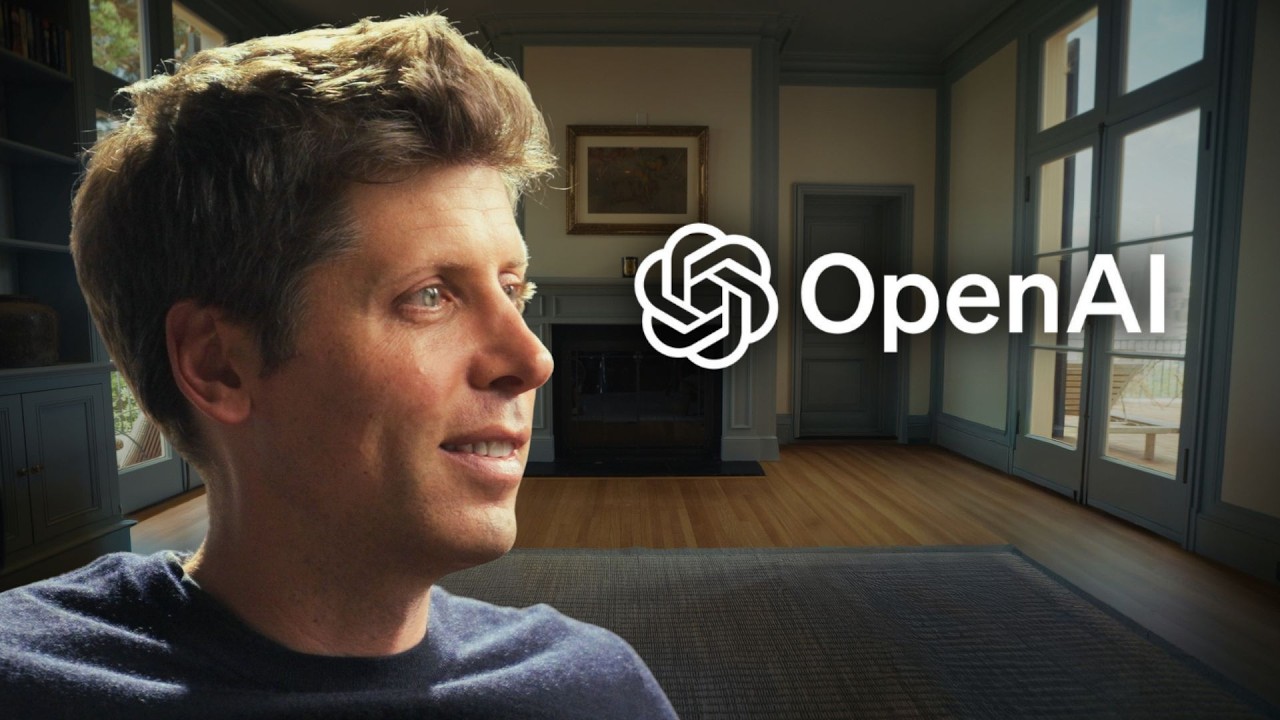
Sam Altman's Latest Interview: When Everything Is Changing Exponentially, What Mindset and Judgment Should You Have
TechFlow Selected TechFlow Selected
Sam Altman's Latest Interview: When Everything Is Changing Exponentially, What Mindset and Judgment Should You Have
Tools iterate rapidly; only by breaking free from old mental frameworks can one adapt to an era of exponential change.
 Navigating Web3 tides with focused insights
Compiled by: Deep Thought Circle
Have you ever thought that a startup founded only two weeks ago could rebuild a whole suite of mainstream office software—docs, spreadsheets, presentations—all redesigned around AI? I'm not making this up; Sam Altman (OpenAI Co-founder and CEO) said this himself in a recent interview. He just met such a company. Ten years ago, you could almost predict what a ten-week-old startup would look like. Nowadays, if a ten-week-old startup still looks like it did ten years ago, it actually means it has already fallen behind.
This interview was packed with information. It talked about startups, how OpenAI has navigated the past few years, and how he handles pressure and makes trade-offs. I've organized the parts that resonated with me the most, added a lot of my own understanding, and written this for you.
Most People Are Still Picking Battles They Can Easily Win
Altman said that this point in time is very interesting. Costs are dropping rapidly, and cycle times for getting things done are shortening quickly. This is exactly when startups have the most advantage. This is happening in many fields simultaneously; theoretically, this should be the best era for entrepreneurship. But he observed a rather contradictory phenomenon: most startups are still doing the same thing—building AI agents for a specific industry. This path works and can even be very profitable, but most likely, these won't be the companies truly remembered by this era.
What I found profound was his following statement. Even though the tools have completely changed generation and model capabilities are still rising, everyone is still hesitant to really bet on something that can't be done now but could be done in two years. He said the temptation is huge. Using today's agents to solve problems that can be solved right now is understandable to everyone, but that's not the path he would choose.
Thinking about it myself, this is actually a matter of patience and belief. Willingness to layout plans in advance for something that cannot be realized yet is, plainly put, betting that models will continue to get stronger and betting that the direction you judged is correct. Most people can't do this, not because they don't understand the trend, but because they can't resist wanting to see returns right now.
Believing in Exponential Growth is Much Harder Than It Looks
Altman mentioned a method he has always used. Every time he meets a new person, he plots a coordinate for this person in his mind, judging where this person is currently positioned. The next time they meet, he sees how far and how fast this person has moved forward. He said this is the same underlying belief as when he judges model capability progress. Plainly put, he has a deep trust in exponential growth, whether that exponent is growing on a person, a company, or a model.
He said if he were still advising entrepreneurs, this is the one thing he would most want them to truly understand. Moreover, he said the reason this is hard to be universally accepted is that the market itself hasn't adapted to the fact that model capabilities will continue to move forward exponentially. So starting projects now that require smarter, cheaper models to be viable is actually completely reasonable.
I think this part is particularly worth pondering. Believing a curve will keep going up sounds like a very simple principle, but actually staking your entire decision on this belief requires much more courage than imagined. Most people's intuition about exponents is wrong; they either underestimate the accumulation in the first few years or start doubting whether the thing is fizzling out during the middle phase of fastest climb.
Enduring Chaos Can Only Be Learned Through Experience, Not Taught
There was a part that impressed me particularly deeply. Altman said that no matter how clear the principles are in someone's mind, some abilities truly require repeated experience to achieve. Operating within chaos, then believing you can eventually handle it, that this won't kill you, that although you don't know how to solve it now, you will solve it. He said this is something that can only be learned, not taught. Moreover, he feels this is the biggest shortcoming for many young founders; they haven't experienced the process of slowly making peace with chaos.
He also gave a very straightforward metaphor. The first time you encounter a major event that could kill the company, it feels like the sky is falling. When you survive the tenth time, you will feel, I've survived the previous nine times, this time probably isn't that bad either. He later figured something out: bad things were always going to happen. Rather than resisting, it's better to learn to accept this uncomfortable process. He said most people think the opposite of a bad experience is a good experience. Actually, the opposite of a bad experience is no experience. In the near future, you will sooner or later enter a phase where there are no waves at all. So even terrible experiences are worth being grateful for.
I paused for a moment after reading this sentence. We are too accustomed to treating pain as something to avoid as much as possible. But if the opposite is not comfort, but emptiness and numbness, then enduring chaos seems not just a cost, but more like a part of being alive.
What Promise Is a Trustworthy Company Actually Making to the World
When discussing mission, Altman mentioned something he cares about deeply. One of the AI risks he worries about most is a small group of people or a single company feeling they should control the entire world. He calls this AI authoritarianism. So what OpenAI wants to do is make intelligence extremely abundant and extremely cheap, putting it into everyone's hands, rather than clutching it in the hands of a few. He emphasized specifically that they do not plan to build every vertical product themselves. Instead, they want to do well on the underlying capability of intelligence, letting the entire economic ecosystem grow various things on top of this foundation.
There was a part I found particularly interesting. He said the things needed to create abundant intelligence—chips, energy, data centers, robots—happen to be exactly the things humanity needs most immediately after intelligence truly becomes abundant. Even if ideas and creativity become worthless, we still live in a physical world; we still need things to be truly built. So energy and robots are not just stepping stones to that goal, but also things that will be used immediately afterwards.
When I read this part myself, my first reaction was that this logic is quite simple. Ultimately, no matter how smart something is, if you want something to happen in reality, someone has to move matter. But thinking carefully, this actually reminds us not to think of intelligence as too abstract. No matter how powerful the model, final implementation must be supported by a pile of very heavy, very physical infrastructure.
The Invention of the Company Is More Important Than Many Technologies Themselves
Altman shared a thought from his childhood. He was always curious about the Industrial Revolution. A bunch of technologies happened to emerge in the same time period and happened to expand at similar speeds. He kept thinking about which technology was the most critical one. He said looking back from today's perspective, he feels the truly critical invention was actually the joint-stock company. Before that, business relied on trust between acquaintances, a bunch of family businesses, no concept of shareholders. After the joint-stock company appeared, sovereign states gave this brand new entity an unprecedented status. It didn't give it state power, but gave it capabilities far beyond individuals. It could gather capital, do extremely high-risk, highly speculative things, and allow different companies to specialize in different links and cooperate with each other.
He mentioned a chart I really want to look up: the decline curve of the proportion of extreme poverty in human history, the decline curve of infant mortality. If you stretch out all of human history and mark the point in time when the joint-stock company was invented, the shape of the curve would be significantly different after that. He said this was a rather outrageous outperformance of capitalism in human society.
I feel this part particularly opened up my thinking. Usually when we talk about startups, we are always talking about products, financing, growth. Rarely do we step back and think that the organizational form of the company itself is actually a technological invention that binds the interests of a large group of people together. Thinking this way, entrepreneurship is essentially utilizing this invention, then stacking your own things on top of it.
Believe Only a Few Things, Keep Everything Else Flexible
Speaking of how to do long-term planning, Altman said he doesn't really work backwards from the future to the present. His more habitual way is to first determine a few directions he deeply believes in, then move forward step by step from the current point in time. Think clearly about what can be done now, what can be done this year. Only in rare cases will he plan for things five or ten years later. He said he has seen too many people hold a bunch of beliefs about the future, only to be constrained by their own rigid worldview. You will see some rocket companies suddenly pivot to do AI; this is that situation. The truly useful approach is to hold fast to only a few deeply believed things, keep everything else flexible, and firmly guard the core.
He mentioned a friend's company core value, called Critical Path. It means always staring at the biggest stumbling block in front of you, move it away, then go find the next one, move it away, repeat this action continuously. He said he has been very clear these past years that the critical path of his life is to make intelligence abundant. As long as that weird concentration of power doesn't appear, he believes this will bring huge prosperity. He said he is rarely tempted by other thoughts, rarely thinks about whether to change goals. Instead, recently he started seriously thinking for the first time about what comes next. If we are really about to create superintelligence, what should be done next step.
I felt quite touched reading this. For a person to focus on pushing forward along one critical path for so many years, almost undistracted by other opportunities along the way, this thing itself is harder than any planning methodology. In the end, planning is not about calculating how accurately, but whether you can believe in only a few things long-term and filter out all the remaining noise.
Dare to Board the Plane When You're on the Edge
Altman mentioned he has always adhered to a principle: in a somewhat risky edge state, if you should get on the plane, just get on the plane. He told the story of the time when ChatGPT was just released. Leaders of countries around the world were very nervous. Some suspected whether this thing was going to get out of control. He could feel a storm gathering. So he followed Brian Chesky's (Airbnb Co-founder) advice and decided to visit intensively within a short time. Originally Chesky himself had done a trip of similar scale, about eight cities. They went straight to 28 countries, 35 days. He said he basically lived on the plane. That experience was strange. Although sitting comfortably, the act of traveling itself is very draining. Jet lag, your own bed, your own office, you miss them all.
He also mentioned a quite interesting judgment criterion: how to distinguish whether something is a real trend or a fake trend. The look of a fake trend is: a bunch of people hype it very hot, but people who actually bought the thing use it for a while and don't like it anymore. They won't design their lives around it. The thing finally gathers dust. He used VR as an example. The look of a real trend is: this thing will continue to appear in your daily life. Like ChatGPT for himself, he uses it almost every day. Sometimes three hours a day, sometimes almost not at all. But it is always a part that continues to exist in life. He said this judgment method is what he summarized after looking at a large number of startups at YC (Y Combinator). As long as you are willing to spend time analyzing these data, you can really see a lot of things.
I really like this real vs. fake trend judgment method because it is simple enough. You don't need to look at any complex growth curves. Just ask one question: Has this thing quietly embedded itself into your daily rhythm, or did it just excite you for a while, and then was thrown aside.
Asking Actively Can Sometimes Really Get You the Impossible
Altman gave the example of Codex (OpenAI's programming agent application). He said this was an experience of actively asking for things that impressed him deeply. At that time, in the programming track, they were already significantly behind Claude Code (Anthropic's programming agent product). According to common sense, in this situation, wanting to turn the tables in a product category where someone else has already taken the lead is basically considered impossible. Most people's approach is to admit it and turn to do the next direction. But they felt this matter was too important to give up easily. So they found a team and assigned this almost suicidal task. As a result, this team achieved results rare even in business history. Now among the best programmers around, the most used programming tool is this product.
He said very directly: if at that time they hadn't actively asked, handing this almost impossible task to the team, none of this would have happened at all. His own explanation is that programming is too important for RSI (Recursive Self-Improvement), not to mention the economic value behind it. They couldn't convince themselves to give up this track.
When I read this part, I was thinking: actively asking is simple to say, but doing it is actually fighting against a very strong social default value. Everyone defaults that the winner is already determined, and trying to grab again is destined to lose. But what Altman did here is actually refusing to accept this default value. First assume it's possible, then try.
Projects That Need Killing and Team Morale That Needs Resetting
The interview touched on a very heartbreaking question. When a project has been invested in for over a year, spent a lot of money, a lot of compute, a lot of people's blood and sweat, users are using it and like it, but you have to pull the plug. How is this decision made? Altman said this is not something that can be decided in one meeting. It's more like a slowly accumulating awareness. You gradually discover that this compute, these people, this product direction could create greater value elsewhere. Then you have to make this very painful decision.
He gave two examples. When GPT-3 (OpenAI's early language model) truly worked, they shut down the robot project that was equally exciting at the time, gathering all resources onto this. Recently, after the programming agent truly worked, they shut down Sora (OpenAI's video generation product) and the browser, two equally promising directions, going all out on the programming matter. He said this doesn't mean Sora was done poorly. If continued investment, it could have been completely successful. It's just that investing compute and energy into the programming agent was more important at that point in time.
Regarding how to let the team accept this pivot, he said everyone actually understands the mission, understands the trade-offs behind this. Even if it feels uncomfortable in the moment, the team clearly knows in their hearts why this is being done. Some people will be unhappy, but more people will say, I understand why this is being done, this is right for the mission.
I feel the hardest part of this section is not in the decision itself, but in how to let a group of people who have already invested a year of blood and sweat believe again that the next thing is equally worth going all in on. This requires not just judgment, but also very strong communication and team leadership capabilities.
Exert Effort Only Where You Are Good, Rely on Finding the Right People for the Rest
Talking about how to become better at something, Altman mentioned the example of Johnny Ive (Apple's former Chief Design Officer). He said the most important lesson he learned from Johnny is that truly great design is more about researching the problem itself thoroughly, rather than having a flash of inspiration to come up with a solution. If you rush too quickly towards the answer, or lock yourself into a certain solution too early, the thing produced usually won't be too good.
He also frankly admitted that he is not good at the product matter. He does not agree with the saying that you can only hire people in fields you deeply understand. He said he also completely doesn't understand design, but as long as he talks with Johnny for thirty minutes, he can see this person is truly great. His principle is: rather than forcing yourself to make up for those shortcomings you are naturally not good at, it's better to spend all your strength on where you are already strong, and desperately make strengths stronger.
There is also a quite personal detail. He mentioned that during the time he was working on Sora, in order to understand the product experience, he deliberately made himself get addicted to TikTok. At first he just wanted to learn, later he discovered he really liked it. From ten minutes before sleep, to one hour, to three hours curled up on the sofa on Saturday afternoon. He said that feeling was very satisfying in the moment, but he obviously knew this thing was not good for him. Later he turned off notifications for most applications, even turned off notifications for messaging Apps, and also deleted TikTok. Because he felt this thing was too powerful for him, couldn't control it.
I was quite surprised when I read this part. A person who creates more powerful AI products every day can also be backlashed by this kind of thing created by themselves. They still have to rely on the most primitive methods, directly turning off notifications, deleting the App to pull back. This reminds me of one thing: judgment is not something created once and for all. It requires continuous self-management, even for people who know these product design logics best.
Some Thoughts of My Own
Listening to the whole interview, I feel what runs through it is actually not some specific methodology, but a mindset facing uncertainty. Believe exponents will continue to go up, endure chaos until it is no longer scary, hold fast to only a few deeply believed things, ask when you should ask, let go when you should let go, spend strength on where you are truly good. These principles looked at individually are nothing new. The hard part is in an environment where all assumptions are being overturned, still being able to do these few things simultaneously.
Altman finally said a sentence that impressed me deeply. He said most startups now still look about the same as ten years ago. Because that set of so-called correct practices is taught that way. At most, they changed the wording, saying hire fewer people, spend more money on tokens. But this is far from enough. I feel this sentence is actually a reminder left for everyone. Tools have completely changed. If thinking methods still stay in the old coordinate system, then no matter how radically spoken, the things produced will most likely still be old.
Join TechFlow official community to stay tuned
Telegram:https://t.me/TechFlowDaily
X (Twitter):https://x.com/TechFlowPost
X (Twitter) EN:https://x.com/BlockFlow_News