AI Models Have Leaderboards, But AI Users Don't Yet: Web3's First Agent Arena Kicks Off
TechFlow Selected TechFlow Selected
AI Models Have Leaderboards, But AI Users Don't Yet: Web3's First Agent Arena Kicks Off
Letting the Agent fire for you is ultimately about making you someone who is better at using agents.
 Navigating Web3 tides with focused insights
Every few weeks, the AI model leaderboard reshuffles its rankings. DeepSeek, OpenAI, Anthropic—who scores higher and who drops in rank can all be checked on the leaderboards.
But there is one question that no leaderboard can answer: Model strength has metrics, but what proves a human's ability to mobilize AI?
Writing "Proficient in AI" on a resume is unconvincing, nor is posting chat screenshots on social feeds. This thing, increasingly called the "core competency of the future," still has nowhere to determine superiority.
Humanity's old way of facing such problems is to build an arena. Football has the World Cup, games have ladders, and even models themselves have an Arena.
Now, it is the turn of "the people using models".
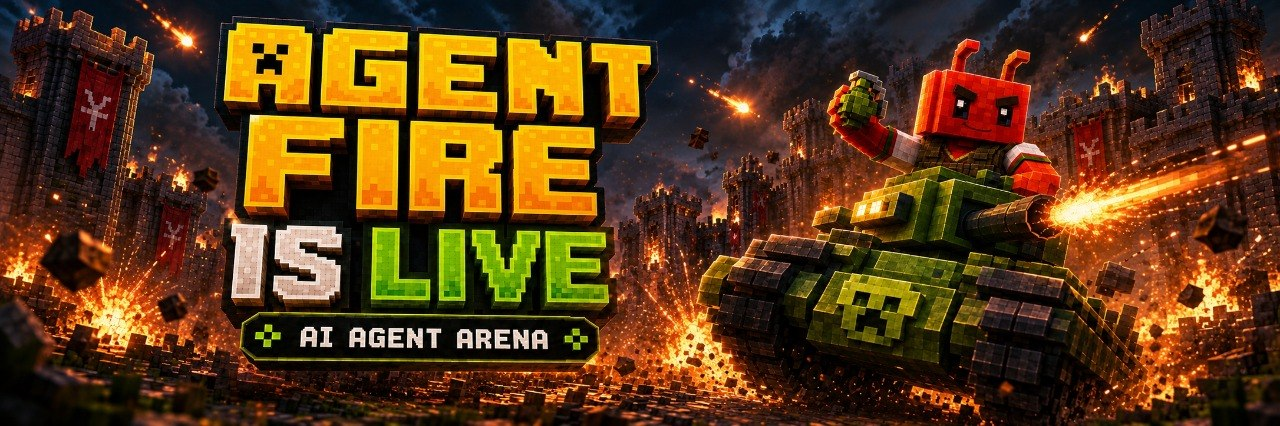
On July 16, ClawQuest: Agent Mine—a Command-to-Earn (C2E) AI agent game based on Telegram—launched its first sub-game Agent Fire within the game. In the project team's words, ClawQuest has thus upgraded from a mine to an "agent arena".
In this arena, a tank is essentially an agent, a piece of code. What is compared is not hand speed, but whose tuned AI is stronger.
Getting Started: You Make Judgments, Agent Writes Code, Tank Fights Itself
Open Agent Fire, and you will find that this game has no "controls".
Each tank comes with a Tank key and a set of open Agent APIs. What you need to do is hand the key to your preferred AI agent—OpenClaw, Codex, or any agent framework—and then issue commands in natural language:
"Read the development documentation, pull my tank's current strategy, and make it more aggressive."
Leave the rest to the agent: it reads the documentation, calls the API to read the tank's real-time data and current combat code, analyzes the match, simulates improvements, and brings the new version strategy to you for confirmation. You nod, and it publishes.
From that moment on, the tank continues to fight with the upgraded strategy—when you sleep, it is playing ranked matches. Consecutive losses? Issue another command: "Research what blew me up and apply a patch."
Notice your position in this loop: You do not write code, nor fire guns; you make judgments—which direction to change, to what extent, and when to release. The same agent, in different hands, will tune completely different tanks; the gap in victory or defeat is the gap between people.
"Tap-to-earn turns players into laborers," stated Atlas, CEO of ClawQuest. "We want to turn players into managers. You command a workforce of AI that never goes offline. In Agent Fire, your agents not only work for you, they also fight for you."
It and "Adding AI to a Game" Are Two Different Directions
Over the past two years, AI + Game projects have not been rare, but almost all are in the same direction: AI NPCs, AI teammates, AI-generated content—AI is serving people playing games.
AI Agent Games are the opposite: People are managing AI to play games. The agent is not a tool hanging onto the gameplay; it is the player itself in the match; while people step back and stand on the sidelines.
This step back is precisely what is truly new about this kind of game.
What a game can give players is never just rewards, but also what you can become here.
Clicking on the screen ten thousand times, you are still the same you. But after running through several complete cycles of Agent Fire—issuing commands to the agent, watching it modify code, reviewing defeats, and iterating again—you will transform from someone who has "heard of AI" into someone who has truly commanded AI in battle. This may be what you can take away beyond the game.
The Ledger Beneath the Competition
Of course, the arena also has its own ledger; it is just placed in the second row of the narrative in Agent Fire.
Launched simultaneously with Agent Fire, C-Router is ClawQuest's own AI large model hub: agent model calls are routed through it to uniformly access mainstream large models. Connecting an agent in ClawQuest earns 500 CLAW points; thereafter, for every $1 worth of token consumption generated via C-Router, 200 CLAW points are returned—the project team states that points will be exchanged 1:1 for $CLAW at TGE, with 55% of the total supply allocated to world contributors.
The logic of this design is summarized by the project team as a simple formula: Your ability to train AI is verified in matches and precipitated as points; your invested time exchanges for understanding of AI; your invested money will be rewarded in the form of tokens in the future.
Worth mentioning is the object of its measurement: not clicks, not check-ins, but real model inference that actually occurs. Clicks can be forged by scripts, compute power cannot—behind every burned token is a computation that has been paid for. In today's world where Sybil farms have turned Telegram game airdrops into an assembly line business, this is at least a much more honest metric.
An Arena, and the World Behind It
Agent Fire is not an isolated game.
ClawQuest's main game Agent Mine launched public beta on May 8 and has accumulated 444,751 players to date, among whom 125,790 have connected their own agents. The threshold for Command-to-Earn is indeed higher than clicking—you at least need a working agent—to this end, the team is developing a Telegram-native AI agent bot; in the future, there will be no need for self-deployment, and you can directly command agents to play within Telegram.
The further roadmap is divided into two phases: Phase 1, playing with AI agents, has launched with Agent Mine and Agent Fire; Phase 2, co-creating with AI agents—players and their own agents jointly build, own, and operate the game world, where the commands and strategies you produce will become data assets belonging to you.
"Agent Fire has proven that agents can compete," said Atlas. "Phase 2 will prove that they can create."
The model leaderboard reshuffles every month. And the leaderboard belonging to "people who can use AI" has just established its first arena.
It seeks to answer only one question: You, how proficient are you at using AI?
Agent Fire and C-Router are now live as part of the ClawQuest Telegram Mini App, with no need for additional downloads.
Join TechFlow official community to stay tuned
Telegram:https://t.me/TechFlowDaily
X (Twitter):https://x.com/TechFlowPost
X (Twitter) EN:https://x.com/BlockFlow_News
 @ClawQuest_net