Rumors of US Listing Resurface, Samsung Electronics Urgently Denies ADR Issuance Assessment
TechFlow Selected TechFlow Selected
Rumors of US Listing Resurface, Samsung Electronics Urgently Denies ADR Issuance Assessment
Reports indicate that Samsung Electronics is re-evaluating the feasibility of issuing U.S. ADRs and has made preliminary contact with investment banks, but has not yet entered the stage of substantive progress. Subsequently, Samsung Electronics came forward to clarify, stating that it is currently not considering the possibility of issuing ADRs.
 Navigating Web3 tides with focused insights
Samsung Electronics is re-evaluating the possibility of listing on the US capital market.
On July 14, according to Bloomberg citing informed sources, Samsung Electronics has made preliminary contacts with several investment banks regarding a potential American Depositary Receipt (ADR) issuance, but relevant discussions are still in the early assessment stage. The company has not yet decided whether to proceed with the transaction, nor has it entered substantive stages such as underwriter selection. Subsequently, Samsung Electronics clarified, stating that it is currently not considering the possibility of issuing ADRs.
SK Hynix previously completed a $26.5 billion US listing, setting a record for the scale of an IPO by a foreign enterprise in the US, showing that the financing attractiveness of core companies in the AI industry chain remains strong. However, Samsung still needs to weigh multiple factors such as stock price volatility in the memory chip sector, complex business structure, and future industry supply and demand changes.
SK Hynix's Record-Breaking IPO Prompts Samsung to Restart Assessment
The report cited informed sources stating that Samsung has studied the feasibility of issuing ADRs multiple times in the past, but none were ultimately implemented. This restart of the assessment was largely driven by SK Hynix's successful listing.
As the world's two largest memory chip manufacturers, Samsung and SK Hynix both directly benefit from the AI infrastructure investment boom. SK Hynix's record-breaking IPO not only refreshed the record for the scale of a foreign enterprise listing in the US but also once again verified the global capital market's allocation demand for core AI supply chain enterprises, even though controversies regarding the high valuation of AI assets still exist in the market.
Since the beginning of this year, Samsung's stock price has cumulatively risen by about 105%; SK Hynix's stock price rose by about 183% during the same period. However, informed sources emphasized that internal discussions at Samsung currently remain at the feasibility assessment stage, with no decision yet made on whether to launch the issuance, nor has a specific transaction plan been determined.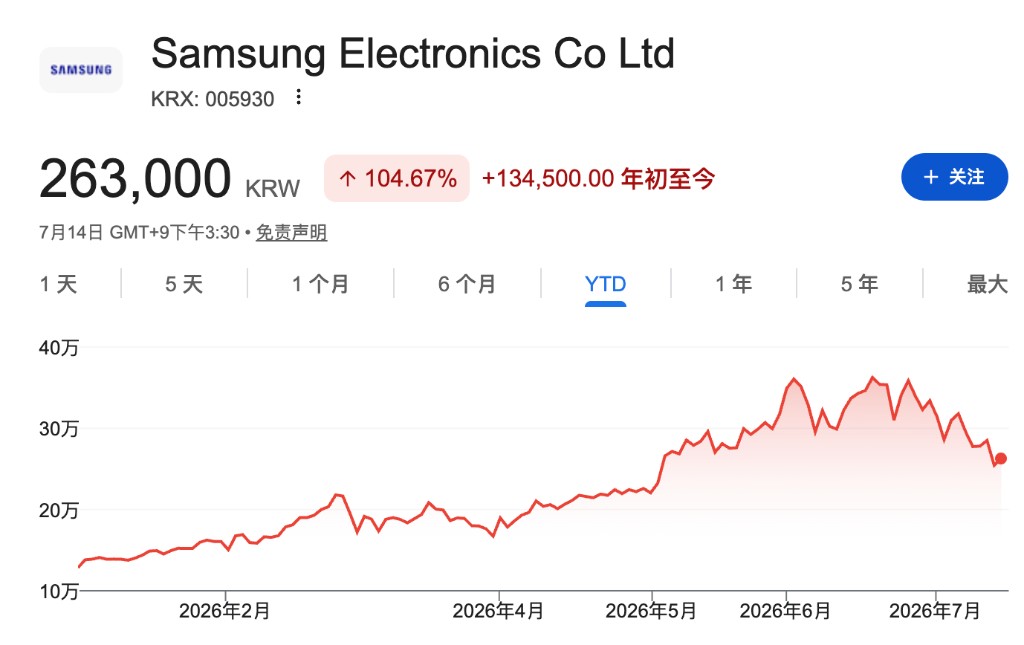
Diversified Business Structure Increases Listing Difficulty
Compared to SK Hynix, the challenges Samsung faces in listing in the US are significantly greater.
The report states that Samsung's business covers multiple fields such as memory chips, logic chips, smartphones, consumer electronics, and display panels. Its business structure is far more complex than SK Hynix, which focuses on memory business, which will increase the difficulty for investor valuation and transaction structure design.
In addition, labor disputes that have repeatedly occurred in recent years may also become risk factors of concern to investors.
On the other hand, Samsung's stock price has already risen significantly, and the market has high expectations for its earnings improvement, which means the difficulty of continuing to exceed investor expectations in the future is also increasing. This was reflected after the latest financial report. Although Samsung's announced preliminary results were overall better than market expectations, the company's stock price still fell significantly afterwards, reflecting that the current AI chip sector valuation is relatively high and market sentiment is relatively sensitive.
Under the AI Production Expansion Boom, Supply Risk Becomes a New Variable
In addition to the capital market environment, changes in industry supply and demand are also important factors Samsung needs to consider.
With AI demand continuing to grow, global memory manufacturers are accelerating production expansion. Last month, Samsung Group and SK Group respectively announced the construction of two new chip manufacturing plants, with a total investment scale of about 800 trillion won (about $536 billion), further expanding advanced chip capacity.
At the same time, the South Korean government also announced an AI infrastructure investment plan with a total scale of 550 trillion won, partnering with enterprises including Naver, planning to build 8.4 gigawatts of AI data center capacity by 2029.
It cannot be ignored that capacity expansion is laying the groundwork for future supply surplus. Once the supply-demand relationship shifts from tight balance to loose, chip prices and profit margins will be squeezed, and the valuation logic of semiconductor enterprises will also be affected. Although Samsung Electronics has currently clearly stated that it is not considering ADR issuance, the evolution of the memory chip industry cycle will still be a critical factor affecting the company's future capital operation decisions.
Join TechFlow official community to stay tuned
Telegram:https://t.me/TechFlowDaily
X (Twitter):https://x.com/TechFlowPost
X (Twitter) EN:https://x.com/BlockFlow_News