








Bitget Wallet Research Institute: A Review of the First Lesson on Participating in On-Chain IPOs
TechFlow Selected TechFlow Selected
Bitget Wallet Research Institute: A Review of the First Lesson on Participating in On-Chain IPOs
Blockchain’s global distribution capability faces a set of entirely foreign rules at its most critical juncture.
 Navigating Web3 tides with focused insights
Author: Lacie Zhang, Researcher at Bitget Wallet
In November 2021, a group of strangers pooled over $40 million within days to bid on a first-edition copy of the U.S. Constitution printed in 1787. This organization—ConstitutionDAO—ultimately lost the auction at Sotheby’s to a hedge fund billionaire. It arrived with money—but left empty-handed. For many, it was their first glimpse of how blockchain could, in an extremely short time, aggregate retail capital scattered across the globe around a scarce asset.
Four and a half years later, a similar scene replayed—on a different stage—and told a different story.
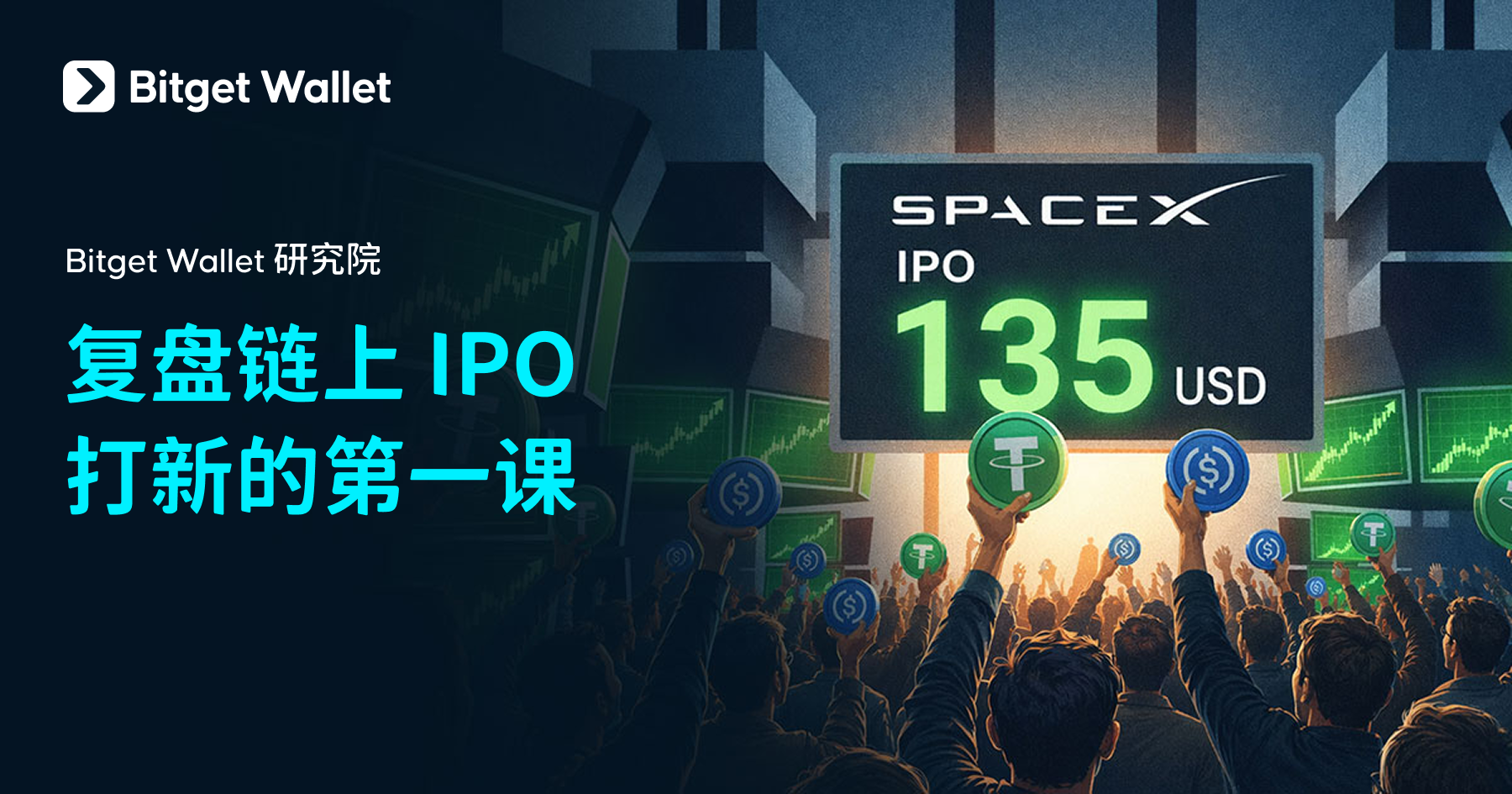
On June 12, 2026, SpaceX (ticker: SPCX) listed on Nasdaq at an opening price of $150—approximately 11% above its indicative IPO price of $135—making it the strongest IPO in history.
For most users, access to U.S. IPOs is nearly invisible. Without qualified investor status, a traditional brokerage account, or longstanding relationships with underwriters, participation remains out of reach. Blockchain dismantles this barrier: multiple crypto platforms attempted to bring this otherwise closed, scarce asset on-chain via tokenization. Bitget Wallet briefly partnered with tokenized stock platform xStocks to open up tokenized subscription for the SPCX IPO, setting individual subscription limits between $10 and $5,000—effectively reducing the participation threshold to near zero.
The outcome was disappointing. Due to xStocks’ upstream underwriting channel failing to secure sufficient allocation, the underlying tokenized shares were not delivered as scheduled—resulting in full refunds.
Yet this outcome precisely serves as the best entry point to understand the real state of on-chain Pre-IPO participation.
I. The Core Challenge of Tokenized IPO Subscriptions: Centralized Off-Chain Asset Allocation
Tokenized IPO subscriptions, in essence, tokenize the allocation quotas traditionally managed by brokerages. The fundamental bottleneck hindering industry-wide efforts lies in the structural mismatch between traditional IPO allocation systems and on-chain distribution capabilities.
What tokenized channels can achieve is moving the subscription entry point on-chain: anyone, anywhere, without account opening, can participate using stablecoins. What tokenization cannot change, however, is that allocation decisions remain firmly in the hands of traditional financial syndicates.
Take SpaceX as an example: the joint bookrunners included top-tier investment banks such as Goldman Sachs, Morgan Stanley, BofA Securities, Citigroup, and JPMorgan Chase—they organized bookbuilding, aggregated demand, and ultimately decided allocations.
This allocation logic prioritizes institutions, long-standing relationships, and loyal clients. Underwriters favor large, stable institutional orders. The scarcer—and more sought-after—the IPO, the more pronounced this tendency becomes. SpaceX’s offering was oversubscribed roughly fourfold; BlackRock alone placed orders totaling approximately $5 billion—leaving minimal quota for crypto-native channels.
The result? Blockchain possesses formidable global distribution capacity—but at the most critical juncture, it confronts a set of rules entirely outside its control.
The path forward isn’t complex—but it requires time: First, gradually integrate crypto-friendly institutions into traditional underwriting networks through licensing, capital strength, and long-term track records—securing institutional seats in primary markets. Second, drive assets to be natively issued on-chain from inception, fundamentally bypassing existing IPO quota systems. Until either path matures, tokenized IPO subscriptions will face persistent supply-side ceilings.
II. An Imperfect—but Important—On-Chain Stress Test
Though settlement fell short, this industry-wide attempt was far from futile. It yielded two tangible signals: First, permissionless on-chain distribution can fully absorb retail investors’ genuine demand for scarce assets. Second, on-chain distribution infrastructure has matured sufficiently—and now shows real potential to reshape traditional IPO subscription workflows.
Demand side. Over $800 million in subscription funds converged rapidly from ordinary users worldwide toward an asset almost entirely inaccessible via traditional channels. Assets like SpaceX are gated by geographic restrictions, qualified investor requirements, and brokerage account mandates—excluding the vast majority. On-chain access provides a new gateway: no traditional brokerage account, no complex onboarding—just a wallet and stablecoins. This demand does not vanish simply because delivery failed once.
Notably, on-chain participation also offers flexibility post-allocation absent in traditional channels. Traditional IPO subscriptions often include “anti-flipping” clauses—short-term trading may trigger fee clawbacks or blacklisting. Tokenized assets typically impose no mandatory lockups; holders can trade freely upon receipt. For retail investors long frustrated merely by “getting in,” the ability to “enter—and exit freely”—is itself a real and scarce value.
Execution side. This event also served as a real-world stress test for on-chain infrastructure. Take Bitget Wallet as an example: leveraging its proprietary DEX aggregator and multi-chain gas fee sponsorship, subscriptions were extended across five chains using USDC/USDT—users could participate using stablecoins on any major chain, eliminating the need for cross-chain swaps or native gas tokens. This provided robust technical support for over $13 million in on-chain subscriptions completed within half an hour.
After confirmation of failed delivery, full refunds—including principal, fees, and forex spreads—were processed within ~4 hours, requiring zero user action. More importantly, every refund, reconciliation, and status update was recorded as a verifiable, on-chain transaction. Compared to traditional brokers’ internal ledgers and manual coordination, the transparency and execution efficiency advantages of on-chain infrastructure were vividly demonstrated during this stress test.
III. Two Ways to Participate in Pre-IPO: Tokenized IPOs vs. Perpetuals
Since tokenized IPOs cannot yet alter how primary-market assets are supplied, expectations must remain tempered—for the foreseeable future. They are unlikely to deliver true permissionless access or infinite supply. A more realistic evolution may be a “stablecoin-enabled” upgrade of traditional IPO subscription processes. When subscription volume exceeds actual allocation, oversubscription, lotteries, pro-rata allocations, or full refunds will become routine.
By contrast, another participation method deserves greater attention: Pre-IPO perpetual contracts (Perps).
These two instruments cater to distinct preferences. Tokenized IPOs align closely with spot logic: backed by real underlying assets, they suit risk-averse users unwilling to bear leverage or funding rate erosion—though supply constraints, oversubscription lotteries, or full refunds come at a cost. Pre-IPO Perps require no waiting for allocations, no reliance on underwriter distribution, and no physical share delivery. Instead, they enable direct trading based on price expectations for unlisted assets—offering greater flexibility but demanding acceptance of leverage and high volatility risks.
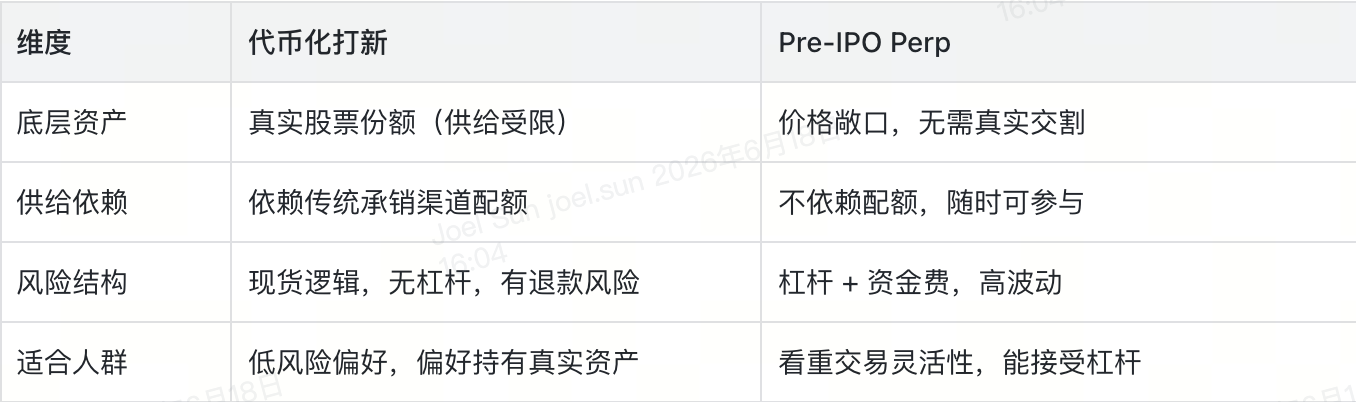
More notably, Pre-IPO Perps have already demonstrated meaningful price discovery capability. The SPCX perpetual began 24/7 trading on platforms like Hyperliquid starting May 18—weeks before its official June 12 listing. As listing approached, its cross-platform volume-weighted average price hovered around $155—about 15% above the $135 issue price; the first official trade occurred at $150, indicating the on-chain market had largely converged near the true price pre-opening. Another reference: Cerebras’ Pre-IPO Perp on Hyperliquid priced within ~1.3% of its $350 opening price.
Clearly, on-chain markets not only form consensus pricing around unlisted assets—they also anticipate formal listing prices to a meaningful degree. This capability already transcends mere “IPO participation.”
IV. Conclusion
Return to that 2021 auction room. ConstitutionDAO lost on bidding power; SpaceX’s tokenized IPO failed on trust and eligibility—the on-chain channel never even entered the room where allocation decisions were made.
The failure reason shifted from “bid too low” to “no eligibility to enter”—signaling that the problem has moved from operational to structural. Mature on-chain infrastructure does not automatically open off-chain supply-side gates. These are two distinct developments—and progress is asynchronous.
Yet viewed over a longer horizon, such asynchrony is unsurprising. Every financial infrastructure transition—from clearinghouses to electronic trading replacing open outcry—has endured prolonged coexistence and friction between old and new systems. Traditional finance won’t instantly open allocation gates after one failed IPO; Sotheby’s won’t rewrite auction rules just because ConstitutionDAO emerged. But friction leaves marks: it reshapes user perception, strengthens platform capabilities, and slowly shifts institutional views on crypto channels.
Perhaps the most noteworthy aspect of this event isn’t the outcome itself—but something it accomplished unintentionally: every user who participated in this tokenized IPO has now grown accustomed to using stablecoins in their wallets to engage with assets previously reserved for institutions. Once formed, this mindset is hard to reverse. By the time supply-side access structures evolve, demand-side readiness—and infrastructure readiness—will already be complete.
The value of this retrospective may lie precisely here: transforming an ambiguous failure into a clearly defined problem—and only clearly defined problems can be solved.
Join TechFlow official community to stay tuned
Telegram:https://t.me/TechFlowDaily
X (Twitter):https://x.com/TechFlowPost
X (Twitter) EN:https://x.com/BlockFlow_News
 @BitgetWallet


