The Inevitable Fate of Digital Banks: No Matter How Fancy the App, It’s No Substitute for a Banking License
TechFlow Selected TechFlow Selected
The Inevitable Fate of Digital Banks: No Matter How Fancy the App, It’s No Substitute for a Banking License
Why Do 76% of Digital Banks Remain Unprofitable?
 Navigating Web3 tides with focused insights
By: Thejaswini M A
Translated by: Saoirse, Foresight News
A central planner walks into a store and sees empty shelves. He says, “Look—there’s clearly no demand.” This is an old joke among economists, poking fun at the Soviet Union.
Today, neobanks are stuck in the exact same vicious cycle. Hundreds of startups have launched checking account services, with 1.4 billion people actively using them—but profitability remains elusive. Seventy-six percent of neobanks remain unprofitable. On average, each neobank earns just $45 per user annually, compared to $350 for traditional banks.
The root cause lies in the very products these companies initially chose to build—businesses with almost no inherent profit margin.
To understand why founders made those choices, we must first examine the flaws of the legacy system they sought to escape.
Traditional banks relentlessly extract value from customers—even withdrawing one’s own salary incurs ATM fees. For users with limited savings, the experience is even worse. When the first wave of neobanks launched accounts with zero fees and no minimum balance requirements, customers naturally flocked to them.
Soon, hundreds of millions of users joined their platforms. Today, Nubank serves over 60% of Brazil’s adult population. Traditional banks have long treated everyday customers as a nuisance—making the explosive growth of neobanks inevitable.
Yet these neobanks themselves struggle to survive.
When you swipe your debit card at a coffee shop, the merchant pays a small interchange fee. Under the Federal Reserve’s Regulation II, the cap on interchange fees for a $40 transaction is roughly $0.22—split among the card network, the issuing bank, and the payment processor.
Neobanks receive only a tiny slice of that revenue. Millions of users treat their neobank accounts solely as everyday spending wallets, keeping mortgages and wealth management elsewhere. These meager interchange fees, even aggregated across vast user bases, simply cannot sustain a viable business.
Traditional banks’ core profitability has never relied on daily consumer transactions—the revenue generated from such activity is negligible.
The true profit engine of banking is credit—interest income from mortgages, auto loans, and other lending products. Payment services are merely the daily entry point for customer engagement; lending is the primary mechanism for extracting profit from users. This is precisely why most neobanks continue to lose money: without a banking license, they cannot scale lending operations or collect interest at scale. Early on, most neobanks operated as tech platforms relying on third-party banking licenses, facing strict legal constraints on large-scale lending.
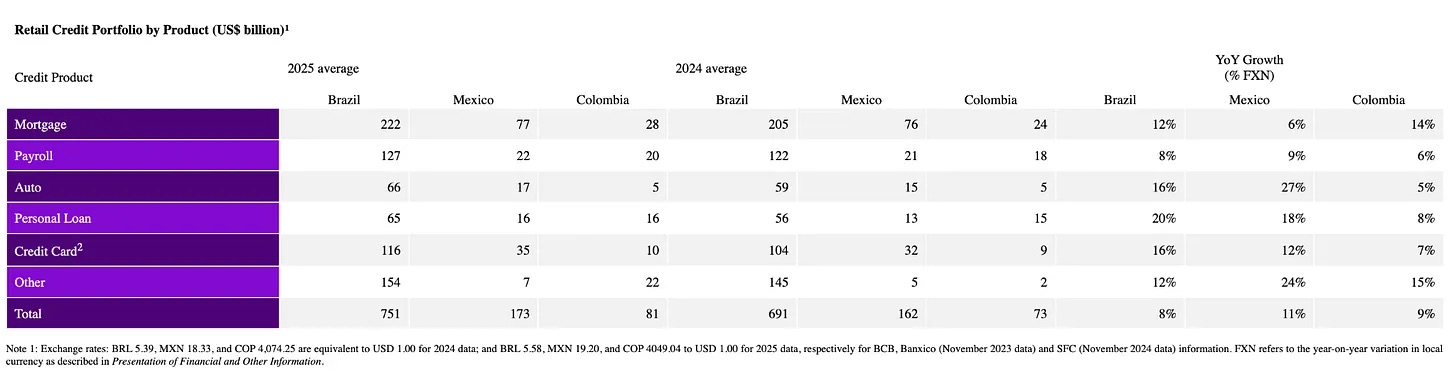
Nubank launched in Brazil in 2013, gaining traction with a free credit card. At the time, local traditional banks charged exorbitant loan rates—creating fertile ground for Nubank’s expansion. By 2026, it had amassed 131 million users.
Today, Nubank’s valuation stands at $60 billion. Its free accounts serve merely as acquisition tools to drive app downloads—the real profits come entirely from its lending business.
Of last year’s $15.8 billion in revenue, the vast majority came from interest on credit cards and personal loans. Personal lending grew rapidly and has now become its largest profit driver. Nubank survived—not through any disruptive technology—but through lending; its seamless app experience was simply the bait to attract users.
Source: @sec.gov
Revolut pursued a different path to profitability. In 2025, it posted £1.3 billion in net profit, with revenue up 46% year-on-year to £4.5 billion—marking five consecutive years of profitability. Profits stemmed primarily from foreign exchange fees, subscription memberships, crypto assets, and its credit portfolio. Its lending book surged 120% year-on-year to $2.9 billion. Early revenues from FX fees and subscriptions gave Revolut ample runway to steadily scale its lending operations.
Chime took the longest to grasp this reality. In its early years, it relied almost entirely on interchange fees. Customer acquisition costs in the U.S. are extremely high; interchange revenue is razor-thin; and income depends entirely on users continuing to swipe cards regularly—if spending drops, revenue collapses overnight.
In 2025, Chime’s revenue surpassed $2 billion—but it still posted a $1 billion loss, driven largely by massive equity compensation expenses tied to its IPO. Valued at $11 billion at listing, its stock price plunged sharply within months. Not until Q1 2026—12 years after founding—did Chime post its first-ever profit: $53 million. The turning point was the explosive growth of its lending products: earned-wage access (EWA) revenue is projected to exceed $400 million, while instant small-dollar loans scaled dramatically.
In June 2026, a Nubank developer accidentally triggered a liquidation notification during routine system maintenance. A flood of users received push notifications and emails stating that the Central Bank had liquidated the bank and instructing them how to claim funds via the deposit insurance fund. Co-founder Cristina Junqueira had to issue a public apology on Instagram, clarifying it was a bizarre operational error—and that both the bank and user funds remained fully secure. Yet within minutes, the erroneous notice led many users to believe the platform was about to collapse.
Fairly speaking, legacy banks also suffer technical blunders—such as miskeying digits and wiring $1 billion to the wrong account. But institutions like Citibank, founded in 1812, enjoy deep-rooted stability: even when glitches occur, users dismiss them as ordinary corporate mishaps. By contrast, if a startup digital bank faces rumors of collapse, users rush en masse to withdraw funds. Legacy banks may lag technologically—but emerging online platforms haven’t yet learned how to operate with the resilience of real banks.
In April 2024, middleware provider Synapse declared bankruptcy.
Neobanks are, at heart, software providers. To offer checking accounts, they must stitch together an entire ecosystem of partners. Synapse acted as the middleman—connecting over 100 neobanks with traditional banks that actually hold deposits, handling ledger management, compliance checks, and asset title registration.
After Synapse collapsed, all its operational records vanished. Approximately $265 million in user funds were frozen. Partner banks could no longer identify which users owned which deposits. Post-mortem audits revealed $95 million in missing funds—exposing a complete absence of accountability mechanisms. Popular digital banking apps like Yotta and Juno left users unable to access accounts for months; some couldn’t even make mortgage payments.
If a banking app outsources custody and clearing functions entirely to third parties beyond its control, the entire architecture is inherently fragile—a house of cards destined to collapse.
Ultimately, the sole safeguard against such systemic risk is a banking license. Yet early neobanks uniformly claimed they didn’t need one.
Last October, I wrote that crypto-native digital banks held genuine growth potential. At the time, regulatory frameworks were crystallizing, and a large user base already held on-chain assets they wanted to use directly for daily payments. That view remains valid—but I gravely underestimated one thing: infrastructure built atop partner banks inevitably inherits all their latent risks.
The crypto industry’s response has been to stop pretending and confront reality head-on. Between December 2025 and May 2026, the U.S. Office of the Comptroller of the Currency (OCC) conditionally approved roughly ten national trust charters for crypto and fintech firms—more than the total issued over the previous decade. Paxos, BitGo, Fidelity Digital Assets, Ripple, Circle, Bridge (acquired by Stripe for $1.1 billion), and Crypto.com all filed applications for similar charters—the very credentials early neobanks dismissed as unnecessary.
The national trust charter is the definitive exit from the middleman trap. Holding one means direct federal endorsement: firms can custody user assets independently, handle payments and clearing in-house, and operate across all 50 U.S. states under a single, unified regulatory framework. No more begging legacy partner banks for survival—and no more betting an entire enterprise’s fate on invisible intermediaries like Synapse.
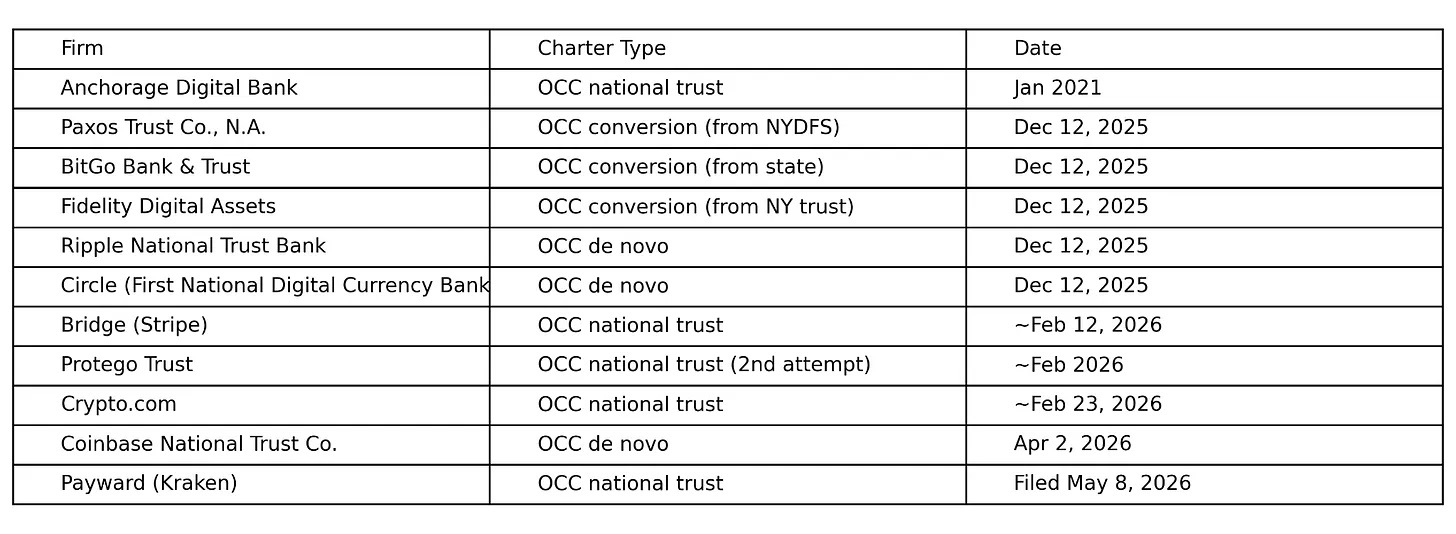
Crypto firms have finally realized: to move billions of dollars in assets without being constantly constrained by legacy banking infrastructure, formal admission into the federal regulatory system is non-negotiable.
Payward—the parent company of Kraken—now holds three layers of U.S. regulatory authorization: a Wyoming financial license, a Federal Reserve master account granted in March 2026, and an OCC national trust charter application submitted in May 2026. SoFi acquired Golden Pacific Bancorp in 2022 to obtain its OCC charter. In December 2025, SoFi launched a USD-pegged stablecoin—the first issued by a U.S. national bank and deployed on a permissionless public blockchain. By May 2026, its 14.7 million users could hold, spend, and redeem the stablecoin directly in-app, with Mastercard serving as its settlement partner. Coinbase leverages the Base blockchain and Morpho protocol to conduct Bitcoin staking and lending—by early 2026, over $1.4 billion worth of BTC was collateralized on its platform.
SoFi’s evolution is emblematic: student loan servicer → digital neobank → licensed national bank → stablecoin issuer—completing the full industry lifecycle.
One major gap remains: unsecured lending. CeFi and DeFi secured lending totals $67.42 billion.
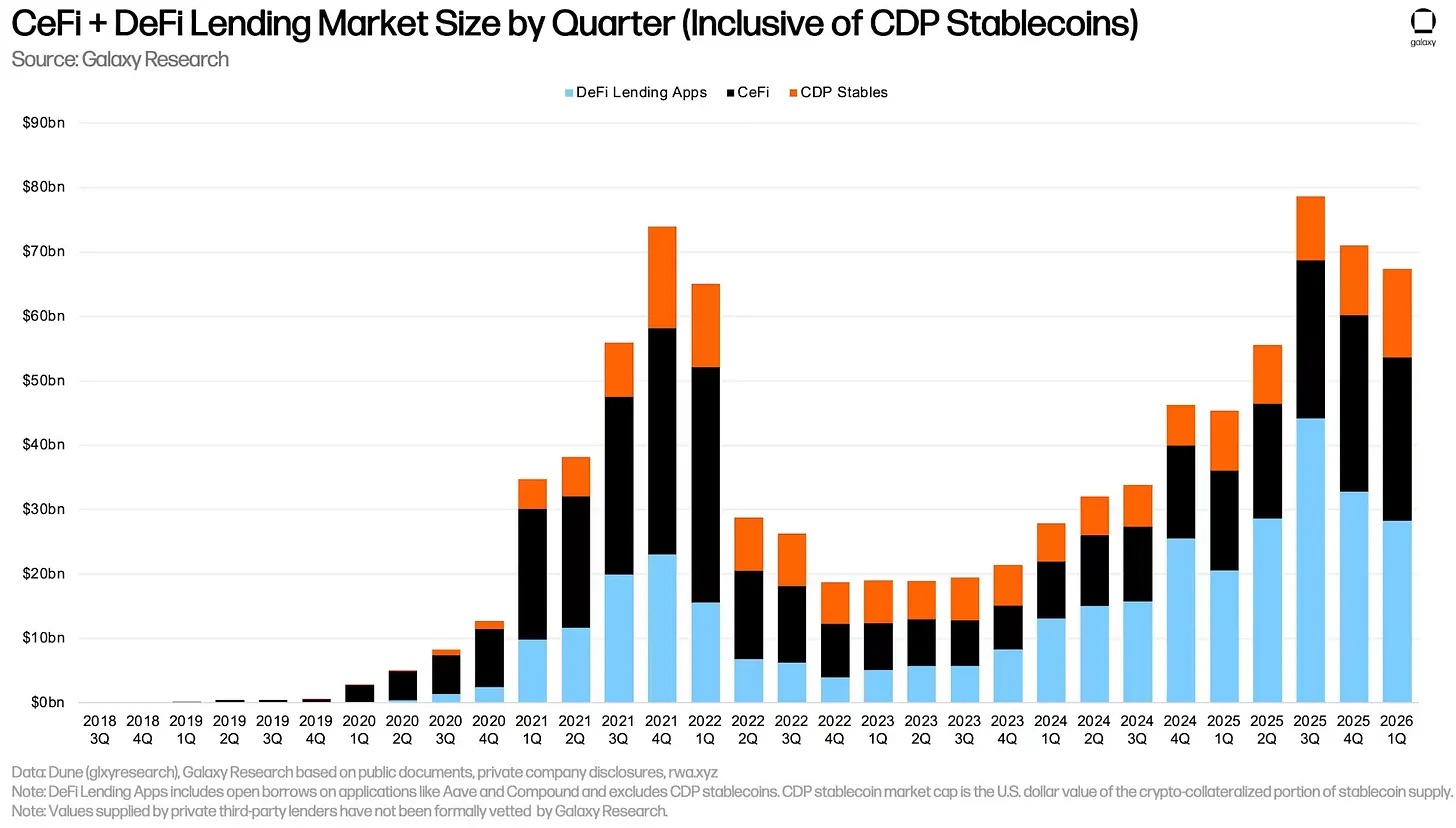
Yet truly deployed unsecured lending across the entire decentralized ecosystem amounts to just $24 million. Protocols once active in unsecured lending—Goldfinch, early Maple, TrueFi—have either fully shifted to over-collateralized models or gradually shut down. Today, Maple—the largest DeFi lending protocol—requires a 160% collateral ratio.
Blockchain addresses are anonymous; unsecured lending lacks enforceable default recovery mechanisms. In the real world, borrowers who default face credit reporting and lawsuits. In decentralized environments, there are no credit bureaus or asset recovery channels—once a borrower absconds with uncollateralized funds, they simply abandon their wallet address, rendering the capital irretrievable. Some DeFi protocols attempted risk management using on-chain reputation data—but still suffered widespread defaults. Industry participants have finally accepted: without real-world legal enforcement, anonymous users have virtually no incentive to repay voluntarily.
Nubank extends loans to 131 million users—including many lacking traditional credit histories—relying instead on behavioral transaction data for risk assessment and underwriting. This service delivers genuine commercial value—but entails extremely high operational costs and significant implementation complexity. To scale similar credit products on blockchains, firms will almost certainly require banking licenses. Expect a growing number of applicants filing for OCC charters in the near future.
Last October, I wrote that crypto-native digital banks are replaying the banking industry’s century-old development pattern. Technology evolves endlessly—but the fundamental logic of how humans use and manage money remains constant. When I penned that line, I saw beauty in its inevitability. Now, rereading it, I see something else entirely.
Banking’s essence has always been earning interest through lending. The neobanks that survived initially promised to break this model—but the ones that actually endured ultimately returned to lending—albeit with friendlier rates and smoother interfaces. The underlying commercial logic remains unchanged.
In short: everything changes—yet the essence stays the same.
Join TechFlow official community to stay tuned
Telegram:https://t.me/TechFlowDaily
X (Twitter):https://x.com/TechFlowPost
X (Twitter) EN:https://x.com/BlockFlow_News