The Battle for the U.S. Tokenization Roadmap: Who Will Become the Next-Generation Asset Gateway—Ondo, xStocks, or NYSE?
TechFlow Selected TechFlow Selected
The Battle for the U.S. Tokenization Roadmap: Who Will Become the Next-Generation Asset Gateway—Ondo, xStocks, or NYSE?
This article outlines three U.S. equity tokenization pathways—Ondo, xStocks, and NYSE—and analyzes how RWAs are evolving from on-chain yield narratives toward global asset gateway competition.
 Navigating Web3 tides with focused insights
Author: Changan I Biteye Content Team
On May 26, 2026, Ondo Finance officially announced that its founder, Nathan Allman, had passed away unexpectedly.
This news reignited market attention on Ondo and once again placed the RWA (Real World Assets) sector under the spotlight.
From tokenized U.S. Treasuries to Ondo Global Markets, and further to U.S. equities and ETFs—traditional financial assets with on-chain exposure—Ondo has consistently occupied a central position in the tokenization of traditional assets.
So as traditional financial assets begin to be tokenized, who will control the next-generation asset gateway?
Today, this question no longer belongs solely to Ondo. Participants such as xStocks and the NYSE are also entering the U.S. equity tokenization market from different directions. Though they all appear to be pursuing U.S. equity tokenization, their underlying strategies differ significantly.
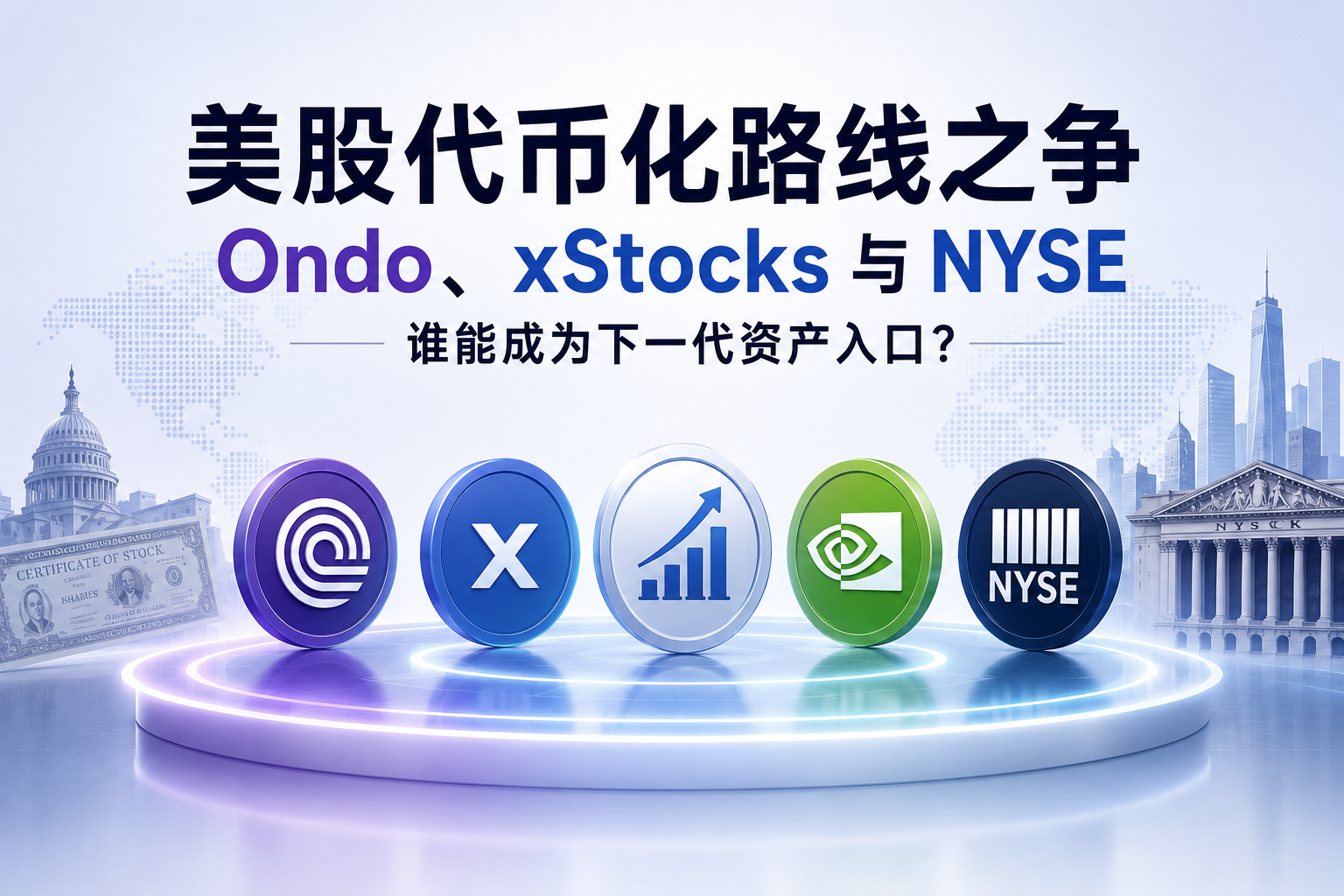
I. Ondo’s Contribution: Shifting RWA from a Yield Narrative to an Asset Gateway Narrative
Nathan Allman’s contribution to Ondo extended far beyond founding an RWA project. More importantly, he transformed what was initially a largely conceptual direction into products that the market could understand and users could actually use.
During the early phase of the RWA narrative, market understanding of RWAs remained vague. Much of the discussion stayed at the level of grand narratives: real estate could be tokenized, bonds could be tokenized, and stocks could be tokenized.
Yet when it came down to the user side, people cared about far more concrete questions: What exactly can I buy? Where does the yield come from? How do I assess risk?
Ondo first seized upon tokenized U.S. Treasuries—a relatively clear entry point.
In a high-interest-rate environment, on-chain capital began seeking more stable yield sources. Compared to DeFi yields reliant on token incentives, traditional assets like U.S. Treasuries and money market funds already possess mature pricing mechanisms and broad market recognition.
Through products such as OUSG and USDY, Ondo brought these traditional financial assets onto the blockchain. This represents one of Nathan Allman’s most critical contributions to Ondo: transforming RWA from a narrative into tangible products.
But Ondo was never content to focus solely on on-chain U.S. Treasuries. From tokenized U.S. Treasuries to Ondo Global Markets, and further to U.S. equities and ETFs—exposures to public-market assets—Ondo’s objective gradually sharpened: packaging traditional financial assets as on-chain financial products and establishing a new distribution framework.
In the past, RWAs functioned more like supplementary yield options within the crypto market.
Ondo elevated RWAs to become an integral part of the on-chain financial system. Assets such as U.S. Treasuries, equities, and ETFs were not merely “moved onto the chain,” but became accessible within wallets, trading platforms, institutional products, and numerous other financial contexts.
This is why Nathan Allman’s passing triggered such a strong market reaction. Ondo is no longer just another ordinary project—it has become one of the most representative case studies in this wave of the RWA narrative, embodying the market’s collective imagination around whether traditional financial assets can truly enter the on-chain world.
Yet this event also reminds the market that although RWAs connect to traditional financial assets such as U.S. Treasuries, equities, and ETFs, the projects themselves remain vulnerable in the manner typical of startups—especially crypto-native ones, where the sudden departure of a founder prompts external observers to reassess organizational resilience.
If Ondo continues advancing Global Markets, maintains institutional partnerships, expands distribution channels, and sustains user and market confidence, this leadership transition may ultimately demonstrate that the project has evolved beyond founder-driven dependence into a more mature stage.
For this very reason, discussing Ondo today cannot be limited to Ondo alone. As RWAs advance from U.S. Treasury yield products toward U.S. equities and ETFs—public-market assets—they inevitably engage not only with internal crypto product innovation but also with the account management, distribution, and settlement systems long controlled by traditional finance.
II. Why Equity Tokenization Will Transform Traditional Brokers’ Asset Gateways
When RWAs shift from U.S. Treasury yield products to public-market assets such as U.S. equities and ETFs, they begin challenging not only on-chain yield generation—but rather the asset distribution infrastructure long dominated by traditional finance.
Historically, global users wishing to purchase U.S. equities have had little choice but to go through brokerage accounts. Account opening, KYC, funding, currency conversion, trading, clearing, and custody—all processes occur entirely within the traditional financial system.
For brokers, equity trading itself is merely the surface layer; what truly matters is client relationships and asset retention. So long as user assets remain held within the brokerage account, services such as margin lending, securities lending, and wealth management can continue revolving around that single account.
Equity tokenization introduces multiple new pathways for users to access U.S. equity assets. Users may no longer need to rely exclusively on traditional brokerage accounts; instead, they may gain exposure to U.S. equities and ETFs via exchanges, wallets, or on-chain applications.
This does not mean brokers will be immediately displaced. However, the asset gateways, trading gateways, and distribution gateways previously centralized within brokerage accounts are now beginning to “leak” outward.
This is precisely why Ondo, xStocks, and the NYSE are entering this competitive arena from divergent angles. What they are vying for is not a particular stock token—but rather the new distribution locus for U.S. equity assets: whoever succeeds in bringing traditional financial assets to broader audiences stands to become the next-generation asset gateway.
III. Ondo, xStocks, NYSE: Three Distinct Pathways to U.S. Equity Tokenization
Superficially, Ondo, xStocks, and the NYSE all appear to be pursuing U.S. equity tokenization—but they represent three fundamentally distinct pathways.
These three pathways will likely determine what on-chain U.S. equities ultimately become.
1. Ondo: Building an On-Chain Financial Asset Platform, Starting from RWA Products
Ondo aims not only to serve as a trading gateway for U.S. equities but also to handle issuance and distribution. It functions more like an intermediary layer bridging traditional finance and on-chain dApps—one end connecting to U.S. equities, the other to wallets.
This differs fundamentally from traditional brokers’ logic. The core of traditional brokerage lies in its account system: users open an account, purchase stocks, and hold those assets within the broker’s and custodian’s infrastructure. Trading, dividends, tax reporting, margin lending—all revolve around that single account.
Ondo seeks instead to transform these traditional assets into on-chain-accessible, transferable, and composable exposures.
This means U.S. equities and ETFs cease being mere holdings within a brokerage account—and instead enter wallets, DEXs, lending protocols, on-chain asset management products, and many other DeFi contexts.
The advantages of Ondo’s approach are clear:
- Greater composability aligned with DeFi principles.
- Ability to serve global, non-U.S. users seeking exposure to U.S. equities and Treasuries.
- Easier integration with on-chain lending, stablecoins, yield products, and institutional wallets.
Yet its challenges are equally apparent.
Ondo-type products require highly complex legal, compliance, and custody structures. Users typically do not acquire traditional stock-account assets, but rather economic exposures packaged via issuing entities and specific legal constructs.
Thus, Ondo functions more as an on-chain gateway to traditional assets—not a full replication of a traditional brokerage account.
2. xStocks: Prioritizing Trading Access—Enabling Equity Exposure to Flow On-Chain
xStocks approaches the space more directly from the trading gateway perspective—leveraging crypto exchanges such as Kraken, Bybit, and KuCoin to place tokenized stocks directly into environments users already know and trust.
Of course, xStocks is not equivalent to traditional equities: users receive price exposure, not full shareholder rights.
It solves the problem of making U.S. equity trading more convenient—but does not yet address deeper issues such as voting rights, corporate actions, or shareholder entitlements.
Beyond that, xStocks-type products face counterparty and custody risks. Even if underlying asset backing is emphasized, users ultimately depend not only on the on-chain token itself, but also on whether the issuer holds corresponding assets per agreed terms, whether custody arrangements are transparent, whether exchange platforms remain stable, and whether redemption and liquidity mechanisms function reliably during extreme market conditions.
This constitutes one of the most fundamental distinctions between tokenized U.S. equities and holding traditional stocks directly.
Within a brokerage account, users operate within a mature ecosystem of securities registration, custody, and investor protection. In contrast, trading tokenized stocks on crypto exchanges requires users to additionally comprehend the interrelationships among issuers, custodians, exchanges, and on-chain smart contracts.
Hence, xStocks’ advantage lies in faster, more direct trading access—but whether it evolves from a trading product into a mature on-chain equity network hinges on underlying asset transparency, custody structure, and payout reliability under stress scenarios.
3. NYSE: Building a Regulated Digital Securities Platform from Traditional Market Infrastructure
The NYSE’s pathway differs markedly from both Ondo’s and xStocks’.
Ondo and xStocks originate from the crypto world, bringing U.S. equities and ETF exposures onto the chain. The NYSE, by contrast, emerges from within the traditional securities market—seeking to digitize foundational processes including trading, settlement, registration, and rights verification.
In March 2026, ICE/NYSE signed a memorandum of understanding (MoU) with Securitize to jointly build a more comprehensive market infrastructure for tokenized securities—including securities registration, transfer agency, tokenized issuance, and regulatory, operational, and technical standards tailored for institutional-grade digital securities markets.
This marks the most significant distinction between the NYSE’s pathway and crypto-native projects.
For the NYSE, tokenized equities are not merely about capturing price movements. The NYSE seeks to resolve deeper structural questions inherent to securities markets: Who confirms holder rights after tokenization? Who handles registration and transfer? How is settlement executed post-trade? And how do traditional securities processes—such as dividend distribution, voting, and corporate actions—continue to function?
This inherently ensures the NYSE’s pathway will move more slowly than crypto-native projects. It requires regulatory approval, coordination among traditional financial institutions, and compatibility with existing securities regulations. Even upon eventual launch, it is unlikely to fully embrace permissionless, highly open DeFi models.
IV. Current Status of the Three Pathways: Ondo and xStocks Are Distributing; NYSE Is Filling Regulatory Gaps
If Section III outlines the differences among the three pathways, then their current progress reveals markedly divergent paces: Ondo is expanding distribution channels, xStocks is generating trading volume on CEXs, and the NYSE remains focused on rulemaking and infrastructure development.
1. Ondo: From Tokenized U.S. Treasuries to an On-Chain Distribution Network for U.S. Equities and ETFs
Compared to its earlier tokenized U.S. Treasury offerings, Ondo Global Markets has broadened its asset scope to include U.S. equities and ETFs.
More importantly, these assets are no longer confined to Ondo’s own platform—they are increasingly appearing across wallets, trading platforms, and other on-chain gateways.
A pivotal milestone was integration with Binance Wallet.
In November 2025, Ondo announced that over 100 tokenized U.S. equities and ETFs had been integrated into Binance Wallet, becoming accessible to Binance Wallet users.
By February 2026, Binance further added 10 Ondo-tokenized U.S. equities and ETFs—including AAPLon, GOOGLon, TSLAon, NVDAon, and QQQon—to both Binance Alpha and Binance Wallet.
This signals Ondo’s evolution from a standalone platform toward broader traffic gateways. Users no longer need to navigate directly to Ondo’s platform—they may encounter these assets via Binance Wallet, Binance Alpha, or similar interfaces.
Ondo Global Markets’ asset scale is also continuing to grow. In May 2026, Ondo announced that Ondo Global Markets’ TVL had surpassed $1 billion—making it the first tokenized equities platform to reach this milestone.
2. xStocks: Faster Exchange Integration, Emerging as the U.S. Equity Trading Gateway Within Crypto
xStocks is now live across multiple exchanges’ equity token gateways.
Kraken stands out as one of the most important platforms. According to Kraken’s disclosures, xStocks currently supports over 100 tokenized U.S. equities and ETFs; since its launch in June 2025, total trading volume has exceeded $25 billion.
Beyond Kraken, exchanges including Bybit and KuCoin have also progressively integrated xStocks. As more platforms join, xStocks is evolving from an experimental offering on a single platform into a widely adopted U.S. equity tokenization solution across multiple CEXs.
From its current progress, xStocks’ achievements manifest in three key areas:
- Multiplying exchange gateways
- Expanding coverage across more assets
- Generating measurable trading volume
Viewed this way, xStocks has preliminarily validated demand for tokenized U.S. equities within CEX environments.
3. NYSE: Slower Pace, But Advancing Toward Tokenized Securities at the Regulatory Level
The NYSE has yet to generate user-facing trading volume comparable to Ondo or xStocks. Its progress remains concentrated at the regulatory and infrastructure levels.
In December 2025, the Depository Trust Company (DTC) received a SEC Staff No-Action Letter permitting it to provide tokenization services for DTC-custodied assets under certain conditions.
Subsequently, the NYSE began advancing its own platform. In January 2026, ICE/NYSE announced development of a tokenized securities platform designed to support 24/7 trading, instant settlement, dollar-based order entry, and stablecoin funding rails—though the platform still awaits regulatory approval.
In March 2026, the NYSE entered into an MoU with Securitize to jointly advance digital transfer agency, tokenized issuance, and regulatory, operational, and technical standards required for institutional-grade digital securities markets.
This month, NYSE Texas filed Rule 7.39—“Tokenized Securities”—proposing amendments allowing participants meeting DTC Pilot Program criteria to trade DTC-eligible securities in tokenized form on the exchange.
At present, the NYSE’s U.S. equity tokenization initiative has not yet entered full-scale deployment. A realistic timeline suggests small-scale pilots may emerge in the second half of 2026—but achieving stable trading volume and integrating broader brokerage and user participation may not occur until 2027 or later.
The U.S. digital asset regulatory framework is also converging in this direction. In May 2026, the CLARITY Act clarified a key principle: tokenized securities remain subject to existing securities regulations—not exempted simply because they reside on-chain—and must instead seek new modalities for trading, settlement, and disclosure within the current regulatory framework.
V. Conclusion: The Next Step for RWAs Is to Unshackle Finance from National Borders
The most compelling aspect of U.S. equity tokenization lies not merely in providing users with another gateway to buy U.S. equities—but in enabling traditional financial assets to enter a more open, fluid network.
When U.S. equities, Treasuries, and ETFs can be purchased with stablecoins, held in wallets, and distributed via exchanges, they cease to be assets locked within a single brokerage account—and instead acquire significantly enhanced global liquidity.
In the short term, Ondo and xStocks are likely to move faster. They align closely with crypto-native users and can more readily generate early liquidity via wallets, CEXs, and on-chain applications. For users, these products first solve the question: “Can I access U.S. equity exposure more conveniently?”
But in the long run, regulated infrastructure players like the NYSE will not be absent.
If the DTC, NYSE, Securitize, and associated regulatory frameworks mature incrementally, tokenized securities may evolve beyond mere on-chain price exposures—approaching digitally native asset forms recognized and accepted by traditional securities markets. At that stage, crypto-native projects will no longer contend with the question of “Do users trade?”—but rather, “Can they integrate with clearer registration, custody, settlement, and rights-verification systems?”
Hence, U.S. equity tokenization will ultimately not devolve into a zero-sum battle between crypto-native and traditional finance (TradFi) pathways.
A more plausible outcome is that Ondo-, xStocks-type projects drive early user education, liquidity generation, and use-case development—while the NYSE, DTC, and other traditional infrastructure providers fill in the regulatory, settlement, and rights-verification layers over time.
At that juncture, for crypto-native projects to retain centrality, they must move beyond front-end trading gateways—and forge deeper integrations with regulated, foundational market infrastructures.
This, in turn, defines the future battleground for RWA competition.
It is not simply about moving a few stocks onto the chain—but rather, determining who can strike the optimal balance between open liquidity and compliant infrastructure—enabling traditional financial assets to enter a truly globalized, trustworthy digital marketplace.
Join TechFlow official community to stay tuned
Telegram:https://t.me/TechFlowDaily
X (Twitter):https://x.com/TechFlowPost
X (Twitter) EN:https://x.com/BlockFlow_News
 @BiteyeCN