








Crypto Morning Brief: Goldman Sachs Raises Year-End S&P 500 Target; Changxin Technology’s STAR Market IPO Approved by Listing Committee
TechFlow Selected TechFlow Selected
Crypto Morning Brief: Goldman Sachs Raises Year-End S&P 500 Target; Changxin Technology’s STAR Market IPO Approved by Listing Committee
Some banks in Hong Kong have added a requirement for declaring the legitimate source of funds when opening investment accounts offline.
 Navigating Web3 tides with focused insights
Author: TechFlow
Yesterday’s Market Updates
Initial informal document outlining Iran-U.S. MOU framework disclosed
According to Iranian sources, an “initial informal document” outlining the framework of a memorandum of understanding (MOU) between Iran and the United States has been disclosed. The document addresses issues including the Strait of Hormuz, regional military deployments, and future agreement arrangements. Under its terms, the U.S. pledges to lift its “maritime blockade” against Iran and withdraw part of its military forces deployed in areas surrounding Iran.
In exchange, Iran will gradually restore commercial vessel traffic through the Strait of Hormuz to pre-escalation levels within one month—excluding military vessels. Management of vessel passage and routing will be jointly coordinated by Iran and Oman. The document states that if Iran and the U.S. reach a final agreement within 60 days, its contents may be formalized as a binding UN Security Council resolution. Iranian officials emphasized that no concrete action will be taken until “practically verifiable” inspections are completed.
U.S. SEC Chair: Trump administration to deliver greater regulatory clarity for digital asset markets
Paul Atkins, Chair of the U.S. Securities and Exchange Commission (SEC), stated that the SEC had long been out of step with emerging technologies and innovation, prompting entrepreneurs to seek opportunities overseas. He declared that era over. Under President Trump’s leadership—and with cooperation from the administration and Congress—the SEC is delivering what it calls “long-overdue clarity” to digital asset markets.
Hong Kong banks introduce new “source-of-funds” declaration requirement for in-person investment account openings
According to Caixin Global, several Hong Kong banks and their clients reported that, effective May 26, certain Hong Kong banks have introduced a new requirement for customers opening investment accounts in person: signing a declaration confirming that all funds used for investment activities and related settlements originate from lawful sources outside mainland China. The newly added document is titled “Cross-Border Disclosure Statement (Applicable to Investment Account Opening Applications),” and the adjustment aligns with local regulatory requirements. Mainland Chinese investors who opened accounts between May 23 and 25 must also sign the updated statement retroactively; failure to do so will temporarily suspend their accounts’ buy functionality, though existing holdings and assets remain unaffected.
Supreme People’s Court: Deepen research into adjudication rules for novel cases—including virtual currencies and cross-border finance—and expedite issuance of judicial interpretations on civil compensation for insider trading and market manipulation
According to CCTV News, the State Council Information Office held a press conference under its “Getting Off to a Strong Start: The 15th Five-Year Plan” series, briefing on progress in “advancing comprehensive law-based governance.” Liu Guixiang, Vice Minister-level Full Member of the Supreme People’s Court’s Judicial Committee and Second-Rank Senior Justice, stated that the court will deepen research into adjudication rules for novel cases—including virtual currencies and cross-border finance—and promptly issue judicial interpretations addressing civil compensation for insider trading and market manipulation, to safeguard stable capital market operations and protect the legitimate rights and interests of small and medium investors. For emerging digital economy business models, the court will develop normative judicial documents covering AI-related cases and judicial protection of data ownership rights. It will refine adjudication rules governing data ownership, data transactions, and AI-generated content, promote deeper integration of digital technologies with the real economy, support improvements to foundational data-element institutional systems, and advance construction of an integrated data market characterized by openness, sharing, and security.
JPMorgan upgrades HashKey (3887.HK) to “Overweight”
JPMorgan recently upgraded HashKey (3887.HK) from “Neutral” to “Overweight,” maintaining its HK$5.00 target price.
The research report notes that following participation in JPMorgan’s China Summit and meetings with HashKey’s management team, the bank gained clearer visibility into HashKey’s recent operational performance and medium-term profitability trajectory, concluding that its growth resilience exceeds expectations. JPMorgan forecasts HashKey’s gross margin will rise approximately 10 percentage points in fiscal year 2026, as trading costs normalize.
Additionally, the bank views favorably HashKey’s strategic positioning in the real-world assets (RWA) space, noting that stock tokenization could gain market traction within the next six to twelve months, with HashKey Chain positioned as a core RWA infrastructure layer.
Goldman Sachs raises year-end 2026 S&P 500 target to 8,000
Goldman Sachs raised its year-end 2026 S&P 500 target to 8,000, up from 7,600.
Polymarket to gradually require KYC for traders amid rising sanctions and legal compliance pressures
According to The Information, prediction market platform Polymarket faces intensifying regulatory and sanctions-compliance pressure. The platform is reportedly implementing Know Your Customer (KYC) procedures for traders to mitigate potential legal and compliance risks.
Although Polymarket’s betting platform rules prohibit such activity in certain jurisdictions, users continue to participate via automated trading bots, creating gray-market usage pathways—particularly in regions like Russia. Some developers even organize trading traffic using tools such as Telegram to expand user bases. As Polymarket scales and regulatory scrutiny increases, the platform faces mounting pressure to balance its decentralized prediction market model with compliance obligations—addressing growing sanctions and legal risks.
Mastercard obtains New York BitLicense, accelerating stablecoin and blockchain payment infrastructure rollout
According to CoinDesk, Mastercard Transaction Services (U.S.) LLC—a subsidiary of Mastercard—has received the BitLicense from the New York State Department of Financial Services (NYDFS), joining a select group of institutions holding this license. Galaxy secured approval earlier this month, while Strike obtained its license in March.
Launched in 2015, the New York BitLicense is among the most stringent cryptocurrency regulatory frameworks in the U.S., requiring licensed entities to meet standards across capital reserves, cybersecurity, compliance, and consumer protection—and to submit to ongoing supervision.
AI programming startup Cognition secures over $1 billion in funding, reaching $26 billion valuation
According to Bloomberg, AI programming startup Cognition AI announced a new funding round exceeding $1 billion, bringing its post-money valuation to $26 billion—more than double its valuation from the previous round in September 2025. Lux Capital, General Catalyst, and 8VC co-led the round, with participation from Ribbit Capital, Atreides Management LP, and Founders Fund—Peter Thiel’s venture firm.
Aztec Labs acquires Obsidion—the ZKPassport team—with protocol remaining open-source
According to official announcements, Aztec Labs has acquired Obsidion, the team behind ZKPassport. While continuing development of ZKPassport, the Obsidion team will also lead development of new consumer-facing products. The ZKPassport protocol will remain open-source.
Aztec Labs explains that ZKPassport enables users to prove attributes—including age, nationality, or sanctions status—based on government-issued identity documents, without uploading personal data to any server and ensuring such data never leaves the user’s device. ZKPassport already supports over 130 countries and regions and has previously been used for nationality and sanctions-compliance verification during Aztec Network token sales.
Changxin Technology’s STAR Market IPO approved by listing committee
According to a Shanghai Stock Exchange announcement, Changxin Technology’s IPO on the STAR Market has been approved by the listing committee.
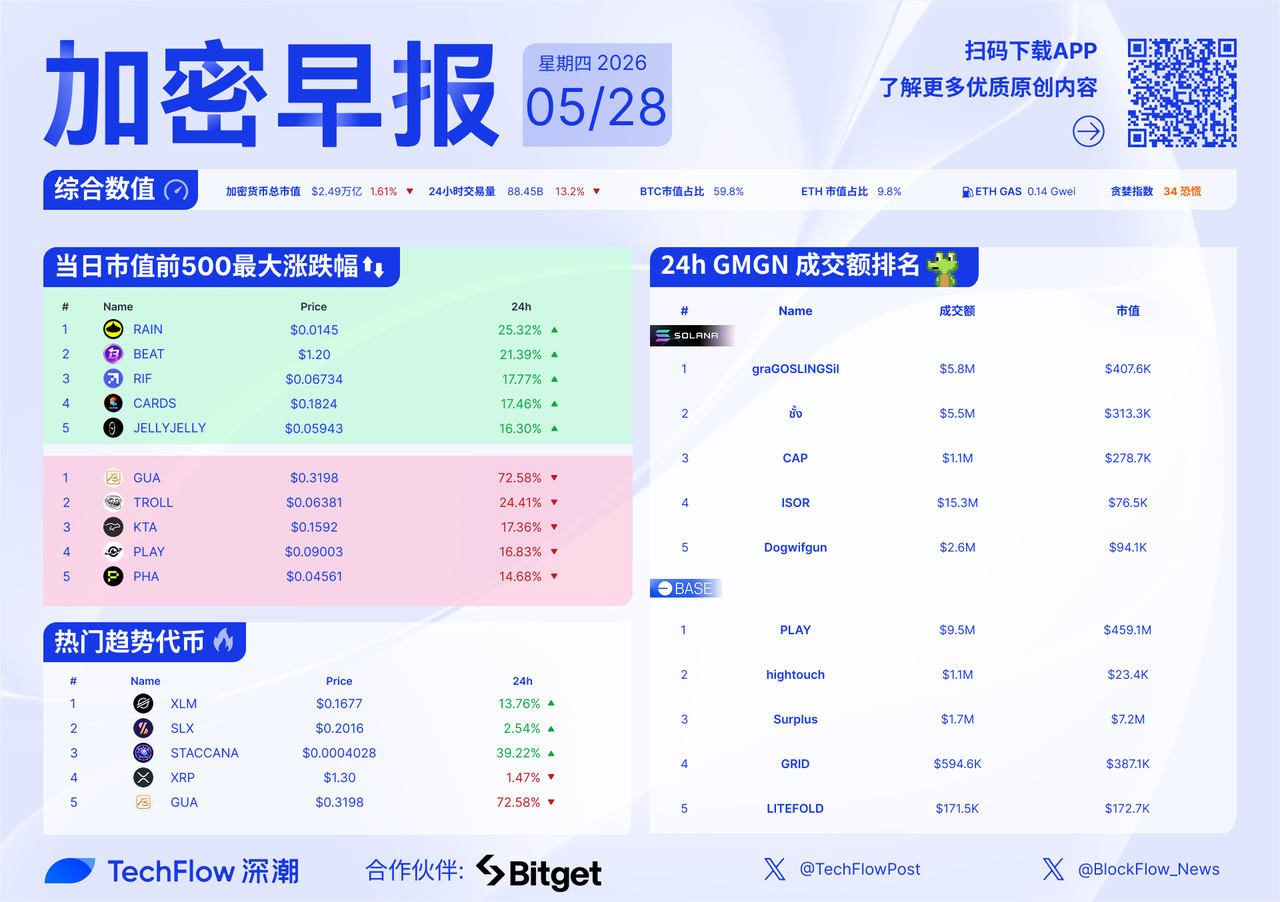
Market Data
Recommended Reading
Bankless Co-Founder David Hoffman Explains Why He Sold His ETH
https://www.techflowpost.com/zh-CN/article/31774
This article, authored by David Hoffman, explains his rationale for selling Ethereum (ETH) and explores the current state and future outlook of the “ETH is money” thesis. Hoffman argues that although Ethereum has achieved tremendous success, its potential as money remains unrealized—and may face even greater challenges ahead. The article analyzes Ethereum’s technical architecture, market position, and competitive landscape relative to other blockchain projects, highlighting Ethereum’s core “giver” characteristic and possible future trajectories.
Why Did Ethereum’s Biggest Evangelist Sell His Lifelong Belief?
https://www.techflowpost.com/zh-CN/article/31776
Ethereum’s most prominent advocate has fully liquidated his ETH holdings, declaring the “ETH is money” narrative over. Hoffman states he remains optimistic about the Ethereum ecosystem but believes ETH’s price has reached its fair market valuation, leaving little room for significant re-rating going forward. Ethereum’s architecture was designed to function as a public good—not to boost ETH’s value through its own success. In fact, Ethereum’s success may inadvertently reinforce the U.S. dollar’s dominance rather than strengthen ETH’s monetary properties.
Interview with Hyperliquid Strategies CEO: SpaceX IPO Could Drive Hyperliquid to New All-Time Highs
https://www.techflowpost.com/zh-CN/article/31781
This article provides an in-depth examination of Hyperliquid’s development, market positioning, and impact on both crypto and traditional financial markets—especially regarding innovations in asset tokenization and price discovery in pre-IPO markets. It further analyzes Hyperliquid’s operational strategy, competition with traditional financial giants, and future growth potential.
10x Faster Than NVIDIA! Micron Hits $1 Trillion Market Cap in Just 48 Days—Is the AI Memory Super-Cycle Just Beginning?
https://www.techflowpost.com/zh-CN/article/31787
Micron Technology surged from a $500 billion to a $1 trillion market capitalization in just 48 trading days—making it the fastest company in U.S. stock market history to reach the $1 trillion milestone. Micron’s shares rose approximately 80% over the past month and nearly 180% since their late-March lows, contributing nearly as much market-cap growth to the S&P 500 as Amazon. Meanwhile, NVIDIA has underperformed in the recent semiconductor rally, while memory and equipment stocks have surged—widening divergence within the Philadelphia Semiconductor Index.
Reddit Thread: Crypto Opportunities Have Already Vanished—But No One Wants to Admit It
https://www.techflowpost.com/zh-CN/article/31777
The liquidity structure of the crypto market has undergone fundamental change—the traditional “altcoin season” phenomenon has effectively ended. Going forward, crypto market liquidity may concentrate around a few strong projects, rather than driving broad-based, indiscriminate gains across all tokens. Commenters acknowledge structural shifts in the crypto market but note that altcoin seasons haven’t disappeared entirely—only evolved into new forms.
Join TechFlow official community to stay tuned
Telegram:https://t.me/TechFlowDaily
X (Twitter):https://x.com/TechFlowPost
X (Twitter) EN:https://x.com/BlockFlow_News
 深潮TechFlow











