The AI Industrial Revolution: Where Do We Stand Today?
TechFlow Selected TechFlow Selected
The AI Industrial Revolution: Where Do We Stand Today?
Under the AI wave, most enterprises merely layer on tools; truly restructuring organizations and workflows constitutes the genuine industrial revolution.
 Navigating Web3 tides with focused insights
By Will A Wang
Over the past year, I’ve attended several AI-themed industry conferences. On stage, speakers take turns demonstrating AI’s flashy capabilities; in the audience, people hold up their phones to film the screens, post to WeChat Moments, and then resume scrolling. Back at the office, however, it’s the same weekly meetings, the same approvals, the same weekly reports. At major tech firms, token consumption has already been written into KPIs—some employees have even become “model workers” by scripting artificial volume. Meanwhile, those same people on WeChat Moments hail Claude’s revolution today, Codex’s brilliance tomorrow, and Gemini’s supremacy the day after—Are they embracing revolution—or just rushing from one event to the next?
All of this is noise—not the answer I’m looking for.
The real question isn’t whether AI is powerful enough—steam engines have already been built. The question is: Who will be the first to dismantle the old workshop?
The Industrial Revolution truly began not when Watt improved the steam engine, but when Lancashire factory owners decided to leave rivers behind and rebuild workshops centered around steam power. Likewise, AI’s most pivotal moment won’t be the invention of large language models—it will be the day the first organization decides to tear down its outdated workflows and reconstruct its entire mode of production around AI. That day hasn’t arrived yet—but it’s already on its way.
Two people saw this early. Notion CEO Ivan Zhao wrote “Steam, Steel, and Infinite Minds” at the end of 2025, delivering a sobering assessment: we’re still in the “replacing waterwheels” phase—bolting AI chatbots onto existing tools, without anyone redesigning the factory. Leopold Aschenbrenner, formerly of OpenAI, took a different path: he authored the 165-page “Situational Awareness,” then launched a fund that grew from $225 million to $13.68 billion—betting entirely on AI infrastructure. One looks inward; the other bets outward.
This article isn’t about them. It’s about us—where we stand now, and which chapter of history we’re repeating.
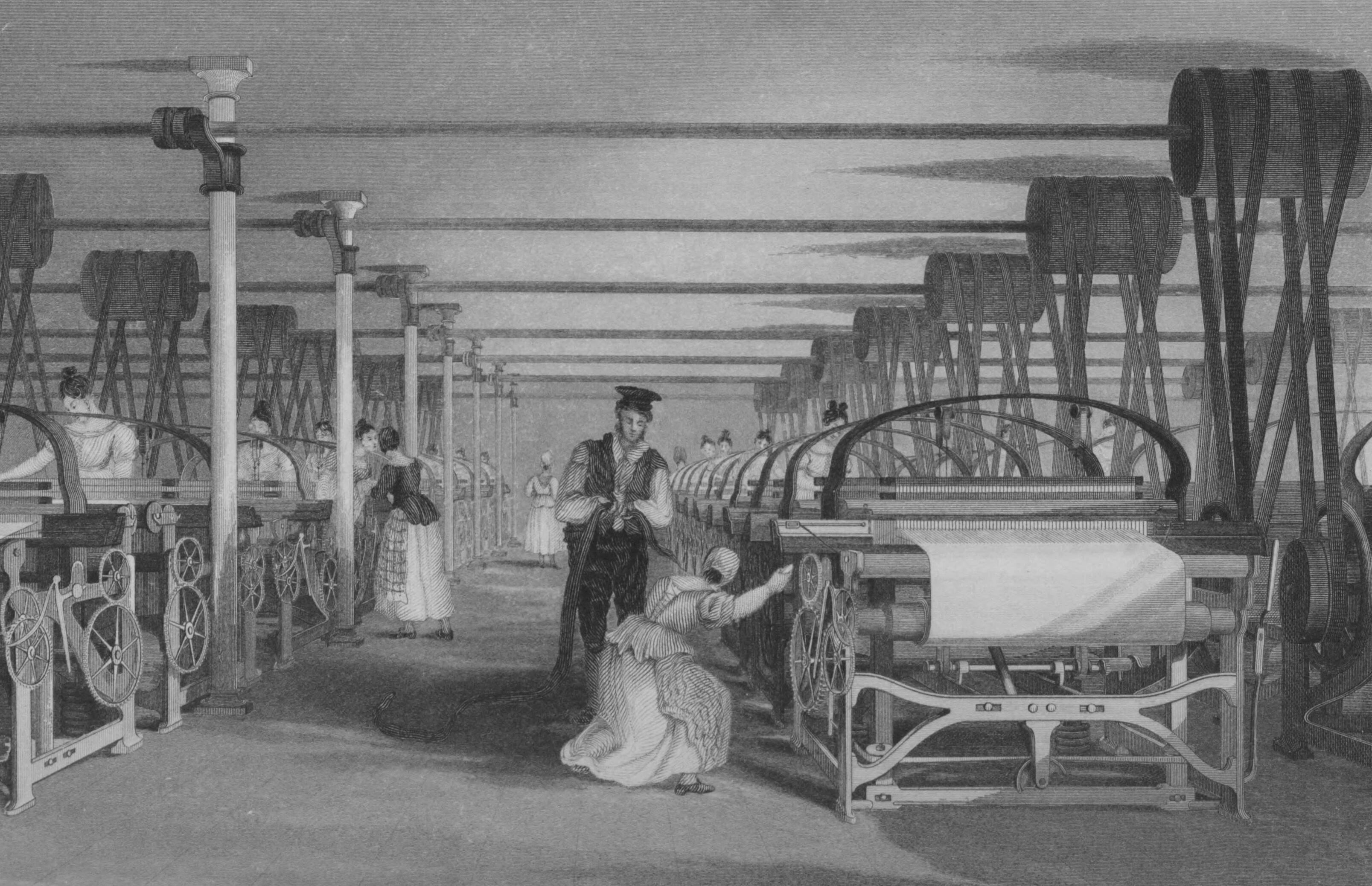
(Power-loom weaving, engraving by J. Tingle after Thomas Allom, 1835 / Wikimedia Commons)
I. The Workshop Is Still Old
Most people’s days go like this: In the morning, they use AI to draft an email—saving ten minutes; then spend two hours in a weekly meeting that didn’t need to happen; in the afternoon, copy-paste the same dataset across three tools; and in the evening, post to WeChat Moments: “AI is amazing!” Those ten saved minutes get swallowed whole by old processes.
Likewise, when steam engines first appeared, factory owners merely swapped out waterwheels—leaving everything else unchanged: factories stayed beside rivers, remained multi-story buildings, and continued using central drive shafts to power entire production lines. We embed ChatGPT into Slack, add Copilot to Office, and slot AI chat windows into our workflows—we’re doing the exact same thing. Tools upgrade; workshops don’t change.
But installing new machines doesn’t mean rebuilding the workshop. As Marshall McLuhan put it well:
We drive toward the future using only the rearview mirror. Using old processes to accommodate new tools is like early films—merely filmed stage plays. Real breakthroughs only come when someone fully liberates the steam engine from rivers and redesigns the entire production system around this new source of power.
Mapping the Industrial Revolution timeline against AI’s trajectory helps locate where we stand:
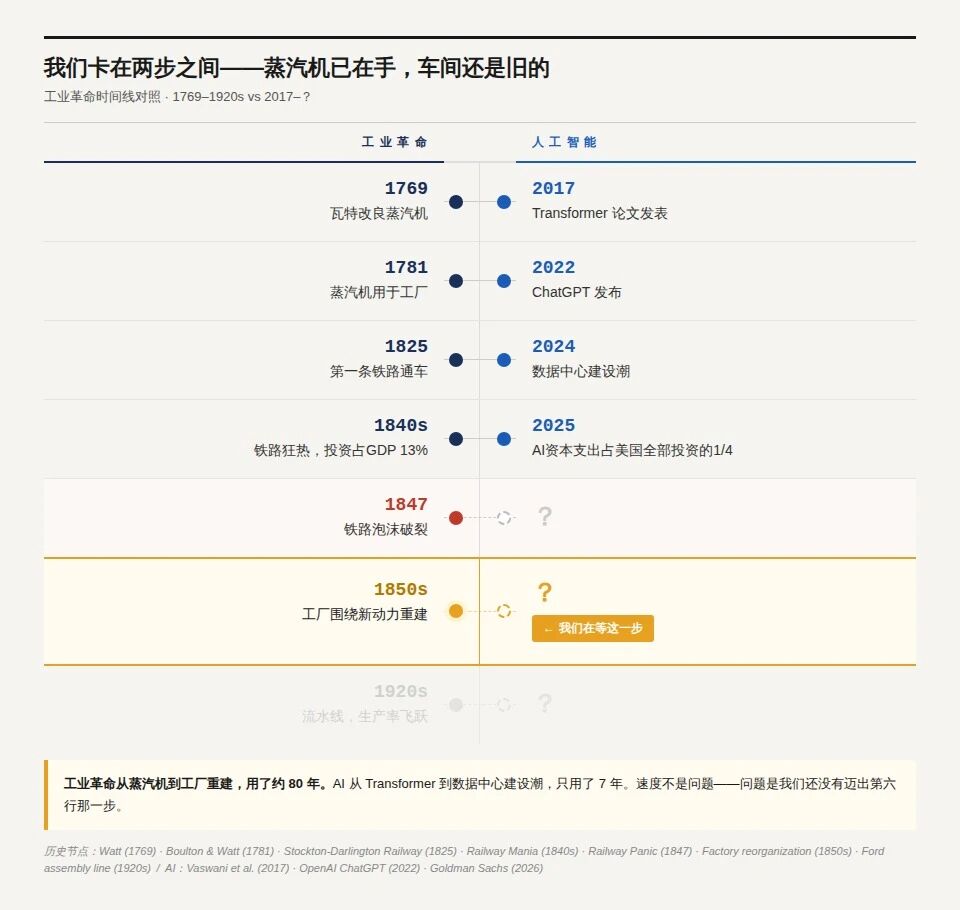
Today’s timeline is drastically compressed. The Industrial Revolution took 60 years from the steam engine to railway mania; AI took just seven years from Transformer to the data center construction boom.
Speed isn’t the issue—the question is where we’re stuck. The first four rows all represent the “old workshop with new machines” phase: steam engines are installed, railways are being laid—but production methods remain untouched. Row six marks the true watershed. We’re almost certainly stuck somewhere between these two stages.
The steam engine is already in our hands—but the workshop remains old.
II. Money Is Piled Entirely on the Layer Farthest from the Factory
Infrastructure is always overbuilt. Investors go bankrupt—not the infrastructure itself.
In 1846, the British Parliament passed 263 railway acts, approving construction of 9,500 miles of new track. At the peak of railway investment, it consumed 13% of UK GDP. Railway stocks required only a 10% deposit—sparking a rush among the middle class. The bubble burst in 1847: one-third of approved routes were never built, and countless investors lost everything. Even Darwin lost 60% on railway stocks—and his luck was better than most.
Yet the railways endured.
Today’s AI infrastructure follows the same path. Goldman Sachs estimates global AI infrastructure capex will reach $765 billion in 2026, rising to $1.6 trillion annually by 2031. Hyperscale cloud providers’ capex as a share of operating cash flow jumped from ~40% in 2023 to nearly 70% in 2025. AI-related investment now accounts for roughly one-quarter of all U.S. investment. Aschenbrenner’s $13.68 billion bet targets precisely this layer—he’s not betting on which application wins, but on underlying compute power itself.
This capital cycle mirrors real estate development. Building data centers is like building skyscrapers: land is electricity; materials are GPUs and storage; contractors are data center builders; developers are cloud providers; tenants are AI application companies; rent is API revenue. Cloud providers’ business model is “rent-to-service”—using API income to cover data center capex while waiting for AI applications’ explosive growth to lift valuations.
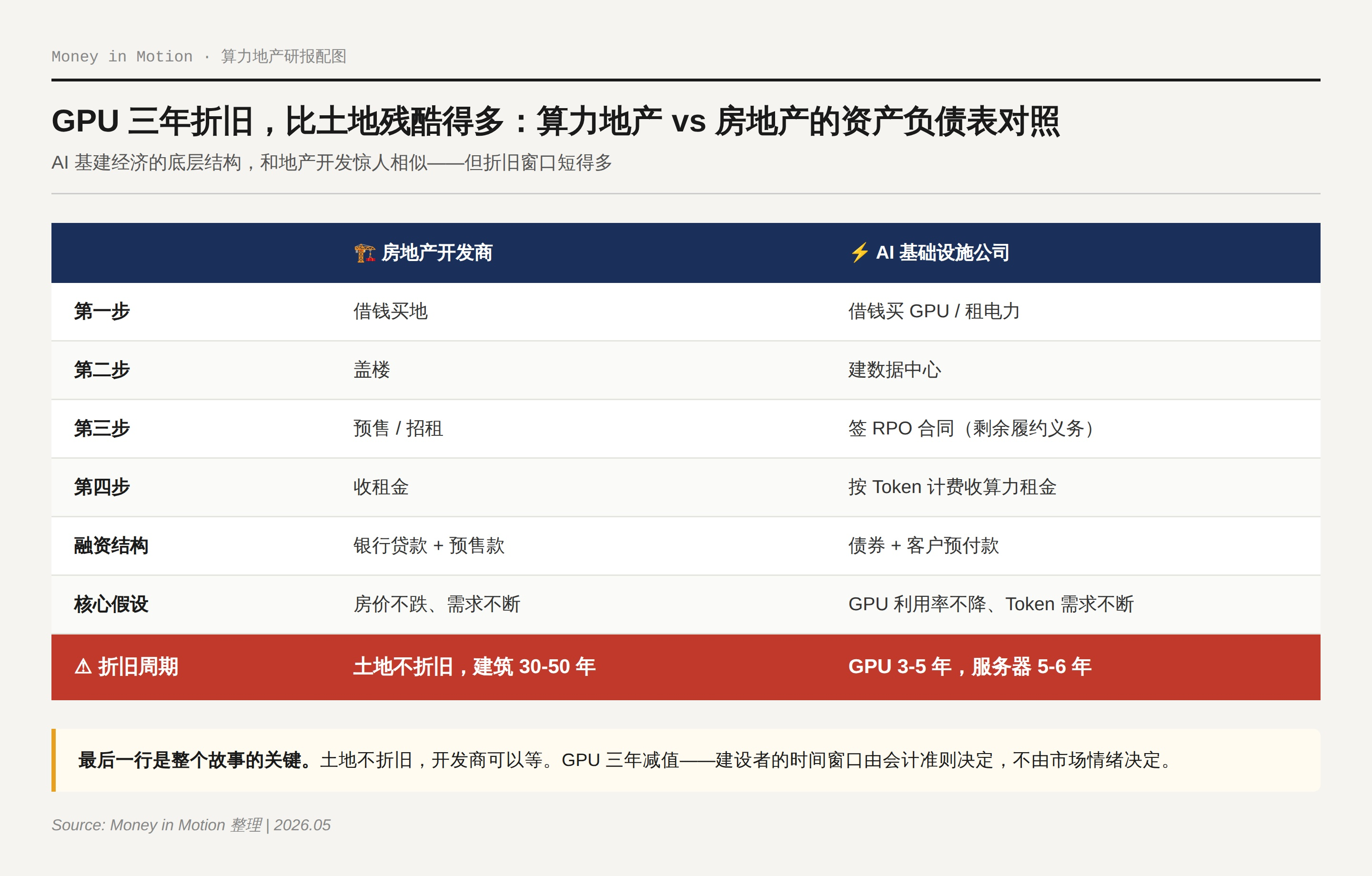
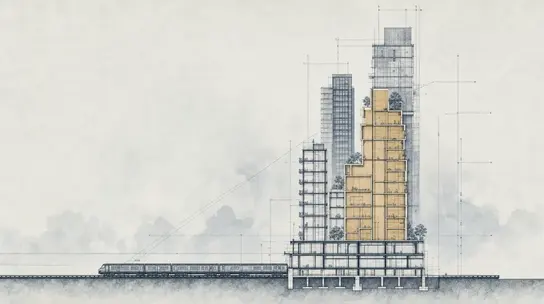
(Compute Real Estate: Each Generation Has Its Own Infrastructure)
The core risk is identical: Does the rate of API price decline outpace the growth in call volume? If rent falls below the debt-service threshold—that’s the real estate developer’s worst nightmare. The 2008 lesson wasn’t that too many houses were built, but that housing supply mismatched real demand structure. AI’s equivalent risk is: general-purpose compute is oversupplied, while specialized capabilities capable of handling high-value tasks—like financial compliance or medical diagnosis—remain scarce.
Railways, real estate, AI—infrastructure investments across three eras share one rule: overbuilding is normal; material suppliers always lose pricing power; long-term returns accrue to owners of “prime locations.” Check Wall Street’s Q1 fund holdings—you’ll likely find ~80% allocated to this infrastructure layer: NVIDIA, data centers, cloud infrastructure. Yet railway mania taught us this isn’t the full picture of the AI revolution—or even the highest-return layer.
What is AI’s prime location? Unique industry data and deeply embedded workflows. For individuals, the true “prime location” isn’t stock holdings—it’s irreplaceable judgment and domain expertise—provided you’ve already rebuilt how you apply them around AI.
Real returns lie in the next layer. But bridging infrastructure and value creation isn’t seamless. A gap exists between them—historically, this gap consumed decades.
III. Who’s Dismantling the Workshop?
Those dismantling workshops and those “using AI for efficiency” aren’t doing the same thing.
Simon, co-founder of Notion and formerly a “10x programmer,” rarely writes code himself anymore—he simultaneously orchestrates three or four AI coding agents, achieving 30–40x productivity gains. Notion now employs 1,000 people and deploys over 700 AI agents. The difference isn’t tools—it’s that Simon dismantled his own old workshop, while most people simply swapped in a new waterwheel.
Six hundred million Chinese users have tried generative AI tools—a 142% YoY increase—the world’s largest AI demand pool. Yet virtually no Chinese company has rebuilt its core workflows around AI. The world’s largest demand-side sits alongside near-zero organizational transformation on the supply side. This stark contrast itself signals something: it’s not that tools are insufficient—it’s that organizations haven’t kept pace. Context for knowledge work is scattered across dozens of tools and dozens of human minds; outputs are unverifiable; nobody knows how to assess whether a strategic memo is effective.
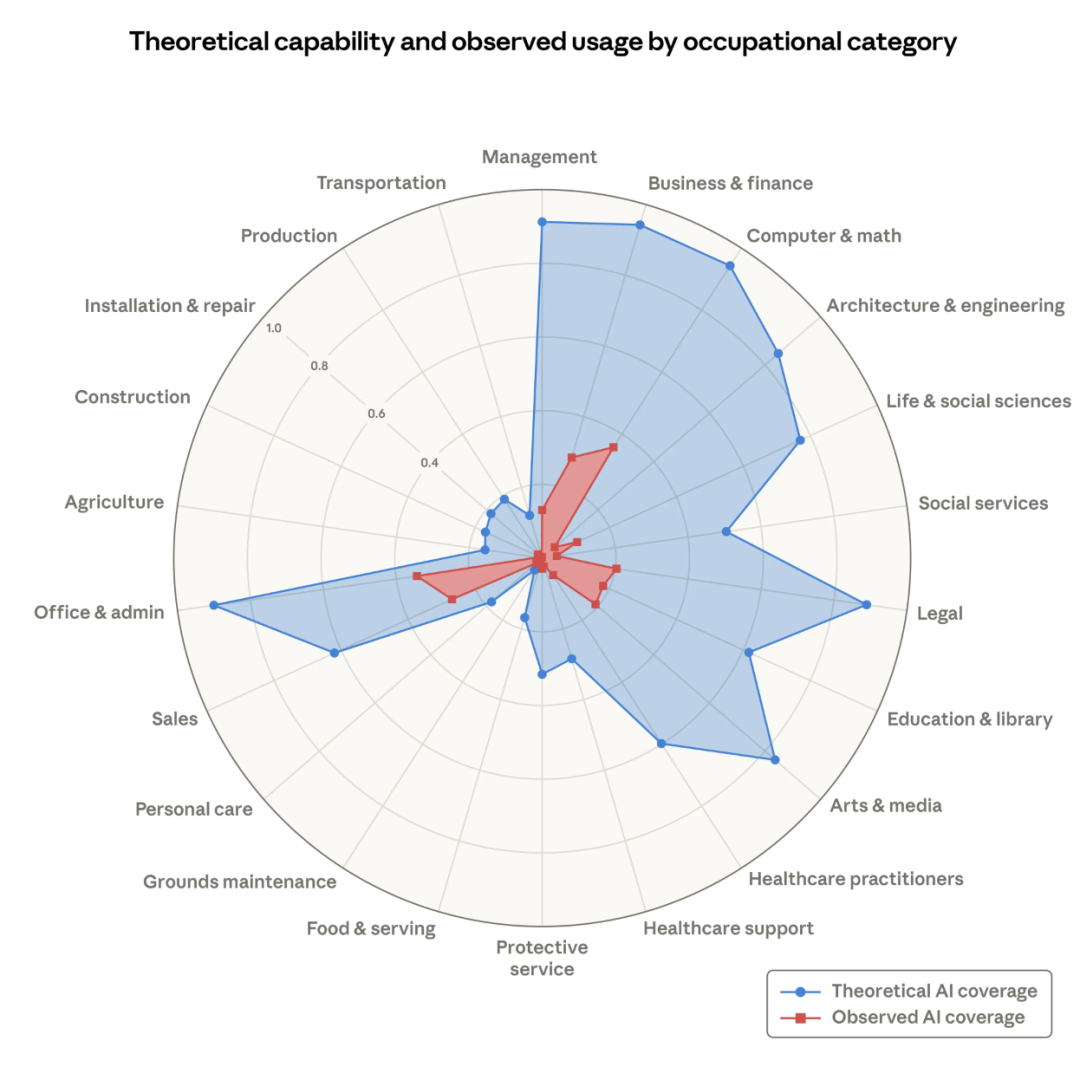
(Labor market impacts of AI: A new measure and early evidence)
Anthropic is acting at scale. They launched the Economic Index, mapping—using real usage data—which tasks and industries AI displaces first, then executing accordingly: co-founding an AI-native enterprise services company with Goldman Sachs, Blackstone, and Hellman & Friedman; forming a global alliance with KPMG, connecting 276,000 employees to Claude; and having Accenture establish a dedicated business group training 30,000 professionals focused on finance, life sciences, and healthcare.
These consulting firms aren’t AI users—they’re AI’s railway engineers. They don’t build steam engines or lay rails; they help enterprises dismantle old factories and rebuild production lines around new power sources. Without this role, most factory owners wouldn’t know where to begin.
Signals are flashing. The sharpest comes from labor markets.
Young adults aged 22–25 entering AI-high-exposure occupations face a 14% lower probability of securing employment than peers entering low-exposure roles. Entry-level positions are already under pressure.
If I were a fresh graduate, this number would directly shape my job search. If I were a manager, the next batch of entry-level hires might no longer be humans.
Organizations are dismantling workshops—what about individuals? My degree, my résumé, my years of accumulated industry experience—these are my waterwheels. They once powered my entire production line—but the steam engine has arrived. “Project 985” and “Project 211” degrees are no longer moats; they merely prove I once built a fine factory beside a river.
The question now is: Do we have the capacity to leave that river?
Anthropic’s data shows users who’ve employed AI tools for over six months achieve 10% higher task success rates than newcomers. Those who started six months ago are already 10% ahead—and this gap compounds over time.
Yet no company has gone bankrupt for failing to adopt AI—at least, my law firm continues to charge ahead with AI. Winners haven’t yet been selected by the market. The learning curve is real—early adopters are accumulating advantages, but most remain at the starting line.
IV. My Next Job Title Doesn’t Yet Exist
Will my current job title still exist in ten years? How many tools from my daily workflow five years ago remain in use today? The answers are likely both “no.” But I don’t know what will replace them—because those things don’t yet exist.
Historically, this is always how it unfolds. New things aren’t planned—they emerge organically once old constraints vanish.
Before railways, Britain consisted of isolated local economies. Manchester cotton prices could differ by 30% from London’s—with no one seeing anything amiss. Each city used its own time standard. After railways, everything changed within twenty years: a national unified market emerged, price disparities vanished; standardized time was forced upon society—not invented. Station masters, telegraph operators, travel agents—none existed before railways.
No one foresaw department stores while laying railway tracks. No one predicted standardized time while building steam engines.

(Steam, Steel and AI Infinite Minds)
Cities tell the same story. Centuries ago, cities were human-scale—Florence could be crossed on foot in forty minutes. Steel frames enabled skyscrapers; railways linked cities to hinterlands; elevators, subways, and highways followed. Tokyo, Chongqing, Dallas—these aren’t bigger Florences; they’re entirely new ways of living.
Today’s knowledge work is also human-scale: teams of dozens, rhythms set by meetings and emails, collapsing beyond a few hundred people. We’re building Florence with stone and wood. AI makes “Tokyo” possible—organizations comprising thousands of AI agents and humans, with workflows running continuously across time zones. Old weekly meetings, quarterly planning, annual reviews may no longer make sense.
Simon no longer writes code—his job is now “managing AI agents.” Two years ago, this role didn’t exist. My next job title may not yet have a name. But someone is already building that unnamed future.
V. What Does the New Workshop Look Like?
After dismantling the old workshop—what do we build? Y Combinator’s answer: Let companies improve themselves.
Their internal systems now rewrite their own code overnight. An employee submits a query during the day—and it fails. A monitoring agent detects the failure, reverse-engineers the cause, writes the fix, submits it for review, and deploys it live. The same query succeeds the next day—entirely while everyone sleeps.
This isn’t AI helping humans produce 30% more. It’s the system completing an entire closed loop—and figuring out how to improve itself.
YC partner Tom Blomfield calls this organizational form the “recursive self-improving AI loop.” His assessment is blunt: most companies remain Roman legions—information flows strictly top-down and bottom-up, with humans serving as mere conduits. AI doesn’t disrupt isolated bottlenecks—it undermines the very premise of hierarchical structures.
His new logic: Burn tokens, not headcount. Bottlenecks are shifting from human labor to compute. YC’s data shows that companies reaching Demo Day now generate ~5x higher per-capita revenue than 18 months ago. Middle management functions are being absorbed by AI—“coordination” no longer requires humans. Everyone should be an IC, builder, or operator—every task assigned to a named owner, not a committee.
One prerequisite: Companies must be “AI-readable.” Unrecorded events are invisible to AI. YC now archives all partner emails, logs every Slack message, and records all office hours. One partner fed 2,000 hours of recordings—accumulated over three months—into AI to regenerate a 150-page internal manual far superior to the original. This manual auto-updates monthly, becoming a perpetually fresh “living brain.”
Tom leaves us with a question:
If you were building your company from scratch today, would you structure it this way? And if your company already has a hierarchy, you face a harder question—does the pain of rebuilding outweigh the cost of continuing to operate like a Roman legion?
Humans aren’t at the workshop’s center—they’re on the periphery, handling areas AI can’t yet reach: offline judgment, entirely novel situations, and high-stakes, high-emotion moments. The company’s center is a “corporate brain” assembled from data, records, and domain knowledge. Software running atop it is disposable—it can be generated, regenerated. What’s valuable resides in human minds—the understanding of how the business actually runs, which steps require judgment. That understanding is the real asset.
Zhao’s “Steam, Steel, and Infinite Minds” describes exactly this direction’s flipside: an organization of 1,000 humans and 700+ AI agents, where humans handle judgment and agents execute. Aschenbrenner bets on compute infrastructure; Zhao bets on organizational restructuring. Both paths converge on the same destination: a new mode of production rebuilt around AI.
VI. Conclusion
Between the 1840s and 1850s—the railways were complete, but factories hadn’t yet been rebuilt.
Where do we stand? Simon no longer writes code. He dismantled his own waterwheel.
The question was never whether the steam engine was good enough—the question was always: Who would be the first to dismantle the old workshop?
I won’t predict tomorrow’s department stores—I’ll simply prepare myself—ensuring I stand along the railway line, not guarding a river that’s drying up.
And you?
Join TechFlow official community to stay tuned
Telegram:https://t.me/TechFlowDaily
X (Twitter):https://x.com/TechFlowPost
X (Twitter) EN:https://x.com/BlockFlow_News
 0xWillmfer