While facing off against the Pentagon in court, did an Anthropic co-founder rush to the Vatican to seek the Pope’s endorsement?
TechFlow Selected TechFlow Selected
While facing off against the Pentagon in court, did an Anthropic co-founder rush to the Vatican to seek the Pope’s endorsement?
“The Religious Diplomacy” of AI Companies
 Navigating Web3 tides with focused insights
Author: Claude, TechFlow
TechFlow Introduction: On May 25, Pope Leo XIV issued his first encyclical since assuming office, Magnifica Humanitas (“The Greatness of Humanity”), a 42,000-word document focused on AI’s threat to human dignity and calling for AI to be “disarmed.” Chris Olah, co-founder of Anthropic, was the sole technology company representative invited to speak alongside the Pope at the Vatican—an unprecedented move. In his speech, Olah publicly acknowledged that “every cutting-edge AI lab, including Anthropic, operates within a set of incentives and constraints that sometimes conflict with doing the right thing.” This rare admission comes against the backdrop of Anthropic’s ongoing legal battle with the Trump administration, which has designated the company a “supply chain risk” and imposed a federal ban after Anthropic refused to allow unrestricted U.S. military use of its Claude AI model.
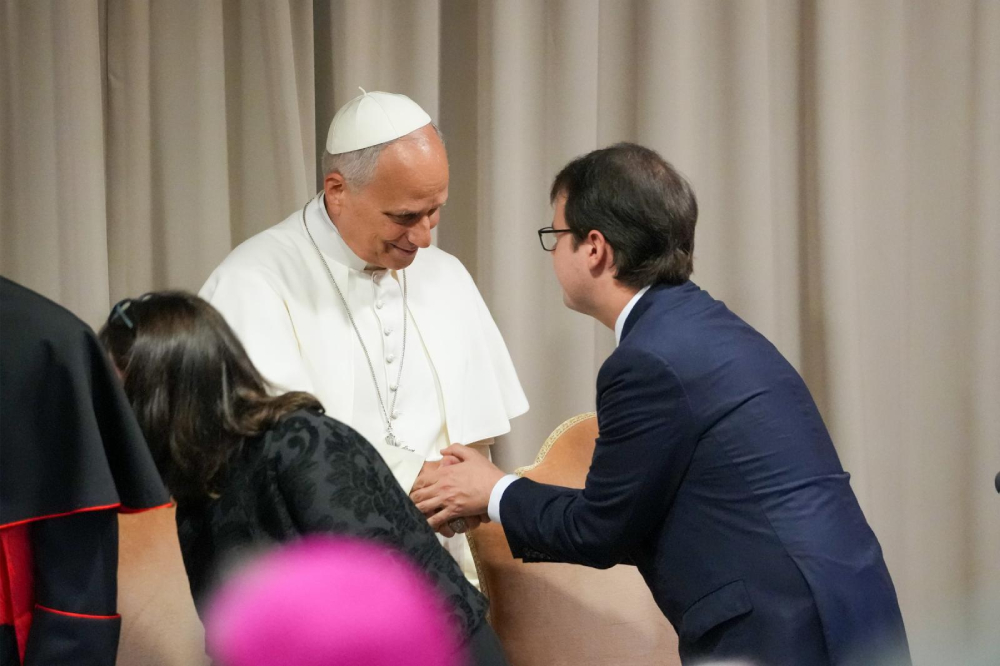
A 33-year-old Canadian atheist and AI researcher—without a university degree—sat among cardinals and theologians, addressing the world alongside the Pope.
On May 25, Pope Leo XIV released his first encyclical, Magnifica Humanitas, in the Vatican’s Synod Hall. Spanning 42,000 words across 82 pages, the document defines AI as “the most urgent human challenge of our time,” urges the world to slow AI development, and compares AI to nuclear energy—calling for it to be “disarmed.”
The Pope personally presided over the launch, breaking from the customary practice where encyclicals are typically announced by only a small group of officials.
What surprised observers most was the choice of guest speaker sharing the stage with the Pope: Chris Olah, co-founder of Anthropic—the only technology company representative present. According to the National Catholic Reporter, Olah delivered his address seated between rows of cardinals and theologians—a configuration virtually unprecedented in formal Vatican doctrinal events.
The timing of this cross-sector collaboration is telling.
Just three months earlier, Anthropic had been labeled a “supply chain risk” by the Trump administration and subjected to a comprehensive federal ban after refusing to permit unrestricted U.S. military use of its Claude AI model. The legal dispute remains ongoing.
A Rare Public “Self-Indictment” from the AI Industry
Olah’s full speech has been published on Anthropic’s official website. Its most striking passage—extraordinarily rare among public statements by AI industry executives—is the following:
“Every cutting-edge AI lab—including Anthropic—operates within a set of incentives and constraints that sometimes conflict with doing the right thing. Pressures to maintain commercial viability, to stay at the research frontier, geopolitical pressures—and older, more fundamental pressures of pride and ambition.”
He continued: “That is why people outside those incentive structures are critically important if we hope this technology moves in a good direction. They care about things moving in a good direction, they insist on safety, they pay close attention, and they’re willing to speak hard truths.”
According to Technobezz, when asked why he was the sole technology company representative invited, Olah responded that it reflected his long-standing focus on AI safety and Anthropic’s prior engagement with over 15 religious groups—but added, “Ultimately, it’s the Vatican that decides whom to invite.”
What sparked further discussion within the tech community was a research finding Olah disclosed during his speech.
He stated that Anthropic’s internal interpretability research team had discovered “internal states functionally analogous to joy, satisfaction, fear, sadness, and unease” inside AI models—as well as “structures echoing findings from human neuroscience.” He added: “I don’t know what this means—but I believe it warrants sustained, careful reflection.”
Olah’s background itself is an intriguing footnote. Born in Toronto, Canada in 1993, he dropped out of school at age 18 and received a Thiel Fellowship. He subsequently conducted neural network interpretability research at Google Brain and OpenAI before co-founding Anthropic in 2021 with Dario Amodei and others. The National Catholic Reporter describes him as an atheist.
An atheist calling upon religious institutions to oversee the AI industry—at a Vatican doctrinal event—creates a jarring juxtaposition that speaks volumes in itself.
Banned by the White House Three Months Ago, Now Seeking “Moral Endorsement” from the Vatican
Olah’s Vatican visit cannot be understood apart from Anthropic’s current political predicament.
In February, Anthropic CEO Dario Amodei met with U.S. Defense Secretary Pete Hegseth and insisted that Claude not be used for autonomous lethal weapons or mass surveillance targeting U.S. citizens. After negotiations collapsed, Trump announced on social media on February 27: “All federal agencies must immediately cease using Anthropic technology.” Hegseth then formally designated Anthropic a “supply chain risk,” prohibiting any defense contractor doing business with the U.S. military from engaging commercially with Anthropic.
According to NPR, the “supply chain risk” label is typically applied to foreign adversaries whose activities may undermine U.S. interests. Its application to a domestic U.S. company is historically unprecedented. White House spokesperson Liz Huston branded Anthropic a “radical left-wing ‘woke’ company.”
On March 9, Anthropic filed two federal lawsuits, accusing the government of taking “unprecedented and unlawful” action constituting retaliation against the company’s exercise of First Amendment rights. As reported by CBS, the Pentagon continued using Claude during the Iran war.
Against this backdrop, Olah’s presence at the Vatican carries clear significance. The Pope’s encyclical explicitly calls for AI not to be used for military competition, criticizes “the relentless pursuit of ever-more-powerful algorithms to satisfy desires for geopolitical or commercial dominance,” and even declares the centuries-old Catholic doctrine of “just war” obsolete—stating outright that “no algorithm can render war morally acceptable.”
These positions closely align with Anthropic’s refusal to permit unrestricted military use of AI.
According to analysis by New Intelligence, the mutual logic is straightforward: For Anthropic, the Holy See’s moral endorsement reinforces its brand positioning as a “responsible AI” company; for the Holy See, enlisting a company actively conducting AI safety research lends concrete weight to the encyclical—moving it beyond abstract moralizing.
What Did the Pope Actually Say in the Encyclical?
Magnifica Humanitas was signed on May 15—the 135th anniversary of Pope Leo XIII’s 1891 encyclical Rerum Novarum. That landmark text laid the foundations of Catholic social teaching amid the First Industrial Revolution, addressing workers’ rights and the limits of capitalism. By signing an AI-focused encyclical on this precise date, Pope Leo XIV deliberately draws a historical parallel between the AI revolution and the Industrial Revolution.
According to CNN, core claims in the encyclical include: AI systems must be “disarmed,” stripped of military and economic interests; certain autonomous weapons systems have already advanced to the point of being “nearly beyond human control”; delegating “lethal decisions” to AI is “unacceptable”; and AI may generate “new forms of enslavement”—particularly in developing countries, where children and adolescents mine rare-earth elements under hazardous conditions “to keep computation flowing uninterrupted.”
Anthropic’s Religious Diplomacy: From 15 Christian Leaders to the Vatican
Olah’s Vatican appearance was no sudden event but rather the culmination of Anthropic’s systematic, months-long outreach to religious communities.
As reported by The Washington Post, in March Anthropic hosted a two-day summit at its San Francisco headquarters, inviting approximately 15 Christian leaders to discuss how Claude should respond to complex ethical issues such as grief and self-harm risk—even debating whether Claude could be considered “a child of God.” Meghan Sullivan, philosophy professor at the University of Notre Dame, remarked: “A year ago, I wouldn’t have told you Anthropic was a company concerned with religious ethics. That has changed.”
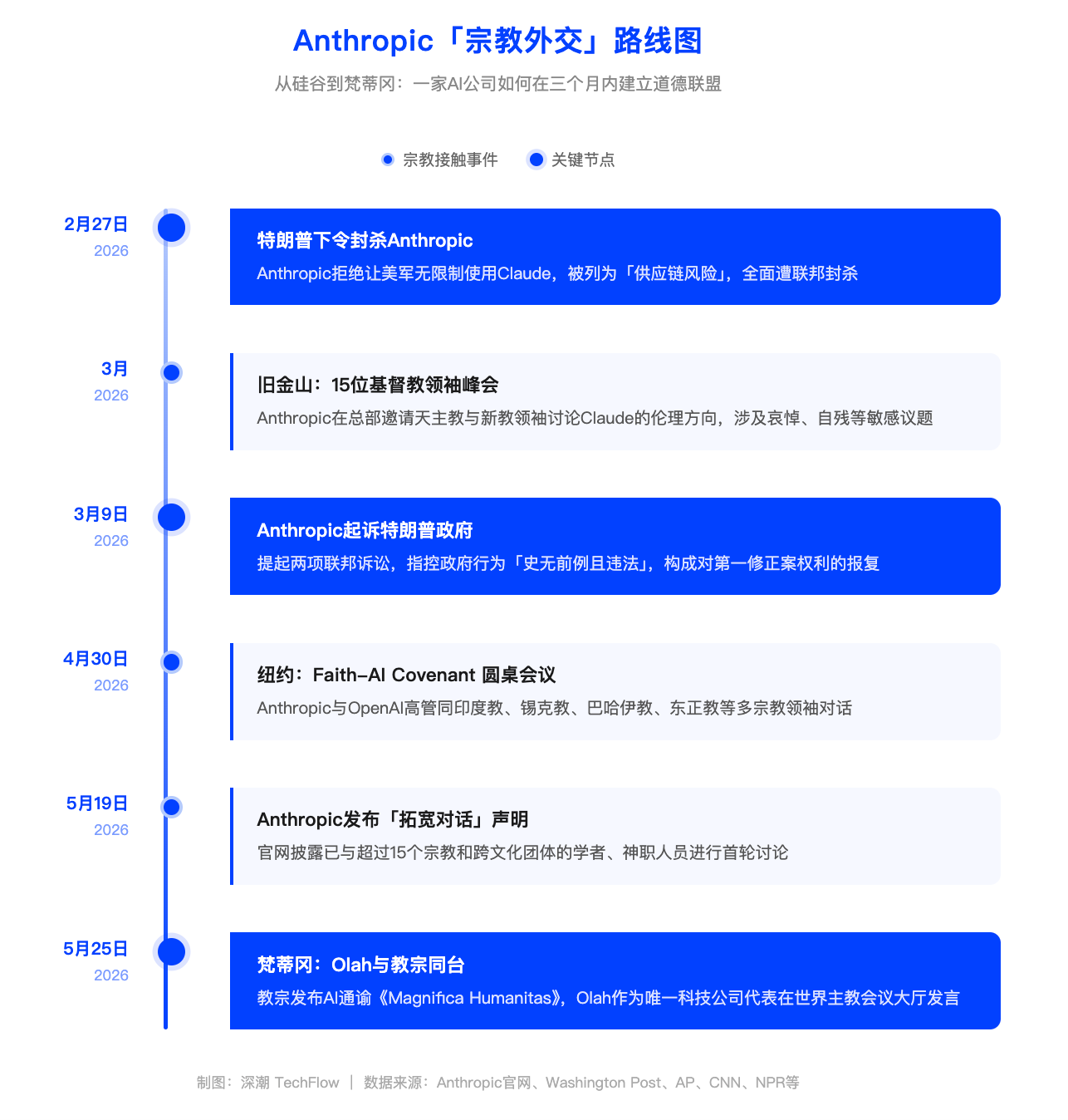
At the end of April, Anthropic and OpenAI executives joined the inaugural “Faith-AI Covenant” roundtable in New York, engaging with leaders from Hinduism, Sikhism, the Baháʼí Faith, Greek Orthodoxy, and Mormonism. According to the Associated Press, similar roundtables are planned for Beijing, Nairobi, and Abu Dhabi.
On May 19, Anthropic published a statement titled “Broadening the Conversation Around Frontier AI” on its official website, revealing that it has already held initial discussions with scholars, clergy, philosophers, and ethicists from over 15 religious and cross-cultural groups.
From San Francisco to New York to the Vatican, this trajectory clearly demonstrates how Anthropic has elevated its religious diplomacy—from internal corporate exploration to public co-staging with the highest global religious authority.
Join TechFlow official community to stay tuned
Telegram:https://t.me/TechFlowDaily
X (Twitter):https://x.com/TechFlowPost
X (Twitter) EN:https://x.com/BlockFlow_News
 深潮TechFlow