








MARA’s Q1 revenue falls short of expectations, with a net loss of $1.3 billion; stock plunges after hours
TechFlow Selected TechFlow Selected
MARA’s Q1 revenue falls short of expectations, with a net loss of $1.3 billion; stock plunges after hours
MARA has explicitly stated that it will no longer purchase new mining rigs and is fully transitioning to AI data centers.
 Navigating Web3 tides with focused insights
Author: Brayden Lindrea
Translated by: TechFlow
TechFlow Intro: Bitcoin mining company MARA Holdings delivered a disappointing Q1 earnings report: revenue fell 18% year-on-year; net loss ballooned from $530 million to $1.3 billion; and its after-hours stock price erased all intraday gains. The bulk of the losses stemmed from unrealized losses on its BTC holdings. More notably, MARA has explicitly stated it will no longer purchase new mining rigs and is fully pivoting to AI data centers—its market capitalization ranking among Bitcoin miners has slipped to seventh.
MARA Holdings’ stock fell 3.44% after hours to $12.93, wiping out its 3.48% intraday gain. The reason is straightforward: its Q1 financial results missed expectations across the board.
Revenue and Profits Miss Estimates
According to MARA’s earnings filing, revenue for the quarter ended March 31 totaled $174.6 million—down 18% year-on-year and below Wall Street’s consensus estimate of $192.7 million.
Net loss amounted to $1.3 billion, compared to $533.4 million in the same period last year—a near 1.5x increase year-on-year. Loss per share was $3.31, significantly exceeding analysts’ forecast of $2.20.
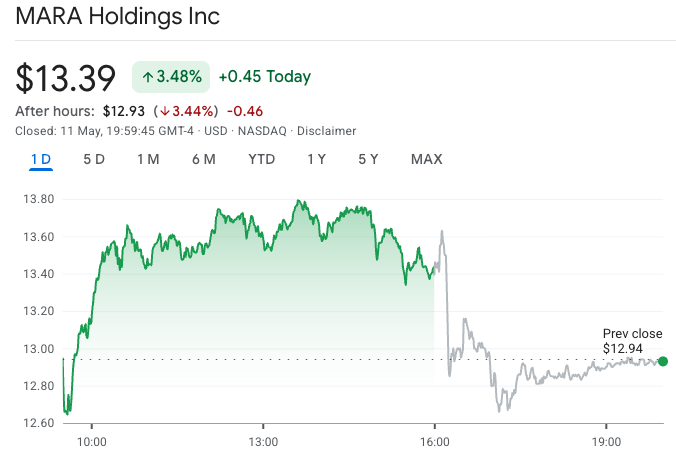
Caption: MARA’s after-hours stock price movement. Source: Google Finance
Where Did the $1.3 Billion Loss Come From?
The primary driver of the loss was unrealized losses on MARA’s 38,689 BTC holdings. Bitcoin’s price dropped 23% during the quarter, directly dragging down its balance sheet.
In the final week of March, MARA sold over 15,100 BTC, worth approximately $1.1 billion, to repurchase debt at a discount.
Deteriorating Mining Conditions
MARA’s struggles are not isolated. The entire U.S. Bitcoin mining sector is sliding from profitability into losses.
Two key pressures are at play: Bitcoin’s price is down more than 35% from its all-time high of $126,080, drastically reducing miners’ per-block revenue; meanwhile, mining difficulty has risen nearly 30% over the past year, pushing up computational cost.
MARA’s industry standing is also eroding. By market cap, it has fallen from the largest Bitcoin miner to the seventh-largest, as competitors advance faster in their AI transitions.
Full Pivot to AI Data Centers
MARA claims Bitcoin mining remains the company’s “operational foundation,” but its actions speak louder than words.
The company’s AI strategy has two main pillars: first, partnering with Starwood Capital to convert existing mining facilities into AI and high-performance computing (HPC) data centers; second, acquiring Long Ridge Energy & Power—a natural gas power plant and its co-located data center—for $1.5 billion at the end of April, as reported by CoinTelegraph.
MARA explained:
“Our strategy is to colocate new infrastructure alongside our existing Bitcoin mining operations. This provides flexibility: we can generate revenue through mining today while retaining the option to redirect power toward AI and mission-critical IT workloads.”
The Long Ridge acquisition ultimately supports up to 600 MW of AI compute capacity, and approximately 90% of MARA’s non-custodial mining capacity can be redeployed for AI and IT computing.
In one sentence summarizing its transformation resolve: the company has explicitly stated it has no plans to purchase new mining rigs going forward.
Join TechFlow official community to stay tuned
Telegram:https://t.me/TechFlowDaily
X (Twitter):https://x.com/TechFlowPost
X (Twitter) EN:https://x.com/BlockFlow_News
 @Cointelegraph


