Power Is King: How Mining Companies Are Seizing the Trillion-Dollar AI Infrastructure Race?
TechFlow Selected TechFlow Selected
Power Is King: How Mining Companies Are Seizing the Trillion-Dollar AI Infrastructure Race?
AI's power demands are difficult to meet, giving mining companies a natural advantage in transitioning to computing centers.
 Navigating Web3 tides with focused insights
Author: Yuuki, TechFlow
This year, mining companies such as IREN, CORZ, and HUT have transformed into AI data centers, with their stock prices rising several-fold. This article analyzes the logic behind the price surge and identifies key factors influencing future market trends.
Under the impact of Bitcoin's halving in 2024, intensified competition among miners, and sluggish BTC price growth, crypto mining firms are accelerating their transformation into AI computing centers. By leveraging existing power infrastructure, these firms are filling the growing AI computing gap. In 2025, multiple mining companies significantly increased revenue and valuation through AI/HPC (high-performance computing) operations, entering a "Davis Double" phase—where rising earnings coincide with higher market valuations, jointly driving substantial stock appreciation.
1. Profit Challenges for Crypto Miners and the Rise of AI Computing Demand
Bitcoin’s fourth halving in April 2024 reduced block rewards from 6.25 BTC to 3.125 BTC. Meanwhile, network-wide hash rate hit a record high (over 1000 EH/s), nearly double that of April 2024. During this period, BTC price rose only about 60%, reflecting intensified competition in mining and deteriorating profitability. For some miners, shutdown prices approached $100,000.

Figure: Network hash rate reaches new highs
Source: Coinwarz

Figure: Mining difficulty hits new highs
Source: Coinwarz
At the same time, explosive growth in AI large models has created massive demand for computing power, which is ultimately driven by electricity. Energy has quietly become the "new oil" of our era. The International Energy Agency (IEA) forecasts global data center electricity consumption will double from 415 TWh in 2024 to 945 TWh in 2030, accounting for 2.5–3% of total global electricity use. A U.S. Department of Energy (DOE) report shows AI data center loads have grown three times faster than the previous decade and are expected to double again by 2028.

Figure: Data center electricity consumption projected to reach 945 TWh by 2030
Source: International Energy Agency (IEA)
2. AI’s Power Demand Is Hard to Meet; Mining Firms Have Natural Advantages in Transitioning to Computing Centers
The explosive power demand driven by AI is difficult to meet in the short term, mainly due to:
1. Limited existing grid capacity and slow expansion;
2. AI data centers require high-density baseload power, imposing strict site selection criteria;
3. Utilities struggle to forecast fluctuations in AI-driven power demand, leading to lagging generation investments;
4. Key components like transformers and cables have long production cycles, making data center development take 2–5 years;
5. Power connection approvals for AI data centers average 12–18 months, reaching up to 3 years in some U.S. states.
These factors make qualified power supply and supporting infrastructure scarce for training large AI models. However, large-scale crypto mining facilities already possess power permits, locked-in low-cost power contracts, and are located in regions with reliable, low-cost electricity (e.g., Texas, USA; Quebec, Canada; Iceland), along with mature substations, power connections, cooling systems, and other infrastructure.
In addition, mining firms often own abundant land, buildings, and network connectivity at strategic locations, enabling rapid deployment of AI computing. These natural advantages make the transition to data centers seamless. Key firms to watch include:
1. IREN Ltd (ticker: IREN)
Founded in Australia in 2018, IREN aims to meet cryptocurrency mining needs using renewable energy. From 2018 to 2021, it expanded rapidly and began establishing data centers in North America. It listed on Nasdaq in 2021. Between 2023 and 2024, it started deploying GPU cloud platforms and signing AI computing contracts, gradually shifting its data centers from Bitcoin mining to AI/HPC (high-performance computing) services. In 2024, it rebranded to IREN Limited, marking its full transformation into a digital infrastructure company.
Compared to other miners, IREN operates an integrated system from energy procurement to data center management. It completed its strategic positioning before the 2024 Bitcoin halving, successfully avoiding the sharp post-halving decline in mining revenues, giving it greater growth flexibility and foresight.
IREN has secured 2.9 GW of power capacity across six operational and under-construction data center campuses. Its unit energy cost is among the lowest in the industry at approximately 3.5 cents/kWh. Its green energy focus also attracts ESG-conscious clients and investors. IREN has gained NVIDIA’s endorsement as a preferred partner and signed a major $9.7 billion collaboration deal with Microsoft on November 3.
2. Core Scientific (ticker: CORZ)
Founded in 2017, Core Scientific was once one of the top Bitcoin mining firms in the U.S. It went public via SPAC in 2022 but filed for bankruptcy the same year due to Bitcoin’s price drop and debt issues. After restructuring, it relisted in January 2024 and quickly entered the AI/HPC services business by leveraging its infrastructure strengths.
In 2024, Core Scientific signed a 12-year agreement with AI cloud provider CoreWeave to deliver up to 200 megawatts of infrastructure hosting services, with expected total revenue exceeding $3.5 billion. In 2025, CoreWeave proposed acquiring Core Scientific for approximately $9 billion, but the shareholder vote rejected the offer in October, as shareholders believed the company had greater potential as an independent entity.
3. Hut 8 (ticker: HUT)
Founded in 2017 and listed on Nasdaq in 2021, Hut 8 is one of North America’s earliest crypto mining companies. Its pivotal transformation occurred in November 2023 when it merged with USBTC, expanding its computing scale and acquiring USBTC’s high-performance computing and AI cloud services, transforming into a diversified digital infrastructure company.
In 2024, Hut 8 raised $150 million through convertible bonds to build AI-related infrastructure. In August 2025, it began constructing four new sites, adding 1.5 GW of capacity. In March 2025, it partnered with the Trump family to establish American Bitcoin, with Eric Trump serving as Chief Strategy Officer. Hut 8 received an 80% stake in the new company by providing mining equipment. The company went public on Nasdaq in September 2025, drawing market attention due to Hut 8’s political and business ties with the Trump family.
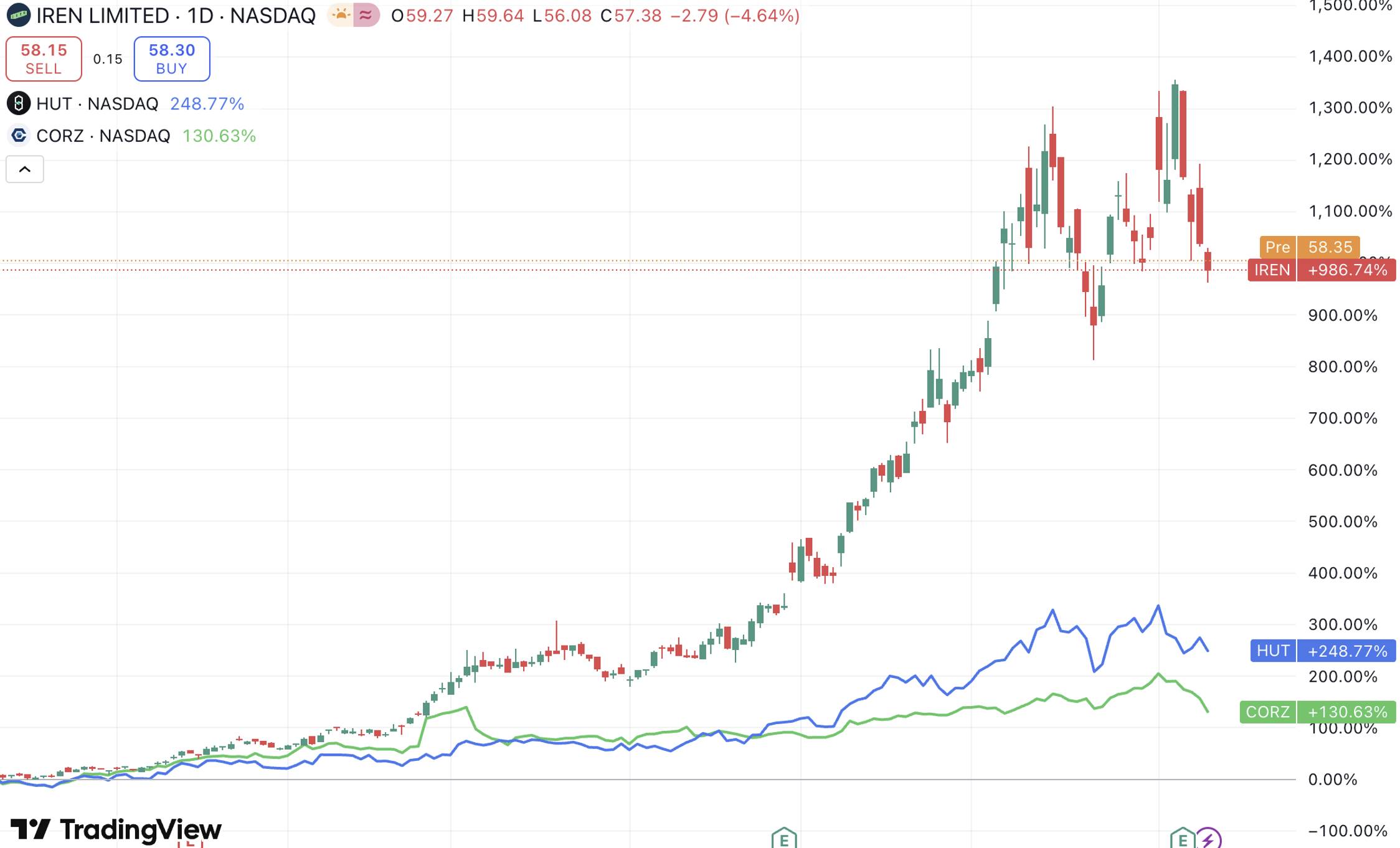
Figure: IREN up 987% YTD, HUT up 249% YTD, CORZ up 131% YTD
Source: TradingView
3. Key Drivers and Risks for Future Market Trends
1. Short-term focus should be on major contract signings and upstream capital expenditure (Capex) plans.
AI/HPC clients are highly concentrated, with companies like CoreWeave, Microsoft, and Google driving most demand. Close monitoring of upstream Capex guidance is essential. If Q4 Capex outlooks are raised, it would signal growing demand for转型 mining firms’ AI/HPC services. Contract signings and execution timelines serve as more direct indicators.
2. Long-term focus should be on mining firms’ ability to scale power supply, maintain low electricity costs, and ensure sustained power demand growth driven by AI expansion—critical for maintaining high valuations in the AI/HPC sector. As data centers are capital-intensive, monitor corporate financing capabilities and financial health. Also consider risks from technological obsolescence depreciating fixed assets, and caution against excessive speculation, given the sector remains in the narrative and construction phase, with risks of underwhelming performance delivery.
Join TechFlow official community to stay tuned
Telegram:https://t.me/TechFlowDaily
X (Twitter):https://x.com/TechFlowPost
X (Twitter) EN:https://x.com/BlockFlow_News
 深潮TechFlow