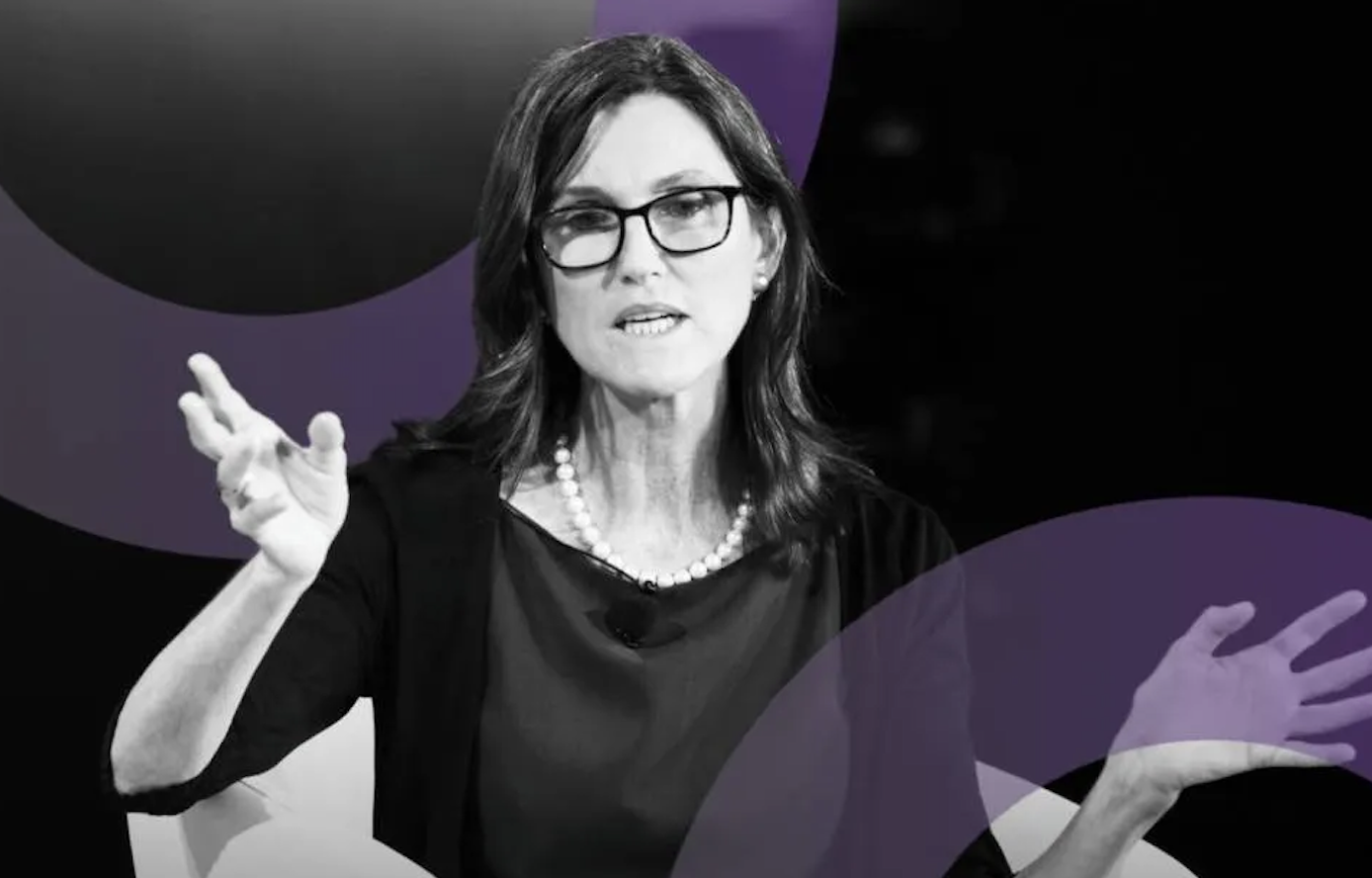
Interview with “Woodstock” Cathie Wood: The Next Bull Market Is Coming
TechFlow Selected TechFlow Selected
Interview with “Woodstock” Cathie Wood: The Next Bull Market Is Coming
“The correlation coefficient between gold and Bitcoin is only 0.14. In the past two cycles, gold has always rallied before Bitcoin—and this cycle is no exception.”
 Navigating Web3 tides with focused insights
Compiled & Translated by TechFlow

Guest: Cathie Wood, CEO & CIO of ARK Invest
Host: Robbie
Podcast Source: The Rollup
Original Title: Cathie Wood: The Next Bull Market Is Here
Air Date: April 28, 2026
Editor’s Note
Cathie Wood, founder of ARK Invest, recently appeared on The Rollup. In the interview, she delivered a clear Bitcoin price forecast: $730,000 in the base case and $1.5 million in the bull case by 2030; the market is currently bottoming, and on-chain analysis indicates an absolute bottom between $50,000 and $55,000. She also introduced a macro insight overlooked by markets: AI training costs are falling 75% annually, while inference costs decline 85–95% per year—sparking a wave of “good deflation.” Trueflation (a blockchain-based real-time inflation indicator) shows core inflation has already dropped to 1.3%, meaning the Federal Reserve will likely be forced into dovish policy—a key catalyst for the next digital asset rally. Additionally, she revealed that ARK’s crypto research team has reduced quarterly report production time by 75% using Claude Co-work, and emphasized that the payment layer for Agentic AI will inevitably be built on blockchain.
Key Quotes
Bitcoin Pricing & Cycle Assessment
- “Our base-case forecast is $730,000 for Bitcoin by 2030, and $1.5 million in the bull case.”
- “A 50% drop isn’t a bear market—it’s child’s play compared to prior drops of 85% or 95%.”
- “Our on-chain analyst David Puell says the absolute bottom lies between $50,000 and $55,000. But I suspect we won’t even reach that level.”
- “The correlation coefficient between gold and Bitcoin is only 0.14. In the past two cycles, gold led Bitcoin higher—and it will again this time.”
Stablecoins & DeFi Evolution
- “CZ and I agree: the biggest surprise—from Bitcoin’s early days to now—has been the rise of stablecoins.”
- “Ironically, the delay of the CLARITY Act has given Tether and Circle more time to compound their network effects.”
- “We originally expected Bitcoin to fulfill the role stablecoins now occupy—especially in emerging markets. Instead, stablecoins have become the bridge from traditional finance into DeFi.”
Institutional Adoption as a Turning Point
- “Larry Fink’s shift has been total. He finally grasped that the internet was built without a financial layer—and tokenization can fill that gap. His endorsement gave the entire industry permission: if he says it matters, then I’d better pay attention too.”
- “When we first bought Bitcoin in 2015, we were mocked. Many dismissed it as mere marketing hype. That collective ridicule only strengthened my conviction that we were right.”
Macro Outlook & Deflation Logic
- “The federal funds rate has already fallen by 175 basis points—but market narratives still claim the Fed is too hawkish.”
- “AI training costs fall 75% annually; inference costs (e.g., the cost for ChatGPT to answer one question) drop 85–95% per year. We’re about to witness massive ‘good deflation.’”
Agentic AI & Blockchain Convergence
- “In the future, we’ll deploy numerous chatbots to work for us. We’ll pay Claude; we’ll pay bots that supply data. All of this is machine-to-machine—and blockchain-based payment systems are the only logical infrastructure.”
- “Our crypto team uses Claude Co-work to produce quarterly reports—cutting production time by 75%. Those saved hours are fully redirected toward deep research.”
ARK’s Five Innovation Platforms Framework
Robbie: You identify five innovation platforms, which spawn 15 technologies—and those technologies are now converging. Before diving deeper into digital assets and public blockchains, could you give us a macro-level perspective on how you think about disruptive innovation?
Cathie Wood: All today’s developments were seeded early in my career. In the 1980s and ’90s, I watched those seeds take root. Yet cloud computing didn’t truly emerge until AWS launched in 2006—and back then, trying to explain cloud computing to investors and advisors felt like speaking science fiction. Similarly, AI’s breakthrough didn’t arrive until deep learning in 2012 and the Transformer architecture in 2017—which later powered ChatGPT and natural language programming.
In the late 1990s, capital vastly outstripped opportunities—the timing was simply too early. Today, it’s the exact opposite: all five innovation platforms and 15 technologies are fully ready—but investors are gripped by fear. As a fund manager, I prefer operating in this environment over the manic bubble years.
Valuations today are far lower than during the bubble; the technologies are mature; and most critically, costs are collapsing at an astonishing pace—meaning these innovations can now reach far more industries and individuals.
I founded ARK in 2014 after witnessing both the dot-com bust and the 2008 financial crisis—events that made institutional investors extremely risk-averse. The industry pivoted sharply toward passive investing, fueling the ETF boom. Even within active management, fund managers heavily relied on benchmark indices to screen investments. We do not. Our screening criterion is original research.
Traditional finance research teams are organized by sector—e.g., five consumer analysts, five healthcare analysts, etc. But to correctly assess innovation, we structure our research teams around those 15 technologies—because they cut across every industry.
Robbie: Why are investors so fearful? Is it because their organizational structures aren’t equipped to grasp this convergence?
Cathie Wood: Yes—convergence is inherently confusing. Tesla is the perfect example. Most research directors assigned Tesla to automotive analysts. But it should at least go to tech analysts—or more precisely, to three analysts collaborating: robotics, energy storage, and AI. Assigning it to experts focused on internal combustion engines and manual driving is fundamentally misaligned. We’re transitioning from the old world to electrification and autonomy.
AI is advancing so rapidly and disrupting so many sectors simultaneously that the experience itself is disorienting. Research directors need time to rethink their organizational models. They must allocate talent by technology—not by legacy sector—and foster collaborative cultures. In traditional institutions, if a stock is assigned to an automotive analyst, others cannot touch it. That model must change—because technologies converge, and analysts must collaborate to understand companies’ true potential.
Crypto Asset Allocation Logic
Robbie: We see tribalism across crypto too. The digital asset story clearly began with Bitcoin. When you founded ARK in 2014, Bitcoin was still searching for its footing. How did you view Bitcoin then? Was it already institutionally investable?
Cathie Wood: Not yet. I’d already begun following and discussing Bitcoin at my prior firm—purely out of curiosity. I brought our most Bitcoin-obsessed analyst to ARK: Brett Winton, now our Chief Futurist.
At ARK’s founding in 2014, we had only four innovation platforms—and merged AI and blockchain into a single category called “Next-Generation Internet.” That’s where ARK’s name originated. At the time, AI had just seen its deep learning breakthrough—it was new, but blockchain excited us more, though we weren’t yet sure whether it warranted a standalone platform.
In 2015, we partnered with Art Laffer (architect of the Laffer Curve and monetary economist, mentored by Nobel laureate Robert Mundell) to publish our first Bitcoin white paper. Its central question: Can Bitcoin fulfill money’s three functions—medium of exchange, store of value, and unit of account?
Art told me: “This is what I’ve waited for since the U.S. closed the gold window in 1971.” I asked how big this idea could be. He replied: “How big is the U.S. monetary base?” It was $4.5 trillion then—while Bitcoin’s network value stood at just $6 billion. He meant “trillions.” I invested personally on the spot.
To secure optimal client exposure, we needed NYSE and SEC approval—and ultimately landed on GBTC (Grayscale Bitcoin Trust). Bitcoin traded at $250 then. That summer, amid Greece’s threat to exit the EU, we established our first position—because we noticed Bitcoin consistently rallied on such geopolitical news. It functions both as a risk-on and a safe-haven asset, playing different roles across market regimes.
Robbie: Looking back, the prevailing narrative then was “institutions are coming to buy Bitcoin from us.” Now, in 2026, we’ve indeed witnessed ETF adoption, stablecoin growth, tokenized assets, the explosion of permissioned chains, and major institutions launching real products. Traditional institutional adoption is converging with crypto-native culture and infrastructure—the largest convergence yet in digital assets.
Yet an intriguing phenomenon has emerged: Crypto natives—the very people who should be most bullish—are now steeped in apathy and internal disillusionment. Meanwhile, newly entering institutions and large corporations are far more optimistic. How do you interpret this dynamic?
Cathie Wood: Several things are happening simultaneously. When we bought Bitcoin in 2015, we were genuinely mocked. Many dismissed it as marketing gimmickry. When so many laugh at or dismiss you, I actually grow more intrigued.
The current landscape looks like this: Bitcoin owns the global monetary system赛道. In DeFi, Ethereum and Solana lead, while Hyperliquid (a decentralized perpetuals exchange) is solidifying its position.
On institutional adoption, Larry Fink’s transformation is the pivotal turning point. He once spearheaded Bitcoin skepticism—but his reversal has been total. It stems from a vision of universal tokenization. He finally understood the internet was built without a financial layer—because no one anticipated e-commerce or online investing; early use cases were limited to information exchange, and some even assumed it would serve only gambling and illicit activity.
Fink’s awakening granted the entire industry permission. Previously, we battled him and Jamie Dimon (CEO of JPMorgan Chase). But once Fink shifted, the industry’s response was: If he says it matters, we’d better learn fast. And BlackRock’s Aladdin platform—a technology backbone for asset managers—means that if Fink declares tokenization critical, every Aladdin-using firm must follow.
Another critical development for DeFi is stablecoin evolution. Yesterday, I recorded a podcast with CZ (Changpeng Zhao, Binance founder). We agreed: the biggest surprise—from Bitcoin’s infancy to today—has been the rise of fiat-backed stablecoins. This was heretical in early crypto circles. Yet even Bitcoin OGs now fully support them—Tether’s Giancarlo and Paolo were among the earliest OGs.
Stablecoins have become the bridge from traditional finance into DeFi. We’d assumed Bitcoin would fill that role—especially in emerging markets. Yet even there, the Bitcoin community views stablecoins as a humanitarian “on-ramp” into crypto—because most emerging-market residents live paycheck-to-paycheck and cannot withstand Bitcoin’s volatility. As their wealth grows, they’ll naturally migrate from stablecoins to broader crypto investment options.
One major open question: Will stablecoins become winner-take-all? Network effects suggest yes. Ironically, the CLARITY Act’s delay has given Tether and Circle more time to compound network effects. CZ expects a stablecoin explosion—and our team members Lorenzo, David, and Ray concur. Regardless of whether an explosion occurs, consensus holds that consolidation into a few winners is inevitable.
Why Tokenization Is the Core Narrative
Robbie: On this show, we’ve long discussed how the tokenization wave began with non-speculative assets, then progressed along the risk curve to Treasuries—and now we’re debating tokenized equities. Your Big Ideas 2026 report estimates the global tokenized asset market could exceed $11 trillion by 2030. My question: As these assets go on-chain, will they ultimately land in DeFi protocols? Where do you see value accruing?
Cathie Wood: We largely agree with your view. In innovation domains, a typical divergence emerges: pure newcomers move faster, more flexibly, and more creatively; incumbents adopt new technologies to cut costs, boost efficiency, and raise productivity. Within the incumbent camp, the most aggressive and visionary firms leverage this to integrate traditional markets.
The best example is Walmart and Amazon. During the dot-com bubble, many believed traditional retail would be obliterated—indeed, many boutique stores vanished—but Walmart used the internet to build an online business (acquiring Jet), thereby integrating rather than ceding traditional retail space. Amazon is a high-growth giant—but both coexist. Today, Walmart is even more aggressive than Amazon on drone delivery, thanks to stronger partnerships with regulators and delivery providers. Amazon previously led Walmart by several generations in drone tech—but regulatory missteps slowed its progress.
The same applies to crypto. Incumbents are embracing the technology. JPMorgan is especially fascinating: Jamie Dimon remains arguably Bitcoin’s loudest critic in many respects—but he lets his tech teams and client demand override his personal views.
Among pure DeFi players, we’re betting on Ethereum, Solana, and Hyperliquid. We’ve purchased some DATs (Digital Asset Tokens) for our ETF—including Bitmine Immersion and Soulmate from the Solana ecosystem. We know DATs are proliferating excessively, guaranteeing massive attrition. We publish daily trades—you’ll see us gradually rebuilding positions, while shifting toward pure Ethereum and Solana exposure within permissible limits. Some platform providers prohibit flagship funds from holding Bitcoin ETFs or Ethereum/Solana ETFs—we operate strictly within those constraints.
DeFi will explode. Economic value allocation between Layer 1 and Layer 2 remains contested—we’re watching closely. But we remain bullish on the “Big Four,” and with WBTC now enabling migration across platforms, Bitcoin is effectively included.
“Good Deflation” & Macro Liquidity Conditions
Robbie: People say, “We hear Cathie’s long-term bullishness—but we’re amid geopolitical turmoil. Equities hit new highs yesterday, while Bitcoin hovers near $75,000. Raoul Pal tweeted that global liquidity is rising. How do you explain crypto’s lag versus equities and commodities? What’s your macro liquidity assessment?
Cathie Wood: I wrote a letter at the start of the year featuring an asset-class correlation matrix. Many assume Bitcoin’s “digital gold” label implies high correlation with gold—but it doesn’t. From 2019 (when institutional interest visibly surged) through today, gold and Bitcoin’s correlation coefficient is only 0.14. Yet across the past two cycles, gold consistently led Bitcoin higher—and we expect it to again.
Bitcoin has indeed corrected significantly versus gold—but on the long-term trend line, lows are rising. Bitcoin’s bull market remains intact. A 50% drop? Compared to prior 85% or 95% collapses, this is a win.
We believe Bitcoin will make new all-time highs in the next cycle. Many doubt it—but we’ve stated clearly in the public record: $730,000 in the base case and $1.5 million in the bull case by 2030.
I’ve been criticized for saying stablecoins are cannibalizing part of Bitcoin’s role. That’s true in emerging markets—but people overlook the flip side: gold is rising, signaling Bitcoin’s store-of-value function is strengthening simultaneously. These two effects offset each other—and the positive shock to gold is stronger.
On-chain analysis shows the absolute bottom lies between $50,000 and $55,000. I doubt we’ll reach that level—just look at Bitcoin’s performance relative to other assets today.
On liquidity: Many focus only on headlines about the Fed’s reluctance to cut rates—but the federal funds rate has already fallen 175 basis points. Market narratives call the Fed “too hawkish,” yet it’s already easing. I expect inflation to undershoot expectations dramatically.
Example: Frito-Lay (a PepsiCo snack brand) cut prices by 15% about three months ago—and just announced sales far exceeding expectations. That’s how low-inflation worlds operate: price cuts drive volume surges. In tech, it’s even more pronounced: AI training costs fall 75% annually; AI inference costs (e.g., ChatGPT answering one query) drop 85–95% per year. We’ll see massive “good deflation”—price reductions fueling explosive volume growth—and that’s why we expect real GDP growth to accelerate.
Data from Trueflation (a blockchain-based, real-time inflation metric tracking tens of thousands of goods) shows consumer price inflation at 1.8%—even including oil volatility—and core inflation at just 1.3%. For the past two to three years, various inflation metrics have oscillated between 2% and 3%; Trueflation’s data suggests they’ll all trend downward.
If inflation truly falls, the Fed will ease. Another reason: although headline unemployment is low, disaggregated data reveals stress in entry-level jobs—firms aren’t firing, but they’re not hiring either. Youth unemployment (ages 16–24) stands at 8.5% (peaking at 11%), indicating slack in the labor market, slowing wage growth, and accelerating productivity. The Fed’s rationale for easing is that money demand relative to supply is rising—a direct result of accelerating real economic growth. The Fed’s mandate is to support real economic growth.
Robbie: A new Fed chair is imminent—and recent disclosures show he holds crypto funds in his portfolio. Do you broadly expect the Fed to recognize “good deflation” and pivot dovish? How large an impact would that have on digital assets? Does the four-year cycle still hold—or could the Fed’s dovish turn accelerate the rally?
Cathie Wood: Watch Bitcoin ETF holders’ behavior. During this downturn, they’ve held remarkably firm. If you’re a traditional asset manager newly encountering this asset class—and you’ve heard of the four-year cycle—then seeing Bitcoin drop 50% signals a severe bear market: i.e., opportunity. We’re indeed observing systematic buying on dips. Weak hands exited—but institutions beginning to truly understand this asset class stepped in to refill those positions.
Whether this is driven by the four-year cycle, I’m uncertain. We experienced a flash crash triggered by auto-deleveraging. A fresh round of tariff turbulence set off a chain reaction—Binance suffered a software failure, triggering auto-deleveraging. Traders who thought they were hedged across two exchanges discovered their hedges failed completely—resulting in $28–30 billion in losses. But we believe this episode has now fully washed out.
Perhaps institutional participation is accelerating the four-year cycle. But the bottom line is: we’re bottoming—and improving liquidity will power the next major rally.
One additional economics angle: U.S. money supply growth currently stands at 4.9%, while nominal GDP is ~5%—roughly aligned. But trade tensions may have slowed money velocity, dampening the effective impact of money supply growth. This variable warrants close monitoring over the coming months.
Scalable Convergence of Agentic AI & Blockchain
Robbie: You noted institutional holders haven’t sold. Meanwhile, Bitcoin’s block reward halvings continue shrinking—and their impact is diminishing. We have just minutes left—but we can’t skip convergence, your central theme. How do blockchain, cryptocurrencies, tokenized assets, and DeFi protocols converge with broader disruptive technologies? Where do blockchain and AI intersect with healthcare? Early excitement centered on putting health records on-chain—but the industry has grown highly financialized. Is that direction still viable?
Cathie Wood: You’ve heard of Agentic AI. In the future, we’ll all deploy numerous chatbots to work for us.
Our crypto team is a great example. We use Claude Co-work (Anthropic’s desktop AI collaboration tool) to produce reports. We issue a quarterly Bitcoin report and a quarterly DeFi report—the Bitcoin one publishes today. We’ve slashed the time required to produce these lengthy reports (packed with charts) by 75%. And it’ll only improve further. This productivity gain lets us conduct deeper research—not waste time on administrative tasks.
Take it one step further: soon, bots will generate these reports automatically. Then we’ll need a paid version of Claude—and payment systems to compensate bots from other firms supplying data. This is all machine-to-machine—and what infrastructure is more suitable than internet finance (i.e., blockchain)? Removing traditional financial intermediaries is essential to unlocking this productivity.
Agentic Commerce works the same way. I hate shopping. In the future, I’ll have an AI shopping agent trained by my personal shopping advisor, Lillian—but the payment layer must be built on blockchain.
Healthcare transformation is underway too. In drug discovery and clinical trials, “no-human labs” are emerging—powered by DeFi and blockchain for peer-to-peer collaboration. They’re called Self-driving Labs—and this is becoming a trend. In the future, Agentic AI combined with a blockchain-based payment ecosystem will become mainstream.
Robbie: Great. Cathie, thank you so much for your time today. We align on many points—and deeply appreciate it. Wishing you joy in life—and continued advocacy for innovation, digital assets, and convergence.
Join TechFlow official community to stay tuned
Telegram:https://t.me/TechFlowDaily
X (Twitter):https://x.com/TechFlowPost
X (Twitter) EN:https://x.com/BlockFlow_News
 深潮TechFlow