








BlackRock’s Annual CEO Letter: The Tokenization Wave Has Arrived, and We Will Lead This Transformation
TechFlow Selected TechFlow Selected
BlackRock’s Annual CEO Letter: The Tokenization Wave Has Arrived, and We Will Lead This Transformation
Rebuilding Capitalism for Everyone.
 Navigating Web3 tides with focused insights
By Larry Fink, BlackRock
Translated and edited by AididiaoJP, Foresight News
Each year, I write this letter to distill the essence of my conversations over the past year—with clients, employees, world leaders, corporate CEOs, and individuals saving for retirement. Lately, no matter whom I speak with, I hear the same phrase: “We’re not sure how to navigate the current situation.”
That sentiment is understandable. We are living through a unique period—where events once large enough to define entire decades have become commonplace: global wars, trillion-dollar companies, fundamental reshaping of international trade, and technological disruption more profound than any since the invention of the computer.
Unfortunately, people often interpret these phenomena through a short-term lens. Daily market fluctuations are mistaken for long-term trends; complex economic or technological transformations are reduced to sensational headlines. We live in a world where information arrives instantly—and reactions follow just as quickly. Sometimes it feels like a dopamine-driven environment—where a constant stream of information fuels short-term impulses. Yet speed distorts perspective, crowding out long-term thinking.
To be fair, short-term behavior in financial markets serves a valuable purpose. It’s a necessary mechanism for absorbing new information, pricing risk, and allocating capital.
Yet over the long term, staying invested matters far more than timing entry and exit points precisely. Over the past two decades, every dollar invested in the S&P 500 has grown more than eightfold. Miss just the ten best trading days, and returns fall below half that amount¹. And some of the strongest market rallies occur precisely when headlines are most turbulent.
The risk lies in focusing so intently on the noise that we forget what truly matters at the foundation. The forces behind today’s headlines have been building for years. The old model of global capitalism is breaking down. Countries are investing heavily to achieve self-reliance in critical areas—energy, defense, and technology.
At the same time, the vast majority of wealth flows to asset owners—not to those who rely primarily on labor income. Since 1989, a dollar invested in the U.S. stock market has appreciated more than 15 times faster than a dollar tied to median wages². Now, artificial intelligence (AI) may replicate—and amplify—this pattern on an unprecedented scale, concentrating wealth among firms and investors with first-mover advantages.
This is the core source of today’s economic anxiety: a deep-seated feeling that capitalism works—but doesn’t work for everyone. Short-term investing cannot solve this. Quite the opposite: only long-term investing can help nations build domestic industries, help individuals accumulate durable wealth, and demonstrate how national growth also lifts personal prosperity.
Ideal long-term investment creates something akin to a civic covenant. When people save and invest over decades—not days—capital markets channel those funds effectively to finance businesses, infrastructure, and jobs. When this cycle occurs domestically, individual futures become tightly linked to national futures. You fund national development—and national development, in turn, fuels your wealth growth.
My belief in this civic miracle is certainly shaped by my profession. But I speak not only as CEO of BlackRock—this conviction is rooted in decades of firsthand experience witnessing how investment helps more people share in the fruits of economic growth.
It is also grounded in my own family’s story. My father was born in 1925, my mother in 1930. They came from modest backgrounds—my father ran a shoe store; my mother taught English. Yet they lived within their means and consistently saved and invested.
That was in the 1950s and ’60s—the era of massive U.S. interstate highway construction, mid-century industrial boom, and automobile-driven transformation of American life. In their own small way, they participated in and supported all of it. They were part of the great tide of capital that built modern America. Over time, the fruits of growth flowed back to them. At retirement, their savings were sufficient to support a comfortable life well into their hundreds—because their wealth growth kept pace with the expansion of the U.S. economy.
This phenomenon is far from uniquely American. Across countries and generations, the pattern is strikingly similar. Families that invested broadly and consistently—through the Great Depression and wars, inflation and financial crises, even global pandemics—gained opportunities for wealth growth aligned with their nation’s economic expansion. This history sustains my long-term optimism—not because the path ahead is easy, but because markets tend to reward those who stay invested amid uncertainty.
That is the defining challenge of our time: expanding opportunity to ensure more people have a stake in national progress—because today, too many are left out.
Many lack the basic capital to invest—particularly wage-dependent households. If you struggle to cover next month’s rent, next week’s groceries, or an unexpected bill, investing is simply not on the table. So the starting point must be helping people build a foundational financial safety net.
Progress is already underway. Emergency savings accounts—offering employer matching contributions and penalty-free withdrawals—are becoming increasingly widespread. More countries are experimenting with “cradle-to-invest” accounts, giving children equity in their nation’s future the moment they leave the hospital.
Even with savings in hand, participation in markets remains limited. The U.S. may have the highest market participation rate globally—but nearly 40% of its population still sits outside capital markets³. Globally, participation rates are far lower⁴. Billions watch their national economies grow while parking savings in low-yield bank accounts—unable to share in the gains through investment.
Markets function effectively only when investors trust they can transact at fair prices. That trust enables companies to raise capital for growth—and lets families diversify across multiple assets affordably, rather than relying solely on a single home. Expanding access to this system—through technological advancement and financial literacy—enables more people to share in economic growth. Over time, the same technologies will also help bring greater transparency to certain private-market segments—like infrastructure and private credit—potentially opening doors previously out of reach for most individual investors.
Half the world’s population carries a digital wallet in their smartphone⁵. Imagine the impact if that same digital wallet enabled long-term, diversified stock investing as easily as sending a payment. Tokenization—by upgrading the foundational architecture of financial systems—can accelerate this vision: making investment issuance, trading, and access simpler.
I began this letter with several forces making today’s discussion especially urgent: the restructuring of global trade, rising inequality over the past generation, and the risk that AI—without broad market participation—could widen disparities further.
Next, I’ll illustrate—with examples from four countries—how nations are beginning to expand market participation and align citizens’ financial futures with national economic progress. (These examples are just a few among many.)
The final section turns to how BlackRock is partnering with clients to advance these goals.
Why Growing With Your Country Has Never Been More Important
First, the world is reorganizing around “self-reliance”—and that demands more long-term investment.
Wherever I go, I hear variations of the same theme. Europe is pursuing autonomous defense industries; emerging markets are developing domestic energy sources; the U.S. is attempting to rebuild its manufacturing base. Details differ—but the trend is unmistakable: countries are investing heavily to reduce mutual dependence.
There are good reasons for this. For many governments, accepting higher costs to achieve self-reliance is seen as an investment in resilience and long-term competitiveness—strengthening domestic industrial capacity, anchoring jobs and investment at home, and enhancing control over critical sectors.
But this transition is expensive. Securing critical minerals like rare earths outside China—or building semiconductor fabrication facilities outside Taiwan—comes at a steep premium. Each step toward self-reliance means temporarily abandoning the cost advantages of decades-long global scale economies. In short: self-reliance is costly—in the near term.
So where does the funding come from? Historically, financing major economic transitions has come from banks, corporations, and governments—not capital markets. That made sense: those were the places people held their money. They deposited savings in bank accounts, purchased goods and services to fuel corporate growth, and paid taxes to support public investment.
But those channels are now stretched thin. Banks alone cannot meet the needs of growing economies. Governments carry record debt—even Gulf economies with massive sovereign wealth funds cannot realize their ambitions with public funding alone. And when the “Magnificent Seven” tech giants build data centers or power infrastructure, they too turn to capital markets⁶.
Funding for self-reliance is increasingly dependent on markets—and it’s logical that a larger share comes from domestic investors.
For decades, capital has chased returns globally—while domestic populations often failed to benefit fully. Capital should continue flowing freely to opportunity—that’s essential for market efficiency. But that doesn’t mean countries can’t do more to steer capital toward their own development.
Energy Abundance and Affordability
For years, I’ve advocated “energy pragmatism.” Meeting rising demand requires expanding supply across oil, natural gas, renewables, storage, nuclear, and grids—no single source can solve everything.
Yet in the U.S., one fact is increasingly hard to ignore: keeping household energy affordable requires rapidly increasing electricity supply.
After years of relative stability, electricity demand is climbing again⁷. Household electrification is rising, industry continues expanding, and data centers require massive, stable power. Meanwhile, adding new generation and transmission capacity takes years. When supply growth lags and demand accelerates, price increases become inevitable.
Natural gas remains vital for grid reliability—and the U.S. has abundant supplies⁸. Yet natural gas alone likely won’t meet projected regional electricity demand growth. Broader power-source expansion is needed. Nuclear is critical long-term—but new capacity takes time to build, underscoring the urgency of scaling other sources now.
Solar power is poised to play a major role in this expansion. It’s among the fastest-deploying new generation sources—and costs have fallen sharply over the past decade⁹. Solar doesn’t replace other sources; it complements them. Paired with battery storage and grid upgrades, solar boosts total supply and eases price pressure over time.
Supply chains are crucial. Today, much of the world’s solar panel and battery manufacturing capacity is concentrated in China¹⁰. For resilience and security, the U.S. and its partners are investing to diversify production and expand domestic manufacturing. As the U.S. deploys more solar, it must simultaneously build a stronger, more diverse supply-chain foundation—including battery manufacturing and its critical minerals and components, which are increasingly vital to energy security and industrial competitiveness.
The principle is simple and clear: affordability depends on abundance. When electricity is scarce, households feel it first—in monthly bills and overall cost of living. When reliable supply grows, economies expand—and households benefit.
The goal isn’t favoring one technology—but ensuring the U.S. produces enough reliable, cost-effective power to support both household budgets and long-term competitiveness. That requires speed, scale, and sustained investment across multiple sources—including meaningful expansion of solar.
Second, expanding investment participation helps address wealth inequality inherited from the last era of global capitalism.
Since the fall of the Berlin Wall, the world has created more wealth than in all prior human history combined¹¹. Over a billion people in developing economies have escaped extreme poverty and joined the middle class¹². Companies in advanced economies gained vast new markets; consumers enjoyed cheaper goods. Yet in wealthy nations, the fruits of growth concentrated in fewer hands.
Economists have written extensively about why this happened. But the simplest—and perhaps least discussed—explanation is that most wealth flows to capital markets, while too few participate in them.
For many families, wealth accumulation relies on a single asset. Homeownership has been—and remains—the primary path to wealth for middle-class families.
Yet housing is not inherently a high-return investment. Factoring in property taxes, insurance, maintenance, and transaction costs—which have risen significantly across many regions—long-term returns may be more modest than nominal price appreciation and more volatile.
This is not unique to the U.S. In many advanced economies, rising home prices and tighter lending conditions make homeownership—especially for younger generations—increasingly difficult.
Housing provides stable shelter, community belonging, and a forced-savings mechanism—benefits that extend well beyond financial returns. Yet if we hope more people share in economic growth, we cannot rely solely on a single asset whose acquisition age keeps rising¹³.
Empathy for this dilemma is understandable. If you no longer believe work is a path to success—if you feel unable to buy a home, or even after buying one, struggle to build meaningful wealth—then the economy feels like it’s not working for you. And if that sentiment becomes widespread, no nation can thrive.
Many proposals exist to address this. But if wealth is increasingly created in capital markets, then part of the solution lies in ensuring more people can participate in them.
This is not to minimize the real challenges of housing affordability—or to deny that many families’ incomes have failed to keep pace with asset-value growth. It simply means a key part of the solution is bringing more people into capital markets—so they can share in the growth happening now, rather than watching from the sidelines.
If wealth is increasingly created in capital markets, then part of the solution lies in ensuring more people can participate in them.
Third, without broader ownership, AI indeed risks exacerbating wealth inequality.
Discussions about AI’s economic impact focus heavily on employment. That is an extremely important issue—and its significance extends well beyond economics. Work provides income, purpose, and dignity.
Yet history shows transformative technologies create enormous value—and much of that value accrues to the companies building and deploying them, and to investors holding their shares.
The economy is rewarding scale more than ever before. Across many industries, we see increasingly divergent “K-shaped” outcomes: leading firms pull far ahead, while others struggle to catch up. Consider the contrast: Walmart’s market cap hits an all-time high, while Saks Fifth Avenue filed for bankruptcy just two weeks ago¹⁴.
AI may accelerate this trend further. Companies with data, infrastructure, and capital to deploy AI at scale will capture a disproportionate share of the gains. This isn’t anomalous—or an inherent flaw. Market leadership shifts with technological change, as it always has. The more central question is: who shares in those gains? When market caps soar but ownership remains concentrated, those outside the circle feel prosperity receding.
AI is inevitable. It’s central to the U.S.-China strategic competition. The U.S. clearly recognizes that leadership in AI is non-negotiable—and requires sustained investment across research, infrastructure, talent, and capital markets capable of financing large-scale innovation.
AI is also reshaping the investment industry itself. Even before generative AI entered public consciousness, advances in data science and computing had already transformed how investors analyze markets, manage risk, and allocate capital. One result is the rise of “systematic investing”—using massive datasets, research-driven models, and rigorous processes to evaluate thousands of securities consistently and at scale, rather than relying solely on individual judgment.
BlackRock has spent four decades building these capabilities: expanding data, refining models, applying technology to identify patterns and manage risk—to help clients achieve better long-term outcomes. As these tools grow more powerful, we believe the combination of systematic insight and human expertise will define the next era of investing.
One thing is certain: AI will create enormous economic value. Ensuring more people share in that growth is both a challenge—and an opportunity.
A Note on AI and the Workforce
Historically, automation has boosted productivity and, over time, expanded the scope of work—even as it displaced some roles. AI may follow suit. But new jobs take time to emerge—and workers don’t always transition smoothly.
There is no consensus on AI’s impact on the labor market—especially for entry-level white-collar roles. The truth is, no one knows for sure.
In the short term, demand is clear—and pay is strong—for certain roles: skilled tradespeople, particularly those building AI’s physical infrastructure—data centers, power systems, and grids. In the U.S., electrician employment is growing three times faster than the national average¹⁵.
These roles pay well above the median wage—many reaching six figures. This holds true across many Western economies¹⁶.
As Jensen Huang, CEO of NVIDIA, told me: “Everyone should be able to have a decent life. That doesn’t require a PhD in computer science.”
The challenge is getting more people into these roles. Skills gaps are real—and require sustained investment in training and apprenticeships. That’s why the BlackRock Foundation launched “Future Builders”—a $100 million philanthropic initiative to expand economic opportunity for the next generation of skilled U.S. tradespeople, aiming to reach 50,000 professionals over five years.
But the issue goes beyond training. For decades, many societies equated success with college degrees and white-collar careers. As technology reshapes parts of the occupational landscape, we need broader conversations about opportunity, dignity, and the value of different types of work. How do we respond?
That’s a conversation worth having.
U.S. skilled trades employment is projected to grow 5%, outpacing the national average of 3% (projected job growth, 2024–2034)
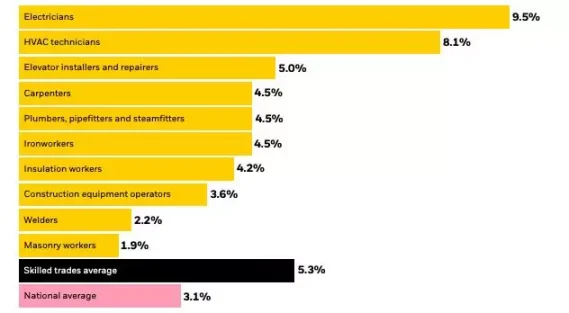
Source: U.S. Bureau of Labor Statistics Occupational Outlook Handbook; BlackRock, 2026. Data last updated by the U.S. Bureau of Labor Statistics in August 2025. National average includes all wage and salary workers, self-employed individuals, and workers in agriculture and private households. Military occupations excluded.
Growing With Your Country—Real-World Examples
United States
People often want to invest in their country’s financial markets—but lack the capital. A BlackRock survey found one-third of Americans couldn’t cover a $500 car repair emergency¹⁷. In fact, many are forced to withdraw from markets just to survive. Last year, a record number of workers tapped their 401(k) accounts to meet financial emergencies¹⁸.
The challenge begins with having savings to invest. That starts with emergency savings accounts—tax-advantaged accounts designed for unexpected needs. BlackRock research found employees with emergency savings are over 70% more likely to contribute to retirement plans¹⁹. U.S. policy now encourages this. Workers can save up to $2,500 (inflation-adjusted) in emergency accounts linked to retirement plans, with employer matching contributions and penalty-free withdrawals²⁰.
Another path to broaden investment participation is “early wealth-building accounts”—investment accounts opened at birth. Canada, the UK, Singapore, and others have piloted such programs, typically with government seed funding. Strong evidence shows these accounts deliver solid returns: on average, people with early wealth-building accounts are more likely to earn advanced degrees, launch businesses, and own homes²¹.
Now, the U.S. is adopting similar policies through “Trump Accounts.” These accounts vary in funding sources. In some cases, they’re government-funded pilots requiring future renewal. Funds may also come from personal contributions—or employer-matching programs like the one we offer employees at BlackRock. In others, private donors provide the capital.
How these accounts evolve remains to be seen. But if carefully designed—and effectively integrated with existing education and retirement savings tools like 529 and 401(k) plans—they could become a pivotal step in helping more young Americans grow with their country.
Beyond that, there’s another potentially transformative lever for wealth creation—though discussing it is never easy: Social Security.
Social Security is one of the most effective anti-poverty programs ever created. According to the U.S. Census Bureau, it lifts nearly 29 million Americans out of poverty each year²². That’s extraordinary.
The problem: Social Security provides stable security—but doesn’t give most Americans a pathway to grow wealth alongside their country.
Today, the system operates largely on a pay-as-you-go basis. Payroll taxes fund current retirees’ benefits; the Social Security Trust Fund invests primarily in U.S. Treasury securities. Effectively, workers lend money to the government—and receive guaranteed benefits in return. As a social insurance program, its structure prioritizes stability and predictability. What it doesn’t do is link beneficiaries’ benefits to overall economic growth. The question is: can Social Security do both? Can part of its funding be invested prudently, broadly, and across market cycles—like other long-term pension plans—while preserving its role as a robust safety net?
This doesn’t mean privatizing Social Security—or putting it all in stocks. It means introducing measured diversification, guided by principles similar to the Federal Employees’ Thrift Savings Plan, which manages retirement savings for millions of federal workers. The goal is to strengthen the system’s sustainability over time—while maintaining its core protections.
Several proposals reflect this idea. For example, Senators Bill Cassidy (R-LA) and Tim Kaine (D-VA) proposed creating a new investment fund—running parallel to, not replacing, the existing trust fund—that would invest in diversified stock and bond portfolios to generate higher long-term returns. The fund would require roughly $1.5 trillion in initial capital and a 75-year growth horizon. During that time, the Treasury would continue paying benefits. Once mature, the fund would repay the Treasury principal and supplement future payroll tax revenue—helping close the system’s funding gap. Benefits for anyone currently receiving or nearing retirement would remain unchanged.
Market-based solutions aren’t theoretical. In some U.S. states, they’re already reality. Roughly six million state and local government employees—including many police officers, firefighters, and teachers—don’t participate in Social Security²³. Instead, they rely on public pension funds invested in diversified portfolios. If long-term investing is already helping millions of public-sector workers build retirement security, it raises a reasonable question: why shouldn’t more Americans have the same opportunity for long-term growth?
Other countries have taken similar steps at the national level. Australia’s superannuation system channels retirement contributions into markets—and has grown into one of the world’s largest retirement savings pools. Strengthening Social Security could draw lessons from such carefully designed approaches.
I understand discussions about Social Security reform provoke unease. Social Security is a foundational promise—and people rightly expect it to be honored. But inaction under the current system risks breaking that promise. Current projections show the trust fund will be unable to pay full benefits by 2033²⁴. Many young Americans doubt they’ll receive full benefits. Closing this gap may require multiple solutions. But prudent long-term investment could be one of them.
I’ve written about Social Security many times. Two years ago, I titled this letter “It’s Time to Rethink Retirement.” Just suggesting Social Security needed reform drew criticism. This time, I may face similar pushback. But in my 50 years in finance, I’ve learned one thing: the issues we avoid discussing are often the ones most worthy of our concern. And that’s why we need to begin this conversation now—because the cost of delay only rises.
Social Security is a foundational promise—and people rightly expect it to be honored. But inaction under the current system risks breaking that promise.
India
India is entering a new chapter of economic growth—and its stock market is performing strongly. As India’s renowned industrialist Mukesh Ambani told me this February: “This is our baby-boom generation—the Indian generation that believes tomorrow will be better than today.” Notably, India has laid the financial groundwork enabling its people to share in that future.
Today, roughly one billion Indians effectively carry bank branches in their pockets²⁵. Through smartphone-based digital wallets, they pay, save, and transact digitally in rupees. While currently used mostly for payments, these smartphones can serve as gateways to capital markets. Our joint venture with Mukesh Ambani’s Reliance Industries—JioBlackRock—is focused precisely on this: helping more Indians become investors. In less than a year, the venture has served over one million investors nationwide.
This isn’t just a story of a latecomer catching up to existing financial systems—it’s a story of building modern financial infrastructure from scratch.
It also offers insights for the next evolution of market infrastructure: tokenization. Tokenization records ownership on digital ledgers—reducing friction, lowering costs, and accelerating settlement. India’s system isn’t blockchain-based—in fact, it follows a different path entirely. That’s precisely the point. Its success shows new financial pathways don’t depend on a single technology. Only when policy, technology, and application advance in tandem does success follow.
Economies that built modern financial systems—the U.S., UK, EU—are now focused on modernizing their mature infrastructures—making traditional and digital markets coexist. When capital markets are already the deepest in the world, change naturally proceeds incrementally. But the goal remains consistent: making it easier for people to invest in their country’s growth.
A smartphone wallet capable of investment is remarkable in itself. But when financial assets themselves become natively digital, the investable world expands dramatically. The bond you hold remains a bond—but it can flow more efficiently on modern infrastructure.
Over time, a single, regulated digital wallet may hold not just payment balances—but a broad range of financial assets. Within that same wallet, someone could hold ETFs, digital euros, tokenized bonds, and shares in assets once out of reach—like infrastructure or private credit funds. By lowering minimum investments and simplifying asset fractionalization, tokenization can attract more investors. It can also make it easier for investors to receive information and exercise shareholder voting rights. The aim isn’t novelty—it’s giving savers simpler, seamless ways to engage markets and build wealth.
As Rob Goldstein and I said last December, we believe tokenization today is roughly where the internet was in 1996. It won’t replace existing financial systems overnight. Think instead of a bridge built simultaneously from both riverbanks—meeting in the middle. On one side stand traditional financial institutions; on the other, digital-first innovators: stablecoin issuers, fintech firms, public blockchains. Policymakers’ task is to help build that bridge as quickly and safely as possible.
Consistency is critical. Rather than writing entirely new rules for digital markets, update existing ones—so traditional and tokenized markets can operate in concert. Tokenization also requires clear safeguards: transparent buyer protections to ensure tokenized products are safe and transparent; strong counterparty-risk standards to prevent contagion; and digital identity verification to manage risks related to illicit finance. Only then can people approach transactions and investments with the same confidence they bring to swiping a card or wiring money.
This isn’t just a story of a latecomer catching up to existing financial systems—it’s a story of building modern financial infrastructure from scratch.
Japan
For decades, Japanese households parked savings in cash and low-yield deposits. This slowed the growth of ordinary citizens’ retirement reserves—a real challenge for the world’s most aged society²⁶. It also starved Japanese markets of the capital needed for growth—forming the backdrop to Japan’s economic stagnation since the late 1980s.
Yet in 2022, Japan doubled—or tripled—the contribution limits for its “Nippon Individual Savings Account” (NISA), a tax-advantaged investment account²⁷. These accounts have existed for nearly a decade—but low contribution limits meant few used them. Raising limits significantly boosted the appeal of equities—and launched a virtuous cycle: more investors injected more capital into markets; rising markets made investing more attractive; and companies began investing more boldly in their futures.
Since the policy announcement, the Nikkei index has surged from roughly 28,000 to over 50,000—and many NISA account holders have benefited²⁸. Within three years, nearly ten million new investors entered Japan’s markets—about 8% of the population²⁹. With the launch of Children’s NISA in 2027, the NISA program is poised for exponential growth—ensuring future generations of Japanese grow up as investors³⁰.
Germany
For many, retirement is their first—and often only—meaningful connection to capital markets. It’s through retirement plans that workers become long-term owners of businesses, infrastructure, and innovation.
Germany is now debating how this connection should evolve. Like most European countries, Germany faces demographic shifts: aging populations and declining worker-to-retiree ratios³¹. Across the EU, fewer than three working-age people now support each person over 65—and total spending on public pensions, healthcare, and long-term care accounts for roughly one-fifth of EU GDP³².
Germany’s retirement system relies primarily on a statutory public pension operating on a pay-as-you-go basis. Occupational and private pensions also play a role—but accumulated pension assets remain relatively modest relative to the size of the economy. As a result, Germany’s pension assets as a share of GDP are lower than in several other advanced European countries³³.
In late 2025, the German government proposed expanding tax-advantaged, state-supported private retirement savings³⁴. Simultaneously, a commission was tasked with reviewing the long-term sustainability of the entire pension system—statutory, occupational, and private pillars³⁵. The goal isn’t to replace the public system—but to assess how accumulative elements can play a larger complementary role over time.
Other European countries demonstrate this balance is possible. In the Netherlands, Denmark, and Sweden, accumulative pension systems have built massive long-term assets—and invested heavily in both public and private markets. Such systems provide retirement-income security while deepening domestic capital markets.
Ireland is also moving in this direction. Earlier this year, it launched a nationwide auto-enrollment retirement savings system—aiming to broaden coverage of accumulative pensions and bring hundreds of thousands of workers into markets for the first time³⁶.
Germany, however, is somewhat different. As Europe’s largest economy, its gradual adjustments to retirement savings structures and investment approaches will have impacts beyond its borders³⁷.
Europe’s overall household savings rate is high. The policy question is how to channel those savings effectively—supporting jobs, infrastructure, and innovation—while strengthening long-term retirement security.
Europe’s demographics make this question increasingly unavoidable. As retirees outnumber workers, the model requiring each generation to fully support the previous one faces mounting strain. Strengthening accumulative retirement savings isn’t about replacing Europe’s social model—it’s about supporting it—by combining shared responsibility with broader ownership of long-term growth.
For years, figures like former ECB President Mario Draghi have argued Europe needs deeper, more integrated capital markets to sustain competitiveness and strategic autonomy³⁸. Pension reform—especially in a large economy like Germany—can meaningfully expand Europe’s long-term capital base—and channel Europe’s vast savings into the growth and innovation that will determine its next phase of development.
Pension reform—especially in a large economy like Germany—can meaningfully expand Europe’s long-term capital base—and channel Europe’s vast savings into the growth and innovation that will determine its next phase of development.
The 250th Anniversary
This July, the United States marks its 250th anniversary—but 2026 is not just America’s celebration.
History’s coincidence is striking: in 1776, as Thomas Jefferson drafted the Declaration of Independence in Philadelphia, Adam Smith published The Wealth of Nations in Scotland—the foundational text of modern economics.
What began as coincidence evolved into interdependence. These two ideas reinforce each other: democratic systems depend on people genuinely feeling they have a tangible stake in their country’s future. And capital markets—today—are the mechanism delivering that stake—in dollars, euros, and yen, in real terms.
Consider how recent this all is. In 1776, no broad capital-market system existed to connect ordinary citizens with economic growth. Today, global capital markets—public and private combined—are worth nearly $300 trillion³⁹. And most of that growth occurred in the past four decades.
BlackRock grew alongside this transformation. In country after country, the stories I’ve shared here are just the beginning. Much of the world remains in the early stages of building markets—not just to fuel economies, but to ensure people claim a meaningful share of the growth they create.
This civic miracle continues unfolding worldwide. Extending it—to enable more people to invest in their country’s growth and share its rewards—is our shared task.
Executing Our 2030 Goals
At our 2025 Investor Day, we outlined BlackRock’s goals through 2030. We’ve built advantages across foundational pillars: ETFs, Aladdin, holistic portfolio management, fixed income, and cash management. These form a solid base for serving clients and achieving organic growth targets.
We’re also advancing organic business development in structural growth categories—including digital assets, active ETFs, model portfolios, and systematic equities.
Looking to 2030, our goal is to achieve over $35 billion in revenue—with 30% or more coming from private markets and technology. We expect revenue growth to be supported by our targets: organic base fee growth of 5% or more, and low-to-mid double-digit annual contract value growth for technology. We aim to nearly double adjusted operating income from 2024 levels—while maintaining an adjusted operating margin of 45% or higher across market cycles. We already have industry-leading margins, and we see opportunities to drive margin expansion through fee-related earnings growth trajectories in private markets—and our highly scalable core businesses. All these targets assume flat market conditions; if markets perform modestly well through 2030, significant upside potential exists.
BlackRock’s 2025 growth is broad—spanning capabilities we’ve held for decades and those we’ve built or acquired in the past two years. We expect the path to 2030 to be similar—growth driven by our strong foundational pillars—such as iShares and Aladdin—as well as newer, high-growth businesses we’re building in markets where we’re less established. Private markets for insurance, private markets for wealth, digital assets, and active ETFs—we believe each could become $500 million revenue streams within five years.
We see a tremendous opportunity to bring private markets to more investors—as portfolio enhancers offering diversification versus public markets, with long-term growth and income potential. Our investments in infrastructure, private credit, and alternative assets for wealth support our $400 billion private markets fundraising target by 2030. BlackRock already manages $3 trillion in assets for insurance, wealth, and outsourced clients. We have a massive opportunity to deliver better outcomes and experiences for clients in private-market allocations.
For example, BlackRock is the largest insurer general account manager⁴⁰, managing $700 billion in assets. Through HPS, we are now also a scaled provider of asset-backed financing and high-grade private debt products. We’re seeing early momentum bringing high-grade private debt into portfolios historically managed for us in public markets.
In wealth, we already wield strong influence—managing over $30 billion in retail private markets, backed by BlackRock’s global distribution platform and comprehensive advisor relationships. We’re now extending private markets for wealth into broader product sets and multi-asset alternative models. We recently partnered with UnitedHealth Group to launch the first private markets separate account solution—enabling broader access to private equity, private credit, and real assets. These strategies are delivered via a single subscription document—designed to meet client objectives while minimizing operational complexity for advisors and their clients. Collectively, these products represent an important step in bringing the benefits of private markets to more investors—including those saving for retirement or other financial goals.
BlackRock has long advocated expanding retirement savings—whether through cradle-to-invest accounts or helping more people transition from savers to investors in capital markets. Over half of our $14 trillion in assets under management relates to retirement—whether for individual investors via ETFs or 401(k) plans, or for pension clients representing millions of schoolteachers, firefighters, and union workers globally⁴¹.
We are the largest defined-contribution investment manager⁴²—including over $600 billion in assets under our LifePath target-date products. Our LifePath Paycheck innovation combines the flexibility of target-date funds with solutions designed to provide workers with reliable retirement income streams.
Many global retirement plans—including defined-benefit plans—already include private-market allocations, delivering diversification, income, and potential alpha to individual members—not just institutions. But in the U.S., the vast majority of retirement savers enter capital markets through 401(k) plans—and cannot access private markets. We see regulatory frameworks shifting significantly, which may change this. We believe private markets—when prudently and responsibly incorporated into professionally managed target-date funds—have the potential to improve participant retirement outcomes. The transformation of bringing private markets into 401(k) plans also presents another opportunity for Preqin. Plan sponsors will need extensive data and standardized benchmarks—and Preqin is well-positioned to provide them and accelerate this shift.
Looking to 2030, our goal is to achieve over $35 billion in revenue—with 30% or more coming from private markets and technology.
Earlier this year, we unified Preqin’s data onto the Aladdin platform. Through Aladdin, eFront, and Preqin, we’ve created a public-and-private-market workflow and data solution—all on a single platform. I believe Aladdin will be a major beneficiary of AI—enabling clients to work more efficiently across growing datasets and unlocking scale effects in their investment and analytical processes. AI can become a powerful business accelerator for Aladdin—enhancing its scale, deep resources, proprietary data, and deeply embedded network across the global investment ecosystem.
BlackRock is also actively building exciting new technologies in financial markets—including digital assets and tokenized funds. Today, traditional investment products are largely inaccessible in digital wallets. We plan to lead this transformation.
BlackRock has already established early leadership in bringing institutional-grade products to digital markets—managing nearly $150 billion in digital-asset-related assets. Our tokenized Treasury fund has grown into the world’s largest tokenized fund; we manage $65 billion in stablecoin reserves—and nearly $80 billion in digital-asset ETFs⁴³. All these businesses were built in the past few years—and we’re exploring further opportunities to expand our leadership.
Our digital-asset ETFs are another example showing how our iShares ETF platform remains a powerful engine for growth and innovation—delivering double-digit organic asset and base-fee growth in 2025. Even with over $5 trillion in assets under management, iShares continues unlocking new use cases for ETFs—bringing new investors into capital markets and expanding our reach across regions.
Beyond digital assets, active ETFs represent an emerging growth channel for iShares. Our active ETF platform tripled in size in 2025—reaching nearly $100 billion in assets under management by year-end—with significant growth potential ahead. Clients are increasingly incorporating active ETFs into portfolio strategies—including model portfolios—to unlock excess returns, manage downside risk, or generate steady income. By bringing active management capabilities to the ETF market, we’re making our portfolio managers and alpha opportunities more widely available to investors worldwide.
In Europe, we’re capturing a growing market opportunity as a wave of first-time investors enters capital markets through monthly savings plans and digital-first products. iShares’ net inflows in Europe were 50% higher in 2025 than in 2024—capturing over one-third of regional flows. We’re seizing this opportunity here—and globally—as ETFs gain increasing recognition among individuals and institutions alike.
For shareholders, our 2030 strategy aims to deliver higher, more durable growth and higher margins over time. As we expand businesses with strong long-term tailwinds and recurring revenue, we expect more stable organic growth, enhanced earnings resilience across market cycles, and meaningful long-term value creation. Our diversified platform, disciplined capital allocation, and execution focus enable BlackRock to deliver compound earnings growth—while continuing to invest in the future. This alignment between client success and shareholder outcomes is central to our strategy—and why we believe the BlackRock we’re building for 2030 will be stronger, more resilient, and better positioned than ever before.
Total Compound Annual Return from BlackRock’s IPO through December 31, 2025
The power of our integrated platform—and the strength of our client relationships—is a key source of differentiated returns for shareholders. Since our 1999 IPO, our annualized total return has been 20%, compared to 9% for the S&P 500 Index and 7% for the financial sector.
The chart compares BlackRock’s 20% total compound annual return since IPO with the S&P 500 Index’s 9% and the financial sector’s 7%.
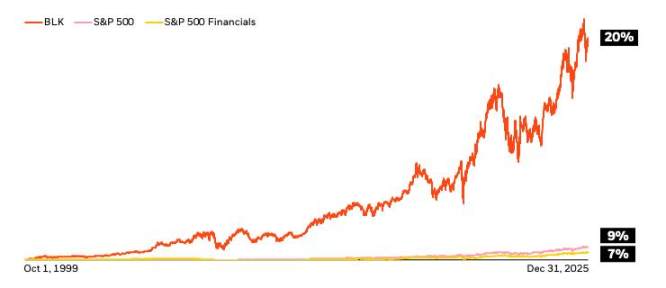
Source: S&P Global, as of December 31, 2025. Past performance is not indicative of future results.
Our growth and success begin with our world-class talent—and our leadership team is no exception. In 2025, we expanded our Global Executive Committee—bringing in more emerging enterprise leaders who will help advance our strategy in the years ahead. Over the past 18 months, we welcomed outstanding leadership teams from GIP, Preqin, and HPS. We have a long history of successful integration—and many of our current senior leaders joined us through acquisitions. We’re already benefiting from fresh perspectives and experience brought by new colleagues—and from our homegrown talent.
AI can become a powerful business accelerator for Aladdin—enhancing its scale, deep resources, proprietary data, and deeply embedded network across the global investment ecosystem.
Looking Ahead
Today, BlackRock stands at the confluence of the most powerful forces reshaping global finance: the long-term growth of capital markets, the modernization of portfolios, the expansion of private investing, the evolution of AI, and the digital transformation of investing itself. Our diversified platform means we can meet clients wherever market opportunity aligns with their portfolio objectives—and do so profitably, responsibly, and at scale.
That’s why we believe now is an exceptionally attractive time to be a BlackRock shareholder. We enter 2026 with strong organic growth, a resilient earnings base, and multiple structural tailwinds. Our strategy is clear. Our balance sheet is strong. Our mission—to help more people achieve financial well-being—continues to guide our growth.
BlackRock has always been built for the long term. Our 2025 results—and the momentum we see today—strengthen our confidence in the years ahead.
Join TechFlow official community to stay tuned
Telegram:https://t.me/TechFlowDaily
X (Twitter):https://x.com/TechFlowPost
X (Twitter) EN:https://x.com/BlockFlow_News
 @BlackRock


