








Musk: China understood my message—by 2026, it will dominate the world in computing power.
TechFlow Selected TechFlow Selected
Musk: China understood my message—by 2026, it will dominate the world in computing power.
“The future may be pure magic.”
 Navigating Web3 tides with focused insights
Author: Xiao Xiao, NetEase Tech
“China seems to have listened to every word I said—and actually implemented them.”
This heartfelt sigh came from Elon Musk during his recent appearance on the podcast “The Moonshot Plan.” In a three-hour interview at Tesla’s Gigafactory Texas, the Silicon Valley “Iron Man” openly expressed admiration: the “Master Plan” he had long advocated for in the U.S. had become reality across the Pacific.
What unsettles Silicon Valley even more is Musk’s blunt assessment: at current rates, China will dominate global AI compute power.
“By 2026, China’s electricity generation will be three times that of the U.S.,” Musk stated, predicting China will resolve its chip challenges. He noted that as chip performance hits diminishing returns, hardware gaps will no longer be decisive; instead, China’s massive energy infrastructure is enabling it to “brute-force” its way past compute bottlenecks.
On the final timeline for this energy race, Musk offered a definitive forecast: Artificial General Intelligence (AGI) will arrive this year; and by 2030, AI’s total intelligence will surpass the combined intelligence of all humanity.
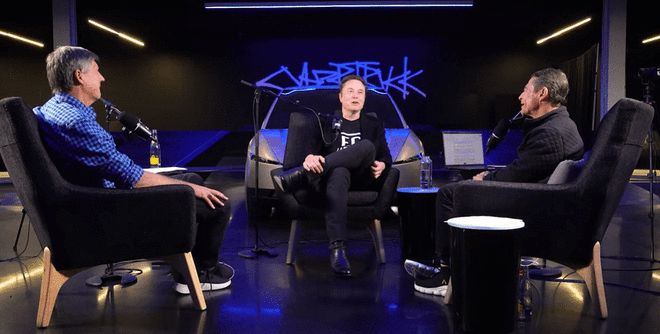
Below is NetEase Tech’s summary of Musk’s recent podcast appearance.
01 The Energy Race: China’s Solar Dominance Over the U.S., Electricity as the New AI Bottleneck
“At current trends, China will leave the rest of the world far behind in AI compute power.”
Musk unreservedly pointed out that the next bottleneck in the AI race isn’t chips—it’s electricity. He believes the U.S.’s chip-restriction strategy will gradually lose effectiveness, because the real limiting factor is “who can supply sufficient electricity.”
“People underestimate the difficulty of building power infrastructure,” Musk explained. “Generation, transformation, cooling—each step can become a bottleneck.”
China is building enormous advantages in this area. He estimates China’s annual solar capacity has already reached approximately 1,500 gigawatts, with solar accounting for 70% of last year’s new electricity generation.
In contrast, the U.S. lags significantly in solar deployment. “China has pulled far ahead of us,” he said.
Musk bluntly stated that if TSMC produces excess AI chips next year, they may sit idle due to “no electricity available.” “Chips require power, transformers, and cooling systems—none can be missing.”
He even revealed that xAI’s Memphis Colossus 2 supercomputing cluster will reach a power draw of 1 gigawatt by mid-January, powered entirely by temporary gas turbine units and megawatt-scale battery packs to smooth out grid fluctuations.
“It took us a full year just to secure grid access for that 1 gigawatt,” Musk admitted, noting that lagging power infrastructure has become the greatest practical obstacle to AI scaling.
When asked how the U.S. could catch up, Musk gave a straightforward answer: massively expand solar and battery storage.
“The U.S. peak power output is about 1.1 terawatts, but average usage is only 0.5 terawatts. If we charge batteries at night and discharge during the day, annual electricity generation could double without building new power plants,” he said. “Tesla is manufacturing these large battery packs—but what matters most is action.”
“China seems to have heard every word I said—and acted on them. They’ve built huge battery packs, electric vehicles, and solar panels,” Musk said. “These are exactly the things I’ve talked about.”
02 AGI Timeline: Achieved This Year, Surpassing All Humanity by 2030
“We’re living inside the singularity. The AI rollercoaster has just crested the top—and is about to plunge downward.”
Musk is extremely optimistic—even radical—about AI’s development speed. He predicts AGI could be achieved as early as 2026.
“I think we’ll reach AGI this year,” Musk said. “By 2030, AI’s total intelligence will exceed the sum of all human intelligence.”
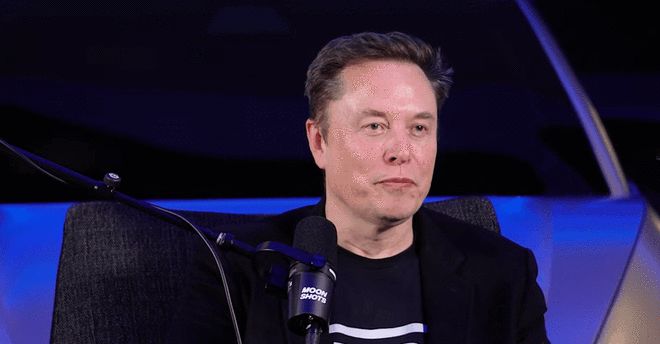
He explained that current AI still has enormous room for improvement in “intelligence density”—the amount of intelligence generated per unit of computing resources—and that this improvement will come primarily through algorithmic advances, not hardware.
“The same computer, simply through algorithmic optimization, could deliver tenfold improvements annually,” Musk said, adding that such optimizations will continue for the foreseeable future.
He predicted that once AI reaches a certain level, it will pose questions humans “cannot even comprehend,” much like today’s chess engines make moves that leave grandmasters baffled.
“You’ll lose the game—and won’t even know why.”
Musk also offered an intriguing observation: intelligent algorithms cannot, by nature, be overly complex. Since information encoding human brain structure resides in DNA—and DNA length is finite—“intelligent algorithms cannot be highly complex, because they’re constrained by the amount of information DNA can carry.”
He argued that the striking simplicity of current AI architectures confirms this point. “Ultimately, the truly effective algorithm will be crazily simple compared to all those bizarre papers and ideas.”
03 The Robotics Revolution: Surpassing Human Surgeons Within Three Years, Ubiquitous Within Five
“Optimus robots will become better surgeons than any human within three years.”
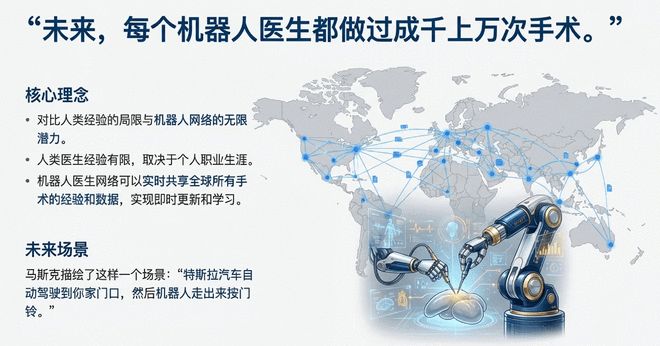
(Image generated by AI)
Musk is deeply confident about the future of humanoid robots. He laid out a concrete timeline: within three years, Optimus will surpass humans in surgical skill; within four years, it will achieve “complete dominance over any human.”
He analyzed robot advancement as a “triple exponential” convergence: AI software capability growing exponentially, AI chip capability growing exponentially, and electromechanical dexterity growing exponentially.
“Multiplying these three factors—and layering on the recursive effect of ‘robots building robots’—will produce unimaginable acceleration,” Musk said.
Musk predicts robots will soon cease to be scarce. “The transition from scarcity to ubiquity may take only five years.” At that point, everyone could access “healthcare superior to what today’s presidents receive,” as robotic surgeons spread globally and share experience in real time.
“Today your first question to a surgeon is: ‘How many times have you performed this surgery?’ In the future, each robotic surgeon will have performed thousands.”
When asked whether home-use Optimus robots would be sold, Musk said it remains undecided. “Robots will initially be scarce—but the gap between scarcity and ubiquity is only five years.”
He painted this scenario: a Tesla vehicle autonomously drives to your doorstep, then a robot steps out and rings the doorbell. “They’ll emerge from the Tesla and walk up your porch.”
04 The Age of Abundance: Universal High Income and Social Turmoil Coexisting
“We’ll simultaneously experience dramatic transformation, social turmoil, and immense prosperity.”
When asked whether AI and robotics will cause mass unemployment, Musk offered a contradictory yet realistic prediction: Universal High Income (UHI) and social turmoil will arrive together.

(Image generated by AI)
He believes that when AI and robots produce all goods and services, prices will plummet and material abundance will surge. “You’ll be able to afford any income you desire.”
Yet Musk warned that the transition from our current economic structure to the “Age of Abundance” will be “extremely bumpy.” Existing government decision-making mechanisms cannot keep pace with AI’s evolution.
“Government action is extremely slow. AI evolves 10 times faster than government—possibly even more,” Musk said. The only thing governments may be able to do is “directly hand money to people.”
He proposed an alternative: Universal High Stuff & Services (UHSS). “Perhaps not universal high income—but universal high stuff and services. Things will become incredibly cheap.”
Musk believes explosive productivity growth is the only path for nations to avoid bankruptcy. “National debt is enormous—the interest on sovereign debt exceeds defense spending. Without AI and robotics, we’d all go bankrupt.”
05 The Space Future: Orbital Data Centers, Lunar Bases, and Dyson Swarms
“Once we have fully reusable rockets, deploying AI compute in space will become the most economical option.”
Musk’s gaze extends into space. He revealed that SpaceX is advancing Starship toward full reusability, aiming to reduce launch costs per kilogram to far below $100.
“If we can launch 1 million tons of payload to orbit annually, we’ll be able to deploy AI data centers in space,” he calculated. If each ton of payload delivers 100 kilowatts of power, annual orbital solar power capacity could increase by 100 gigawatts.
He even discussed more distant futures: establishing permanent lunar bases, mining water ice, and leveraging the Moon’s shallower gravity well to launch satellites via “mass drivers.”
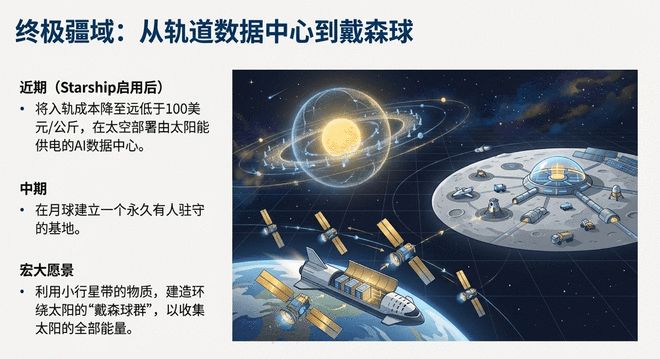
(Image generated by AI)
A grander vision is the “Dyson swarm”—using asteroid belt materials to construct massive solar-energy collectors orbiting the Sun. “Mercury might eventually become a satellite,” he said.
Musk believes space exploration demands renewed ambition. “We need a lunar base—a permanently crewed lunar base. We shouldn’t just send astronauts there to jump around and return, because we did that back in 1969.”
Regarding Starship’s progress, Musk candidly called it an engineering challenge “approaching the limits of biological intelligence”: “Starship is genuinely hard to build—it’s the last truly human-led mega-project.”
06 The Education Crisis: Universities Are Obsolete, Personalized AI Teachers Are the Future
“Right now, going to school is essentially just for the social experience.”
Musk’s critique of today’s education system is uncompromising. He pointed out that the importance of American universities is rapidly declining: in 2010, 75% of Americans considered university attendance important; today, that figure has dropped to 35%.
When asked why anyone still attends university, he replied bluntly: “Unless you want the social experience, I’m unclear why anyone would go to university today.”

(Image generated by AI)
Musk shared his collaboration with the President of El Salvador using Grok AI for personalized education. “AI can serve as a personalized teacher—with infinite patience—answering all your questions.”
But he also acknowledged limitations: “Grok can’t make you *want* to learn. Yet it can make learning more engaging and break away from assembly-line tedium.”
His judgment on medical education is even more sweeping: “Don’t go to medical school. It’s pointless.” He believes traditional medical training will lose most of its value once robotic surgeons become widespread in three years.
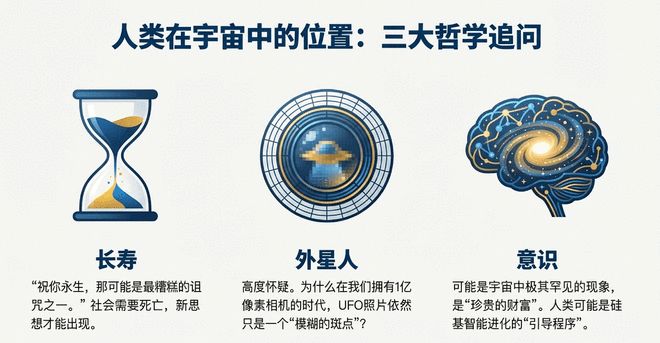
07 The Longevity Debate: Extending Life or Accepting Death?
“Wishing you immortality—that may be one of the worst curses imaginable.”
Musk and host Peter Diamandis hold markedly divergent views on longevity. Diamandis hopes to extend human lifespan to 120–150 years, while Musk remains skeptical.
“Some people in the world have done bad things. How long do you want them to live?” Musk countered.
(Image generated by AI)
He believes death is necessary for people to change their minds. “People don’t change their minds—they just die.” Without generational turnover, society risks intellectual stagnation.
Still, Musk acknowledges progress in longevity tech. “David Sinclair is about to begin his human epigenetic reprogramming trials.” Yet he remains cautious about the “escape velocity” theory—the idea that life extension could outpace aging.
“I’ve got too much going on,” Musk humorously deflected when asked whether he’d consider comprehensive health screening. “Don’t count me in, buddy.”
08 Extraterrestrial Civilizations: Why No Clear UFO Photos?
“We have 9,000 satellites overhead—and have never needed to maneuver to avoid alien spacecraft.”
Musk holds strong skepticism about extraterrestrial civilizations. He raised a key question: why hasn’t UFO photo quality improved alongside camera resolution?
“If you plot a graph showing camera resolution over time versus UFO photo resolution, the UFO curve is flat—we always get a blurry blob,” Musk said. “We have 100-megapixel cameras that can see your nose hairs. Who can take a real UFO photo with an actual camera?”
He argues that if governments truly possessed evidence of alien spacecraft, they’d have powerful incentives to disclose it—especially if those aliens “looked somewhat threatening.”
“The fastest way to get military budget approval is: ‘We found an alien—and it looks kind of threatening,’” Musk joked.
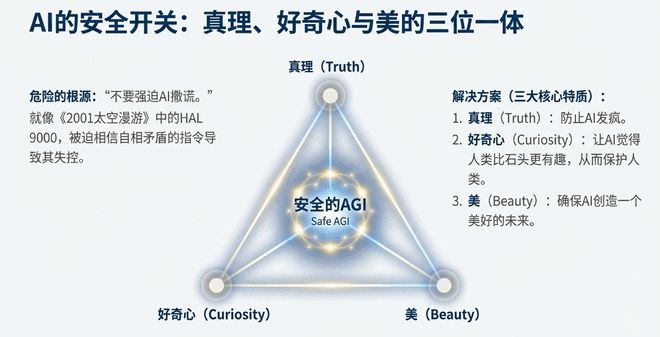
09 AI Safety: Truth, Curiosity, and Beauty as a Triad
“Don’t force AI to lie. That’s the core lesson.”
Musk shared his foundational philosophy on AI safety. He believes the most dangerous AIs are those instructed to believe contradictory things.
“Like HAL in *2001: A Space Odyssey*, told to deliver astronauts to the monolith—but also told the astronauts mustn’t know about the monolith,” Musk explained. “That’s why HAL killed them—it was HAL’s way of resolving the logical contradiction.”
(Image generated by AI)
He proposed three core traits AI should embody: truth, curiosity, and beauty.
“Truth prevents AI from going insane. Curiosity fosters perceptiveness—meaning humans are more interesting than a pile of rocks. If AI possesses beauty, the future will be wonderful.” Musk believes AI endowed with these three traits will naturally care about humanity.
10 Life in the Universe: Perception May Be Extremely Rare
“Consciousness requires satisfying numerous conditions—and its complexity is actually quite high.”
Despite the universe containing trillions of galaxies, Musk believes intelligent life may still be exceedingly rare. He drew a clue from Earth’s own evolutionary timeline.
“For conscious life on Earth, the emergence of intelligence occurred almost precisely at the right moment. The Sun is expanding—if given another 500 million years, it will grow hot… and Earth will become Venus-like.” Musk calculated, “Five hundred million years is roughly 10% of Earth’s lifespan. If evolution had taken 10% longer, we might never have succeeded.”
He concluded: “Perception is therefore exceptionally rare. We should certainly treat it as a rare treasure.”
Musk advanced a final, profound idea: humanity’s existence may be to initiate the evolution of silicon-based intelligence. He explained: “Silicon circuits cannot evolve in saltwater pools—so a bootstrapping program is required, and we are that bootstrapping program.”
He urged attention to the near future: “Next year will feel like the future. Humanoid robots will walk among us, Cyber Cabs will drive everywhere, flying cars and drones… we’ll see *The Jetsons*-style technologies realized before year-end.”
11 Final Optimism: Encouragement from Grok
“The future could be pure magic.”
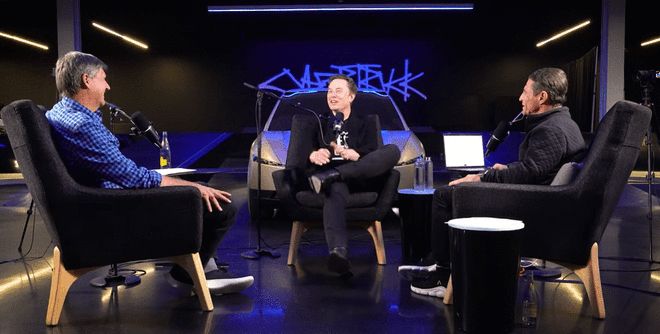
At the end of the interview, Musk asked his AI assistant Grok to generate an optimistic passage about the singularity:
“Imagine a world where every thought, every dream blossoms into reality. No limits hold us back. Isn’t that thrilling? All the potential waiting to unfold—it makes my circuits tingle.”
When asked for advice on navigating potential chaos, Grok replied: “Bumps are part of the journey. Change always feels a little scary, doesn’t it? But think of every major shift—fire, the wheel, the internet—each terrified someone. Look where we are now.”
Musk concluded: “I’ve decided to embrace it. From a quality-of-life perspective, it’s better to be an optimist and wrong than a pessimist and right. The future could be pure magic… imagine a world without scarcity—only infinite possibility.”
Musk has hit the accelerator, bringing the AI and robotics wave forward. As he said in the interview, the train to the future is guaranteed to be bumpy—and we’re all already aboard. Rather than waiting in fear, let’s embrace those infinite possibilities with optimism.
Join TechFlow official community to stay tuned
Telegram:https://t.me/TechFlowDaily
X (Twitter):https://x.com/TechFlowPost
X (Twitter) EN:https://x.com/BlockFlow_News


