Who profited 6,200x—Who is Moore Threads' biggest winner?
TechFlow Selected TechFlow Selected
Who profited 6,200x—Who is Moore Threads' biggest winner?
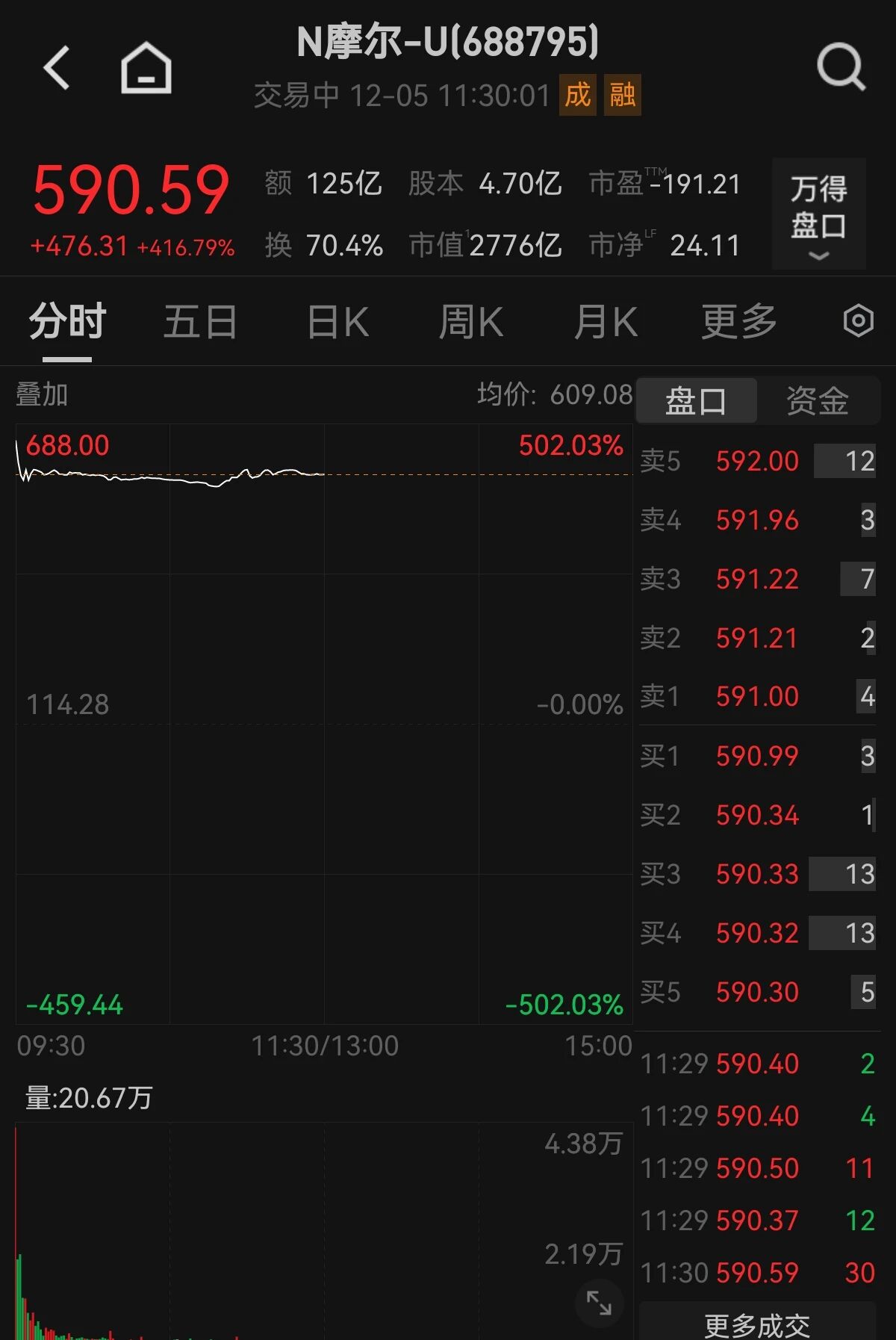
On December 5, Moore Threads officially listed on the STAR Market, opening at 650 yuan, a 468.78% surge from its IPO price of 114.28 yuan.
 Navigating Web3 tides with focused insights
Source: Wall Street Horizon
As the "first domestically produced GPU stock," Moore Threads' debut on the STAR Market ignited market enthusiasm with an astonishing surge, a direct affirmation of its technological scarcity and highlighting strong market optimism about the prospects of China's high-end computing chips amid the artificial intelligence wave.
On December 5, Moore Threads officially listed on the STAR Market, opening at 650 yuan, a 468.78% increase from its IPO price of 114.28 yuan. The intraday high reached 688 yuan, up 502%, briefly pushing its market capitalization above 270 billion yuan. Based on the opening price, investors who won one lot (500 shares) saw floating profits exceeding 280,000 yuan, making it one of the most profitable new stocks this year. At the time of writing, the stock was trading at 590.59 yuan per share, up 416.79%.
Moore Threads also delivered extraordinary returns to early investors—Pexian Qianyao, one of the earliest investors, achieved over 6,262 times book value appreciation on its initial investment, creating a capital legend.
This IPO attracted 267 institutions to participate in pricing, with offline subscription multiples reaching 1,572 times. Top-tier institutions such as Southern Fund and E Fund deployed hundreds of products for bidding. The company raised approximately 8 billion yuan, becoming the largest IPO on the STAR Market this year. Despite still being unprofitable, its price-to-sales ratio of 122 times far exceeds overseas giants like NVIDIA, indicating the market is assigning a high premium based on future growth potential and technological uniqueness.
As the only domestic company capable of functionally matching NVIDIA, Moore Threads has achieved breakthroughs in AI computing, graphics rendering, physical simulation, and video encoding/decoding on a single chip using its self-developed MUSA architecture. The company expects to achieve profitability as early as 2027 and completed the process from application submission to listing in just 158 days, demonstrating the "STAR Market acceleration."
Zhang Jianzhong, founder, chairman, and CEO of Moore Threads, stated that the company will maintain an annual iteration pace for full-function GPU chips and is committed to building an all-scenario computing platform covering both cloud and edge. He emphasized that as long as AI continues evolving, demand for computing power will not be a bubble.
A "Rare Asset" Favored by Institutions
Moore Threads demonstrated overwhelming institutional investor enthusiasm during the preliminary pricing phase. According to the issuance announcement, 267 institutional investors submitted valid quotes, managing 7,555 allocation accounts, with effective subscription volume reaching 70.406 billion shares—an offline subscription multiple of 1,572 times, far surpassing the inquiry multiples of most new stocks this year.
The roster of participating institutions was impressive: 86 mutual funds, 124 private equity funds, 30 securities firms, and 13 insurance companies participated in bidding. Among them, Southern Fund used 404 products to bid, planning to subscribe 5.285 billion shares cumulatively; E Fund used 389 products; ICBC Credit Suisse and Fullgoal Fund used 345 and 265 products respectively.
Moore Threads' initial online allotment winning rate was 0.02423369%. When subscriptions opened on November 24, its IPO price of 114.28 yuan per share set a record for the highest IPO price among new stocks this year. This IPO raised about 8 billion yuan, making it the largest IPO project on the STAR Market this year.
From submitting its IPO application on June 30 to listing on December 5, the entire process took only 158 days. As the only domestic GPU manufacturer with deep布局 in both B2B and consumer markets, Moore Threads has become a "rare and irreplicable asset" in the eyes of capital markets.
Early Investors Gain 6,200x Returns
Since its founding in 2020, Moore Threads quickly became a focal point in the primary market. The company advanced financing at an astonishing speed, raising over 10 billion yuan cumulatively, with as many as 86 shareholders before listing.
Its fundraising prowess is reflected not only in total amounts but also in the extraordinary returns delivered to early investors—Pexian Qianyao, one of the earliest investors, achieved over 6,262 times book value appreciation on its initial investment, creating a capital myth.
Moore Threads emerged during China's semiconductor investment boom in 2020, when competition in the GPU sector was fierce. Despite intense rivalry, Moore Threads made a stunning debut under the halo of being dubbed the "Chinese NVIDIA," completing two rounds of financing within 100 days of establishment, achieving a valuation exceeding 1 billion U.S. dollars, setting a new industry record for the "fastest unicorn creation," showcasing its powerful market appeal and development potential.
After gaining initial market recognition, Moore Threads fully ignited capital market enthusiasm. From the Pre-A round in 2021 to Series A funding, the company attracted a "bulk purchase" style of investment from dozens of top-tier institutions including Shenzhen Capital Group, Sequoia China, GGV Capital, ByteDance, and Guosheng Capital. This phenomenon shows that whether established players deeply entrenched in the field or cross-sector industrial capitals, all regard Moore Threads as a must-have leading asset, rushing in to jointly propel its rapid development.
Profitability Challenges Under High Valuation
Despite high market enthusiasm, the company remains in a state of continuous loss. Moore Threads reported revenue of 438 million yuan in 2024, with a net loss of 1.618 billion yuan. Its price-to-sales ratio of 122 times significantly exceeds that of overseas GPU giants like NVIDIA.
The company’s revenue has grown rapidly in recent years, increasing from 46.0883 million yuan in 2022 to 438 million yuan in 2024. In the first three quarters of 2025, it already achieved 785 million yuan in revenue. However, due to massive R&D investments, net losses were 1.894 billion yuan, 1.703 billion yuan, and 1.618 billion yuan in 2022, 2023, and 2024 respectively. In the first three quarters of 2025, losses amounted to 724 million yuan, with a single-quarter loss of 453 million yuan in Q3, widening by nearly 180 million yuan year-on-year.
R&D expenses remain persistently high, amounting to 1.116 billion yuan, 1.334 billion yuan, and 1.359 billion yuan in 2022–2024 respectively, and 557 million yuan in the first half of 2025. The company’s R&D spending has long exceeded its revenue, reflecting its strong emphasis on technology development. Moore Threads expects to achieve consolidated profit as early as 2027, meaning domestic GPU companies still face a prolonged cultivation period.
"Full-Function GPU" Competing with NVIDIA
"Moore Threads is the definitor of full-function GPUs," explained Zhang Jianzhong. Unlike other domestic GPU companies, Moore Threads offers "full-function GPUs." Based on its self-developed MUSA architecture, the company pioneered breakthroughs enabling a single-chip architecture to simultaneously support AI computing acceleration, graphics rendering, physical simulation, and ultra-high-definition video processing.
Zhang noted that as humanity enters the intelligent era, scientific research demands for computing platforms are breaking boundaries—scientists may simultaneously require AI model training, high-performance computing, 3D graphics rendering, video encoding/decoding, and physical simulation. Moore Threads aims to build a general-purpose computing acceleration platform to help unlock scientific research thinking and discover more AI application scenarios.
The MUSA architecture maintains compatibility with the international mainstream GPU ecosystem dominated by NVIDIA, allowing developers to leverage existing code resources at low cost. This makes Moore Threads the only domestic company capable of functionally competing with NVIDIA and earns it the title of "China's NVIDIA."
Three IPO Projects Targeting All-Scenario Layout
Moore Threads allocated funds from this IPO to three major projects: the AI training-and-inference-integrated chip project aims to develop an intelligent computing platform integrating computation, storage, and communication, capable of meeting demands for ten-thousand-card or even hundred-thousand-card intelligent computing clusters; the next-generation autonomous controllable graphics chip meets needs related to 3D rendering, such as digital twins and physical world simulations; the AI SoC chip project targets intelligent devices in an interconnected world, fulfilling edge-side AI requirements.
"Through iterative development based on the MUSA architecture, we aim to create an all-scenario computing platform covering both cloud and edge, providing robust AI computing support for digital and intelligent transformation across industries," said Zhang Jianzhong. Since its inception in 2020, the company has consistently focused on independent research and design of full-function GPUs.
According to Frost & Sullivan forecasts, the global GPU market size will reach 3.62 trillion yuan by 2029. China's market growth is particularly rapid, expected to reach 1.36 trillion yuan, increasing its global share from 15.6% in 2024 to 37.8%, with a compound annual growth rate as high as 51.1%. Zhang Jianzhong believes, "Human society has entered the computing era—computing power equals national strength, and GPU chips have become the cornerstone of computing power."
Join TechFlow official community to stay tuned
Telegram:https://t.me/TechFlowDaily
X (Twitter):https://x.com/TechFlowPost
X (Twitter) EN:https://x.com/BlockFlow_News