Last night's US stocks opened with an "epic" surge before plunging, as Nvidia rode a rollercoaster
TechFlow Selected TechFlow Selected
Last night's US stocks opened with an "epic" surge before plunging, as Nvidia rode a rollercoaster
The analysis suggests that when positive news fails to drive market gains, this in itself becomes a strong bearish signal, triggering widespread profit-taking and technical selling in U.S. stocks.
 Navigating Web3 tides with focused insights
Last night, Nvidia's better-than-expected earnings report combined with a "Goldilocks" nonfarm payroll report (stronger-than-expected job growth but rising unemployment) created a double positive.
Major U.S. stock indexes surged at the open, with the S&P 500 briefly up over 1.4% and the Nasdaq soaring 2.18%.
But by the close, all indexes had sharply reversed, with the S&P 500 ending down 1.56% and the Nasdaq plunging 2.16%.
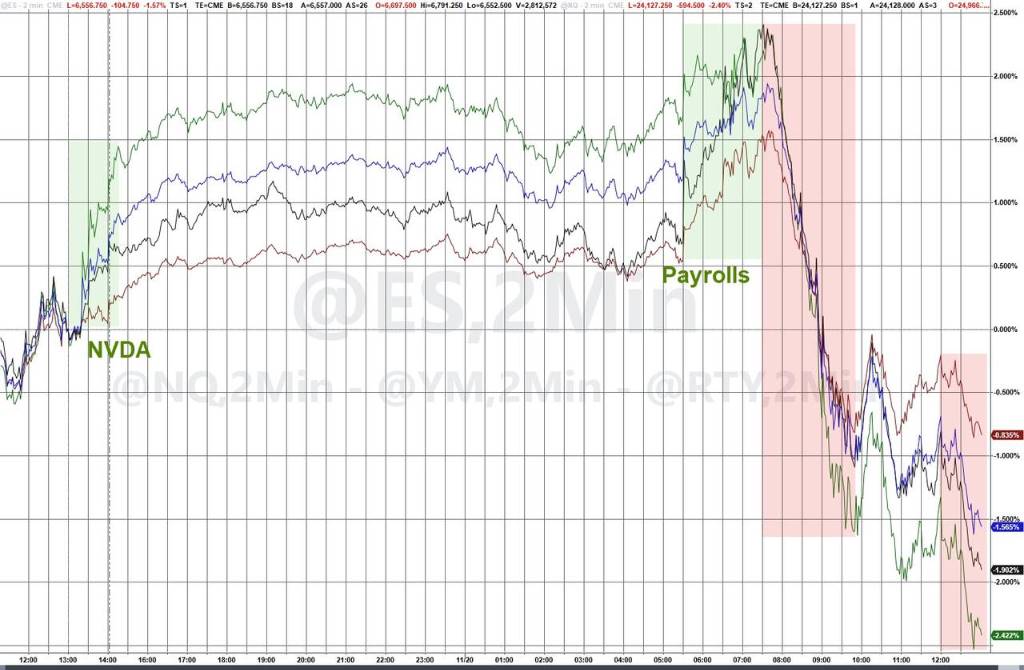
This scenario has only occurred twice before: April 7, 2020 (after the pandemic shock) and April 8, 2025 (after the Trump tariff shock).
Nvidia's gains proved fleeting as well, with its stock dropping 3% after earlier rising more than 5%. The Philadelphia Semiconductor Index turned from strong morning gains to a near 4.8% loss at closing.
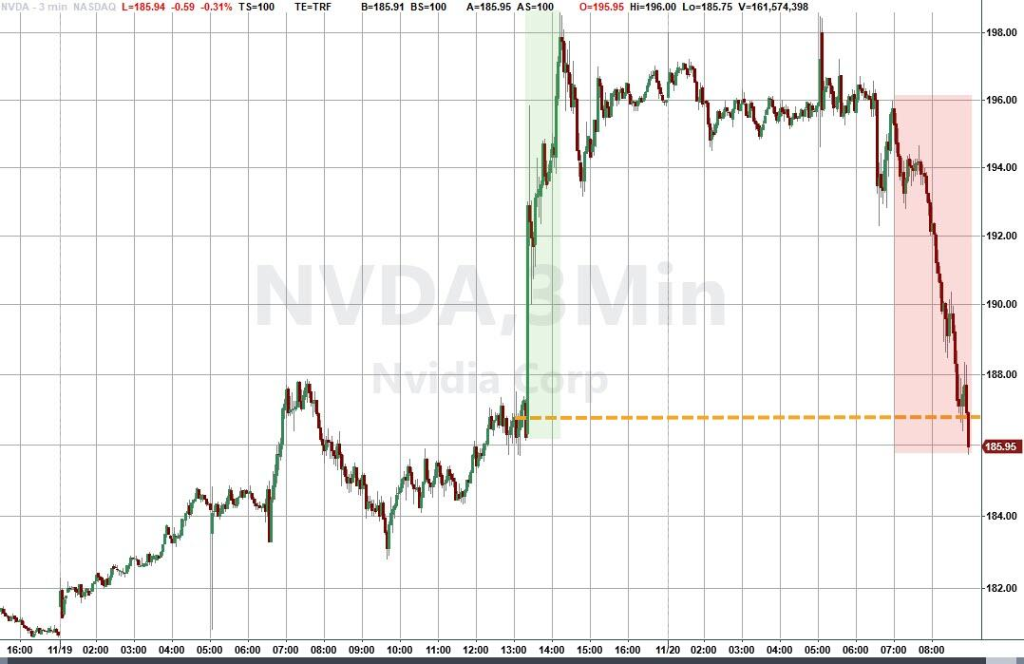
Analysts believe that when positive news fails to drive markets higher, it becomes a strong bearish signal, triggering widespread profit-taking and technical selling in U.S. equities.
U.S. Stocks Post Largest Intraday Reversal Since April Tariff Shock
Before trading began, September’s nonfarm payroll report showed 119,000 new jobs—well above expectations—while the unemployment rate unexpectedly rose to 4.4%, the highest level in four years. This mixed data suggests labor market resilience while also increasing expectations for future rate cuts.
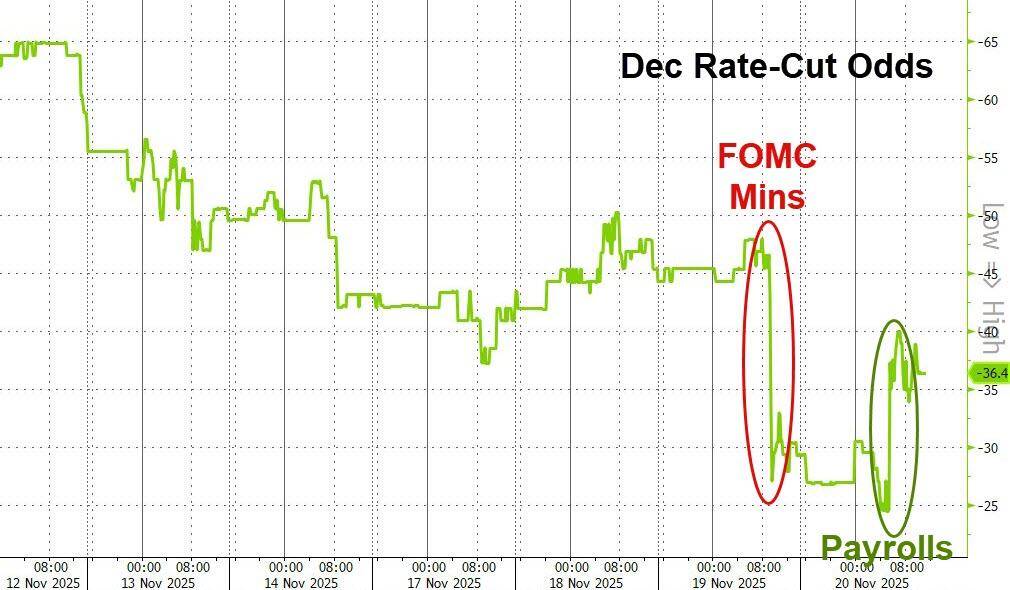
In early trading, boosted by both the "Goldilocks" employment data and Nvidia's strong earnings, all three major indexes opened sharply higher.
At midday, Bitcoin broke below the $90,000 mark during U.S. trading hours, falling more than $5,000 intraday, sparking a sell-off in high-risk assets.
In addition, Federal Reserve Governor Cook warned that risks in private credit markets could spread across the financial system.
Nick Timiraos, known as the "new Fed whisperer," wrote that the September jobs report is unlikely to help the Fed reach consensus on whether to pause rate cuts next month.
Market sentiment quickly shifted, leading to a dramatic "sell-off after surge." All three major U.S. equity indexes turned negative and continued to widen losses.
Ultimately, the S&P 500 closed down 103.40 points, or 1.56%, at 6538.76.
The Dow Jones Industrial Average fell 386.51 points, or 0.84%, to 45752.26.
The Nasdaq dropped 486.181 points, or 2.16%, to 22078.048.
Market Questions Nvidia: “The Pickaxe Seller Won’t Say There’s No Gold in the Mountain”
Despite Nvidia reporting a 62% year-over-year revenue increase to $57.01 billion and issuing strong guidance for Q4, investor concerns about an AI valuation bubble have not fully subsided.
On Thursday, Nvidia’s stock reversed course and declined despite its initially positive reaction to the strong earnings, which had pushed shares up 5% earlier in the session.
Following the earnings release, AI ecosystem stocks including AMD and Broadcom initially rose but later followed the broader market lower.
Nvidia CEO Jensen Huang stated bluntly on the earnings call: “There’s a lot of discussion about an AI bubble, but from our perspective, the situation is entirely different.”
Yet, to some market observers, such a defense is inevitable.
Analysts compare this to a hardware store owner during a gold rush—he would never tell prospectors, “There’s actually no gold in the mountain.” Even if there is an AI bubble, Huang, as the biggest beneficiary, has no incentive to admit it.
Investor concerns about an AI bubble are not focused on this quarter or the next few quarters, but rather whether capital expenditures can sustain growth one or two years out. These massive investments must eventually generate returns.
History offers relevant parallels. During the dot-com bubble, Cisco, as the world’s leading networking equipment provider, was the quintessential “pickaxe seller.” While Cisco’s revenue growth did not match Nvidia’s current pace, it was still robust and even re-accelerated at times—until it collapsed abruptly after the bubble burst.
Nvidia has announced a quarterly dividend of 1 cent per share. Based on its pre-market price of $195.60, it would take nearly 4,900 years for shareholders to recoup their investment through dividends alone.
Analysts argue that if AI investments are indeed unsustainable, we cannot expect Huang to admit it outright, nor will it necessarily show up in Nvidia’s current results or short-term outlook. The path of slowing growth will shape the trajectory of AI-related stocks—but the causality may also run in reverse: stock volatility could influence investment decisions.
Join TechFlow official community to stay tuned
Telegram:https://t.me/TechFlowDaily
X (Twitter):https://x.com/TechFlowPost
X (Twitter) EN:https://x.com/BlockFlow_News