Solana Shenzhen event ended early, and the reason might not be what you think
TechFlow Selected TechFlow Selected
Solana Shenzhen event ended early, and the reason might not be what you think
It's not that "Web3 events can't be held in mainland China," but rather a reminder: some things can be done, but one must understand how to do them properly.
 Navigating Web3 tides with focused insights
Author: Liu Honglin, Founder of Shanghai Manqin Law Firm
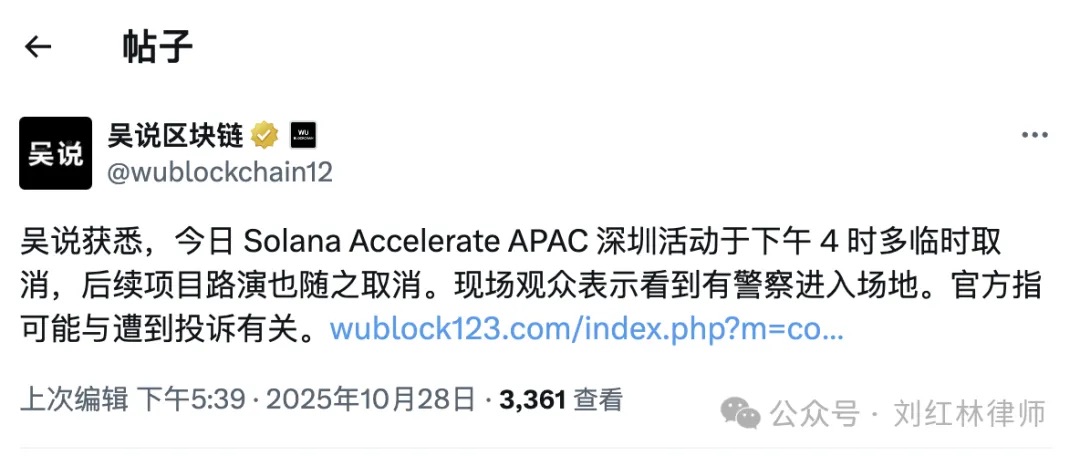
Wu Shuo reported that the Solana Accelerate APAC event in Shenzhen was temporarily cut short due to police intervention, with subsequent project roadshows canceled. Lily, Chairperson of the Solana Foundation, was also present at the scene.
After the news broke, the community immediately erupted—WeChat groups and social media platforms were abuzz: Does this mean Web3 events can no longer be held on the mainland? Has regulatory stance shifted again? "If even Solana can't do it, who dares?"
In my view, such reactions are mostly emotional. The reality is simpler—and more nuanced—than rumors suggest. This isn't a tightening of mainland regulatory policy, but more likely just an isolated incident.
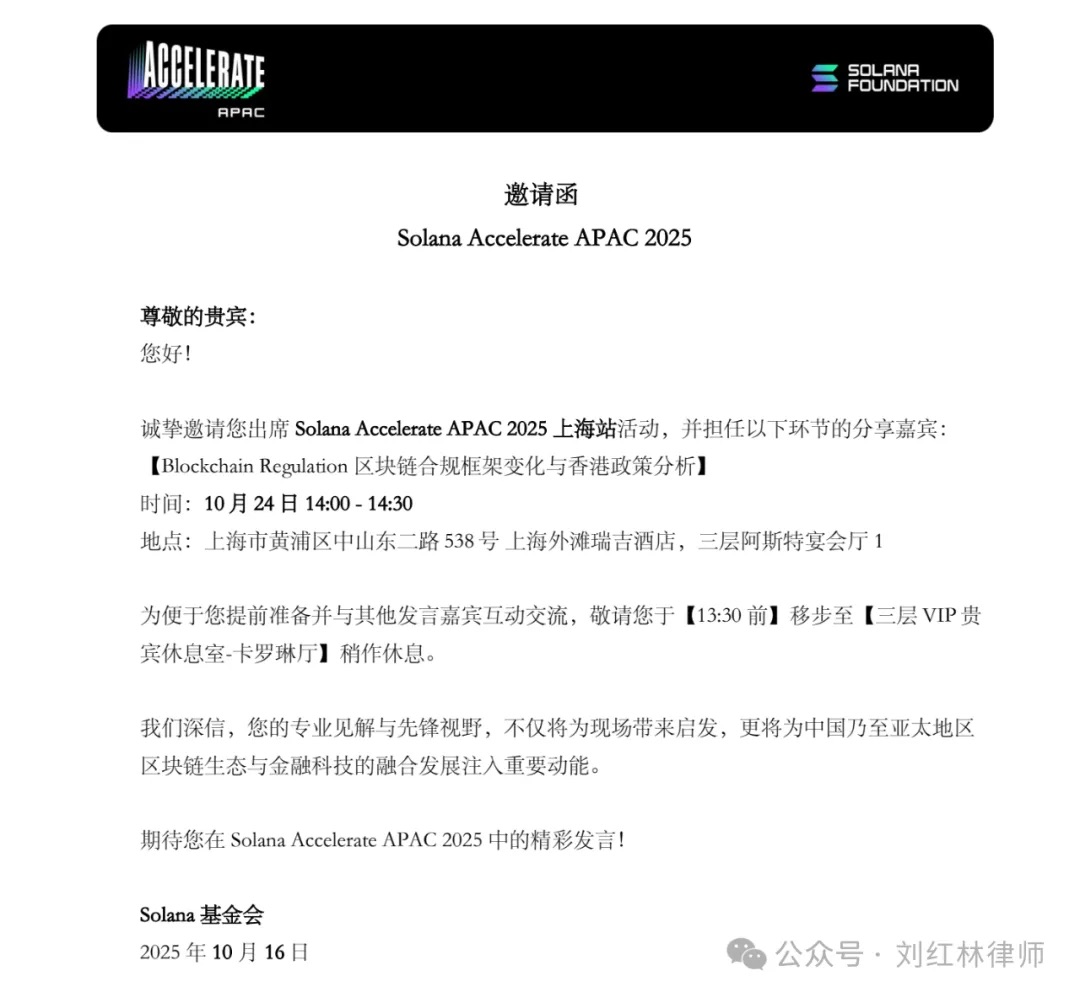
Interestingly, last Friday, Attorney Honglin was invited to speak as a panelist at Solana’s same-series event in Shanghai. So I have some understanding of the operational details behind Solana's offline events, and feel it’s necessary to share insights on how blockchain-related offline gatherings can be conducted more safely and compliantly within mainland China.
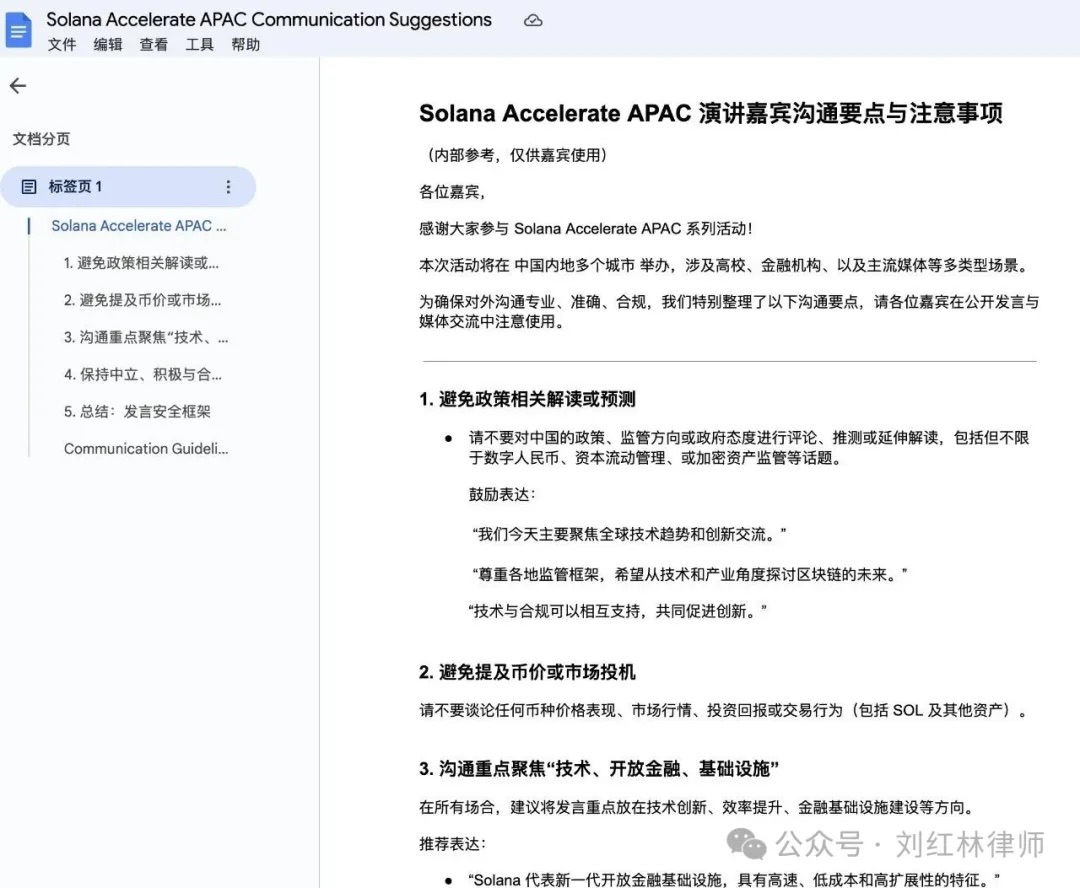
Solana's event organization impressed me greatly—the team was highly professional. Days in advance, the foundation communicated clearly with all speakers about speaking guidelines, so detailed they could serve as an industry benchmark. They explicitly required: no discussion of token prices, no predictions about regulation, no comparisons between domestic and foreign policies—only focus on technology, ecosystem, infrastructure, open finance, and similar topics.
They even prepared bilingual "safe expression" templates, for example: "Today we’re focusing on global tech trends and innovation exchange," "Respecting regulatory frameworks everywhere, we hope to explore blockchain’s future from technological and industrial perspectives," and "Technology and compliance can support each other and jointly promote innovation." Clearly, the Solana team demonstrates a level of understanding of the Chinese context and risk awareness far above the industry average. It was one of the most well-executed, compliance-conscious events I’ve attended.
Based on Attorney Honglin’s knowledge of the industry, the Shenzhen clearance was more likely triggered by a malicious report stemming from an investment dispute involving a guest or participant project, prompting lawful police intervention. When law enforcement receives a report, they don’t distinguish whether it’s a “Web3 conference”—any suspected illegal activity requires response. In other words, this isn’t evidence that “Web3 events cannot be held on the mainland,” but rather a reminder: certain activities are possible, but must be done with greater awareness of how.
From the perspective of legal compliance professionals in the industry, Attorney Honglin believes Solana’s approach to communicating with event organizers and speakers, along with their compliance documentation, deserves emulation by every organizer in the space. They clearly defined five key boundaries for event communications, effectively summarizing how to conduct Web3 exchanges legally and healthily in China.
First, avoid policy interpretation and regulatory forecasting. Any remarks about “regulatory direction” or “policy signals,” even if well-intentioned speculation, may be amplified by media into perceived official statements. In public settings on the mainland, the safest approach is to respect regulators and refrain from speaking on their behalf. Discuss global trends and technical practices, but don’t invent justifications for policy.
Second, do not touch upon token prices or investment returns. Any mention of price, market conditions, or ROI—whether case studies, jokes, or analogies—could be misinterpreted as token promotion or investment advice. Token price is not the sole measure of industry value; centering discussions on technology and applications remains the safest strategy.
Third, focus on technology, ecosystem, and infrastructure. These are the safest and most substantively valuable themes within the Chinese context. Talking about TPS, development efficiency, and global collaboration is not only compliant but also showcases professionalism. Solana’s own emphasis on “open financial infrastructure” during the event was an excellent positioning.
Fourth, maintain neutrality and a cooperative tone. Avoid country comparisons, refrain from expressions like “China vs. other countries,” and never use Hong Kong as an example to imply “mainland lags behind.” The correct way to express this is: different regions have different regulatory paces, but the shared goal is enabling innovation to grow within controllable frameworks.
Fifth, prepare registration and contingency mechanisms in advance. This point is often overlooked. In fact, reporting the event in advance to the venue provider, industrial park, or local subdistrict office serves as an effective risk barrier. Ideally, co-hosting the event with government-affiliated industry associations would be even better. Should complaints or misunderstandings arise, having prior registration allows immediate clarification of the event’s nature. Additionally, require speakers to sign compliance commitment letters, clearly prohibiting token promotion, marketing, or investment inducement. Finally, prepare an emergency statement template so that if law enforcement shows up or public sentiment turns negative, timely responses can prevent secondary misinterpretations.
These measures may seem cumbersome, but they represent essential底线 thinking.
From a broader perspective, China’s policy stance toward blockchain has remained consistently clear: support technological innovation, oppose financial speculation; support digital economy, oppose token-based fundraising. The policy boundaries are stable and well-defined.
Claims of a sudden “shift in wind direction” are largely external misreadings. Over the past few years, whether in blockchain + supply chain finance, digital asset ownership verification, cross-border data governance, or judicial evidence storage, national-level initiatives have continuously encouraged blockchain innovation and real-world application.
Just yesterday, Attorney Honglin participated as a review expert in a blockchain special funding evaluation organized by a district government in Shanghai—proof that Shanghai authorities are putting real money behind blockchain startups genuinely building solutions.
In other words, the real red lines aren’t blockchain itself, but “token financialization” and “using blockchain as a cover for fraud.” Understanding the boundary between encouragement of technology and restrictions on finance is fundamental for anyone operating in Web3 within China.
Looking back at industry history—from the 2018 cancellation of a “Blockchain Conference” in Beijing, to the 2021 summoning of a “Metaverse Salon” elsewhere, to this recent Solana Shenzhen incident—each time an event has been cleared, it hasn’t been to suppress innovation, but to send a message: industry exchanges can happen, but require more nuanced judgment.
Join TechFlow official community to stay tuned
Telegram:https://t.me/TechFlowDaily
X (Twitter):https://x.com/TechFlowPost
X (Twitter) EN:https://x.com/BlockFlow_News